From the free course Philosophical and Literary Perspectives on Freedom on Lykke
Totalitarianism and the Literary Resistance
Key concepts: Totalitarianism · Internal Exile · Stalinism · The Republic of the Imagination
An examination of how literature serves as a site of resistance against oppressive regimes, focusing on Soviet and Iranian contexts.
Totalitarianism and the Literary Resistance
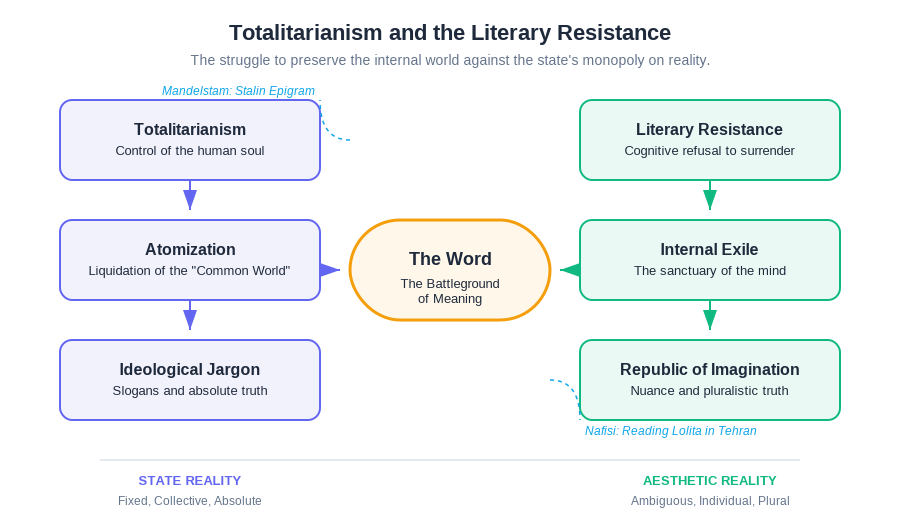
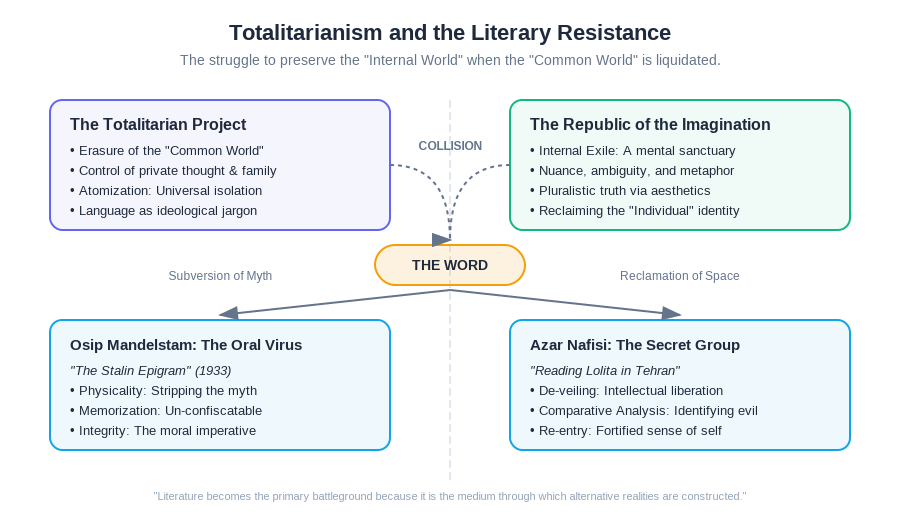
Totalitarianism is not merely a form of extreme governance; it is a comprehensive ontological project that seeks to collapse the distinction between the private individual and the public state. In this environment, the "Literary Resistance" emerges not as a political party or an armed insurgency, but as a cognitive and aesthetic refusal to surrender the "internal world" to the state's monopoly on reality. Through the works of Osip Mandelstam, Azar Nafisi, Hannah Arendt, and Franz Kafka, we examine how the act of writing and reading becomes a high-stakes mechanism for preserving human agency when the "Common World" has been systematically dismantled.
The Architecture of Totalitarianism
To understand the resistance, one must first define the structure of the oppression. As Hannah Arendt articulates in The Origins of Totalitarianism, these regimes differ fundamentally from traditional autocracies or dictatorships. While an autocrat seeks to control political power, a totalitarian regime seeks to control the very nature of reality and the human soul.
Totalitarianism: A system of government that is centralized and dictatorial and requires complete subservience to the state, characterized by the erasure of the "Common World"—the shared space of appearance where individuals can act and speak in their uniqueness.
Why It Matters
In a totalitarian state, the "private" is viewed as a subversive category. If a citizen has a thought that is not state-sanctioned, that thought is a potential site of rebellion. Therefore, the state must occupy the imagination. Literature becomes the primary battleground because it is the medium through which alternative realities are constructed and maintained.
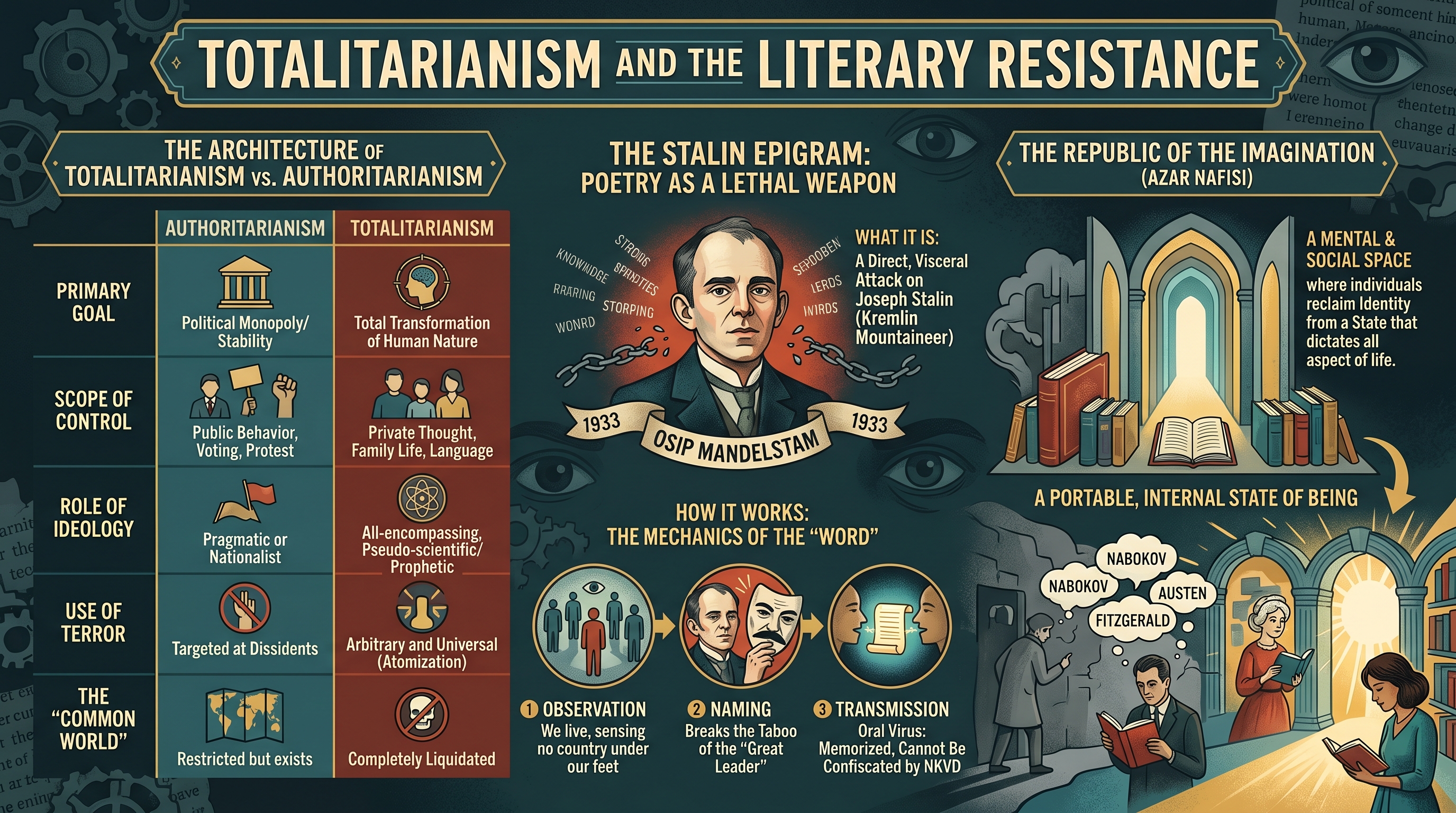
Comparison of Power Structures
| Feature | Authoritarianism | Totalitarianism |
|---|---|---|
| Primary Goal | Political monopoly / Stability | Total transformation of human nature |
| Scope of Control | Public behavior, voting, protest | Private thought, family life, language |
| Role of Ideology | Often pragmatic or nationalist | All-encompassing, pseudo-scientific/prophetic |
| Use of Terror | Targeted at dissidents | Arbitrary and universal (to ensure total atomization) |
| The "Common World" | Restricted but exists | Completely liquidated |
The Stalin Epigram: Poetry as a Lethal Weapon
The case of Osip Mandelstam provides the definitive "worked example" of the lethal stakes of literary resistance under Stalinism. In 1933, Mandelstam wrote a sixteen-line poem, often referred to as the Stalin Epigram ("Our lives no longer feel the ground under them...").
What It Is
The poem is a direct, visceral attack on Joseph Stalin, describing him as a "Kremlin mountaineer" with "fat fingers... like worms" and "cockroach whiskers." It was never written down initially; it was memorized by a small circle of friends.
How It Works: The Mechanics of the "Word"
In a state where the leader's image is curated to be god-like, the poet uses the Physicality of Language to strip away the myth. By describing Stalin’s physical grotesqueness, Mandelstam reasserts the reality of the body over the abstraction of the state.
- Observation: "We live, sensing no country under our feet." This describes the state of Atomization—the loss of a shared, stable reality.
- Naming: By naming the "mountain-climber," Mandelstam breaks the taboo of the "Great Leader."
- Transmission: The poem functioned as an "oral virus." Because it was memorized, it could not be confiscated by the secret police (NKVD) until someone betrayed the circle.
Common Pitfalls
A common misconception is that Mandelstam was a political activist. He was not. He was a poet who believed that the "integrity of the word" was a moral imperative. His resistance was aesthetic; the political consequence (his eventual death in a transit camp) was a reaction by a state that could not tolerate a competing creator of meaning.
The Republic of the Imagination (Azar Nafisi)
In Reading Lolita in Tehran, Azar Nafisi describes a different but related phenomenon: the creation of a "Republic of the Imagination" during the Islamic Revolution in Iran.
What It Is
The Republic of the Imagination is a conceptual sanctuary—a mental and social space where individuals can engage with forbidden texts (Nabokov, Fitzgerald, Austen) to reclaim their identity from a state that dictates their dress, their speech, and their public persona.
The Republic of the Imagination: A portable, internal state of being where the laws of the aesthetic world supersede the laws of the ideological state. It is the ultimate form of Internal Exile.
How It Works: The Reading Group Pipeline
Nafisi’s secret reading group functioned as a laboratory for the soul. The process followed a specific "implementation" of resistance:
- De-Veiling (Literal and Metaphorical): In the privacy of Nafisi's home, the students removed their mandatory robes. This physical act mirrored the intellectual act of removing the state’s ideological "veil."
- Comparative Analysis: Comparing the characters in Lolita (the victimizer Humbert Humbert and the victim Lolita) to their own lives. They identified the "Humbertish" nature of the state—the desire to turn a living person into a fixed, controllable image.
- Re-entry: The students would then re-enter the "real" world equipped with a secret language and a fortified sense of self.
The Mechanics of Aesthetic Resistance
| Concept | State Reality (The "Upside-Down") | The Republic of the Imagination |
|---|---|---|
| Language | Slogans, ideological jargon | Nuance, ambiguity, metaphor |
| Identity | Collective, religious, obedient | Individual, complex, flawed |
| Truth | Absolute and state-defined | Pluralistic and discovered through art |
| Time | The "Eternal Present" of the Revolution | The timelessness of the Great Books |
Internal Exile: The Geography of the Mind
Internal Exile (or vnutrennyaya emigratsiya) is the condition of being a foreigner within one's own country. It is a psychological defense mechanism where the individual withdraws from public life to protect their intellectual and moral integrity.
The Mechanics of Withdrawal
Internal exile is not passive. It requires a rigorous "doubling" of the self.
- The Public Mask: The performance of compliance (attending rallies, using state-approved greetings).
- The Private Core: The cultivation of a "hidden life" through forbidden literature, secret correspondence, or "writing for the drawer."
Case Study: The "Nika" Phenomenon
The Soviet poet Nika Turbina (the subject of the film Nika) represents the tragic intersection of talent and state co-option. Totalitarian states often attempt to "adopt" child prodigies to prove the superiority of their system. When the individual’s internal reality no longer matches the state’s narrative, the resulting "collapse" is both personal and symbolic. Nika’s struggle highlights that the state does not just want your silence; it wants your voice to speak its words.
Kafkaesque Realities and the Bureaucracy of Terror
Franz Kafka’s work, though written before the height of 20th-century totalitarianism, provides the "source code" for understanding the experience of the individual caught in an illogical, all-powerful system.
The "Trial" Algorithm
In Kafka's The Trial, the protagonist Josef K. is arrested for a crime that is never named, by a court that is inaccessible. This mirrors the Arbitrary Terror of Stalinism or the Iranian Revolutionary Courts.
- Input: An ordinary life.
- Trigger: An arbitrary accusation (often based on "thought-crime").
- Process: An endless, circular bureaucracy where the "Law" is always just out of reach.
- Output: Execution "like a dog," with the victim often feeling a sense of shame despite their innocence.
Comparison: Kafka vs. The Totalitarian State
| Kafkaesque Element | Totalitarian Parallel |
|---|---|
| The Inaccessible Law | Secret decrees and shifting ideological lines |
| The Infinite Bureaucracy | The party apparatus and secret police |
| The Internalized Guilt | The "Confession" in show trials |
| The Absurdity | The gap between state propaganda and lived reality |
Synthesis: The "Dream of the Raised Arm"
Zadie Smith, reflecting on these themes, discusses the "Dream of the Raised Arm"—the idea that even a small, physical gesture of refusal can hold immense power. In the context of literary resistance, the "raised arm" is the act of holding a book.
The Pipeline of Resistance
- Preservation: Keeping the text alive (e.g., memorizing Mandelstam).
- Interpretation: Refusing the state's "correct" reading of history or literature.
- Communication: Sharing the "secret" with a trusted circle (the "Parallel Polis").
- Transformation: The individual is no longer a "cog" in the machine but a "citizen" of the Republic of the Imagination.
Common Pitfalls in Analysis
- The "Hero" Fallacy: Assuming that literary resistors are always "heroes" in the traditional sense. Many were terrified, compromised, or deeply flawed. Their resistance lay in their work, not necessarily their physical bravery.
- The "Escapism" Misconception: Viewing the Republic of the Imagination as "escapism." In a totalitarian context, reading is not an escape from reality; it is an escape to reality—a way to find the truth that the state has obscured.
- Over-Politicization: Reducing a poem to a political pamphlet. The power of Mandelstam’s epigram wasn't just that it "hated Stalin," but that it was better than Stalin's propaganda. It was an aesthetic victory.
Key Insight: Totalitarianism wins when it convinces the individual that there is no "outside" to the system. Literature provides the "outside." It proves that the state is not the horizon of the universe.
Appendix: Key Figures and Texts
| Figure | Key Work / Concept | Role in Resistance |
|---|---|---|
| Osip Mandelstam | The Stalin Epigram | The "Martyr" of the Word; proved poetry can be lethal. |
| Azar Nafisi | Reading Lolita in Tehran | Defined the "Republic of the Imagination" and the secret reading group. |
| Hannah Arendt | The Origins of Totalitarianism | Provided the theoretical framework for "Atomization" and the "Common World." |
| Franz Kafka | The Trial / The Castle | Mapped the psychological landscape of the individual vs. the Bureaucracy. |
| Vladimir Nabokov | Invitation to a Beheading | A frequent text in resistance circles; deals with the "translucence" of the individual. |
| Nika Turbina | Biopic: Nika | Illustrates the state's co-option and subsequent destruction of the "prodigy." |
This article serves as a foundational guide for understanding the intersection of political science, history, and literary theory within the context of 20th and 21st-century unfreedom.
Source Materials
- J._S._Mill's_on_Liberty_in_Focus_----_(JOHN_STUART_MILL_AND_ISAIAH_BERLIN_THE_ENDS_OF_LIFE_AND_THE_PRELIMINAR...).pdf
- J._S._Mill's_on_Liberty_in_Focus_----_(JOHN_STUART_MILL_AND_ISAIAH_BERLIN_THE_ENDS_OF_LIFE_AND_THE_PRELIMINAR...).pdf
- Osip Mandelstam - Stalin Epigram- Russian and English.docx
- The Dream of the Raised Arm _ Zadie Smith _ The New York Review of Books.pdf
- Berlin and Mill Feb 23 2026.pptx
- Nietzsche, Friedrich Wilhelm - -On Truth and Lie-.pdf
- Recommended- Radishchev Intro by Kahn and Reyfman.pdf
- Russia's Wars on Page and Screen - Sp 26 - 2.26.26.pdf
Study Philosophical and Literary Perspectives on Freedom on Lykke
This course page is free to open: signed out, you can read its first two sections, and signing in, on any plan, opens the rest. The free Lykke Chrome extension syncs your own Canvas courses, so ChatGPT, Claude and Muse can answer from your classes and deadlines. It only reads Canvas.
Add the free extensionSign in to open every sectionAll sections of Philosophical and Literary Perspectives on Freedom · Browse more course pages