From the free course Philosophical and Literary Perspectives on Freedom on Lykke
Truth, Rebellion, and Existential Freedom
Key concepts: On Truth and Lie · Metaphysical Rebellion · The Fire Next Time · Moral Responsibility
Explores the relationship between truth-telling and freedom, and the existential necessity of rebellion in the face of injustice.
Truth, Rebellion, and Existential Freedom
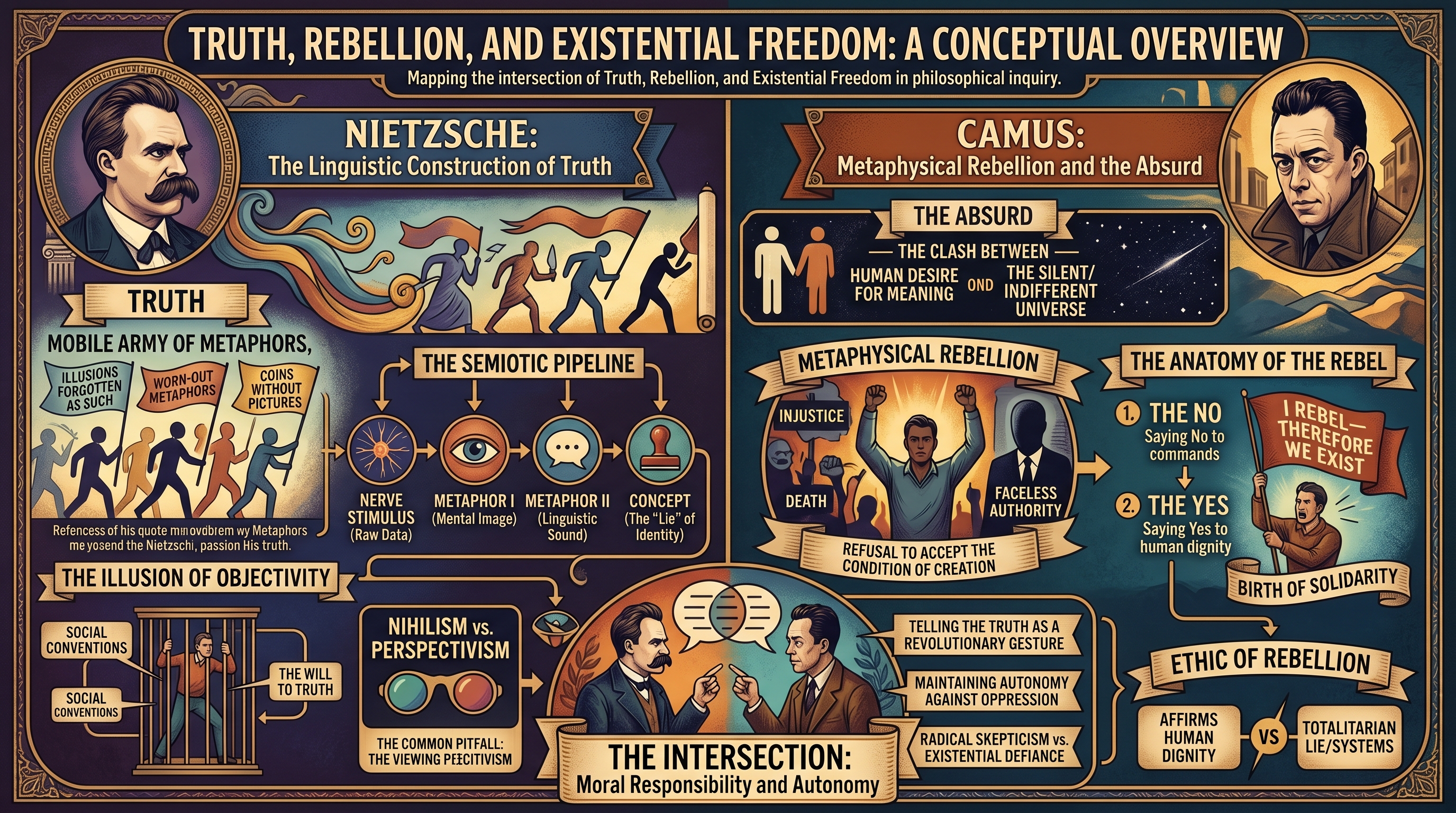
The intersection of Truth, Rebellion, and Existential Freedom represents one of the most rigorous domains of human inquiry. At its core, this triad addresses a fundamental tension: the human drive to construct meaning within a world that often appears indifferent, deceptive, or systematically oppressive. To engage with these concepts is to move beyond passive existence and into the realm of Moral Responsibility, where the act of "telling the truth" becomes a revolutionary gesture.
This article synthesizes the radical skepticism of Friedrich Nietzsche, the existential defiance of Albert Camus, the prophetic social critique of James Baldwin, and the literary resistance documented by Azar Nafisi and Hannah Arendt. Together, these thinkers provide a framework for understanding how the individual maintains autonomy against the "totalitarian" lie—whether that lie is metaphysical, linguistic, or political.
Nietzsche: The Linguistic Construction of Truth
In his seminal essay On Truth and Lie in an Extra-Moral Sense, Friedrich Nietzsche challenges the foundational assumption that "truth" is an objective, discoverable entity. Instead, he posits that what we call truth is a social construct—a "peace treaty" designed to facilitate human coexistence.
What it is: The Extra-Moral Lie
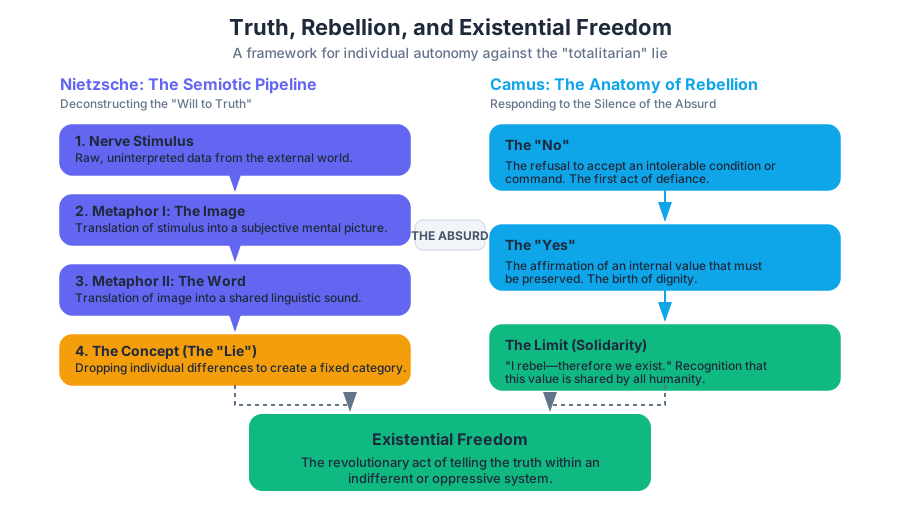
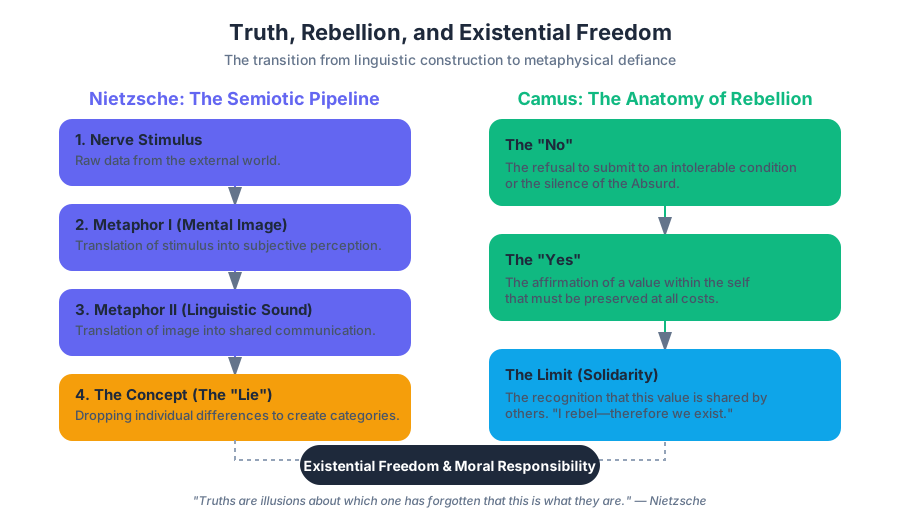
Nietzsche defines Truth not as a correspondence with reality, but as a Mobile Army of Metaphors. He argues that human cognition is inherently metaphorical. We translate a nerve stimulus into an image (the first metaphor) and then the image into a sound/word (the second metaphor). By the time we reach a "concept," we have completely abandoned the unique, individual reality of the original experience.
"Truths are illusions about which one has forgotten that this is what they are; metaphors which are worn out and without sensuous power; coins which have lost their pictures and now matter only as metal, no longer as coins." — Friedrich Nietzsche
Why it matters: The Illusion of Objectivity
Nietzsche’s critique is vital because it exposes the Will to Truth as a form of social control. If truth is merely a convention, then those who control the conventions control the "reality" of the populace. This provides the philosophical groundwork for understanding how systems of power (political or religious) use language to enforce a specific worldview.
How it works: The Semiotic Pipeline
Nietzsche describes a process of cognitive abstraction where the "thing-in-itself" is lost through successive layers of human interpretation.
| Stage | Process | Result |
|---|---|---|
| Stimulus | Nerve excitation from the external world. | Raw, uninterpreted data. |
| Metaphor I | Translation of stimulus into a mental image. | Subjective perception. |
| Metaphor II | Translation of image into a linguistic sound. | Shared communication. |
| Concept | Dropping individual differences to create a "category." | The "Lie": treating different things as identical. |
Common Pitfalls: Nihilism vs. Perspectivism
A common mistake is assuming Nietzsche is a pure nihilist who believes nothing matters. In reality, he is a Perspectivist. He does not argue that there is no reality, but rather that our access to it is always mediated by our perspective. The "lie" is not a moral failing; it is a biological and social necessity for survival.
Camus: Metaphysical Rebellion and the Absurd
While Nietzsche deconstructs the nature of truth, Albert Camus focuses on the human response to a world devoid of inherent meaning—a condition he calls The Absurd. In The Rebel, Camus moves from the individual's recognition of the absurd to a collective ethics of rebellion.
What it is: Metaphysical Rebellion
Metaphysical Rebellion is the movement by which a human being protests against their condition and the whole of creation. It is the refusal to accept the "silence" of the universe or the injustice of death and suffering. Unlike a revolution, which seeks to replace one power structure with another, rebellion is a permanent state of defiance that affirms human dignity.
Why it matters: "I Rebel—Therefore We Exist"
Camus’s famous dictum, "I rebel—therefore we exist," marks a transition from Cartesian solipsism ("I think, therefore I am") to a social ethic. When an individual rebels against an injustice, they are not just fighting for themselves; they are asserting that there is a limit—a "standard of value"—that applies to all humans. Rebellion is the birth of solidarity.
How it works: The Anatomy of the Rebel
The act of rebellion follows a specific psychological and logical progression:
- The "No": The rebel says "No" to a command or a condition that they find intolerable.
- The "Yes": In saying no, the rebel simultaneously says "Yes" to the existence of a value within themselves that must be preserved.
- The Limit: The rebel recognizes that this value is shared by others, creating a boundary that neither the rebel nor the oppressor should cross.
| Concept | Definition | Goal |
|---|---|---|
| The Absurd | The conflict between human longing for order and the silent, chaotic universe. | Recognition of reality. |
| Rebellion | The refusal to submit to the Absurd or to injustice. | Preservation of dignity. |
| Revolution | A systematic attempt to reshape the world according to an ideology. | Total transformation (often leads to tyranny). |
Concrete Example: The Myth of Sisyphus
Sisyphus is the ultimate metaphysical rebel. Condemned to roll a rock up a hill for eternity only for it to roll back down, he is conscious of his hopeless fate. However, in his consciousness and his refusal to despair, he is "superior to his rock." His rebellion lies in his joy—a joy that the gods cannot take away.
Baldwin: The Fire Next Time and the Moral Responsibility of Truth
James Baldwin’s The Fire Next Time applies the concepts of truth and rebellion to the specific context of American racial injustice. For Baldwin, freedom is not a legal status but a spiritual and existential achievement that requires the courage to confront a painful history.
What it is: The Crime of Innocence
Baldwin introduces a devastating critique of White Innocence. He argues that the refusal of white Americans to acknowledge the truth of their history and the reality of Black suffering is not a passive state, but a "crime." This "innocence" is a lie that protects the ego but destroys the soul of both the oppressor and the oppressed.
"It is the innocence which constitutes the crime... they are, in effect, still trapped in a history which they do not understand; and until they understand it, they cannot be released from it." — James Baldwin
Why it matters: Freedom as Integration
For Baldwin, Freedom is the ability to see oneself and the world as they truly are. This requires "integration"—not just in a legal sense, but in the sense of integrating the "dark" and "light" parts of the human experience. To be free is to stop lying to oneself about the past.
How it works: The Dialectic of Love
Baldwin proposes Love as a revolutionary force. This is not "love" in the sentimental sense, but a "state of being, or a state of grace—not in the infantile American sense of being made happy but in the tough and universal sense of quest and daring and growth."
| Baldwin's Key Pillars | Description | Existential Function |
|---|---|---|
| Historical Witness | The duty to tell the truth about the past. | Breaks the cycle of the "Lie." |
| The Fire | The inevitable consequence of a society built on a lie. | Catalyst for radical change. |
| Conscious Love | The force required to "end the racial nightmare." | Re-humanizes the "other." |
Common Pitfalls: Misunderstanding "The Fire"
Readers often mistake "The Fire Next Time" as a threat of violence. While Baldwin acknowledges the possibility of destruction, the "Fire" is primarily a metaphor for a spiritual reckoning. It is the purification that comes when a society can no longer sustain its illusions.
Nafisi, Arendt, and the Republic of the Imagination
The source materials regarding Azar Nafisi’s Reading Lolita in Tehran and Hannah Arendt’s work on totalitarianism bridge the gap between abstract philosophy and lived experience under oppressive regimes.
What it is: The Republic of the Imagination
Azar Nafisi describes how, in the face of the Islamic Republic’s strict ideological control, she and her students created a "Republic of the Imagination." By reading forbidden Western literature (Nabokov, Fitzgerald, Austen), they engaged in a form of rebellion that was internal and intellectual. Literature provided a "truth" that the state could not touch.
Why it matters: Factual Truth vs. Political Opinion
Hannah Arendt argues that in totalitarian systems, Factual Truth is the first casualty. When a regime can change the past or deny the evidence of one's own senses, the individual loses their "footing" in reality. In this context, simply remembering a fact or reading a "non-aligned" book is an act of existential rebellion.
Comparison of Existential Frameworks
| Thinker | Source of "The Lie" | Mode of Rebellion | Ultimate Goal |
|---|---|---|---|
| Nietzsche | Language/Concepts | Artistic Creation | The Overman (Übermensch) |
| Camus | The Absurd/Injustice | Saying "No" with Solidarity | Human Dignity |
| Baldwin | Racial "Innocence" | Conscious Love/Witnessing | Social & Spiritual Integration |
| Nafisi | Totalitarian Ideology | Literature/Imagination | Personal Autonomy |
| Arendt | Political Propaganda | Factual Truth/Thinking | The Preservation of the Polis |
Synthesis: The Mechanics of Existential Freedom
Existential freedom is not the absence of constraints; it is the conscious navigation of those constraints through truth-telling and rebellion. The process can be visualized as a pipeline of liberation:
- Deconstruction (Nietzsche): Recognize that the "truths" handed down by society are often metaphors and conventions.
- Confrontation (Camus): Face the absurdity of existence and the injustice of the world without turning away.
- Witnessing (Baldwin): Acknowledge the specific historical and social lies (like racism) that prevent collective freedom.
- Creation (Nafisi): Build an internal "republic" where truth and beauty can survive even if the external world is dark.
Common Pitfalls in Existential Thought
- The Trap of Despair: Thinking that because truth is "constructed" (Nietzsche) or the world is "absurd" (Camus), nothing matters. Existentialism argues the opposite: because there is no pre-given meaning, we are responsible for creating it.
- The Trap of the "Beautiful Soul": Withdrawing into a private world of literature (Nafisi) and ignoring the social responsibility to change the world (Baldwin).
- The Trap of Violent Revolution: Forgetting Camus’s "Limit" and becoming an oppressor in the name of "liberation."
"The only way to deal with an unfree world is to become so absolutely free that your very existence is an act of rebellion." — Albert Camus
Further Reading and Contextual Notes
- Arendt and Kafka: The source materials suggest a connection between Arendt’s analysis of power and Kafka’s depiction of the "Absurdity of the Law." In Kafka’s The Trial, the lie becomes the world order. Arendt’s response is to emphasize the "vita activa"—the life of action and speech in the public sphere.
- The Role of the Response Paper: As noted in the instructor's materials, analyzing these texts requires moving beyond summary. A successful analysis must "find a direction"—connecting the philosophical "Truth" of Nietzsche to the "Imagination" of Nafisi or the "Witness" of Baldwin.
- The "No-Device" Policy: The instructor's insistence on hard copies and "no devices" mirrors the existential focus on presence. To engage with these texts is to be "present" to the truth, away from the distractions of the digital "mobile army of metaphors."
Source Materials
- Nietzsche, Friedrich Wilhelm - -On Truth and Lie-.pdf
- Baldwin.Fire Next Time excerpt.pdf
- Baldwin.Fire Next Time excerpt.pdf
- Nietzsche, Friedrich Wilhelm - -On Truth and Lie-.pdf
- 2026-02-18 guest lecture Nietzsche's -On Truth & Lie-.pptx
- J._S._Mill's_on_Liberty_in_Focus_----_(JOHN_STUART_MILL_AND_ISAIAH_BERLIN_THE_ENDS_OF_LIFE_AND_THE_PRELIMINAR...).pdf
- 2026-02-18 guest lecture Nietzsche's -On Truth & Lie-.pptx
- J._S._Mill's_on_Liberty_in_Focus_----_(JOHN_STUART_MILL_AND_ISAIAH_BERLIN_THE_ENDS_OF_LIFE_AND_THE_PRELIMINAR...).pdf
Study Philosophical and Literary Perspectives on Freedom on Lykke
This course page is free to open: signed out, you can read its first two sections, and signing in, on any plan, opens the rest. The free Lykke Chrome extension syncs your own Canvas courses, so ChatGPT, Claude and Muse can answer from your classes and deadlines. It only reads Canvas.
Add the free extensionSign in to open every sectionAll sections of Philosophical and Literary Perspectives on Freedom · Browse more course pages