Philosophical and Literary Perspectives on Freedom
Institution: MIT
159 study materials · 5 sections
This interdisciplinary honors seminar explores the multifaceted nature of freedom through philosophical, literary, and historical lenses. Students examine foundational concepts of intellectual autonomy, the tension between public and private freedom, and the mechanisms of resistance against totalitarianism. The course analyzes diverse texts ranging from Enlightenment philosophy to contemporary accounts of rebellion and social transformation.
Course Sections
Foundations: Enlightenment, Aesthetics, and Public Freedom
Key concepts: Intellectual Autonomy · Aesthetic Education · Public Freedom · The Gap between Past and Future
Explores the origins of modern freedom through Kant's intellectual autonomy, Schiller's aesthetic education, and Arendt's concept of public action.
Foundations: Enlightenment, Aesthetics, and Public Freedom
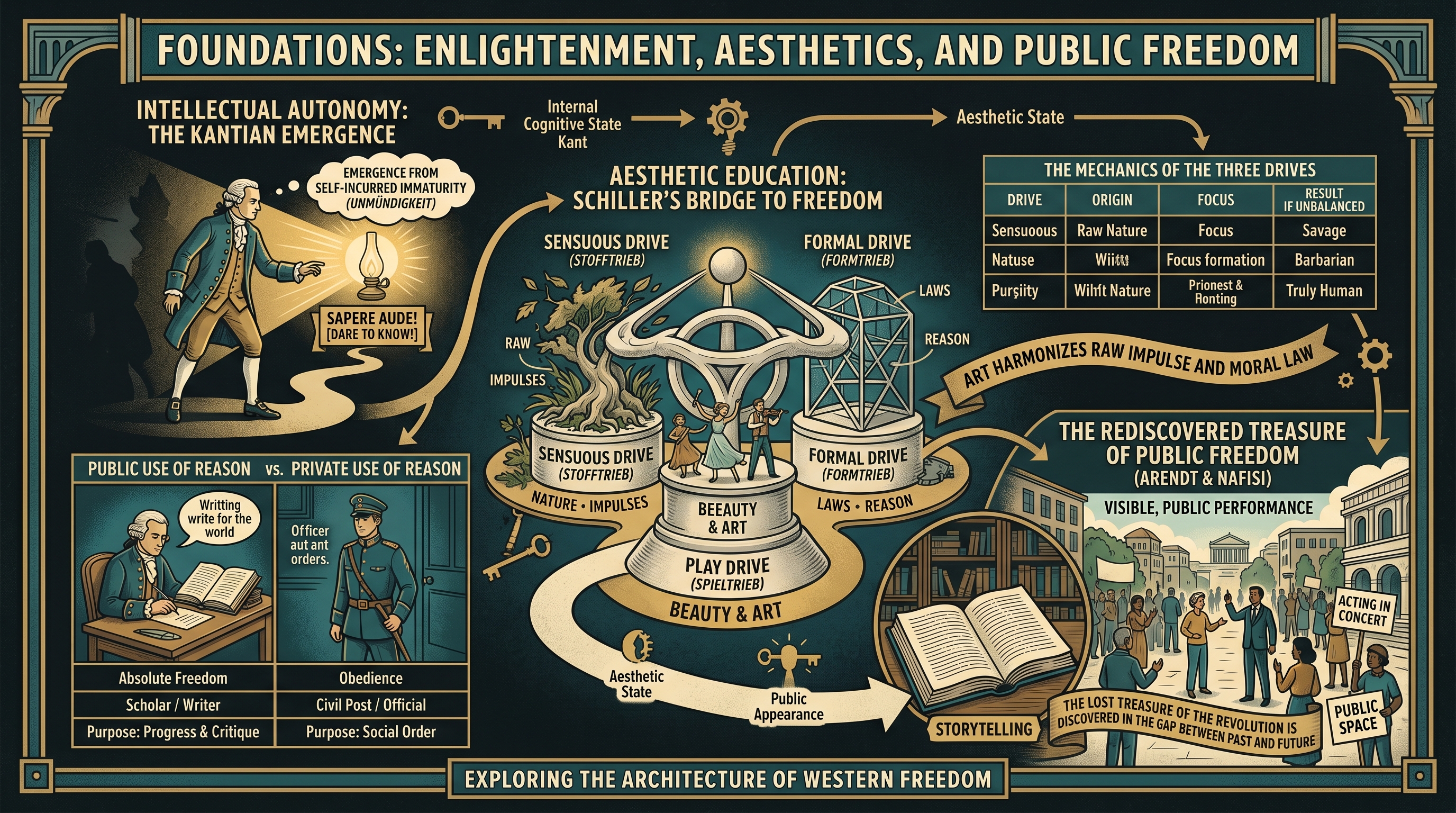
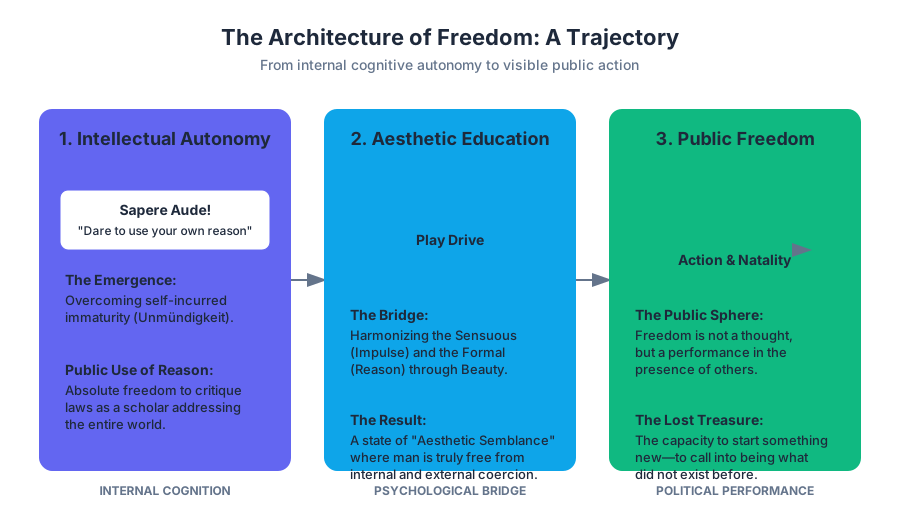
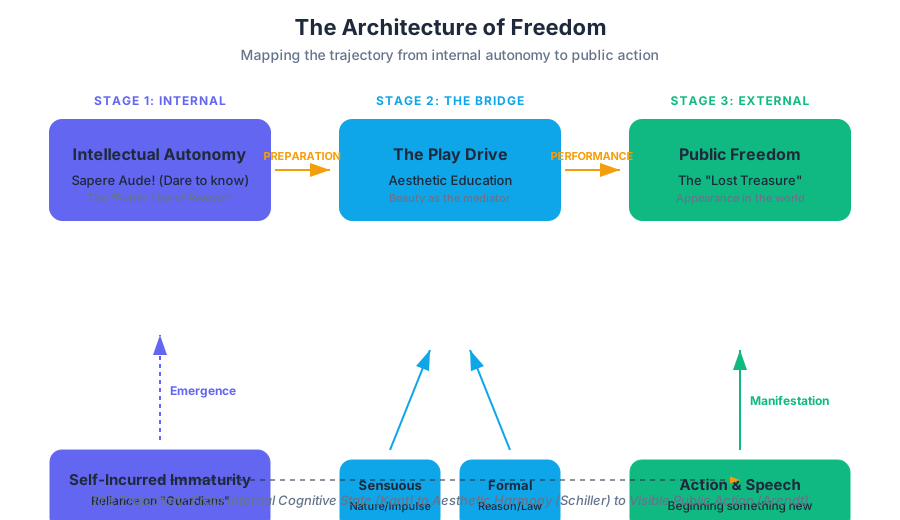
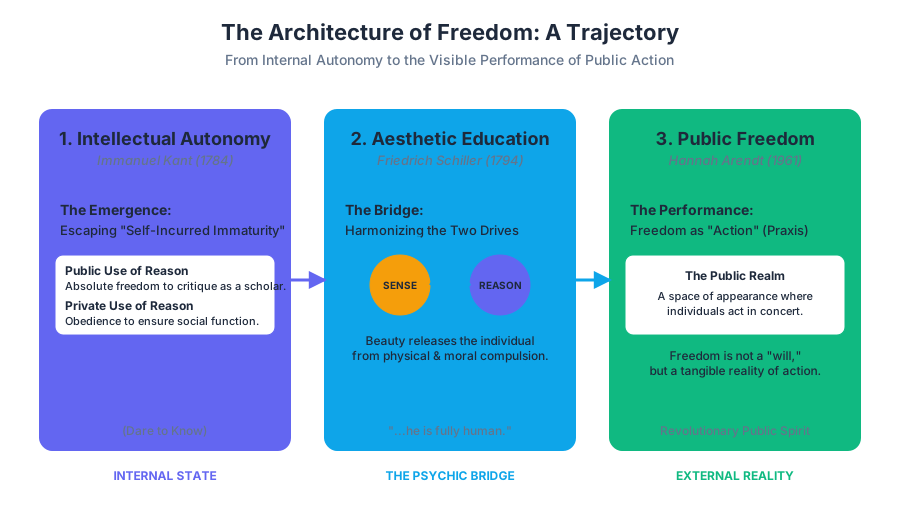
The concept of freedom in the Western tradition is not a monolithic entity but a layered architecture of intellectual, aesthetic, and political dimensions. This section explores the foundational theories that define how individuals emerge from "immaturity" into autonomy, how art serves as the bridge between raw impulse and moral law, and how the "lost treasure" of public freedom is rediscovered in the gap between the past and the future. By synthesizing the works of Immanuel Kant, Friedrich Schiller, Hannah Arendt, and Azar Nafisi, we can map the trajectory of freedom from an internal cognitive state to a visible, public performance.
Intellectual Autonomy: The Kantian Emergence
At the heart of the Enlightenment lies the concept of Intellectual Autonomy. In his seminal 1784 essay, Answering the Question: What is Enlightenment?, Immanuel Kant defines enlightenment not as an accumulation of knowledge, but as a shift in the "mode of thought."
1. What it is
Intellectual Autonomy is the capacity of an individual to use their own understanding without the guidance of another. Kant famously identifies the obstacle to this state as Self-Incurred Immaturity (Unmündigkeit). This immaturity is "self-incurred" because its cause lies not in a lack of understanding, but in a lack of resolve and courage.
"Enlightenment is man's emergence from his self-incurred immaturity. Immaturity is the inability to use one's own understanding without the guidance of another. This immaturity is self-incurred if its cause is not lack of understanding, but lack of resolution and courage to use it without the guidance of another. Sapere aude! [Dare to know!] Have the courage to use your own understanding! is therefore the motto of enlightenment." — Immanuel Kant
2. Why it matters
Kant’s definition shifted the burden of freedom from the state to the individual. It suggests that political freedom is impossible without first achieving intellectual independence. If a population is habituated to "guardians" (clergy, monarchs, or even modern algorithms) doing their thinking for them, any revolution will merely replace one set of dogmas with another.
3. How it works: The Public vs. Private Use of Reason
Kant introduces a counter-intuitive distinction between two spheres of reasoning. In a "private" role (as an employee or official), one must obey to ensure the machine of society functions. However, in a "public" role (as a scholar addressing the world), one must have total freedom to critique and argue.
| Sphere | Role | Requirement | Purpose |
|---|---|---|---|
| Private Use of Reason | Civil post, officer, tax-payer | Obedience | Ensuring social order and institutional function. |
| Public Use of Reason | Scholar, writer, thinker | Absolute Freedom | The progress of humanity; the critique of existing laws. |
4. Common Pitfalls
- Confusing "Private" with "Personal": In Kantian terms, "private" refers to a specific job or social function (like a "private" in the army), while "public" refers to the universal stage of ideas.
- Assuming Enlightenment is a Destination: Kant clarifies we do not live in an enlightened age, but an age of enlightenment—a process of becoming, not a static state.
Aesthetic Education: Schiller’s Bridge to Freedom
If Kant provided the intellectual framework, Friedrich Schiller provided the psychological and emotional bridge. Writing in the wake of the French Revolution’s descent into the Terror, Schiller’s Letters on the Aesthetic Education of Man (1794) argues that political revolution failed because the people were not yet "ready" for freedom.
1. What it is
Aesthetic Education is the process of harmonizing the two conflicting drives of human nature—the Sensuous Drive (Stofftrieb) and the Formal Drive (Formtrieb)—through the Play Drive (Spieltrieb).
2. The Mechanics of the Three Drives
Schiller posits that humans are pulled between their physical needs (nature) and their moral/rational laws (reason).
| Drive | Origin | Focus | Result if Unbalanced |
|---|---|---|---|
| Sensuous Drive (Stofftrieb) | Physicality / Nature | Change, Sensation, Time | The "Savage": Slave to impulses and instincts. |
| Formal Drive (Formtrieb) | Reason / Morality | Permanence, Law, Logic | The "Barbarian": Slave to rigid principles; lacks empathy. |
| Play Drive (Spieltrieb) | Art / Aesthetics | Harmony, Freedom, Beauty | The Truly Human: Capable of moral action without coercion. |
3. How it works: The Play Drive
The Play Drive is activated by the experience of Beauty. When we engage with art, we are momentarily released from the "compulsion" of physical need and the "compulsion" of moral duty. In this state of "aesthetic semblance," we are truly free because we are not being forced by either nature or logic.
"Man only plays when he is in the fullest sense of the word a human being, and he is only fully a human being when he plays." — Friedrich Schiller
4. Concrete Example
Consider a person following a law. If they follow it only because they fear punishment, they are ruled by the Sensuous Drive (fear). If they follow it only because of a cold, abstract duty, they are a "Barbarian" of reason. But if they follow it because they have cultivated an "aesthetic" soul that finds harmony in justice, they are acting out of true freedom.
Public Freedom: Hannah Arendt and the "Lost Treasure"
Moving from the internal (Kant) and the aesthetic (Schiller) to the political, Hannah Arendt redefines freedom not as a property of the will, but as a quality of Action in the public sphere.
1. What it is
Public Freedom is the ability to "call into being something which did not exist before." For Arendt, freedom is synonymous with Action (Praxis) and Natality (the capacity for new beginnings). It is not the "inner freedom" of the stoic, but the visible freedom of the citizen.
2. Why it matters: The "Lost Treasure"
In On Revolution, Arendt argues that modern revolutions (like the American and French) often lost sight of the "treasure" of public happiness—the joy of participating in public affairs. Instead, they became obsessed with "liberation" from want or "liberation" from tyranny, which are merely prerequisites for freedom, not freedom itself.
3. The Taxonomy of Human Activity
Arendt distinguishes between three types of human activity in The Human Condition. Freedom only exists in the third category.
| Activity | Definition | Goal | Relation to Freedom |
|---|---|---|---|
| Labor | Biological processes (eating, sleeping) | Survival | Necessity (The opposite of freedom) |
| Work | Creation of durable objects (building, art) | Utility / Worldliness | Fabrication (Constraint of the blueprint) |
| Action | Interaction between people via speech | Freedom | The "Miracle": Starting something new. |
4. The Gap Between Past and Future
Arendt describes the present as a "gap" in time—a nunc stans (standing now). This is the space where the "force" of the past and the "force" of the future collide.
- The Past: A force that pushes us forward but can also weigh us down with tradition and trauma.
- The Future: A force that drives us back, representing the unknown and the inevitable.
- The Gap: The small space where the human mind stands, resisting both forces to create a "diagonal" path of thought and action.
"This small track of non-time which the activity of thought beats within the time-space of mortal men... is the 'gap' between past and future." — Hannah Arendt
Synthesis: The Republic of the Imagination
How do these abstract concepts—Kant’s autonomy, Schiller’s aesthetics, and Arendt’s public freedom—manifest in the real world? Azar Nafisi’s Reading Lolita in Tehran provides a contemporary "implementation" of these theories.
1. The Literary Resistance
In a totalitarian regime, the "Public Square" (Arendt's space of action) is often closed or policed. Nafisi and her students created a "Republic of the Imagination" by reading forbidden Western literature (Nabokov, Fitzgerald, James).
2. Connecting the Concepts
- Kant in Tehran: The act of reading and interpreting a text for oneself, rather than accepting the state’s ideological interpretation, is the ultimate "Public Use of Reason." It is the refusal of "self-incurred immaturity."
- Schiller in Tehran: The "Aesthetic Education" provided by novels allowed the students to maintain their humanity. By engaging with the "Play Drive" of fiction, they found a space where they were neither victims of the state (Sensuous) nor rigid ideologues (Formal).
- Arendt in Tehran: The secret reading group became a "Public Space." Even though it was held in a private living room, it functioned as a political space because it was a place of Action and Speech where new ideas were born.
3. The Kafkaesque Intersection
Arendt frequently cites Franz Kafka to illustrate the "Gap between Past and Future." In Kafka’s parables, the protagonist is often trapped by an incomprehensible law or a past they cannot escape. Nafisi uses this to describe the "blindness" of the censor. The censor sees only the "Formal" law; the reader sees the "Aesthetic" truth.
Comparative Summary: Perspectives on Freedom
To understand the foundations of this section, one must compare how each thinker locates the "site" of freedom and the "enemy" of freedom.
| Thinker | Site of Freedom | Primary Enemy | Key Requirement |
|---|---|---|---|
| Kant | The Mind / Reason | Cowardice / Laziness | Courage to think (Sapere Aude) |
| Schiller | The Aesthetic State | Fragmentation / Brutality | Balance of drives (Play) |
| Arendt | The Public Square | Necessity / Totalitarianism | Action and Speech |
| Nafisi | The Imagination | Ideological Blindness | Reading/Interpretation as Resistance |
Common Pitfalls and Misconceptions
- The "Freedom as License" Fallacy: A common mistake is thinking freedom means "doing whatever I want." For Kant, this is actually a form of slavery to one's impulses (Sensuous Drive). True freedom is Autonomy—giving the law to oneself through reason.
- The "Art is a Luxury" Fallacy: Schiller argues the opposite. Art is not a luxury for the wealthy; it is a "necessity" for the citizen. Without aesthetic education, a person cannot handle the responsibility of political freedom.
- The "Privacy is Freedom" Fallacy: Arendt argues that if you are only "free" in your private home, you are not truly free. Freedom requires a Public where your actions can be seen and your words heard.
Implementation: The "Action" Pipeline
How does an idea move from a thought to a public reality? Using Arendtian and Kantian logic, we can visualize the "Freedom Pipeline":
- Input (Sapere Aude): The individual decides to use their own understanding to critique a situation.
- Processing (Aesthetic Education): The individual uses art and imagination to envision a world not governed by mere necessity or rigid dogma.
- Output (Action/Speech): The individual enters the public sphere (the "Gap") and speaks or acts in a way that initiates something new.
- Result (Public Freedom): The "lost treasure" is found when the action is witnessed and remembered by others, creating a new "past" for the future.
- Intellectual Autonomy: The capacity to use one's understanding without another's guidance (Kant).
- Self-Incurred Immaturity: A state of reliance on others' thoughts caused by lack of courage (Kant).
- Sensuous Drive (Stofftrieb): The human impulse toward physical sensation and change (Schiller).
- Formal Drive (Formtrieb): The human impulse toward moral law and permanence (Schiller).
- Play Drive (Spieltrieb): The synthesis of sensuous and formal drives through beauty (Schiller).
- Natality: The human capacity to begin something new through action (Arendt).
- The Gap between Past and Future: The present moment where thought and action occur (Arendt).
- Public Freedom: Freedom that is visible and performed in the presence of others (Arendt).
- Republic of the Imagination: A mental and social space of freedom created through literature (Nafisi).
-
According to Kant, why is immaturity "self-incurred"?
- (A) Because people lack the intelligence to understand complex laws.
- (B) Because people lack the resolve and courage to think for themselves.
- (C) Because the state forbids the use of reason.
- (D) Because the past is too heavy to overcome.
- Answer: B
-
In Schiller's theory, what happens if the "Formal Drive" (Reason) completely dominates the "Sensuous Drive" (Nature)?
- (A) The person becomes a "Savage."
- (B) The person becomes a "Barbarian."
- (C) The person achieves enlightenment.
- (D) The person enters the "Play" state.
- Answer: B
-
How does Arendt define "Action"?
- (A) Productive labor that ensures survival.
- (B) The fabrication of durable objects like buildings.
- (C) Speech and deeds that start something new in public.
- (D) The internal process of silent meditation.
- Answer: C
-
What is the "Lost Treasure" Arendt refers to in the context of revolutions?
- (A) The gold reserves of the monarchy.
- (B) The spirit of public freedom and participation.
- (C) The written constitutions of the new states.
- (D) The safety and security of the private home.
- Answer: B
-
In Nafisi's Reading Lolita in Tehran, how does literature function as a "Public Space"?
- (A) It was read aloud in the city squares.
- (B) It provided a shared world of meaning where students could speak freely.
- (C) It was used to write the new laws of the country.
- (D) It replaced the need for actual political action.
- Answer: B
Foundations: Enlightenment, Aesthetics, and Public Freedom
Core Objective: Understand the transition from internal cognitive freedom to external political action.
Key Texts to Review:
- Kant, "What is Enlightenment?": Focus on the distinction between Public and Private Reason. Remember: Sapere Aude.
- Schiller, "Aesthetic Education": Focus on the Three Drives. Understand why Art is the "bridge" to political freedom.
- Arendt, "Between Past and Future" & "On Revolution": Focus on the "Gap," "Natality," and the "Lost Treasure."
- Nafisi, "Reading Lolita in Tehran": Focus on the "Republic of the Imagination" as a practical application of these theories in a totalitarian context.
Potential Essay Themes:
- Compare Kant's "Public Use of Reason" with Arendt's "Action." How are they similar in their requirement for a public audience?
- Explain why Schiller believes that a "Moral State" cannot exist without first undergoing an "Aesthetic Education."
- Analyze how Nafisi's students use literature to navigate the "Gap between Past and Future."
- Discuss the role of "Courage" in the theories of both Kant and Arendt. Why is freedom not just an intellectual exercise?
Technical Vocabulary to Master:
- Unmündigkeit (Immaturity)
- Praxis (Action)
- Nunc Stans (The Standing Now)
- Aesthetic Semblance
- The Play Drive
- Cognitive Autonomy
Totalitarianism and the Literary Resistance
Key concepts: Totalitarianism · Internal Exile · Stalinism · The Republic of the Imagination
An examination of how literature serves as a site of resistance against oppressive regimes, focusing on Soviet and Iranian contexts.
Totalitarianism and the Literary Resistance
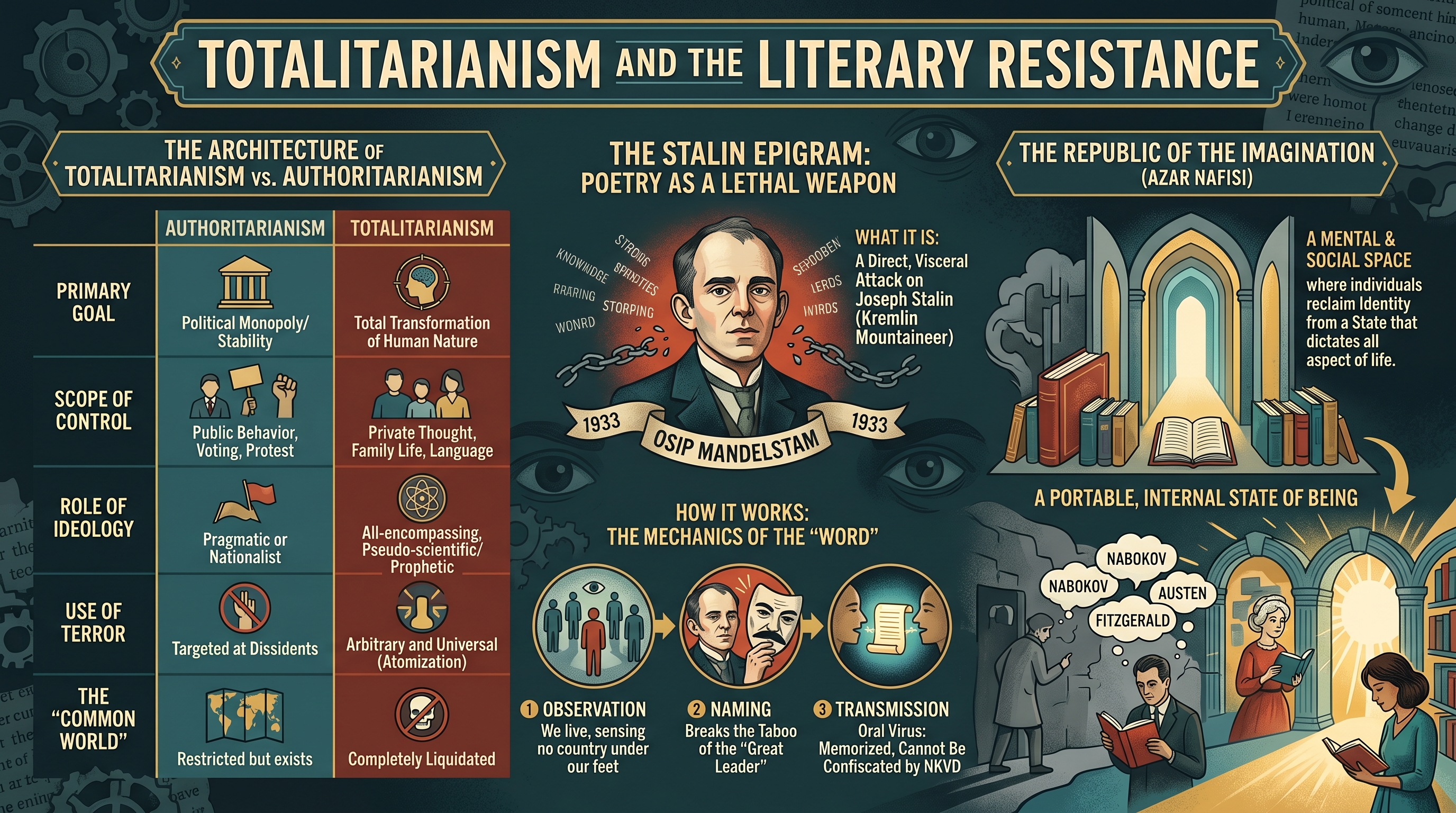
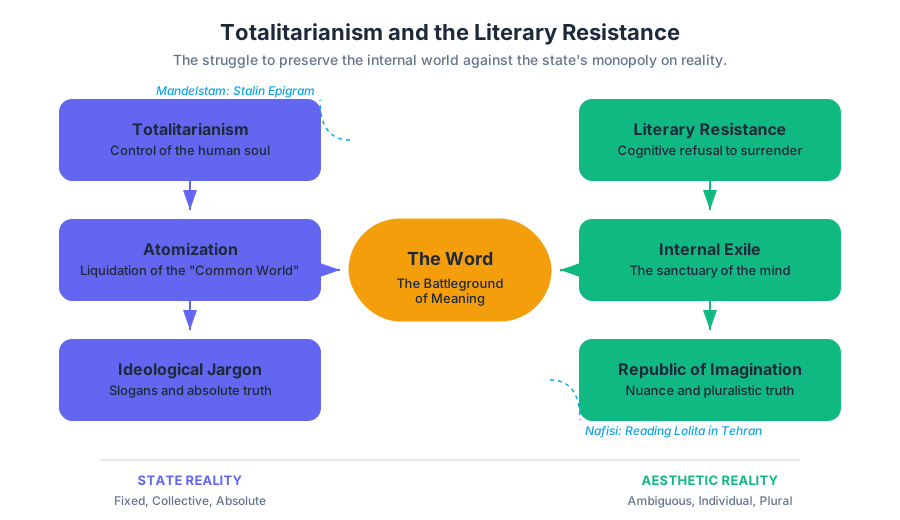
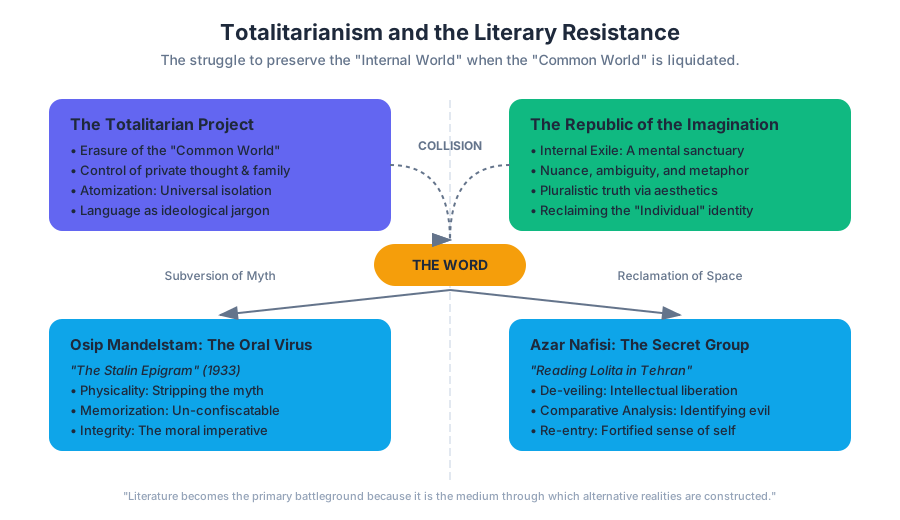
Totalitarianism is not merely a form of extreme governance; it is a comprehensive ontological project that seeks to collapse the distinction between the private individual and the public state. In this environment, the "Literary Resistance" emerges not as a political party or an armed insurgency, but as a cognitive and aesthetic refusal to surrender the "internal world" to the state's monopoly on reality. Through the works of Osip Mandelstam, Azar Nafisi, Hannah Arendt, and Franz Kafka, we examine how the act of writing and reading becomes a high-stakes mechanism for preserving human agency when the "Common World" has been systematically dismantled.
The Architecture of Totalitarianism
To understand the resistance, one must first define the structure of the oppression. As Hannah Arendt articulates in The Origins of Totalitarianism, these regimes differ fundamentally from traditional autocracies or dictatorships. While an autocrat seeks to control political power, a totalitarian regime seeks to control the very nature of reality and the human soul.
Totalitarianism: A system of government that is centralized and dictatorial and requires complete subservience to the state, characterized by the erasure of the "Common World"—the shared space of appearance where individuals can act and speak in their uniqueness.
Why It Matters
In a totalitarian state, the "private" is viewed as a subversive category. If a citizen has a thought that is not state-sanctioned, that thought is a potential site of rebellion. Therefore, the state must occupy the imagination. Literature becomes the primary battleground because it is the medium through which alternative realities are constructed and maintained.
Comparison of Power Structures
| Feature | Authoritarianism | Totalitarianism |
|---|---|---|
| Primary Goal | Political monopoly / Stability | Total transformation of human nature |
| Scope of Control | Public behavior, voting, protest | Private thought, family life, language |
| Role of Ideology | Often pragmatic or nationalist | All-encompassing, pseudo-scientific/prophetic |
| Use of Terror | Targeted at dissidents | Arbitrary and universal (to ensure total atomization) |
| The "Common World" | Restricted but exists | Completely liquidated |
The Stalin Epigram: Poetry as a Lethal Weapon
The case of Osip Mandelstam provides the definitive "worked example" of the lethal stakes of literary resistance under Stalinism. In 1933, Mandelstam wrote a sixteen-line poem, often referred to as the Stalin Epigram ("Our lives no longer feel the ground under them...").
What It Is
The poem is a direct, visceral attack on Joseph Stalin, describing him as a "Kremlin mountaineer" with "fat fingers... like worms" and "cockroach whiskers." It was never written down initially; it was memorized by a small circle of friends.
How It Works: The Mechanics of the "Word"
In a state where the leader's image is curated to be god-like, the poet uses the Physicality of Language to strip away the myth. By describing Stalin’s physical grotesqueness, Mandelstam reasserts the reality of the body over the abstraction of the state.
- Observation: "We live, sensing no country under our feet." This describes the state of Atomization—the loss of a shared, stable reality.
- Naming: By naming the "mountain-climber," Mandelstam breaks the taboo of the "Great Leader."
- Transmission: The poem functioned as an "oral virus." Because it was memorized, it could not be confiscated by the secret police (NKVD) until someone betrayed the circle.
Common Pitfalls
A common misconception is that Mandelstam was a political activist. He was not. He was a poet who believed that the "integrity of the word" was a moral imperative. His resistance was aesthetic; the political consequence (his eventual death in a transit camp) was a reaction by a state that could not tolerate a competing creator of meaning.
The Republic of the Imagination (Azar Nafisi)
In Reading Lolita in Tehran, Azar Nafisi describes a different but related phenomenon: the creation of a "Republic of the Imagination" during the Islamic Revolution in Iran.
What It Is
The Republic of the Imagination is a conceptual sanctuary—a mental and social space where individuals can engage with forbidden texts (Nabokov, Fitzgerald, Austen) to reclaim their identity from a state that dictates their dress, their speech, and their public persona.
The Republic of the Imagination: A portable, internal state of being where the laws of the aesthetic world supersede the laws of the ideological state. It is the ultimate form of Internal Exile.
How It Works: The Reading Group Pipeline
Nafisi’s secret reading group functioned as a laboratory for the soul. The process followed a specific "implementation" of resistance:
- De-Veiling (Literal and Metaphorical): In the privacy of Nafisi's home, the students removed their mandatory robes. This physical act mirrored the intellectual act of removing the state’s ideological "veil."
- Comparative Analysis: Comparing the characters in Lolita (the victimizer Humbert Humbert and the victim Lolita) to their own lives. They identified the "Humbertish" nature of the state—the desire to turn a living person into a fixed, controllable image.
- Re-entry: The students would then re-enter the "real" world equipped with a secret language and a fortified sense of self.
The Mechanics of Aesthetic Resistance
| Concept | State Reality (The "Upside-Down") | The Republic of the Imagination |
|---|---|---|
| Language | Slogans, ideological jargon | Nuance, ambiguity, metaphor |
| Identity | Collective, religious, obedient | Individual, complex, flawed |
| Truth | Absolute and state-defined | Pluralistic and discovered through art |
| Time | The "Eternal Present" of the Revolution | The timelessness of the Great Books |
Internal Exile: The Geography of the Mind
Internal Exile (or vnutrennyaya emigratsiya) is the condition of being a foreigner within one's own country. It is a psychological defense mechanism where the individual withdraws from public life to protect their intellectual and moral integrity.
The Mechanics of Withdrawal
Internal exile is not passive. It requires a rigorous "doubling" of the self.
- The Public Mask: The performance of compliance (attending rallies, using state-approved greetings).
- The Private Core: The cultivation of a "hidden life" through forbidden literature, secret correspondence, or "writing for the drawer."
Case Study: The "Nika" Phenomenon
The Soviet poet Nika Turbina (the subject of the film Nika) represents the tragic intersection of talent and state co-option. Totalitarian states often attempt to "adopt" child prodigies to prove the superiority of their system. When the individual’s internal reality no longer matches the state’s narrative, the resulting "collapse" is both personal and symbolic. Nika’s struggle highlights that the state does not just want your silence; it wants your voice to speak its words.
Kafkaesque Realities and the Bureaucracy of Terror
Franz Kafka’s work, though written before the height of 20th-century totalitarianism, provides the "source code" for understanding the experience of the individual caught in an illogical, all-powerful system.
The "Trial" Algorithm
In Kafka's The Trial, the protagonist Josef K. is arrested for a crime that is never named, by a court that is inaccessible. This mirrors the Arbitrary Terror of Stalinism or the Iranian Revolutionary Courts.
- Input: An ordinary life.
- Trigger: An arbitrary accusation (often based on "thought-crime").
- Process: An endless, circular bureaucracy where the "Law" is always just out of reach.
- Output: Execution "like a dog," with the victim often feeling a sense of shame despite their innocence.
Comparison: Kafka vs. The Totalitarian State
| Kafkaesque Element | Totalitarian Parallel |
|---|---|
| The Inaccessible Law | Secret decrees and shifting ideological lines |
| The Infinite Bureaucracy | The party apparatus and secret police |
| The Internalized Guilt | The "Confession" in show trials |
| The Absurdity | The gap between state propaganda and lived reality |
Synthesis: The "Dream of the Raised Arm"
Zadie Smith, reflecting on these themes, discusses the "Dream of the Raised Arm"—the idea that even a small, physical gesture of refusal can hold immense power. In the context of literary resistance, the "raised arm" is the act of holding a book.
The Pipeline of Resistance
- Preservation: Keeping the text alive (e.g., memorizing Mandelstam).
- Interpretation: Refusing the state's "correct" reading of history or literature.
- Communication: Sharing the "secret" with a trusted circle (the "Parallel Polis").
- Transformation: The individual is no longer a "cog" in the machine but a "citizen" of the Republic of the Imagination.
Common Pitfalls in Analysis
- The "Hero" Fallacy: Assuming that literary resistors are always "heroes" in the traditional sense. Many were terrified, compromised, or deeply flawed. Their resistance lay in their work, not necessarily their physical bravery.
- The "Escapism" Misconception: Viewing the Republic of the Imagination as "escapism." In a totalitarian context, reading is not an escape from reality; it is an escape to reality—a way to find the truth that the state has obscured.
- Over-Politicization: Reducing a poem to a political pamphlet. The power of Mandelstam’s epigram wasn't just that it "hated Stalin," but that it was better than Stalin's propaganda. It was an aesthetic victory.
Key Insight: Totalitarianism wins when it convinces the individual that there is no "outside" to the system. Literature provides the "outside." It proves that the state is not the horizon of the universe.
Appendix: Key Figures and Texts
| Figure | Key Work / Concept | Role in Resistance |
|---|---|---|
| Osip Mandelstam | The Stalin Epigram | The "Martyr" of the Word; proved poetry can be lethal. |
| Azar Nafisi | Reading Lolita in Tehran | Defined the "Republic of the Imagination" and the secret reading group. |
| Hannah Arendt | The Origins of Totalitarianism | Provided the theoretical framework for "Atomization" and the "Common World." |
| Franz Kafka | The Trial / The Castle | Mapped the psychological landscape of the individual vs. the Bureaucracy. |
| Vladimir Nabokov | Invitation to a Beheading | A frequent text in resistance circles; deals with the "translucence" of the individual. |
| Nika Turbina | Biopic: Nika | Illustrates the state's co-option and subsequent destruction of the "prodigy." |
This article serves as a foundational guide for understanding the intersection of political science, history, and literary theory within the context of 20th and 21st-century unfreedom.
Defining Liberty: Mill, Berlin, and Skinner
Key concepts: Negative Liberty · Positive Liberty · The Harm Principle · Non-domination
A deep dive into the political definitions of liberty, comparing negative, positive, and republican (neo-Roman) concepts.
Defining Liberty: Mill, Berlin, and Skinner
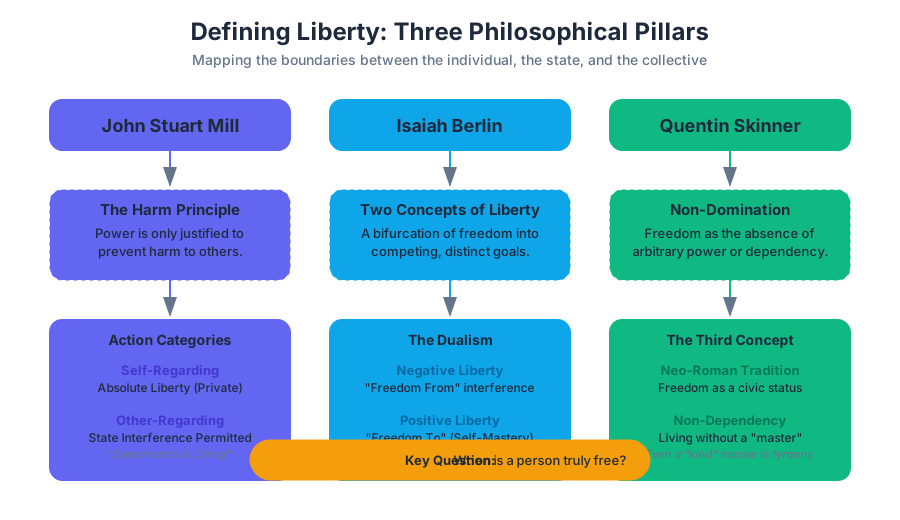
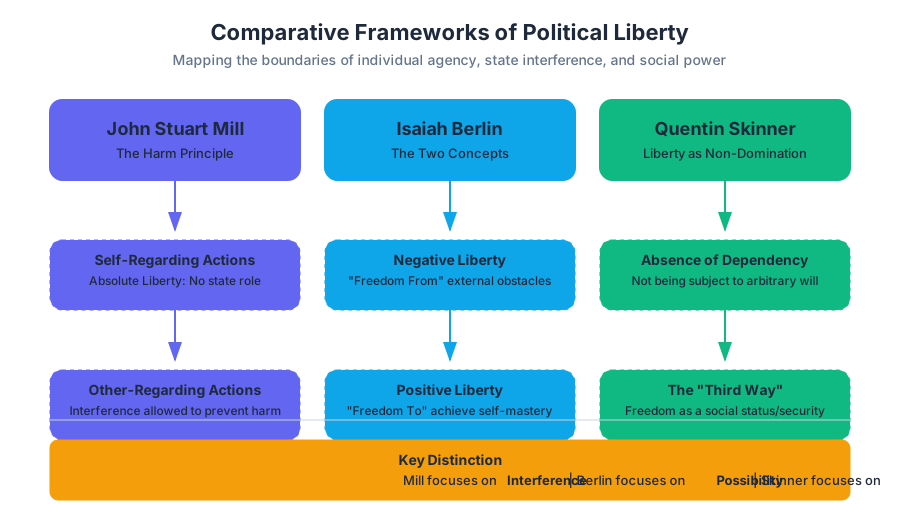
The concept of "liberty" is perhaps the most contested term in the lexicon of political philosophy. While colloquially used to denote a general state of "being free," the technical definitions employed by theorists like John Stuart Mill, Isaiah Berlin, and Quentin Skinner reveal a complex architecture of power, agency, and social structure. To understand liberty is not merely to define a word, but to map the boundaries between the individual and the collective, the state and the subject, and the "higher" and "lower" selves.
John Stuart Mill: The Harm Principle and the Limits of Authority
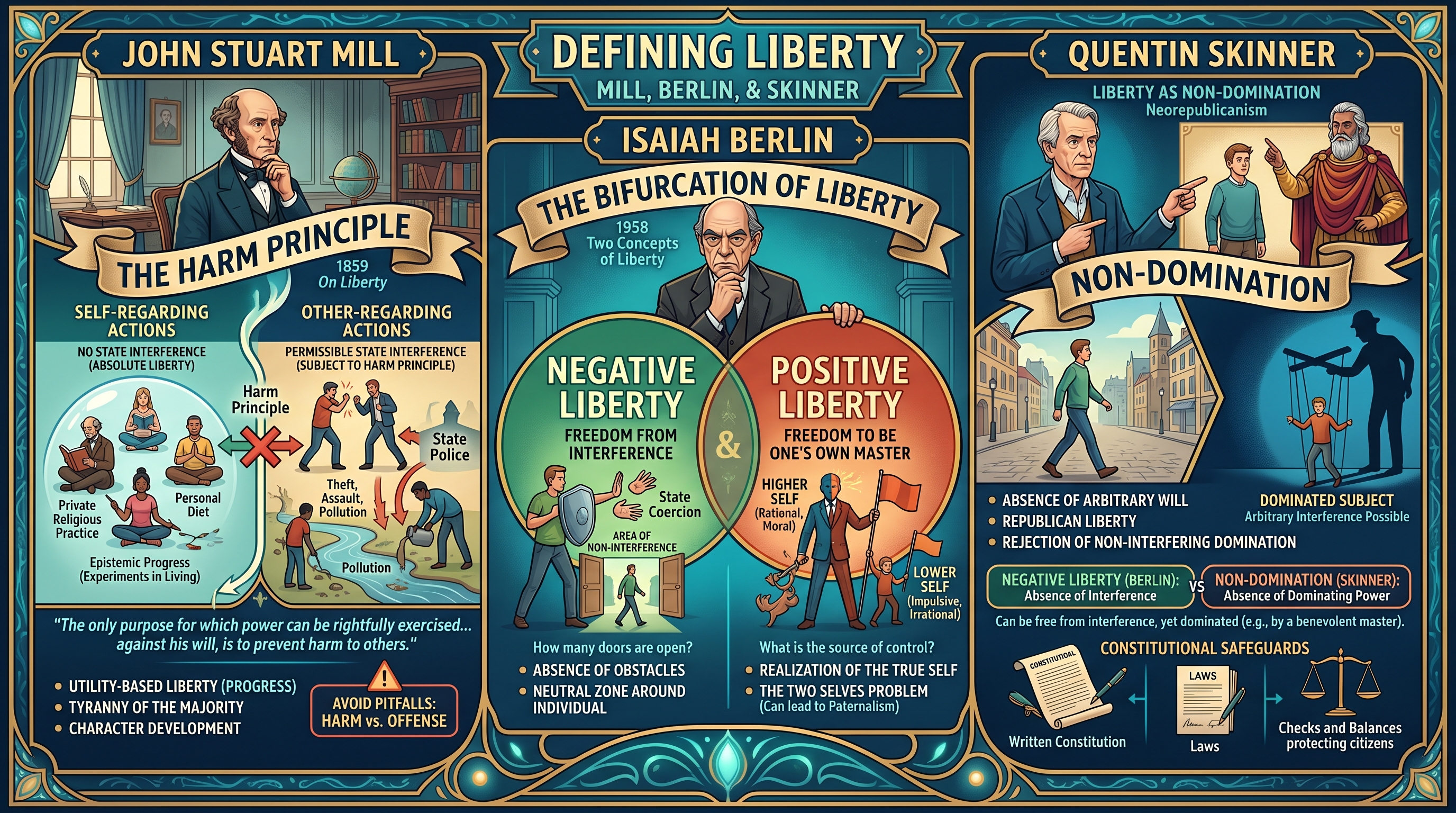
In his seminal 1859 work On Liberty, John Stuart Mill sought to establish a "one very simple principle" to govern the dealings of society with the individual in the way of compulsion and control. Mill’s project was a response to the "tyranny of the majority," a phenomenon where social and political pressure could stifle individual genius and autonomy.
The Harm Principle: Definition and Derivation
Mill’s central thesis, known as the Harm Principle, serves as the foundational axiom of modern liberalism.
"The only purpose for which power can be rightfully exercised over any member of a civilized community, against his will, is to prevent harm to others. His own good, either physical or moral, is not a sufficient warrant."
For Mill, liberty is defined by the absence of coercion regarding self-regarding actions. Coercion is only permissible for other-regarding actions that cause demonstrable harm.
| Category | Definition | Permissibility of State Interference |
|---|---|---|
| Self-Regarding | Actions that affect only the actor (e.g., private religious practice, personal diet). | Never (Absolute Liberty) |
| Other-Regarding | Actions that affect the interests or rights of others (e.g., theft, assault, pollution). | Permissible (Subject to the Harm Principle) |
| Paternalism | Intervening for the individual's "own good" (e.g., seatbelt laws, drug bans). | Prohibited (According to Mill) |
How it Works: The Utility of Liberty
Mill does not argue for liberty as an "abstract right." Instead, he derives it from Utilitarianism. He argues that liberty is "the permanent interests of man as a progressive being." By allowing individuals to engage in "experiments in living," society discovers better ways of life and avoids the stagnation of custom.
- Epistemic Progress: If we silence an opinion, we may be silencing the truth. Even if the opinion is false, the struggle with error clarifies the truth.
- Character Development: Autonomy is a "muscle." If the state makes all decisions for the individual, the individual’s mental and moral powers atrophy.
- The Limit of Harm: "Harm" must be more than mere offense. If my neighbor's religious practice offends me, that is not "harm" in the Millian sense; it is a "displeasure" that does not violate a distinct and assignable obligation.
Common Pitfalls: The "Harm" Ambiguity
A frequent mistake in applying Mill is failing to define "harm" strictly. If "harm" is expanded to include "psychological distress" or "economic competition," the Harm Principle collapses, as almost every action could be seen as harming someone. Mill insists on a distinction between harm (violation of a right or interest) and offense (unpleasant feelings).
Isaiah Berlin: The Bifurcation of Liberty
In his 1958 lecture Two Concepts of Liberty, Isaiah Berlin introduced a distinction that redefined 20th-century political thought. He argued that "liberty" actually refers to two different, and often incompatible, goals: Negative Liberty and Positive Liberty.
Negative Liberty: The "Freedom From"
Negative Liberty is the answer to the question: "What is the area within which the subject—a person or group of persons—is or should be left to do or be what he is able to do or be, without interference by other persons?"
- Mechanics: It is a measure of the absence of obstacles. If
xis prevented byyfrom doingz,xlacks negative liberty. - The "Area" Metaphor: Berlin imagines a "neutral zone" around the individual where the state cannot enter. The wider this zone, the more negative liberty one possesses.
Positive Liberty: The "Freedom To"
Positive Liberty answers the question: "What, or who, is the source of control or interference that can determine someone to do, or be, this rather than that?"
- Mechanics: It is the wish on the part of the individual to be his own master. It involves the "realization" of one's true self.
- The "Two Selves" Problem: Positive liberty often relies on a distinction between a "higher" self (rational, moral) and a "lower" self (impulsive, irrational).
| Feature | Negative Liberty | Positive Liberty |
|---|---|---|
| Core Question | How many doors are open to me? | Who is the master? |
| Focus | Absence of interference | Presence of self-control/autonomy |
| Risk | Social atomization / Indifference | Totalitarianism (forcing one to be "free") |
| Key Proponents | Mill, Bentham, Hobbes | Rousseau, Hegel, Marx |
The Perversion of Positive Liberty
Berlin’s primary concern was the "slippery slope" of positive liberty. If we define freedom as "obeying one's rational self," then a state might claim that by coercing you to act rationally (e.g., forcing you to join a revolution or follow a specific religion), it is actually making you "free." This logic was used by 20th-century totalitarian regimes to justify oppression in the name of "true" liberation.
Quentin Skinner: Liberty as Non-Domination
In the late 20th century, Quentin Skinner (and Philip Pettit) argued that Berlin’s dichotomy was incomplete. They proposed a Third Concept of Liberty, rooted in the "Neo-Roman" or Republican tradition: Liberty as Non-Domination.
The "Slave with a Kind Master" Thought Experiment
To understand Skinner, consider a slave whose master is exceptionally kind and never interferes with the slave’s actions. The master allows the slave to go where he wants, marry whom he likes, and keep his earnings.
- According to Berlin (Negative Liberty): The slave is free because there is no interference.
- According to Skinner: The slave is unfree because he lives at the mercy of the master. The master could interfere at any moment.
Definition of Non-Domination
Non-domination is the absence of dependence on the arbitrary will of another.
Liberty is not just the absence of interference (Negative) or the presence of self-mastery (Positive); it is the security of one's status as a free citizen who cannot be interfered with at the whim of a superior.
Comparison of Interference vs. Domination
| Scenario | Interference? | Domination? | Status of Liberty |
|---|---|---|---|
| The Kind Master | No | Yes | Unfree (Dependent) |
| Fair Law Enforcement | Yes | No | Free (Non-arbitrary interference) |
| The Tyrant | Yes | Yes | Unfree (Oppressed) |
| The Independent Citizen | No | No | Free (Ideal) |
Why it Matters: The Republican Ideal
Skinner’s view emphasizes that a person is only free in a "free state"—a community where the laws are not arbitrary and where no individual or group has the power to interfere with others without accountability. This shifts the focus from "individual rights" to "civic participation" and the "rule of law."
Synthesis: Enlightenment, Public Freedom, and Resistance
The theoretical frameworks of Mill, Berlin, and Skinner provide the tools to analyze the historical and literary accounts of freedom found in the works of Kant, Arendt, and Nafisi.
Immanuel Kant and the "Exit from Immaturity"
Kant’s definition of Enlightenment as "man's emergence from his self-incurred immaturity" is a classic expression of Positive Liberty. Immaturity is the inability to use one's understanding without guidance from another. For Kant, the "motto" of enlightenment is Sapere aude! (Dare to know!). This requires a specific kind of liberty: the public use of reason.
Hannah Arendt: The "Lost Treasure" of Public Freedom
In the supplementary materials, Arendt discusses the résistance in France and the "lost treasure" of revolution. For Arendt, freedom is not a private phenomenon (Negative Liberty) but a public action.
- Public Freedom: The ability to be a "participator in government" and to begin something new (natality).
- The Gap between Past and Future: Arendt argues that in times of crisis (like the collapse of France in 1940), the "testament" of tradition is broken. In this gap, individuals are forced to discover freedom through action and speech in the public sphere.
Azar Nafisi: The Republic of the Imagination
In Reading Lolita in Tehran, Nafisi illustrates the struggle for liberty under a totalitarian regime that seeks to control both the negative and positive dimensions of freedom.
- Resistance as Liberty: When the state dictates every aspect of public life, the act of reading forbidden literature becomes an assertion of Non-domination.
- The Private vs. Public: Nafisi’s students create a "Republic of the Imagination," a space where they can exercise their "higher selves" (Positive Liberty) despite the total interference of the state (Lack of Negative Liberty).
Summary of Theoretical Frameworks
| Philosopher | Key Term | Definition of Unfreedom | Goal of Society |
|---|---|---|---|
| Mill | Harm Principle | Coercion in self-regarding matters. | Maximize utility through individual autonomy. |
| Berlin | Negative Liberty | Physical or legal barriers to action. | Protect a private sphere from state overreach. |
| Berlin | Positive Liberty | Subjection to impulses or "lower" self. | Achieve self-realization (risks totalitarianism). |
| Skinner | Non-domination | Dependence on an arbitrary will. | Ensure no citizen is "at the mercy" of another. |
| Arendt | Public Freedom | Exclusion from the public realm/action. | Create a space for "beginning" and political speech. |
Concrete Example: The Case of "Mandatory Seatbelts"
- Mill's Analysis: This is "paternalism." Unless not wearing a seatbelt harms others (e.g., increasing insurance premiums for everyone), the state has no right to mandate it. It is a violation of liberty.
- Berlin (Negative): A seatbelt law is a clear interference. It reduces the "area" of non-interference. It is a loss of negative liberty.
- Berlin (Positive): The "rational self" wants to live. By forcing the "impulsive self" to wear a seatbelt, the state is helping the individual achieve their true goal (survival). This is an exercise of positive liberty.
- Skinner: Is the law arbitrary? If the law was passed through a democratic process with clear rules and oversight, it is not "domination," even if it is "interference." The citizen remains free because they are not subject to a whim, but to a settled law.
Study Guide: Defining Liberty
I. Core Definitions
- Negative Liberty: Freedom from interference. It is the size of the "unobstructed" space an individual possesses. (Berlin)
- Positive Liberty: Freedom to be one's own master. It involves self-realization and the triumph of the "rational" self over "baser" instincts. (Berlin)
- The Harm Principle: The state may only interfere with an individual's liberty to prevent harm to others. (Mill)
- Non-domination: The absence of dependence on the arbitrary will of another. You are free if no one could interfere with you at their whim. (Skinner)
II. Key Distinctions
- Self-regarding vs. Other-regarding: Mill's boundary for state intervention.
- Interference vs. Domination: You can have interference without domination (fair laws) and domination without interference (the kind master).
- Public vs. Private Freedom: Arendt's focus on freedom as "action" in the public square versus the liberal focus on "rights" in the private sphere.
III. Critical Debates
- The Danger of Positive Liberty: Why did Berlin fear that "self-mastery" leads to the guillotine? (The "Two Selves" problem).
- The Definition of Harm: How does Mill distinguish between "harm" and "offense"? Why is this distinction vital for a free society?
- The Status of the Slave: Why does Skinner argue that a slave with a kind master is still unfree?
IV. Historical/Literary Context
- Kant: Enlightenment as the courage to use one's own reason.
- Arendt: The "lost treasure" of the revolutionary spirit and the importance of the "gap" between past and future.
- Nafisi: The use of literature and the "imagination" as a site of resistance against totalitarian control.
V. Application Checklist
When analyzing a policy or situation, ask:
- Is there physical or legal interference? (Negative Liberty)
- Does the individual have the capacity for self-direction? (Positive Liberty)
- Is the power being exercised over them arbitrary or accountable? (Non-domination)
- Does the action harm a "distinct and assignable obligation" to others? (Harm Principle)
Truth, Rebellion, and Existential Freedom
Key concepts: On Truth and Lie · Metaphysical Rebellion · The Fire Next Time · Moral Responsibility
Explores the relationship between truth-telling and freedom, and the existential necessity of rebellion in the face of injustice.
Truth, Rebellion, and Existential Freedom
The intersection of Truth, Rebellion, and Existential Freedom represents one of the most rigorous domains of human inquiry. At its core, this triad addresses a fundamental tension: the human drive to construct meaning within a world that often appears indifferent, deceptive, or systematically oppressive. To engage with these concepts is to move beyond passive existence and into the realm of Moral Responsibility, where the act of "telling the truth" becomes a revolutionary gesture.
This article synthesizes the radical skepticism of Friedrich Nietzsche, the existential defiance of Albert Camus, the prophetic social critique of James Baldwin, and the literary resistance documented by Azar Nafisi and Hannah Arendt. Together, these thinkers provide a framework for understanding how the individual maintains autonomy against the "totalitarian" lie—whether that lie is metaphysical, linguistic, or political.
Nietzsche: The Linguistic Construction of Truth
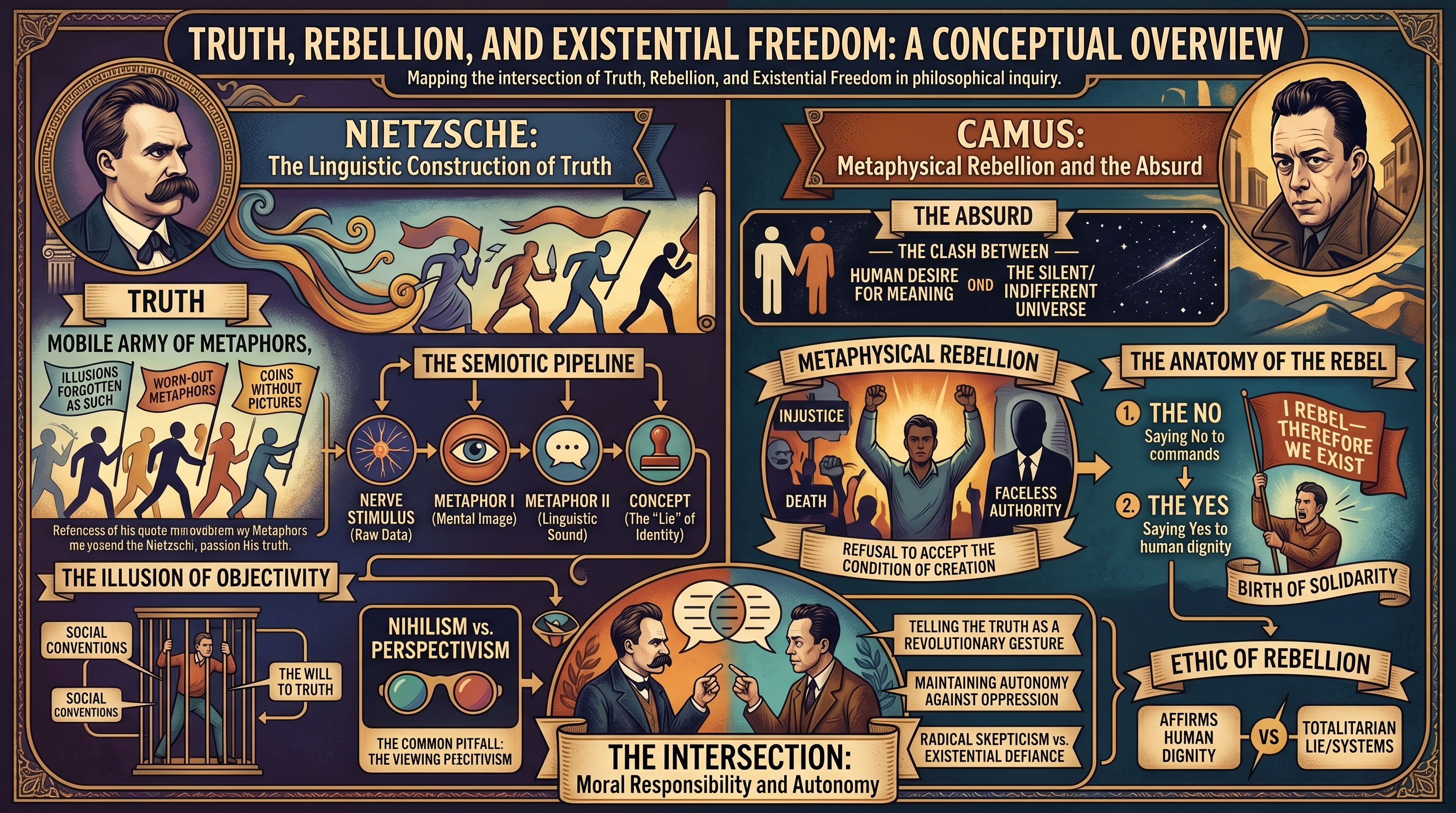
In his seminal essay On Truth and Lie in an Extra-Moral Sense, Friedrich Nietzsche challenges the foundational assumption that "truth" is an objective, discoverable entity. Instead, he posits that what we call truth is a social construct—a "peace treaty" designed to facilitate human coexistence.
What it is: The Extra-Moral Lie
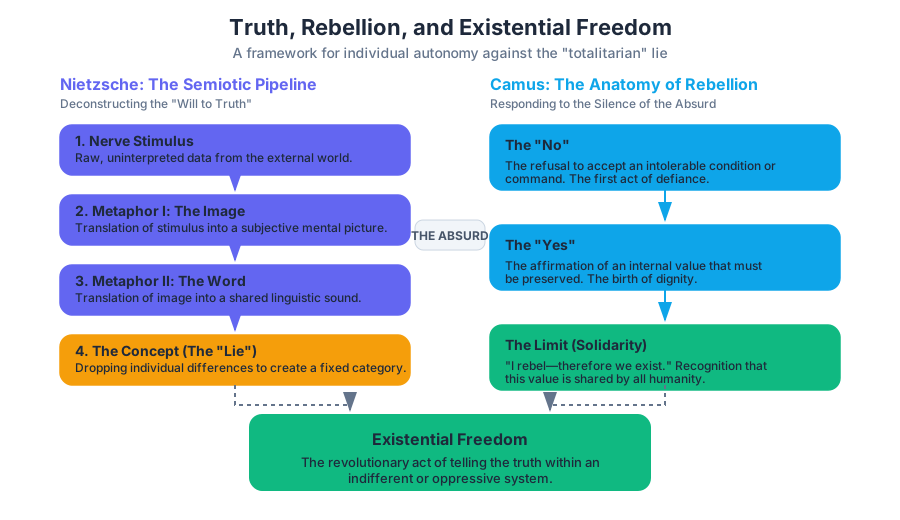
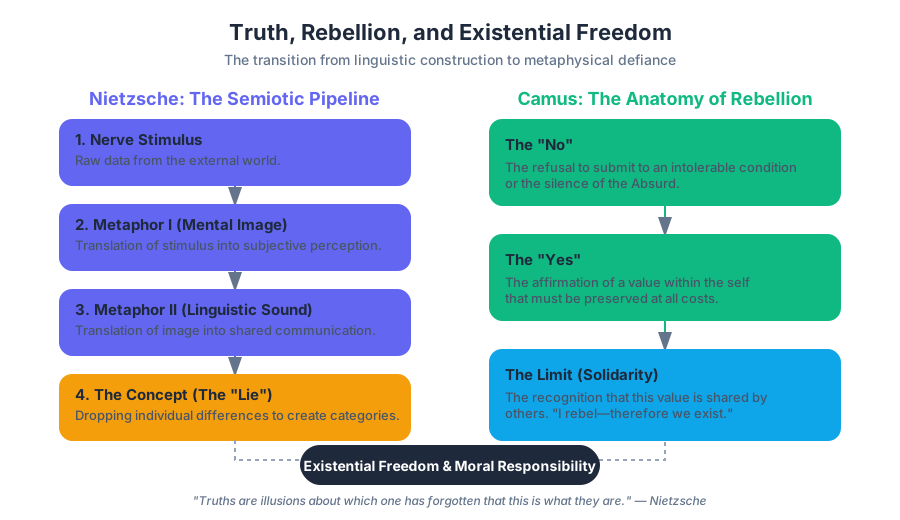
Nietzsche defines Truth not as a correspondence with reality, but as a Mobile Army of Metaphors. He argues that human cognition is inherently metaphorical. We translate a nerve stimulus into an image (the first metaphor) and then the image into a sound/word (the second metaphor). By the time we reach a "concept," we have completely abandoned the unique, individual reality of the original experience.
"Truths are illusions about which one has forgotten that this is what they are; metaphors which are worn out and without sensuous power; coins which have lost their pictures and now matter only as metal, no longer as coins." — Friedrich Nietzsche
Why it matters: The Illusion of Objectivity
Nietzsche’s critique is vital because it exposes the Will to Truth as a form of social control. If truth is merely a convention, then those who control the conventions control the "reality" of the populace. This provides the philosophical groundwork for understanding how systems of power (political or religious) use language to enforce a specific worldview.
How it works: The Semiotic Pipeline
Nietzsche describes a process of cognitive abstraction where the "thing-in-itself" is lost through successive layers of human interpretation.
| Stage | Process | Result |
|---|---|---|
| Stimulus | Nerve excitation from the external world. | Raw, uninterpreted data. |
| Metaphor I | Translation of stimulus into a mental image. | Subjective perception. |
| Metaphor II | Translation of image into a linguistic sound. | Shared communication. |
| Concept | Dropping individual differences to create a "category." | The "Lie": treating different things as identical. |
Common Pitfalls: Nihilism vs. Perspectivism
A common mistake is assuming Nietzsche is a pure nihilist who believes nothing matters. In reality, he is a Perspectivist. He does not argue that there is no reality, but rather that our access to it is always mediated by our perspective. The "lie" is not a moral failing; it is a biological and social necessity for survival.
Camus: Metaphysical Rebellion and the Absurd
While Nietzsche deconstructs the nature of truth, Albert Camus focuses on the human response to a world devoid of inherent meaning—a condition he calls The Absurd. In The Rebel, Camus moves from the individual's recognition of the absurd to a collective ethics of rebellion.
What it is: Metaphysical Rebellion
Metaphysical Rebellion is the movement by which a human being protests against their condition and the whole of creation. It is the refusal to accept the "silence" of the universe or the injustice of death and suffering. Unlike a revolution, which seeks to replace one power structure with another, rebellion is a permanent state of defiance that affirms human dignity.
Why it matters: "I Rebel—Therefore We Exist"
Camus’s famous dictum, "I rebel—therefore we exist," marks a transition from Cartesian solipsism ("I think, therefore I am") to a social ethic. When an individual rebels against an injustice, they are not just fighting for themselves; they are asserting that there is a limit—a "standard of value"—that applies to all humans. Rebellion is the birth of solidarity.
How it works: The Anatomy of the Rebel
The act of rebellion follows a specific psychological and logical progression:
- The "No": The rebel says "No" to a command or a condition that they find intolerable.
- The "Yes": In saying no, the rebel simultaneously says "Yes" to the existence of a value within themselves that must be preserved.
- The Limit: The rebel recognizes that this value is shared by others, creating a boundary that neither the rebel nor the oppressor should cross.
| Concept | Definition | Goal |
|---|---|---|
| The Absurd | The conflict between human longing for order and the silent, chaotic universe. | Recognition of reality. |
| Rebellion | The refusal to submit to the Absurd or to injustice. | Preservation of dignity. |
| Revolution | A systematic attempt to reshape the world according to an ideology. | Total transformation (often leads to tyranny). |
Concrete Example: The Myth of Sisyphus
Sisyphus is the ultimate metaphysical rebel. Condemned to roll a rock up a hill for eternity only for it to roll back down, he is conscious of his hopeless fate. However, in his consciousness and his refusal to despair, he is "superior to his rock." His rebellion lies in his joy—a joy that the gods cannot take away.
Baldwin: The Fire Next Time and the Moral Responsibility of Truth
James Baldwin’s The Fire Next Time applies the concepts of truth and rebellion to the specific context of American racial injustice. For Baldwin, freedom is not a legal status but a spiritual and existential achievement that requires the courage to confront a painful history.
What it is: The Crime of Innocence
Baldwin introduces a devastating critique of White Innocence. He argues that the refusal of white Americans to acknowledge the truth of their history and the reality of Black suffering is not a passive state, but a "crime." This "innocence" is a lie that protects the ego but destroys the soul of both the oppressor and the oppressed.
"It is the innocence which constitutes the crime... they are, in effect, still trapped in a history which they do not understand; and until they understand it, they cannot be released from it." — James Baldwin
Why it matters: Freedom as Integration
For Baldwin, Freedom is the ability to see oneself and the world as they truly are. This requires "integration"—not just in a legal sense, but in the sense of integrating the "dark" and "light" parts of the human experience. To be free is to stop lying to oneself about the past.
How it works: The Dialectic of Love
Baldwin proposes Love as a revolutionary force. This is not "love" in the sentimental sense, but a "state of being, or a state of grace—not in the infantile American sense of being made happy but in the tough and universal sense of quest and daring and growth."
| Baldwin's Key Pillars | Description | Existential Function |
|---|---|---|
| Historical Witness | The duty to tell the truth about the past. | Breaks the cycle of the "Lie." |
| The Fire | The inevitable consequence of a society built on a lie. | Catalyst for radical change. |
| Conscious Love | The force required to "end the racial nightmare." | Re-humanizes the "other." |
Common Pitfalls: Misunderstanding "The Fire"
Readers often mistake "The Fire Next Time" as a threat of violence. While Baldwin acknowledges the possibility of destruction, the "Fire" is primarily a metaphor for a spiritual reckoning. It is the purification that comes when a society can no longer sustain its illusions.
Nafisi, Arendt, and the Republic of the Imagination
The source materials regarding Azar Nafisi’s Reading Lolita in Tehran and Hannah Arendt’s work on totalitarianism bridge the gap between abstract philosophy and lived experience under oppressive regimes.
What it is: The Republic of the Imagination
Azar Nafisi describes how, in the face of the Islamic Republic’s strict ideological control, she and her students created a "Republic of the Imagination." By reading forbidden Western literature (Nabokov, Fitzgerald, Austen), they engaged in a form of rebellion that was internal and intellectual. Literature provided a "truth" that the state could not touch.
Why it matters: Factual Truth vs. Political Opinion
Hannah Arendt argues that in totalitarian systems, Factual Truth is the first casualty. When a regime can change the past or deny the evidence of one's own senses, the individual loses their "footing" in reality. In this context, simply remembering a fact or reading a "non-aligned" book is an act of existential rebellion.
Comparison of Existential Frameworks
| Thinker | Source of "The Lie" | Mode of Rebellion | Ultimate Goal |
|---|---|---|---|
| Nietzsche | Language/Concepts | Artistic Creation | The Overman (Übermensch) |
| Camus | The Absurd/Injustice | Saying "No" with Solidarity | Human Dignity |
| Baldwin | Racial "Innocence" | Conscious Love/Witnessing | Social & Spiritual Integration |
| Nafisi | Totalitarian Ideology | Literature/Imagination | Personal Autonomy |
| Arendt | Political Propaganda | Factual Truth/Thinking | The Preservation of the Polis |
Synthesis: The Mechanics of Existential Freedom
Existential freedom is not the absence of constraints; it is the conscious navigation of those constraints through truth-telling and rebellion. The process can be visualized as a pipeline of liberation:
- Deconstruction (Nietzsche): Recognize that the "truths" handed down by society are often metaphors and conventions.
- Confrontation (Camus): Face the absurdity of existence and the injustice of the world without turning away.
- Witnessing (Baldwin): Acknowledge the specific historical and social lies (like racism) that prevent collective freedom.
- Creation (Nafisi): Build an internal "republic" where truth and beauty can survive even if the external world is dark.
Common Pitfalls in Existential Thought
- The Trap of Despair: Thinking that because truth is "constructed" (Nietzsche) or the world is "absurd" (Camus), nothing matters. Existentialism argues the opposite: because there is no pre-given meaning, we are responsible for creating it.
- The Trap of the "Beautiful Soul": Withdrawing into a private world of literature (Nafisi) and ignoring the social responsibility to change the world (Baldwin).
- The Trap of Violent Revolution: Forgetting Camus’s "Limit" and becoming an oppressor in the name of "liberation."
"The only way to deal with an unfree world is to become so absolutely free that your very existence is an act of rebellion." — Albert Camus
Further Reading and Contextual Notes
- Arendt and Kafka: The source materials suggest a connection between Arendt’s analysis of power and Kafka’s depiction of the "Absurdity of the Law." In Kafka’s The Trial, the lie becomes the world order. Arendt’s response is to emphasize the "vita activa"—the life of action and speech in the public sphere.
- The Role of the Response Paper: As noted in the instructor's materials, analyzing these texts requires moving beyond summary. A successful analysis must "find a direction"—connecting the philosophical "Truth" of Nietzsche to the "Imagination" of Nafisi or the "Witness" of Baldwin.
- The "No-Device" Policy: The instructor's insistence on hard copies and "no devices" mirrors the existential focus on presence. To engage with these texts is to be "present" to the truth, away from the distractions of the digital "mobile army of metaphors."
The Power of the Powerless and Social Transformation
Key concepts: Living in Truth · Theatre of the Oppressed · Everything Flows · Social Transformation
Analyzes how marginalized or oppressed individuals can effect change through 'living in truth' and radical performance.
The Power of the Powerless and Social Transformation
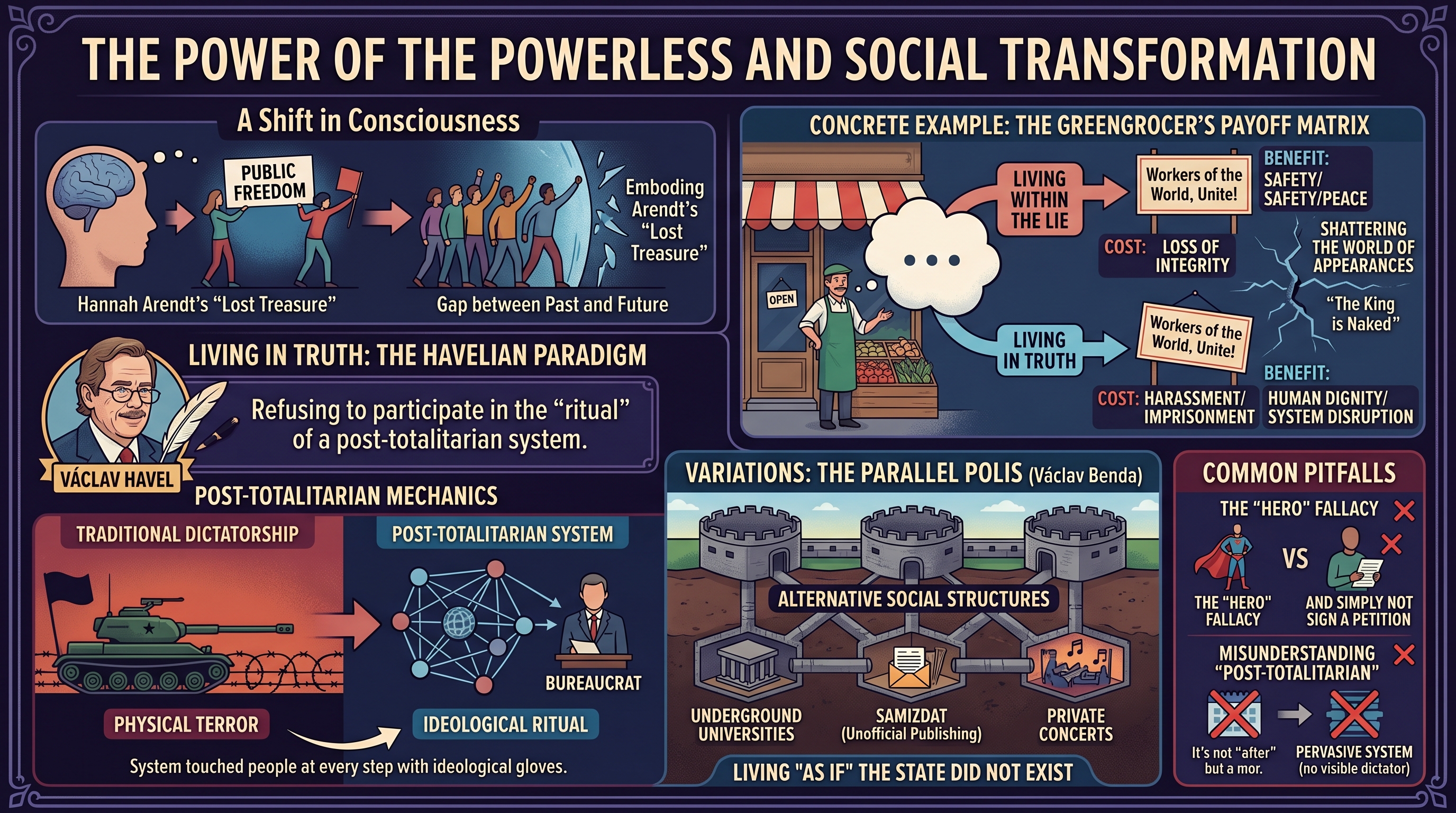
The study of social transformation is not merely the study of historical "events"—revolutions, coups, or legislative shifts—but the study of the underlying shifts in human consciousness and the reclamation of what Hannah Arendt calls the "lost treasure" of public freedom. This section examines the transition from theoretical concepts of liberty to the practical, often dangerous, application of those concepts within repressive systems. We focus on the late 20th-century Eastern Bloc and the development of participatory methods for social change, exploring how individuals navigate the "gap between past and future."
Living in Truth: The Havelian Paradigm
What it is
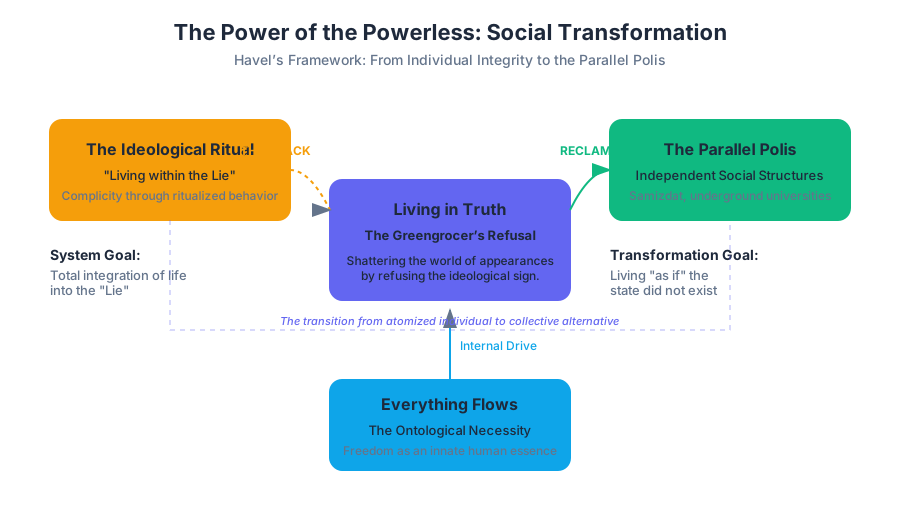
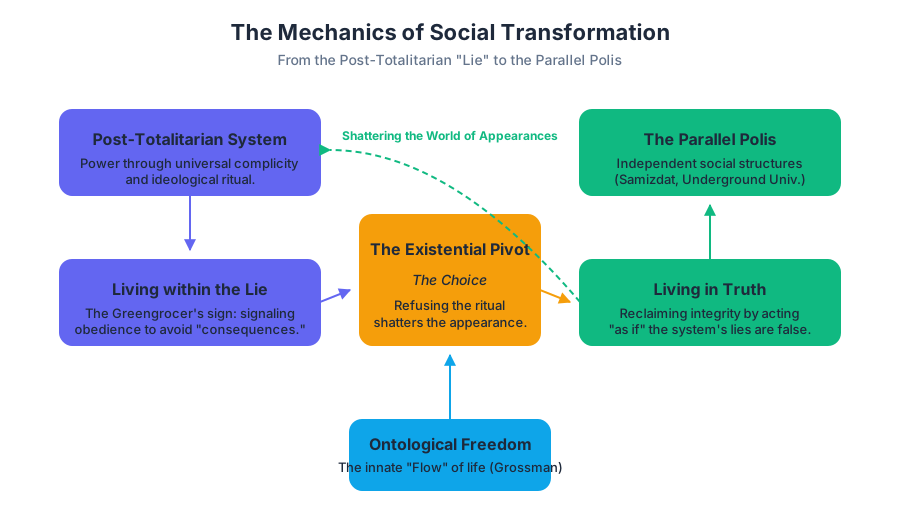
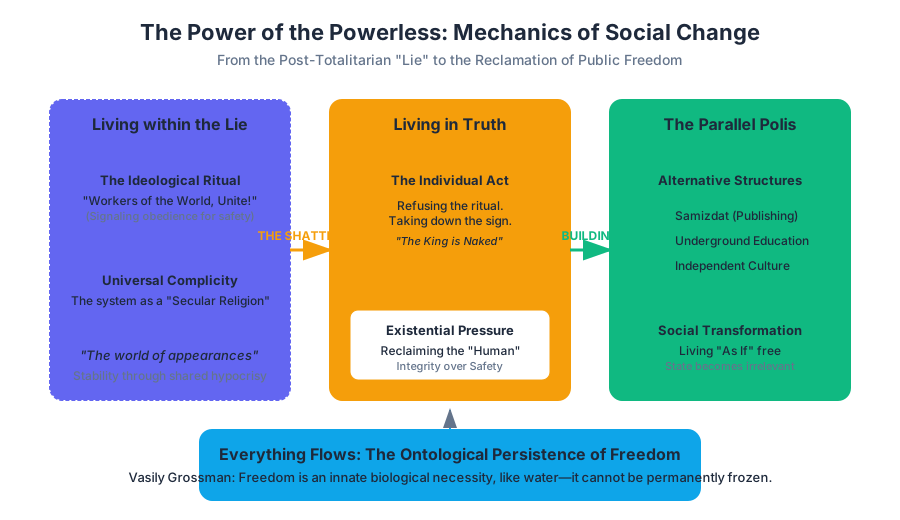
Living in Truth is a concept articulated by Václav Havel in his 1978 essay, The Power of the Powerless. It defines a mode of existence where an individual refuses to participate in the "ritual" of a post-totalitarian system. In such a system, power is not maintained solely through external force (like a traditional dictatorship) but through the universal complicity of the citizenry in a web of lies.
"The system touches people at every step, but it does so with its ideological gloves on. This is why life in the system is so thoroughly permeated with hypocrisy and lies... because the regime is captive to its own lies, it must falsify everything. It falsifies the past. It falsifies the present, and it falsifies the future." — Václav Havel
Why it matters
Havel’s work provides a theoretical framework for understanding why "stable" repressive regimes suddenly collapse. It solves the problem of the "atomized individual" who feels powerless against a monolithic state. By shifting the focus from military or economic power to the existential level, Havel demonstrates that the system’s greatest vulnerability is the individual’s potential to stop "living within the lie."
How it works: The Post-Totalitarian Mechanics
Havel distinguishes between a traditional dictatorship and a post-totalitarian system. The latter is "post" not because it is no longer totalitarian, but because it is a new form of the phenomenon, characterized by an all-encompassing ideological framework that provides a "secularized religion."
| Feature | Traditional Dictatorship | Post-Totalitarian System |
|---|---|---|
| Power Source | Military force, local autocrat | Ideological ritual, global bureaucracy |
| Citizen Role | Passive obedience or active revolt | Complicity through ritualized behavior |
| Primary Tool | Physical terror | Social and psychological pressure |
| System Goal | Control of territory/resources | Total integration of life into the "lie" |
The core mechanic of this system is the Ideological Ritual. When a greengrocer places a sign in his window saying "Workers of the World, Unite!", he is not expressing a political conviction. He is signaling to the system: "I am here, I know what is expected of me, I am obedient, and therefore I have the right to be left in peace."
Concrete Example: The Greengrocer’s Payoff Matrix
Consider the greengrocer’s decision-making process. If he displays the sign, he avoids trouble. If he refuses, he faces "consequences" (loss of job, children denied education).
| Action | Cost of Compliance | Benefit of Compliance | Cost of Resistance | Benefit of Resistance |
|---|---|---|---|---|
| Living within the Lie | Loss of personal integrity | Safety, stability, "peace" | N/A | N/A |
| Living in Truth | N/A | N/A | Harassment, imprisonment | Reclaiming the "human," system disruption |
When the greengrocer stops putting up the sign, he does more than commit a minor act of defiance. He shatters the world of appearances. He demonstrates that the "king is naked." Because the system is built on the assumption that everyone will play the game, a single person who refuses to play creates a "crack" in the system's foundation.
Variations: The Parallel Polis
Building on Havel, Václav Benda proposed the Parallel Polis. This is the idea that "living in truth" should not just be a solitary act of defiance but should lead to the creation of alternative, independent social structures (underground universities, unofficial publishing/Samizdat, private concerts). These structures do not seek to overthrow the state directly but to live "as if" the state did not exist, thereby rendering the state irrelevant.
Common Pitfalls
- The "Hero" Fallacy: Assuming "living in truth" requires grand, cinematic gestures. In reality, it is often found in the mundane refusal to sign a petition or attend a mandatory rally.
- Misunderstanding "Post-Totalitarian": Thinking the term means the system is "after" totalitarianism. It actually refers to a system that has become so pervasive it no longer needs a visible dictator to function.
Everything Flows: The Ontological Persistence of Freedom
What it is
Derived from Vasily Grossman’s posthumous novel Everything Flows (Panta Rhei), this concept posits that the human desire for freedom is an innate biological and ontological necessity, rather than a mere political preference. Grossman argues that even in the most extreme conditions of the Soviet Gulag, the "human" cannot be fully extinguished because freedom is the fundamental "essence" of life.
Why it matters
Grossman’s work serves as a philosophical bridge between the Enlightenment ideals of Kant and the lived reality of 20th-century terror. It addresses the "Totalitarian Paradox": if a state can control all information, all movement, and all thought, does the concept of "freedom" cease to exist? Grossman answers with a resounding "no," suggesting that freedom is like water—it can be dammed or frozen, but its nature remains "flowing."
How it works: The Derivation of Human Essence
Grossman’s logic follows a quasi-biological derivation:
- Life is Choice: At its most basic level, life involves selecting environments and resources that sustain it.
- Freedom is Choice: Human freedom is the conscious extension of this biological drive.
- Totalitarianism is Anti-Life: By attempting to remove all choice (necessity), the totalitarian state attempts to negate life itself.
- The Persistence of the Flow: Because the state cannot stop the biological drive to live, it can never fully stop the drive for freedom.
Concrete Example: The "Lost Treasure" in the Gulag
In Everything Flows, Grossman describes prisoners who, despite decades of dehumanization, still engage in "useless" acts of kindness or intellectual debate. These acts have no "survival value" in the Darwinian sense of the Gulag, yet they persist. This is the "everything flows" principle—the refusal of the human spirit to be reduced to a mere cog in the state machine.
Variations / Extensions: The Gap between Past and Future
This connects to Hannah Arendt’s analysis of the "gap" in history. When a system collapses (like France in 1940), a space opens up where "the past no longer throws its light upon the future." In this gap, the "lost treasure" of the revolution—the sheer joy of public action and freedom—is rediscovered.
| Concept | Author | Focus |
|---|---|---|
| Living in Truth | Havel | Existential/Political Resistance |
| Everything Flows | Grossman | Ontological/Biological Necessity |
| Lost Treasure | Arendt | Historical/Public Action |
Theatre of the Oppressed: Rehearsing the Revolution
What it is
Theatre of the Oppressed (TO) is a system of theatrical techniques developed by Brazilian practitioner Augusto Boal. It transforms the traditional "spectator" (passive observer) into a "spect-actor" (active participant). It is a "rehearsal for revolution," using the stage as a laboratory for testing social and political changes.
Why it matters
Traditional Aristotelian theatre often functions as a "purgation" (catharsis). The audience sees a tragedy, feels pity and fear, and leaves the theatre emotionally drained and thus less likely to act in the real world. Boal argues that this is a tool of the ruling class to maintain the status quo. TO solves this by making the theatre a place where people practice taking power.
How it works: The Methodology of Action
Boal’s system is structured as a pipeline of increasing engagement:
- Image Theatre: Participants use their bodies to create "statues" representing an oppression. This bypasses the limitations of language and reveals the "internalized" nature of power.
- Forum Theatre: A short play is performed showing a protagonist being oppressed. The play is then repeated, and any "spect-actor" can shout "STOP!", take the place of the protagonist, and attempt a different strategy to overcome the oppression.
- Invisible Theatre: A play performed in a public space (like a subway or restaurant) where the "audience" does not know it is a play. This forces people to react to social injustice as a reality, not a fiction.
- Legislative Theatre: Using TO techniques to determine what laws should be written, effectively turning the theatre into a democratic assembly.
Concrete Example: The Workplace Harassment Forum
- The Scene: A boss makes an inappropriate comment to an employee. The employee stays silent to keep their job.
- The Intervention: A spect-actor replaces the employee.
- Attempt 1: The spect-actor yells at the boss. Result: The boss fires them immediately. (Failure: The oppression is not solved).
- Attempt 2: The spect-actor looks for allies among other coworkers in the scene. Result: They realize the boss cannot fire everyone. (Success: A collective strategy is identified).
Variations: The Rainbow of Desire
While early TO focused on external, political oppression (landlords, police), Boal later developed the "Rainbow of Desire" to address internalized oppression—the "cops in the head" that prevent individuals from acting even when no external threat is present.
Common Pitfalls
- The "Magic" Solution: Spect-actors sometimes propose "magical" solutions (e.g., "I'll just win the lottery"). The Joker (facilitator) must reject these, insisting on solutions that are possible in the real world.
- Catharsis vs. Action: If the forum becomes too emotional, it might provide catharsis rather than mobilization. The goal is to leave the theatre unsatisfied and ready to act.
The Mechanics of Social Transformation
The Gap Between Past and Future
Social transformation occurs in what Arendt calls the "gap between past and future." This is a period of crisis where the old "testament" (tradition, laws, norms) has failed, and the new one has not yet been written.
"Notre héritage n’est précédé d’aucun testament—our inheritance was left to us by no testament." — René Char
This aphorism, cited by Arendt, suggests that the "treasure" of freedom is often lost because there is no language or tradition to carry it forward after the revolution ends. The challenge of social transformation is not just the "uprising," but the institutionalization of freedom without losing its vital spirit.
The Pipeline of Transformation
- Individual Awakening: Living in Truth (Havel) / Recognizing the Flow (Grossman).
- Collective Rehearsal: Theatre of the Oppressed (Boal) / Parallel Polis (Benda).
- The Moment of Crisis: The "Gap" (Arendt) / The collapse of the world of appearances.
- Transformation: The creation of new public spaces and the "lost treasure" becoming a new foundation.
Comparison of Resistance Modalities
| Modality | Primary Actor | Mechanism | Goal |
|---|---|---|---|
| Samizdat | Intellectuals/Writers | Illegal circulation of texts | Breaking the information monopoly |
| Forum Theatre | Community Members | Interactive performance | Rehearsing social change |
| Parallel Polis | Civil Society | Independent institutions | Rendering the state obsolete |
| Public Action | Citizens | Appearance in the "Public Square" | Reclaiming the "Lost Treasure" |
Pitfalls in Social Transformation
- The Vacuum of Power: If the "Parallel Polis" is not strong enough when the state collapses, the "gap" is often filled by new forms of authoritarianism.
- Internalized Oppression: As Boal noted, the "cops in the head" often survive the removal of the "cops in the street."
- The Loss of the "Testament": Failing to document and articulate the meaning of the struggle, leading to a generation that inherits the results of freedom but not the experience of it.
Source Materials
- J._S._Mill's_on_Liberty_in_Focus_----_(JOHN_STUART_MILL_AND_ISAIAH_BERLIN_THE_ENDS_OF_LIFE_AND_THE_PRELIMINAR...).pdf
- J._S._Mill's_on_Liberty_in_Focus_----_(JOHN_STUART_MILL_AND_ISAIAH_BERLIN_THE_ENDS_OF_LIFE_AND_THE_PRELIMINAR...).pdf
- Arendt_What is Freedom?+preface.pdf
- Boym- Another Freedom - excerpts for 1.21.26.pdf
- Kant What is Enlightenment.pdf
- Osip Mandelstam - Stalin Epigram- Russian and English.docx
- Schiller Aesthetic Letters 1-9.pdf
- The Dream of the Raised Arm _ Zadie Smith _ The New York Review of Books.pdf
- Berlin and Mill Feb 23 2026.pptx
- Nietzsche, Friedrich Wilhelm - -On Truth and Lie-.pdf
- Recommended- Radishchev Intro by Kahn and Reyfman.pdf
- Russia's Wars on Page and Screen - Sp 26 - 2.26.26.pdf
Study Philosophical and Literary Perspectives on Freedom with AI — Free on Lykke
Sign up for free to generate personalized flashcards, quizzes, and study guides from this course. Chat with an AI tutor that knows the material.
Get Started FreeView this course wiki on Lykke · Browse all public course wikis