From the free course Philosophical and Literary Perspectives on Freedom on Lykke
Defining Liberty: Mill, Berlin, and Skinner
Key concepts: Negative Liberty · Positive Liberty · The Harm Principle · Non-domination
A deep dive into the political definitions of liberty, comparing negative, positive, and republican (neo-Roman) concepts.
Defining Liberty: Mill, Berlin, and Skinner
The concept of "liberty" is perhaps the most contested term in the lexicon of political philosophy. While colloquially used to denote a general state of "being free," the technical definitions employed by theorists like John Stuart Mill, Isaiah Berlin, and Quentin Skinner reveal a complex architecture of power, agency, and social structure. To understand liberty is not merely to define a word, but to map the boundaries between the individual and the collective, the state and the subject, and the "higher" and "lower" selves.
John Stuart Mill: The Harm Principle and the Limits of Authority
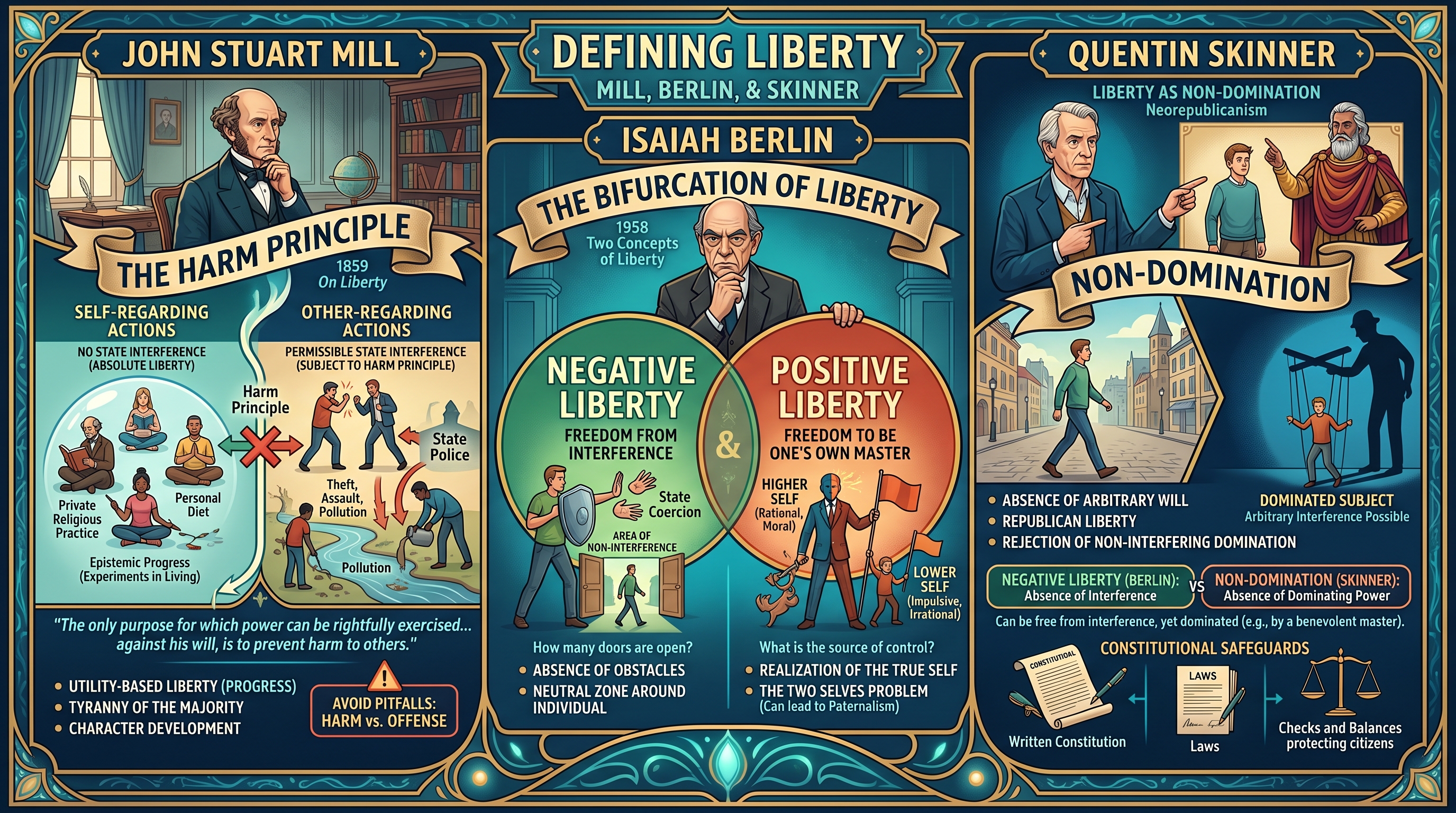
In his seminal 1859 work On Liberty, John Stuart Mill sought to establish a "one very simple principle" to govern the dealings of society with the individual in the way of compulsion and control. Mill’s project was a response to the "tyranny of the majority," a phenomenon where social and political pressure could stifle individual genius and autonomy.
The Harm Principle: Definition and Derivation
Mill’s central thesis, known as the Harm Principle, serves as the foundational axiom of modern liberalism.
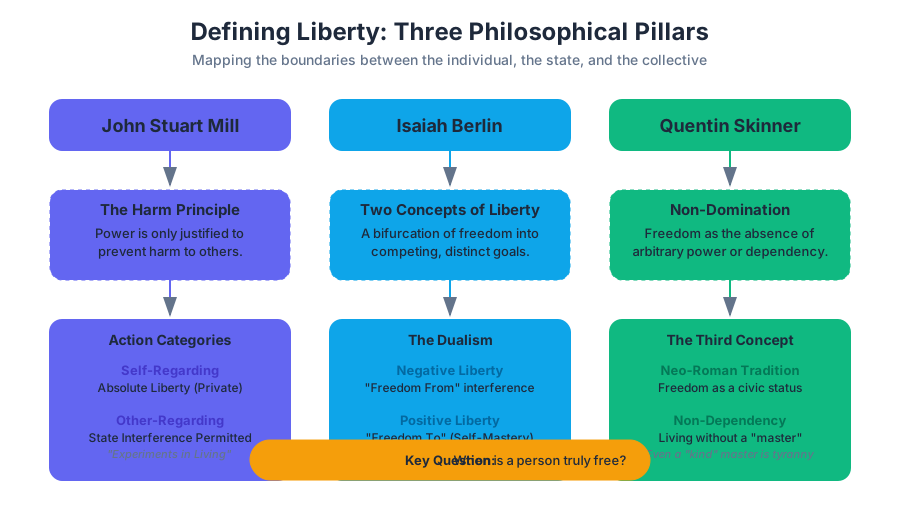
"The only purpose for which power can be rightfully exercised over any member of a civilized community, against his will, is to prevent harm to others. His own good, either physical or moral, is not a sufficient warrant."
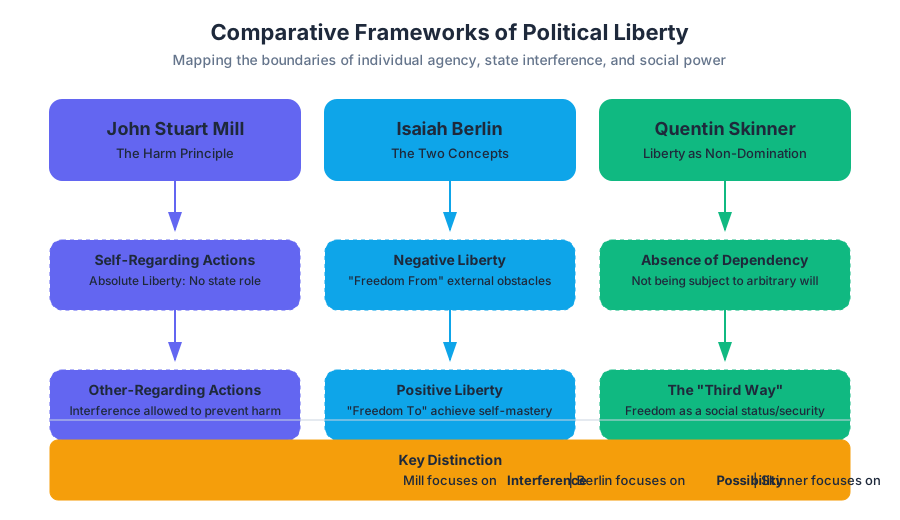
For Mill, liberty is defined by the absence of coercion regarding self-regarding actions. Coercion is only permissible for other-regarding actions that cause demonstrable harm.
| Category | Definition | Permissibility of State Interference |
|---|---|---|
| Self-Regarding | Actions that affect only the actor (e.g., private religious practice, personal diet). | Never (Absolute Liberty) |
| Other-Regarding | Actions that affect the interests or rights of others (e.g., theft, assault, pollution). | Permissible (Subject to the Harm Principle) |
| Paternalism | Intervening for the individual's "own good" (e.g., seatbelt laws, drug bans). | Prohibited (According to Mill) |
How it Works: The Utility of Liberty
Mill does not argue for liberty as an "abstract right." Instead, he derives it from Utilitarianism. He argues that liberty is "the permanent interests of man as a progressive being." By allowing individuals to engage in "experiments in living," society discovers better ways of life and avoids the stagnation of custom.
- Epistemic Progress: If we silence an opinion, we may be silencing the truth. Even if the opinion is false, the struggle with error clarifies the truth.
- Character Development: Autonomy is a "muscle." If the state makes all decisions for the individual, the individual’s mental and moral powers atrophy.
- The Limit of Harm: "Harm" must be more than mere offense. If my neighbor's religious practice offends me, that is not "harm" in the Millian sense; it is a "displeasure" that does not violate a distinct and assignable obligation.
Common Pitfalls: The "Harm" Ambiguity
A frequent mistake in applying Mill is failing to define "harm" strictly. If "harm" is expanded to include "psychological distress" or "economic competition," the Harm Principle collapses, as almost every action could be seen as harming someone. Mill insists on a distinction between harm (violation of a right or interest) and offense (unpleasant feelings).
Isaiah Berlin: The Bifurcation of Liberty
In his 1958 lecture Two Concepts of Liberty, Isaiah Berlin introduced a distinction that redefined 20th-century political thought. He argued that "liberty" actually refers to two different, and often incompatible, goals: Negative Liberty and Positive Liberty.
Negative Liberty: The "Freedom From"
Negative Liberty is the answer to the question: "What is the area within which the subject—a person or group of persons—is or should be left to do or be what he is able to do or be, without interference by other persons?"
- Mechanics: It is a measure of the absence of obstacles. If
xis prevented byyfrom doingz,xlacks negative liberty. - The "Area" Metaphor: Berlin imagines a "neutral zone" around the individual where the state cannot enter. The wider this zone, the more negative liberty one possesses.
Positive Liberty: The "Freedom To"
Positive Liberty answers the question: "What, or who, is the source of control or interference that can determine someone to do, or be, this rather than that?"
- Mechanics: It is the wish on the part of the individual to be his own master. It involves the "realization" of one's true self.
- The "Two Selves" Problem: Positive liberty often relies on a distinction between a "higher" self (rational, moral) and a "lower" self (impulsive, irrational).
| Feature | Negative Liberty | Positive Liberty |
|---|---|---|
| Core Question | How many doors are open to me? | Who is the master? |
| Focus | Absence of interference | Presence of self-control/autonomy |
| Risk | Social atomization / Indifference | Totalitarianism (forcing one to be "free") |
| Key Proponents | Mill, Bentham, Hobbes | Rousseau, Hegel, Marx |
The Perversion of Positive Liberty
Berlin’s primary concern was the "slippery slope" of positive liberty. If we define freedom as "obeying one's rational self," then a state might claim that by coercing you to act rationally (e.g., forcing you to join a revolution or follow a specific religion), it is actually making you "free." This logic was used by 20th-century totalitarian regimes to justify oppression in the name of "true" liberation.
Quentin Skinner: Liberty as Non-Domination
In the late 20th century, Quentin Skinner (and Philip Pettit) argued that Berlin’s dichotomy was incomplete. They proposed a Third Concept of Liberty, rooted in the "Neo-Roman" or Republican tradition: Liberty as Non-Domination.
The "Slave with a Kind Master" Thought Experiment
To understand Skinner, consider a slave whose master is exceptionally kind and never interferes with the slave’s actions. The master allows the slave to go where he wants, marry whom he likes, and keep his earnings.
- According to Berlin (Negative Liberty): The slave is free because there is no interference.
- According to Skinner: The slave is unfree because he lives at the mercy of the master. The master could interfere at any moment.
Definition of Non-Domination
Non-domination is the absence of dependence on the arbitrary will of another.
Liberty is not just the absence of interference (Negative) or the presence of self-mastery (Positive); it is the security of one's status as a free citizen who cannot be interfered with at the whim of a superior.
Comparison of Interference vs. Domination
| Scenario | Interference? | Domination? | Status of Liberty |
|---|---|---|---|
| The Kind Master | No | Yes | Unfree (Dependent) |
| Fair Law Enforcement | Yes | No | Free (Non-arbitrary interference) |
| The Tyrant | Yes | Yes | Unfree (Oppressed) |
| The Independent Citizen | No | No | Free (Ideal) |
Why it Matters: The Republican Ideal
Skinner’s view emphasizes that a person is only free in a "free state"—a community where the laws are not arbitrary and where no individual or group has the power to interfere with others without accountability. This shifts the focus from "individual rights" to "civic participation" and the "rule of law."
Synthesis: Enlightenment, Public Freedom, and Resistance
The theoretical frameworks of Mill, Berlin, and Skinner provide the tools to analyze the historical and literary accounts of freedom found in the works of Kant, Arendt, and Nafisi.
Immanuel Kant and the "Exit from Immaturity"
Kant’s definition of Enlightenment as "man's emergence from his self-incurred immaturity" is a classic expression of Positive Liberty. Immaturity is the inability to use one's understanding without guidance from another. For Kant, the "motto" of enlightenment is Sapere aude! (Dare to know!). This requires a specific kind of liberty: the public use of reason.
Hannah Arendt: The "Lost Treasure" of Public Freedom
In the supplementary materials, Arendt discusses the résistance in France and the "lost treasure" of revolution. For Arendt, freedom is not a private phenomenon (Negative Liberty) but a public action.
- Public Freedom: The ability to be a "participator in government" and to begin something new (natality).
- The Gap between Past and Future: Arendt argues that in times of crisis (like the collapse of France in 1940), the "testament" of tradition is broken. In this gap, individuals are forced to discover freedom through action and speech in the public sphere.
Azar Nafisi: The Republic of the Imagination
In Reading Lolita in Tehran, Nafisi illustrates the struggle for liberty under a totalitarian regime that seeks to control both the negative and positive dimensions of freedom.
- Resistance as Liberty: When the state dictates every aspect of public life, the act of reading forbidden literature becomes an assertion of Non-domination.
- The Private vs. Public: Nafisi’s students create a "Republic of the Imagination," a space where they can exercise their "higher selves" (Positive Liberty) despite the total interference of the state (Lack of Negative Liberty).
Summary of Theoretical Frameworks
| Philosopher | Key Term | Definition of Unfreedom | Goal of Society |
|---|---|---|---|
| Mill | Harm Principle | Coercion in self-regarding matters. | Maximize utility through individual autonomy. |
| Berlin | Negative Liberty | Physical or legal barriers to action. | Protect a private sphere from state overreach. |
| Berlin | Positive Liberty | Subjection to impulses or "lower" self. | Achieve self-realization (risks totalitarianism). |
| Skinner | Non-domination | Dependence on an arbitrary will. | Ensure no citizen is "at the mercy" of another. |
| Arendt | Public Freedom | Exclusion from the public realm/action. | Create a space for "beginning" and political speech. |
Concrete Example: The Case of "Mandatory Seatbelts"
- Mill's Analysis: This is "paternalism." Unless not wearing a seatbelt harms others (e.g., increasing insurance premiums for everyone), the state has no right to mandate it. It is a violation of liberty.
- Berlin (Negative): A seatbelt law is a clear interference. It reduces the "area" of non-interference. It is a loss of negative liberty.
- Berlin (Positive): The "rational self" wants to live. By forcing the "impulsive self" to wear a seatbelt, the state is helping the individual achieve their true goal (survival). This is an exercise of positive liberty.
- Skinner: Is the law arbitrary? If the law was passed through a democratic process with clear rules and oversight, it is not "domination," even if it is "interference." The citizen remains free because they are not subject to a whim, but to a settled law.
Study Guide: Defining Liberty
I. Core Definitions
- Negative Liberty: Freedom from interference. It is the size of the "unobstructed" space an individual possesses. (Berlin)
- Positive Liberty: Freedom to be one's own master. It involves self-realization and the triumph of the "rational" self over "baser" instincts. (Berlin)
- The Harm Principle: The state may only interfere with an individual's liberty to prevent harm to others. (Mill)
- Non-domination: The absence of dependence on the arbitrary will of another. You are free if no one could interfere with you at their whim. (Skinner)
II. Key Distinctions
- Self-regarding vs. Other-regarding: Mill's boundary for state intervention.
- Interference vs. Domination: You can have interference without domination (fair laws) and domination without interference (the kind master).
- Public vs. Private Freedom: Arendt's focus on freedom as "action" in the public square versus the liberal focus on "rights" in the private sphere.
III. Critical Debates
- The Danger of Positive Liberty: Why did Berlin fear that "self-mastery" leads to the guillotine? (The "Two Selves" problem).
- The Definition of Harm: How does Mill distinguish between "harm" and "offense"? Why is this distinction vital for a free society?
- The Status of the Slave: Why does Skinner argue that a slave with a kind master is still unfree?
IV. Historical/Literary Context
- Kant: Enlightenment as the courage to use one's own reason.
- Arendt: The "lost treasure" of the revolutionary spirit and the importance of the "gap" between past and future.
- Nafisi: The use of literature and the "imagination" as a site of resistance against totalitarian control.
V. Application Checklist
When analyzing a policy or situation, ask:
- Is there physical or legal interference? (Negative Liberty)
- Does the individual have the capacity for self-direction? (Positive Liberty)
- Is the power being exercised over them arbitrary or accountable? (Non-domination)
- Does the action harm a "distinct and assignable obligation" to others? (Harm Principle)
Source Materials
- J._S._Mill's_on_Liberty_in_Focus_----_(JOHN_STUART_MILL_AND_ISAIAH_BERLIN_THE_ENDS_OF_LIFE_AND_THE_PRELIMINAR...).pdf
- J._S._Mill's_on_Liberty_in_Focus_----_(JOHN_STUART_MILL_AND_ISAIAH_BERLIN_THE_ENDS_OF_LIFE_AND_THE_PRELIMINAR...).pdf
- Berlin and Mill Feb 23 2026.pptx
- Berlin and Mill Feb 23 2026.pptx
- Berlin - Two Concepts of Liberty.pdf
- Quentin Skinner · A Third Concept of Liberty_ Living in Servitude.pdf
- Berlin - Two Concepts of Liberty.pdf
- Quentin Skinner · A Third Concept of Liberty_ Living in Servitude.pdf
Study Philosophical and Literary Perspectives on Freedom on Lykke
This course page is free to open: signed out, you can read its first two sections, and signing in, on any plan, opens the rest. The free Lykke Chrome extension syncs your own Canvas courses, so ChatGPT, Claude and Muse can answer from your classes and deadlines. It only reads Canvas.
Add the free extensionSign in to open every sectionAll sections of Philosophical and Literary Perspectives on Freedom · Browse more course pages