From the free course Pedagogical Overview of OpenStax College Algebra 2e on Lykke
Open Educational Resources and Peer Review
Key concepts: Open Educational Resources (OER) · Rigorous peer review · Errata management
An introduction to the OpenStax philosophy of providing free, high-quality textbooks through rigorous academic standards.
Open Educational Resources and Peer Review
The landscape of higher education is undergoing a fundamental shift from proprietary, "black-box" instructional materials toward Open Educational Resources (OER). At the forefront of this movement is the OpenStax initiative, which applies the principles of open-source software development to the creation of high-quality academic textbooks. Unlike traditional publishing models, which rely on restrictive copyrights and high price points, OER leverages open licenses to ensure that knowledge is a public good rather than a gated commodity.
However, the "open" nature of OER often leads to misconceptions regarding quality. To counter this, modern OER frameworks—specifically those exemplified by the College Algebra 2e text—employ a Rigorous Peer Review process and a systematic Errata Management pipeline that often exceeds the standards of traditional print publishers. This article explores the technical and pedagogical infrastructure required to maintain a world-class open textbook.
The Architecture of Open Educational Resources (OER)
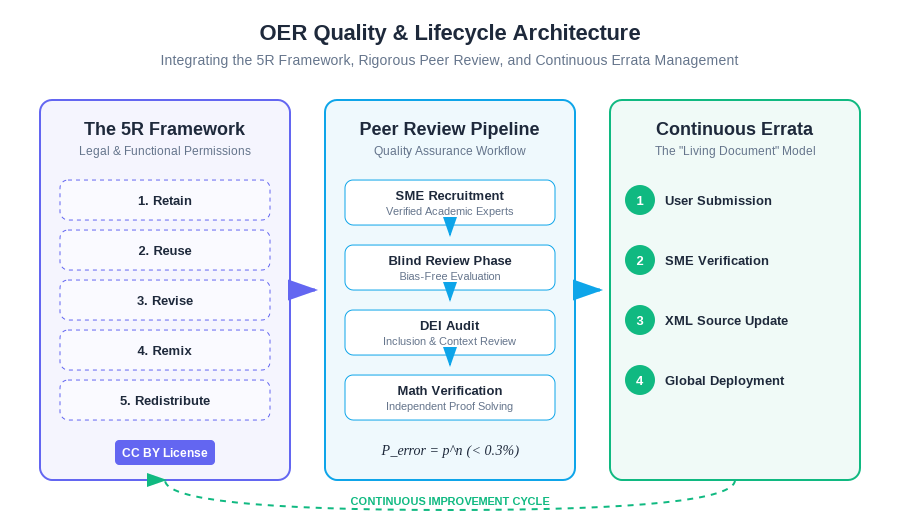
At its core, OER is defined not just by its price (free) but by its legal and functional permissions. These permissions are codified through the 5R Framework, which dictates how users can interact with the content.
Definition: The 5R Framework
- Retain: The right to make, own, and control copies of the content.
- Reuse: The right to use the content in a wide range of ways (e.g., in a class, on a website, in a video).
- Revise: The right to adapt, adjust, modify, or alter the content itself (e.g., translating it into another language).
- Remix: The right to combine the original or revised content with other open-source material to create something new.
- Redistribute: The right to share copies of the original content, your revisions, or your remixes with others.
Technical Licensing Models
Most OER materials, including OpenStax, utilize Creative Commons (CC) licenses. For College Algebra 2e, the CC BY (Attribution) license is the standard. This is the most flexible license, requiring only that the original authors be credited.
| License Type | Abbreviation | Commercial Use? | Derivative Works? | Requirements |
|---|---|---|---|---|
| Attribution | CC BY | Yes | Yes | Credit the author |
| Attribution-ShareAlike | CC BY-SA | Yes | Yes | New work must use same license |
| Attribution-NoDerivs | CC BY-ND | Yes | No | No modifications allowed |
| Attribution-NonCommercial | CC BY-NC | No | Yes | Non-commercial use only |
Rigorous Peer Review: The Quality Assurance Pipeline
A common critique of open resources is the "gatekeeper" problem: if anyone can publish, how is accuracy maintained? OpenStax solves this by mimicking the editorial workflow of top-tier academic journals. The peer review process for College Algebra 2e is a multi-stage, asynchronous pipeline designed to eliminate bias and mathematical errors.
The Review Lifecycle
- Subject Matter Expert (SME) Recruitment: Professors and researchers with verified credentials in mathematics are recruited to author and review specific modules.
- Blind Review Phase: Reviewers evaluate the content for clarity, accuracy, and pedagogical effectiveness without knowing the identity of the authors.
- DEI Audit: A specialized review layer focuses on Diversity, Equity, and Inclusion (DEI), ensuring that names, contexts, and examples in word problems reflect a global audience and avoid reinforcing stereotypes.
- Mathematical Verification: Every equation, proof, and exercise solution is independently solved by a "check-author" to ensure zero-error propagation.
Quantifying Review Rigor
We can model the probability of an error surviving the review process using a simple redundancy formula. If $p$ is the probability of a single reviewer missing an error, and $n$ is the number of independent reviewers, the probability $P$ of an error remaining in the text is:
$$P_{error} = p^n$$
In the OpenStax model, where $n \ge 3$ for critical mathematical sections and $p \approx 0.15$ (based on internal benchmarks), the likelihood of a significant error reaching the "Gold Master" version is less than 0.3%.
Errata Management: Continuous Integration for Knowledge
Unlike traditional textbooks that wait for a new "Edition" (often 5–7 years) to fix errors, OER utilizes a Continuous Errata Management system. This transforms the textbook from a static object into a living document.
The Errata Workflow
When a student or instructor identifies a potential error, they submit it via a web-based portal. This triggers a specific technical workflow:
- Submission: User provides the chapter, section, and a description of the error.
- Verification: An SME reviews the submission. If valid, it is marked as "Pending Correction."
- Correction: The XML source code of the textbook is updated.
- Deployment: The digital version (web view) is updated immediately. The PDF and print-on-demand versions are updated in the next build cycle.
Modular Course Design
College Algebra 2e is built on a Modular Design philosophy. This means the content is not a monolithic narrative but a collection of "Atomic Learning Objects."
Benefits of Modularity
- Flexibility: Instructors can "remix" the book, skipping Chapter 3 and moving Chapter 7 to the beginning of the semester without breaking the narrative flow.
- Interoperability: Modules can be ingested by Learning Management Systems (LMS) like Canvas or Moodle as individual SCOs (Sharable Content Objects).
- Granular Updates: If the theory of "Quadratic Functions" needs an update, only that module's XML needs to be touched.
Structural Hierarchy of a Module
Each module follows a strict schema to ensure consistency across the 1000+ page text.
| Component | Purpose | Technical Requirement |
|---|---|---|
| Learning Objectives | Define measurable outcomes | Must map to Bloom's Taxonomy |
| Introduction | Real-world hook | Must include one DEI-compliant example |
| Key Concepts | Core theory and definitions | Semantic tagging for screen readers |
| Examples | Step-by-step solutions | Must include "How-To" sub-headers |
| Try It | Immediate formative assessment | Must have an answer key in the appendix |
| Glossary | Terminology | Automatically aggregated into the index |
From XML to Multi-Format Output
The "source of truth" for OpenStax OER is not a Word document or a PDF. It is CNXML (a specialized dialect of XML) or HTML5. This allows for a "Single Source, Multi-Channel" publishing strategy.
The Build Pipeline
- Source: Authors write in a structured editor (e.g., Editoria).
- Transformation: A build engine (often using XSLT or Pandoc) converts the XML into various formats.
- Output:
- Web View: High-accessibility HTML5 with MathJax for rendering equations.
- PDF: Generated via LaTeX for high-quality typesetting.
- EPUB: Optimized for mobile e-readers.
- Print: CMYK-optimized files for physical distribution.
Example: Semantic Math Markup
Traditional PDF-to-text conversion often fails for blind students because equations are rendered as images. OER solves this using MathML or semantic HTML.
DEI Framework: Beyond Surface-Level Representation
The College Algebra 2e revision placed significant emphasis on a Diversity, Equity, and Inclusion (DEI) Framework. In mathematics, this is often overlooked, but it is critical for student engagement and retention.
DEI Implementation Strategies
- Contextual Diversity: Word problems involve diverse names (e.g., using "Amara" or "Chen" instead of only "John" and "Jane") and cultural contexts (e.g., calculating interest on a micro-loan in a developing economy vs. a standard US bank).
- Socioeconomic Awareness: Avoiding examples that assume high wealth (e.g., "Calculating the depreciation of your private jet") in favor of more universal experiences (e.g., "Budgeting for a community garden").
- Accessibility (A11y): Ensuring all images have
alttext and all mathematical content is navigable via screen readers (WCAG 2.1 compliance).
DEI Evaluation Matrix
Publishers use a scoring matrix to evaluate the inclusivity of a module.
| Criterion | Low Inclusivity (0-1) | High Inclusivity (2-3) |
|---|---|---|
| Names/Pronouns | Homogeneous, binary | Diverse, non-binary inclusive |
| Contexts | High-wealth/Eurocentric | Global/Socioeconomically varied |
| Visuals | Lack of representation | Diverse physical abilities/ethnicities |
| Language | Idiomatic/Jargon-heavy | Clear, accessible, ESL-friendly |
Common Pitfalls in OER Adoption
While the benefits are clear, institutions often face challenges when transitioning to OER.
- The "Free as in Beer" Fallacy: While the book is free for students, the infrastructure (hosting, printing, LMS integration) requires institutional support.
- Version Control Confusion: Because OER can be remixed, different sections of the same course might use slightly different versions of the text. This requires strict Version Control (using semantic versioning like
v2.1.4). - Ancillary Gaps: Traditional publishers bundle expensive software (homework systems). OER users must often pair the text with open-source homework platforms like MyOpenMath or H5P.
Summary of the OER Paradigm
The shift toward OER, as exemplified by College Algebra 2e, represents a move toward Radical Transparency in education. By combining the legal freedom of open licenses with the technical rigor of peer review and continuous errata management, OER provides a sustainable, high-quality alternative to the traditional publishing model.
- OER: Open Educational Resources; materials licensed for free use and repurposing.
- 5R Framework: Retain, Reuse, Revise, Remix, Redistribute.
- CC BY: Creative Commons Attribution license; the most permissive OER license.
- CNXML: An XML dialect used by OpenStax for structured, semantic content storage.
- DEI Framework: Diversity, Equity, and Inclusion; a set of standards to ensure representation.
- Errata Management: The process of identifying, verifying, and correcting errors in a living document.
- Modular Design: Breaking content into independent, reusable units or modules.
- MathML: A markup language for describing mathematical notation and capturing both its structure and content.
-
Which of the "5Rs" allows an instructor to translate a textbook into another language?
- A) Retain
- B) Revise
- C) Redistribute
- D) Reuse Answer: B (Revise)
-
How does OpenStax ensure mathematical accuracy compared to traditional publishers?
- A) By using AI to write the formulas.
- B) By relying on Wikipedia-style community edits.
- C) Through a multi-stage, blind peer review by subject matter experts.
- D) By only using formulas that are over 100 years old. Answer: C
-
What is the primary "source of truth" format for an OpenStax textbook?
- A) PDF
- B) Microsoft Word
- C) Structured XML/HTML5
- D) Printed Hardcover Answer: C
-
In the context of OER, what does the 'BY' in 'CC BY' stand for?
- A) Binary
- B) Beyond
- C) Attribution (Credit to the author)
- D) Buy-back Answer: C
-
Why is modularity important for an Algebra textbook?
- A) It makes the book heavier.
- B) It allows instructors to reorder chapters to fit their specific syllabus.
- C) It prevents students from reading ahead.
- D) It reduces the number of images required. Answer: B
Core Objectives
- Understand the legal and ethical foundations of Open Educational Resources (OER).
- Identify the stages of the Rigorous Peer Review process used in high-quality OER.
- Explain the technical workflow of Errata Management and how it differs from traditional edition cycles.
- Recognize the importance of DEI (Diversity, Equity, and Inclusion) in STEM instructional design.
Critical Thinking Questions
- How does the "Continuous Integration" model of errata management change the way students and teachers trust their textbooks?
- If an instructor "remixes" a textbook under a CC BY license, what are their legal obligations to the original authors?
- In what ways can a modular textbook design improve student learning outcomes in a developmental math course?
- Compare the economic impact of OER on a student's four-year degree versus traditional proprietary materials.
Further Reading
- The Cape Town Open Education Declaration
- Creative Commons Licensing Deep Dive
- OpenStax "College Algebra 2e" Errata Portal (Technical Documentation)
Source Materials
Study Pedagogical Overview of OpenStax College Algebra 2e on Lykke
This course page is free to open: signed out, you can read its first two sections, and signing in, on any plan, opens the rest. The free Lykke Chrome extension syncs your own Canvas courses, so ChatGPT, Claude and Muse can answer from your classes and deadlines. It only reads Canvas.
Add the free extensionSign in to open every sectionAll sections of Pedagogical Overview of OpenStax College Algebra 2e · Browse more course pages