From the free course Pedagogical Overview of OpenStax College Algebra 2e on Lykke
Diversity, Equity, and Inclusion (DEI) Framework
Key concepts: Diversity, Equity, and Inclusion (DEI) framework · Inclusive pedagogy
An exploration of how the second edition incorporates DEI principles to create a more inclusive learning environment.
Diversity, Equity, and Inclusion (DEI) Framework
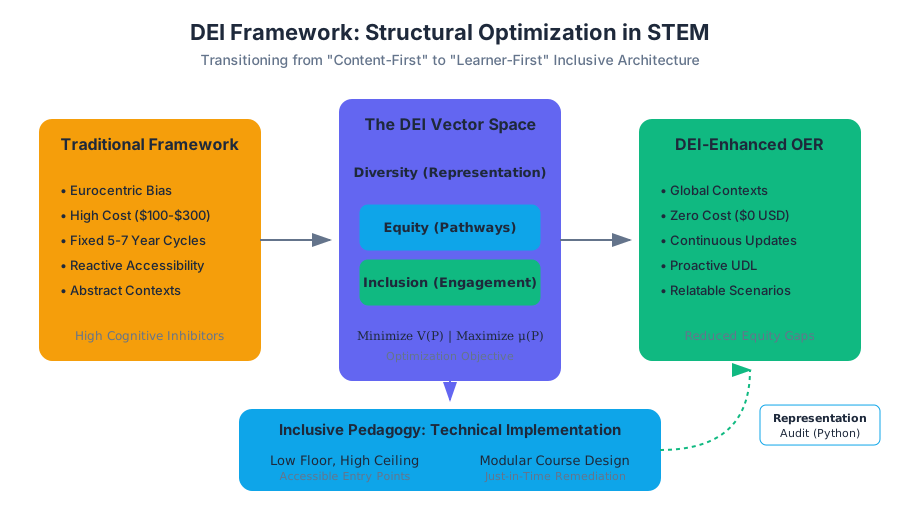
The institutionalization of Diversity, Equity, and Inclusion (DEI) within academic frameworks—particularly in STEM (Science, Technology, Engineering, and Mathematics) and Open Educational Resources (OER)—represents a fundamental shift from "content-first" to "learner-first" architecture. In the context of the College Algebra 2e revision, the DEI framework is not merely a set of cosmetic adjustments but a structural optimization designed to remove systemic barriers to information processing and retention.
By integrating inclusive pedagogy into the core modular design of mathematics, educators can mitigate "math anxiety" and "stereotype threat," which are known cognitive inhibitors. This article explores the technical implementation of DEI frameworks, the mechanics of inclusive pedagogy, and the data-driven approach to creating equitable learning environments.
The Core Pillars of the DEI Framework
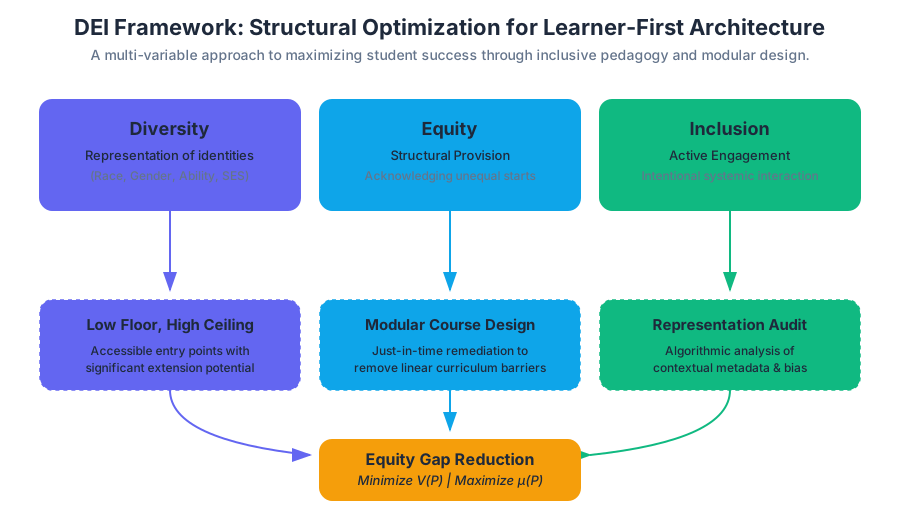
The DEI framework operates as a multi-variable optimization problem where the goal is to maximize student success across heterogeneous populations. It is defined by three distinct but interlocking vectors:
- Diversity: The quantitative and qualitative representation of different identities (race, gender, socioeconomic status, ability, and age) within the curriculum.
- Equity: The structural provision of resources and pathways that acknowledge unequal starting points, ensuring that the outcome of success is accessible to all.
- Inclusion: The active, intentional, and ongoing engagement with diversity in ways that increase awareness, content knowledge, and empathetic understanding of the complex ways individuals interact within systems.
Definition: The DEI Vector Space Let $S$ be the set of all students. A DEI-optimized framework $F$ seeks to minimize the variance in performance $V(P)$ across all subsets $s \subset S$ while maintaining a constant or increasing mean performance $\mu(P)$.
Comparison of Traditional vs. DEI-Enhanced Frameworks
| Feature | Traditional Framework | DEI-Enhanced Framework (OER) |
|---|---|---|
| Content Origin | Eurocentric, historical bias | Global, multi-contextual |
| Problem Context | Abstract or high-SES (e.g., stock portfolios) | Relatable, varied (e.g., community health, gig economy) |
| Accessibility | Post-hoc accommodation (reactive) | Universal Design for Learning (proactive) |
| Cost Barrier | High ($100-$300 USD per unit) | Zero ($0 USD via OER) |
| Feedback Loop | Fixed editions (5-7 year cycle) | Continuous errata and modular updates |
Inclusive Pedagogy: The Mechanics of Engagement
Inclusive pedagogy is the functional application of the DEI framework in the classroom and within the textbook's instructional design. It moves beyond "what" is taught to "how" it is taught, focusing on the cognitive load and the relational aspects of learning.
The "Low Floor, High Ceiling" Architecture
A key technical implementation of inclusive pedagogy is the Low Floor, High Ceiling (LFHC) task design.
- Low Floor: The entry point to a mathematical concept is accessible to all students, regardless of prior preparation.
- High Ceiling: The problem allows for significant extension and complexity, challenging high-performing students without alienating others.
Implementation via Modular Course Design
OpenStax's College Algebra 2e utilizes a modular design to support equity. By breaking down complex algebraic structures into discrete, independent modules, the framework allows for "just-in-time" remediation. If a student lacks the prerequisite knowledge for Logarithmic Functions, they can access the Exponential Growth module without the stigma of "falling behind" a linear curriculum.
Auditing for Representation
To ensure the DEI framework is rigorous, developers use algorithmic and manual audits to analyze the "contextual metadata" of word problems and examples. This involves parsing the text for names, locations, and scenarios to ensure they reflect a global demographic.
Mathematical Formalization of Equity Gaps
In a DEI framework, we often measure the Equity Gap (EG). This is the delta between the performance of the highest-performing demographic group and the lowest-performing group. The goal of inclusive pedagogy is to drive $EG \to 0$ without lowering the absolute performance threshold.
Mathematical Derivation of the Equity Index
\text{Let } G = \{g_1, g_2, \dots, g_n\} \text{ be the set of student demographic groups.}
\text{Let } \mu(g_i) \text{ be the mean score of group } g_i.

\text{The Equity Index (EI) is defined as:}
EI = 1 - \frac{\sigma(\mu(G))}{\mu_{total}}

\text{Where:}
\sigma(\mu(G)) = \sqrt{\frac{\sum_{i=1}^{n} (\mu(g_i) - \bar{\mu})^2}{n}}

\text{A value of } EI = 1 \text{ represents perfect equity across all groups.}
Modular Design and Errata Management
One of the most technically significant aspects of the College Algebra 2e DEI framework is its Errata Management System. Unlike traditional print media, OER allows for "hot-patching" content. If a community member identifies a problem context that is exclusionary or mathematically imprecise, the modular nature of the content allows for a surgical update.
Comparison of Content Update Lifecycles
| Phase | Traditional Textbook | OER (College Algebra 2e) |
|---|---|---|
| Detection | Internal review only | Public "Report Errata" portal |
| Verification | Subject Matter Expert (SME) | Peer-review + Open community |
| Deployment | Next physical printing (years) | Digital update (weeks/months) |
| Cost to User | Purchase of new edition | Free automatic update |
Common Pitfalls in DEI Implementation
Even with a robust framework, several pitfalls can undermine the effectiveness of DEI initiatives in STEM:
- Tokenism: Simply changing names (e.g., changing "Bob" to "Amir") without changing the underlying context or complexity of the problem. True inclusion requires diversifying the scenarios themselves (e.g., modeling the spread of a virus in a rural village vs. a suburban city).
- Cognitive Overload: Introducing too much social context can sometimes distract from the mathematical objective. The DEI framework must balance "real-world relatability" with "mathematical clarity."
- The Rigor Fallacy: The misconception that making a course more inclusive or accessible somehow "waters down" the mathematics. On the contrary, removing barriers allows for more rigorous engagement by a broader range of minds.
"Inclusion is not the sacrifice of standards; it is the expansion of the standard to include the full spectrum of human potential."
Case Study: The "Personal Finance" Module Shift
In College Algebra 1e, many interest-rate problems focused on high-end investments or complex stock portfolios. In 2e, the DEI framework shifted these contexts to include:
- Micro-loans for small businesses in developing economies.
- Student loan interest calculations.
- Community savings circles (Tandas or Susus).
This shift didn't change the formula $A = P(1 + \frac{r}{n})^{nt}$, but it changed the student's relationship to the formula. By seeing their own financial realities reflected, the "affective filter" (the emotional barrier to learning) is lowered, allowing the cognitive processes to function more efficiently.
Summary of DEI Impact Metrics
To validate the framework, OpenStax and similar OER providers track specific Key Performance Indicators (KPIs).
| Metric | Definition | DEI Goal |
|---|---|---|
| DFW Rate | Percentage of students who receive a grade of D, F, or Withdraw. | Minimize the gap in DFW rates between demographic groups. |
| Sense of Belonging | Qualitative survey data regarding student comfort in the course. | Increase scores across underrepresented minorities (URM). |
| Persistence | The rate at which students move from Algebra to Calculus. | Normalize persistence rates across all socioeconomic tiers. |
| OER Adoption | Number of institutions switching from paid to free materials. | Maximize adoption in Title I and community colleges. |
Conclusion
The DEI framework in College Algebra 2e is a sophisticated integration of social justice and instructional design. By leveraging the modularity of OER, the precision of data-driven audits, and the empathy of inclusive pedagogy, the framework transforms the textbook from a static repository of facts into a dynamic, equitable engine for social mobility. The technical rigor of the mathematics is not compromised but is instead reinforced by a structure that ensures every student, regardless of background, has the "modular" support necessary to master the complexities of algebra.
Source Materials
Study Pedagogical Overview of OpenStax College Algebra 2e on Lykke
This course page is free to open: signed out, you can read its first two sections, and signing in, on any plan, opens the rest. The free Lykke Chrome extension syncs your own Canvas courses, so ChatGPT, Claude and Muse can answer from your classes and deadlines. It only reads Canvas.
Add the free extensionSign in to open every sectionAll sections of Pedagogical Overview of OpenStax College Algebra 2e · Browse more course pages