From the free course Pedagogical Overview of OpenStax College Algebra 2e on Lykke
Conceptual Algebra and Practical Application
Key concepts: Conceptual explanations · Practical application
The core mathematical focus of the course, emphasizing the 'why' behind the math and how it applies to the real world.
Conceptual Algebra and Practical Application
Algebra is often mischaracterized as a mere collection of rules for manipulating symbols. In a rigorous academic context, specifically within the framework of modern Open Educational Resources (OER) like the OpenStax College Algebra 2e curriculum, algebra is redefined as the study of mathematical structures and the logic of relationships. This section explores the transition from procedural fluency—simply "doing" the math—to conceptual mastery and its subsequent application in complex, real-world systems.
The Philosophy of Conceptual Algebra
At its core, Conceptual Algebra prioritizes the why over the how. While arithmetic deals with specific numbers, algebra introduces the variable, a placeholder that allows us to reason about generalities. This shift from the concrete to the abstract is the foundation of all higher-level STEM (Science, Technology, Engineering, and Mathematics) disciplines.
The Logic of Equality and Transformation
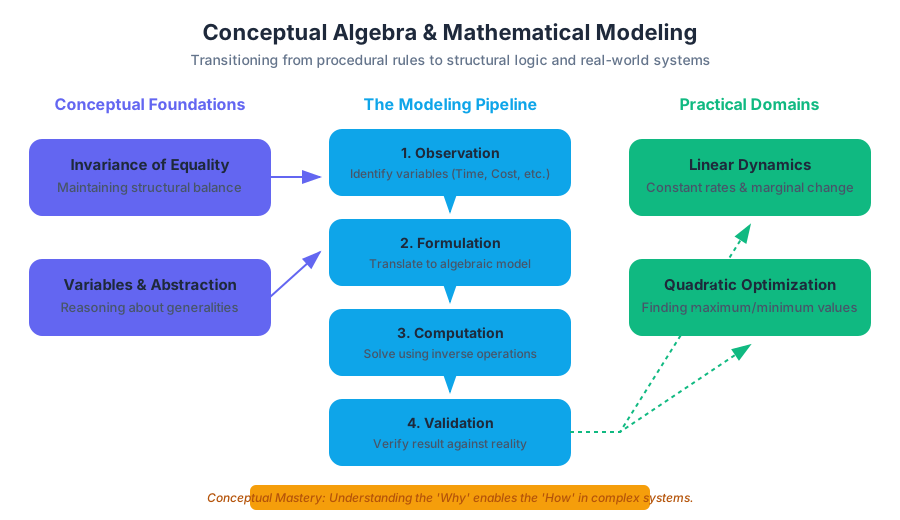
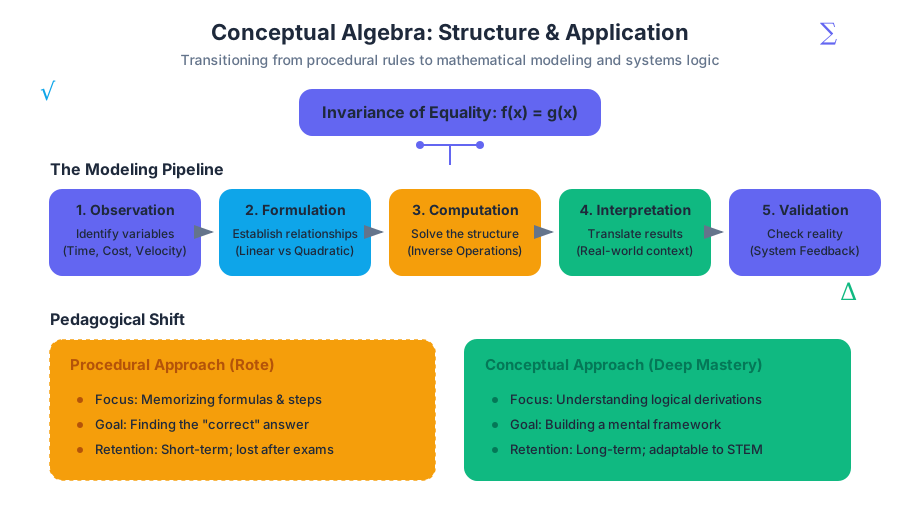
The fundamental principle of algebra is the Invariance of Equality. Any operation performed on one side of an equation must be mirrored on the other to maintain the structural integrity of the relationship. Conceptually, an equation is not a command to "find the answer," but a statement of balance.
The Structural Theorem of Algebra: An algebraic expression is a representation of a functional relationship where the output (dependent variable) is determined by a set of operations applied to an input (independent variable). Solving an equation is the process of reversing these operations through inverse functions to isolate the identity of the input.
Procedural vs. Conceptual Learning
The following table contrasts the traditional "rote" approach with the "conceptual" approach emphasized in modern pedagogy.
| Feature | Procedural Approach (Rote) | Conceptual Approach (DeepWiki) |
|---|---|---|
| Focus | Memorizing formulas (e.g., $x = \frac{-b \pm \sqrt{b^2-4ac}}{2a}$) | Understanding the derivation (Completing the square) |
| Problem Solving | Matching "types" of problems to "steps" | Deconstructing the problem into a mathematical model |
| Retention | Short-term; lost after the exam | Long-term; forms a mental framework for new logic |
| Application | Limited to textbook word problems | Adaptable to engineering, finance, and data science |
Mathematical Modeling and Practical Application
The ultimate goal of algebra is Mathematical Modeling: the process of translating a real-world phenomenon into a set of algebraic expressions. This allows us to make predictions, optimize systems, and understand the limits of physical and economic processes.
The Modeling Pipeline
- Observation: Identifying variables (e.g., time, cost, velocity).
- Formulation: Establishing the relationship (Linear, Quadratic, Exponential).
- Computation: Solving the resulting algebraic structure.
- Interpretation: Translating the numerical result back into the real-world context.
- Validation: Checking if the result aligns with observed reality.
Linear Relationships and Rate of Change
Linear algebra (in the context of college algebra) focuses on relationships with a constant rate of change. This is the simplest form of modeling but remains the most widely used in fields like economics (marginal cost) and physics (uniform motion).
The Concept of Slope as a Derivative
In conceptual algebra, the slope $m$ is not just "rise over run"; it is the marginal change. It represents how much the dependent variable $y$ changes for every single unit increase in the independent variable $x$.
f(x) = mx + b
\text{where } m = \lim_{\Delta x \to 0} \frac{\Delta y}{\Delta x}
In a practical sense, if $x$ represents "hours worked" and $y$ represents "total production," $m$ is the productivity rate.
Quadratic Dynamics and Optimization
While linear models assume a constant rate of change, Quadratic Functions introduce acceleration. In the real world, quadratics govern the path of projectiles, the shape of satellite dishes, and the optimization of profit in business.
The Vertex and Optimization
The Vertex of a parabola $(h, k)$ represents the maximum or minimum value of a function. In business algebra, if the function represents "Profit vs. Price," the vertex provides the "Optimal Price" to maximize revenue.
Derivation of the Quadratic Formula
To understand the conceptual root of the quadratic formula, one must master the technique of Completing the Square. This is the process of transforming a general polynomial into a perfect square trinomial.
% Derivation of the Quadratic Formula
1. Start with: ax^2 + bx + c = 0
2. Divide by a: x^2 + (b/a)x + (c/a) = 0
3. Move constant: x^2 + (b/a)x = -c/a
4. Add (b/2a)^2 to both sides: x^2 + (b/a)x + (b^2/4a^2) = (b^2/4a^2) - (c/a)
5. Factor left side: (x + b/2a)^2 = (b^2 - 4ac) / 4a^2
6. Take square root: x + b/2a = ±√(b^2 - 4ac) / 2a
7. Final result: x = (-b ± √(b^2 - 4ac)) / 2a
Exponential and Logarithmic Scaling
In finance and biology, change is often proportional to the current amount. This leads to Exponential Growth or Decay. The inverse of this relationship is the Logarithm, which is used to solve for time or rates within exponential models.
Applications of Logarithms
Logarithms are not just "math problems"; they are the basis for how we perceive the world. Many human senses (hearing, sight) are logarithmic.
| Scale | Application | Algebraic Basis |
|---|---|---|
| pH Scale | Chemistry (Acidity) | $pH = -\log[H^+]$ |
| Richter Scale | Seismology (Earthquakes) | $M = \log(A/A_0)$ |
| Decibels (dB) | Acoustics (Sound Intensity) | $L = 10 \cdot \log(I/I_0)$ |
| Compound Interest | Finance | $A = P(1 + r/n)^{nt}$ |
Systems of Equations and Matrix Algebra
When multiple constraints act on a single system, we use Systems of Equations. In engineering, this might represent the forces acting on a bridge; in economics, it represents the equilibrium between supply and demand.
The Intersection of Constraints
Conceptually, solving a system of two linear equations is finding the point in $N$-dimensional space where two hyperplanes intersect. If the lines are parallel, the system is Inconsistent (no solution). If they are identical, the system is Dependent (infinite solutions).
Modular Design and the OER Framework
The OpenStax College Algebra 2e curriculum utilizes a Modular Design. This is a structural choice that mirrors the "Object-Oriented" philosophy in software engineering. Each chapter is a self-contained module with specific prerequisites and learning outcomes.
Benefits of Modularity
- Flexibility: Instructors can reorder chapters to fit specific course durations (e.g., 10-week quarters vs. 15-week semesters).
- Scaffolding: Concepts are layered. You cannot master "Exponential Functions" (Module 6) without the "Functions" foundation (Module 3).
- Diversity, Equity, and Inclusion (DEI): Modular design allows for the integration of diverse perspectives and real-world examples that reflect a global student body, rather than a narrow, historical subset of mathematicians.
| Module Type | Focus | Key Outcome |
|---|---|---|
| Foundational | Prerequisites, Equations, Inequalities | Algebraic Fluency |
| Functional | Domain, Range, Transformations | Graphical Intuition |
| Advanced | Sequences, Series, Binomial Theorem | Pattern Recognition |
Common Pitfalls in Conceptual Algebra
Even senior engineers and students often stumble on specific "traps" where procedural habits override conceptual logic.
- The Freshmen's Dream: Mistakenly believing that $(a + b)^n = a^n + b^n$. Conceptually, this ignores the middle terms generated by the binomial expansion (the "cross-talk" between variables).
- Dividing by Zero (Variables): In the process of simplifying an equation like $x^2 = x$, dividing both sides by $x$ "kills" a valid solution ($x=0$). The conceptual approach is to set the equation to zero and factor: $x(x-1) = 0$.
- Logarithm Domain Errors: Forgetting that $\log(x)$ is only defined for $x > 0$. In practical modeling (like sound or chemistry), a negative result often indicates an impossible physical state.
- Misinterpreting Slope: Assuming a high slope always means "better." In a model of "Cost vs. Production," a high slope indicates inefficiency (high marginal cost).
Conclusion: The Synthesis of Theory and Practice
Conceptual algebra is the bridge between the abstract world of logic and the tangible world of application. By moving beyond the "plug-and-chug" mentality, students and professionals gain the ability to deconstruct complex problems into their constituent variables and relationships. Whether you are optimizing a neural network, calculating the trajectory of a spacecraft, or managing a diversified investment portfolio, the algebraic structures of balance, transformation, and rate of change remain the universal language of progress.
- Variable: A symbol used to represent an unknown or changing quantity in a mathematical expression.
- Function: A relationship where each input has exactly one output, often denoted as $f(x)$.
- Slope (m): The constant rate of change in a linear relationship; the ratio of the change in $y$ to the change in $x$.
- Vertex: The maximum or minimum point of a parabola, representing an optimal value in quadratic models.
- Logarithm: The inverse of an exponential function; the exponent to which a base must be raised to produce a given number.
- System of Equations: A set of two or more equations with the same variables, solved to find a common intersection point.
- Modular Design: A pedagogical approach where content is divided into independent, self-contained units for flexibility and clarity.
- Mathematical Modeling: The process of using algebraic structures to represent and solve real-world problems.
- Conceptual: Why is "Completing the Square" considered a more powerful conceptual tool than simply using the Quadratic Formula?
- Application: If a population grows by 5% every year, why is this modeled with an exponential function rather than a linear one?
- Logic: Explain why a system of two parallel lines has no solution in the context of "Intersection of Constraints."
- Optimization: In a quadratic profit model $P(x) = -2x^2 + 40x - 100$, what does the $x$-coordinate of the vertex represent in a business context?
- Transformation: How does adding a constant $k$ to the end of a function $f(x) + k$ differ conceptually from adding it inside the argument $f(x + k)$?
Key Formulas to Master:
- Linear: $y = mx + b$ (Slope-Intercept)
- Quadratic: $x = \frac{-b \pm \sqrt{b^2-4ac}}{2a}$ (Quadratic Formula)
- Exponential: $A = Pe^{rt}$ (Continuous Growth)
- Logarithmic: $\log_b(x) = y \iff b^y = x$ (Definition of Log)
Practice Strategy:
- Derive, Don't Just Memorize: Try to derive the vertex formula $h = -b/2a$ from the general quadratic form.
- Units Matter: In every word problem, track your units (e.g., $/year, meters/second). If the units don't balance, the algebra is wrong.
- Graphing Intuition: Use tools like Desmos or a graphing calculator to visualize how changing a single coefficient (like $a$ in $ax^2$) stretches or flips the entire model.
- Contextualize: Find one example in your current field (coding, nursing, business) where a rate of change determines a critical outcome.
Source Materials
Study Pedagogical Overview of OpenStax College Algebra 2e on Lykke
This course page is free to open: signed out, you can read its first two sections, and signing in, on any plan, opens the rest. The free Lykke Chrome extension syncs your own Canvas courses, so ChatGPT, Claude and Muse can answer from your classes and deadlines. It only reads Canvas.
Add the free extensionSign in to open every sectionAll sections of Pedagogical Overview of OpenStax College Algebra 2e · Browse more course pages