From the free course Online Writing Lab on Lykke
The Writing Process Overview
Key concepts: Recursive Writing Process · Slinky Metaphor · Non-linear Development · Iterative Stages
An introduction to writing as a recursive, non-linear journey involving creative and critical thinking.
The Writing Process Overview
Writing is frequently mischaracterized as a linear progression—a straight line beginning at a blank page and ending at a finished manuscript. In reality, expert-level composition is a non-linear, iterative process that functions as the tangible manifestation of complex creative and critical thinking. It is a recursive system where the writer moves through distinct phases, often looping back to earlier stages as new insights emerge or structural weaknesses are identified.
To master the writing process is to understand that writing is not merely a way to record thoughts, but a way to discover them. This section explores the architectural framework of writing, from the initial entropy of idea generation to the surgical precision of final editing.
The Recursive Writing Process: The Slinky Metaphor
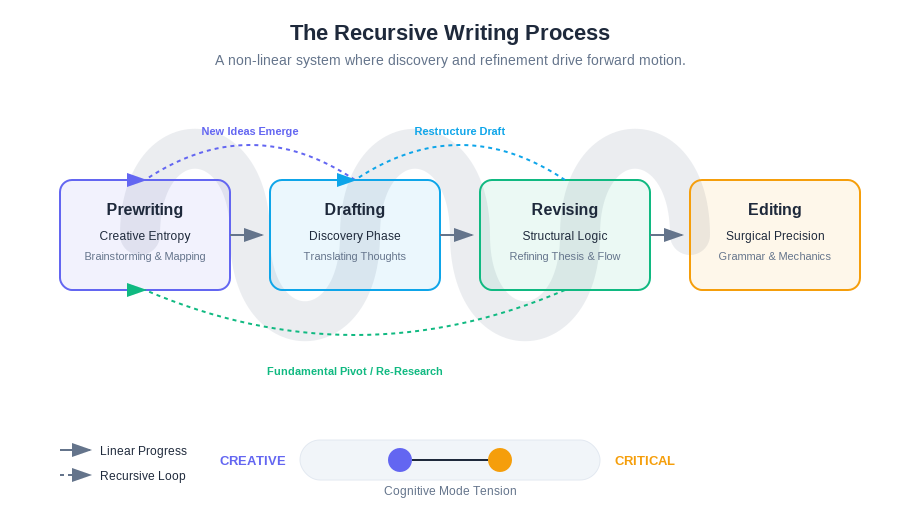
The most accurate model for modern composition is the Recursive Writing Process. Unlike a traditional "step-by-step" list, recursion implies that the output of one stage often becomes the input for a previous stage, creating a feedback loop.
The Slinky Metaphor
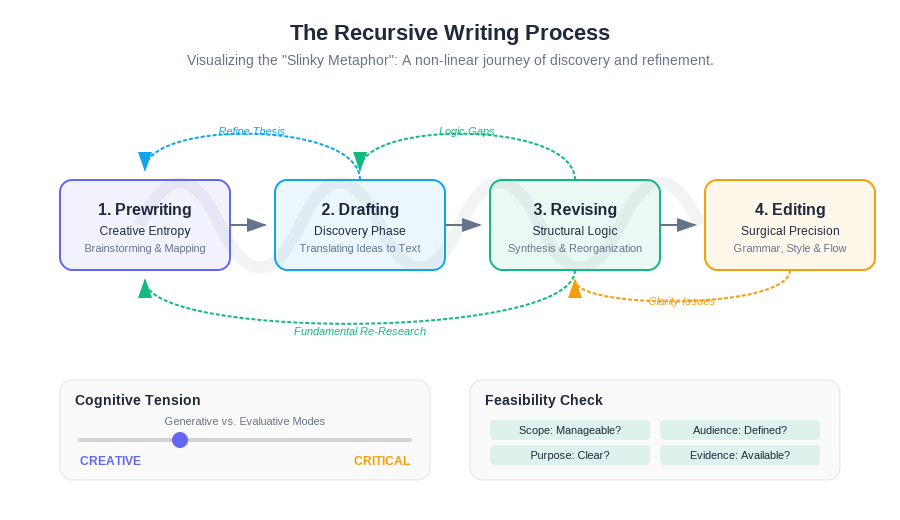
A useful pedagogical tool for visualizing this is the Slinky Metaphor. Consider a Slinky toy: it consists of a single, continuous wire coiled into many loops. When it "walks" down a flight of stairs, it moves forward, but it does so by flipping its coils back over themselves.
The Slinky Principle: Writing is a singular journey (the forward motion) composed of smaller, overlapping cycles (the coils). To move forward in a draft, a writer must frequently "loop back" to refine a thesis, re-research a point, or reorganize a paragraph.
Linear vs. Recursive Modeling
| Feature | Linear Model (Traditional) | Recursive Model (Modern) |
|---|---|---|
| Direction | Unidirectional ($A \to B \to C$) | Multidirectional/Cyclical |
| Error Handling | Correction occurs only at the end | Correction is continuous and formative |
| Idea Development | Static; ideas are fixed at the start | Dynamic; ideas evolve through the act of writing |
| Cognitive Load | High at the end (Editing) | Distributed throughout the process |
| Outcome | Often superficial or "filled in" | Deeply synthesized and structurally sound |
Phase 1: Developing Ideas and Creative Entropy
Before a single sentence is structured, a writer must engage in Idea Development. In an academic or professional context, this is the transition from "summary" to "original analysis." College-level writing, in particular, demands that the author contribute unique observations rather than merely aggregating existing data.
Prewriting Strategies
Prewriting is the "entropy" phase, where the goal is to generate a high volume of raw material without the interference of the "internal critic."
- Brainstorming: Rapid, non-judgmental listing of all possible angles on a topic.
- Mapping/Clustering: A visual representation of ideas showing how sub-concepts radiate from a central node.
- Journaling/Freewriting: Continuous writing for a set period to bypass cognitive blocks and reach deeper subconscious connections.
The Creative vs. Critical Tension
Writing requires a delicate balance between two cognitive modes:
- Creative Thinking: Generative, expansive, and messy. It prioritizes "what if" and "more."
- Critical Thinking: Evaluative, reductive, and precise. It prioritizes "so what" and "less."
To model this programmatically, we can view the writing process as a state machine where the transition between states is governed by the quality of the current output.
Phase 2: Narrowing the Topic and Feasibility Analysis
A common pitfall for novice writers is selecting a topic that is too broad, leading to a "mile wide and inch deep" analysis. Topic Narrowing is the process of defining a feasible scope that aligns with the assignment’s constraints (word count, audience, and purpose).
The Feasibility Matrix
When narrowing a topic, writers should evaluate their focus against four primary vectors:
| Vector | Requirement | Failure State (Too Broad) | Success State (Narrowed) |
|---|---|---|---|
| Scope | Can it be covered in $X$ pages? | "The History of Warfare" | "The use of longbows at the Battle of Agincourt" |
| Depth | Does it allow for original analysis? | "Global Warming is bad" | "The impact of permafrost melt on Arctic infrastructure" |
| Evidence | Are there specific sources available? | "The thoughts of prehistoric humans" | "Symbolic representation in Lascaux cave paintings" |
| Audience | Is the technical level appropriate? | "Quantum Mechanics" (for 5th graders) | "How magnets work using simple field lines" |
The Mathematical Derivation of Focus
We can represent the relationship between topic breadth ($B$) and analysis depth ($D$) as an inverse relationship relative to the total word count ($W$):
D \approx \frac{W}{B}
As $B$ (the number of sub-topics) increases, $D$ (the depth of analysis per sub-topic) must decrease to satisfy the constraint of $W$. To achieve "Expert-Level" depth ($D_{max}$), the writer must minimize $B$.
Phase 3: Gathering Information and the Hand Fan Analogy
Once a topic is narrowed, the writer enters the Information Gathering phase. This is not a passive collection of facts but a strategic search for evidence that supports or challenges the emerging thesis.
The Hand Fan Analogy
Imagine a folding hand fan.
- The Pivot Point: This is your narrowed topic. Everything must stay connected here.
- The Ribs: These are the primary lines of inquiry or sub-arguments.
- The Leaf (Fabric): This is the gathered information that spans between the ribs, creating a cohesive surface.
If the pivot point is too loose (a broad topic), the fan cannot provide structure. If the ribs are too far apart, the fabric (information) will tear, leaving gaps in the argument.
Academic Research Standards
| Source Type | Utility | Academic Weight |
|---|---|---|
| General Encyclopedias | Preliminary overview; finding keywords | Low (Do not cite) |
| Peer-Reviewed Journals | Primary evidence; current discourse | High |
| Monographs | Deep theoretical frameworks | High |
| Trade Publications | Industry-specific trends and data | Moderate |
| Primary Sources | Raw data, historical documents, interviews | Highest |
Phase 4: Ordering and Drafting
Drafting is the act of translating the "messy" ideas of prewriting into a structured, logical sequence. This stage is often supported by Outlining, which serves as the architectural blueprint of the essay.
The Structural Hierarchy
- Thesis Statement: The "North Star" of the document. Every paragraph must serve the thesis.
- Topic Sentences: The "mini-thesis" for each paragraph.
- Evidence and Analysis: The "meat" that supports the topic sentence.
- Transitions: The "connective tissue" that ensures logical flow.
Logical Flow and Evidence Sufficiency
A draft fails when it lacks Sufficiency. This occurs when a claim is made but the supporting data is either missing, irrelevant, or misinterpreted.
Phase 5: Revising vs. Editing
One of the most critical distinctions in the writing process is the difference between Revision and Editing. Confusing these two leads to "polishing a sinking ship"—fixing grammar in a paragraph that should be deleted entirely.
The Revision/Editing Dichotomy
| Feature | Revision (Macro) | Editing (Micro) |
|---|---|---|
| Focus | Content, Logic, Structure, Audience | Grammar, Spelling, Punctuation, Style |
| Action | Adding, deleting, or moving sections | Correcting and refining sentences |
| Perspective | The Reader's understanding | The Writer's precision |
| Timing | Early and mid-process | Final stage only |
The Revision Theorem: The quality of a final manuscript is directly proportional to the number of structural changes made during the revision phase, not the number of typos fixed during editing.
Multiple Editing Passes
Editing should be done in "passes" to avoid cognitive fatigue.
- Pass 1: Clarity and Flow (Sentence structure).
- Pass 2: Technical Accuracy (Grammar and Punctuation).
- Pass 3: Formatting (Citations, Margins, Font).
Phase 6: Framing - Introductions and Conclusions
The Introduction and Conclusion act as the "bookends" of the essay. They provide the necessary context for the reader to enter the argument and the final synthesis for them to leave it.
The Introduction: The Funnel Approach
A successful introduction typically follows a "funnel" structure:
- Hook: Engage the reader.
- Context: Provide background information.
- The Pivot: Identify the central issue or problem.
- Thesis: State the main argument clearly.
The Conclusion: The Reverse Funnel
- Restatement: Reiterate the thesis in a new way (synthesis, not repetition).
- Summary: Briefly touch upon the main points.
- The "So What?": Explain the broader implications of the findings.
- Final Impression: Leave the reader with a provocative thought or a call to action.
Common Pitfalls in the Process
- The "One-and-Done" Fallacy: Believing that the first draft is the final draft. This ignores the recursive nature of thinking.
- Premature Editing: Focusing on commas before the argument is sound. This stifles creative flow and wastes time on text that may be deleted.
- Research Rabbit Holes: Gathering information indefinitely to avoid the "pain" of drafting.
- Ignoring the Audience: Writing for oneself rather than the intended reader, leading to unexplained jargon or missing context.
Summary of the Iterative Cycle
The writing process is not a burden to be bypassed but a framework to be utilized. By separating the creative act of generation from the critical act of revision, and by respecting the recursive "Slinky" motion of development, a writer can transform a chaotic spark of an idea into a rigorous, persuasive, and polished piece of scholarship.
Source Materials
Study Online Writing Lab on Lykke
This course page is free to open: signed out, you can read its first two sections, and signing in, on any plan, opens the rest. The free Lykke Chrome extension syncs your own Canvas courses, so ChatGPT, Claude and Muse can answer from your classes and deadlines. It only reads Canvas.
Add the free extensionSign in to open every sectionAll sections of Online Writing Lab · Browse more course pages