Online Writing Lab
Institution: MIT
43 study materials · 5 sections
The Excelsior Online Writing Lab (OWL) is a comprehensive resource designed to guide writers through the complexities of academic writing. It emphasizes a recursive, non-linear writing process that involves iterative stages of planning, drafting, and refining. By focusing on rhetorical strategies, audience awareness, and structured prewriting, the course helps students transform creative thoughts into polished, professional academic work.
Course Sections
The Writing Process Overview
Key concepts: Recursive Writing Process · Slinky Metaphor · Non-linear Development · Iterative Stages
An introduction to writing as a recursive, non-linear journey involving creative and critical thinking.
The Writing Process Overview
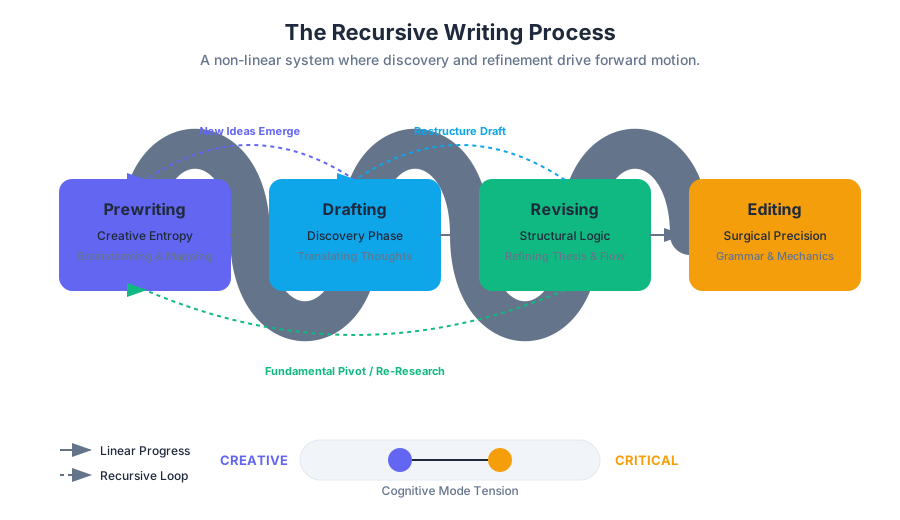
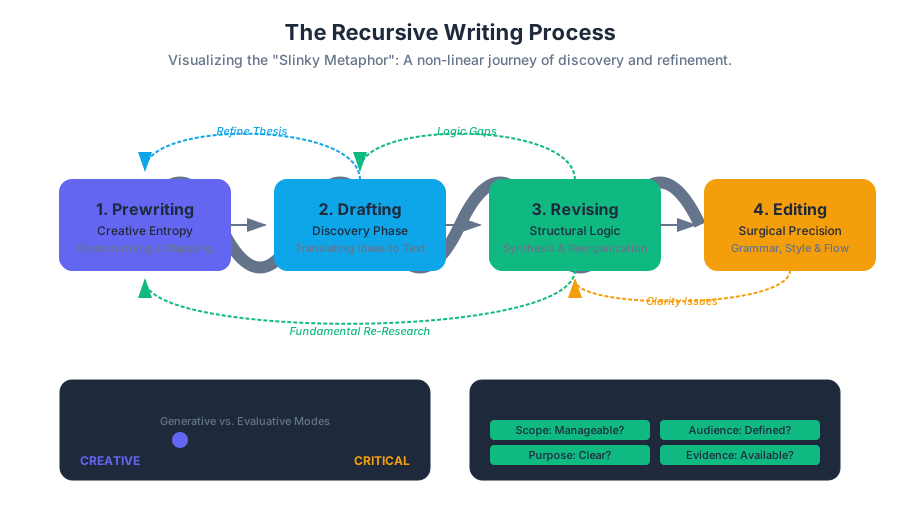
Writing is frequently mischaracterized as a linear progression—a straight line beginning at a blank page and ending at a finished manuscript. In reality, expert-level composition is a non-linear, iterative process that functions as the tangible manifestation of complex creative and critical thinking. It is a recursive system where the writer moves through distinct phases, often looping back to earlier stages as new insights emerge or structural weaknesses are identified.
To master the writing process is to understand that writing is not merely a way to record thoughts, but a way to discover them. This section explores the architectural framework of writing, from the initial entropy of idea generation to the surgical precision of final editing.
The Recursive Writing Process: The Slinky Metaphor
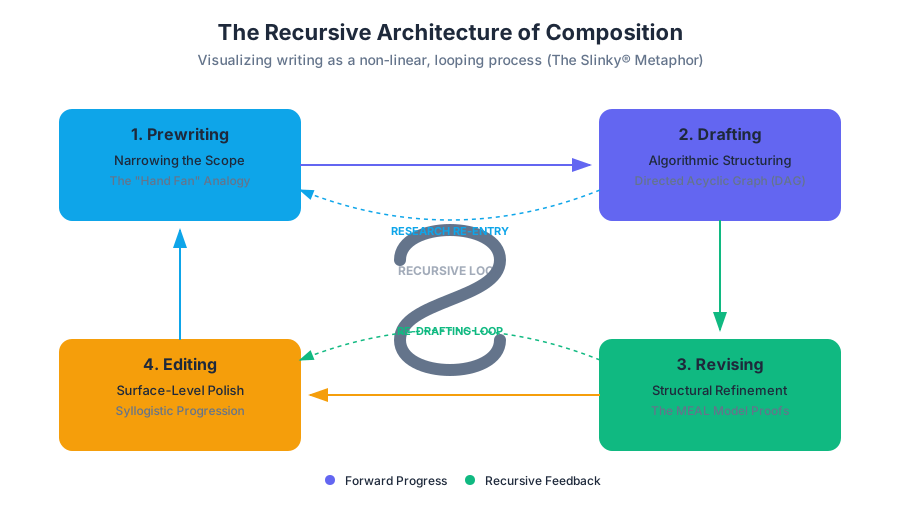
The most accurate model for modern composition is the Recursive Writing Process. Unlike a traditional "step-by-step" list, recursion implies that the output of one stage often becomes the input for a previous stage, creating a feedback loop.
The Slinky Metaphor
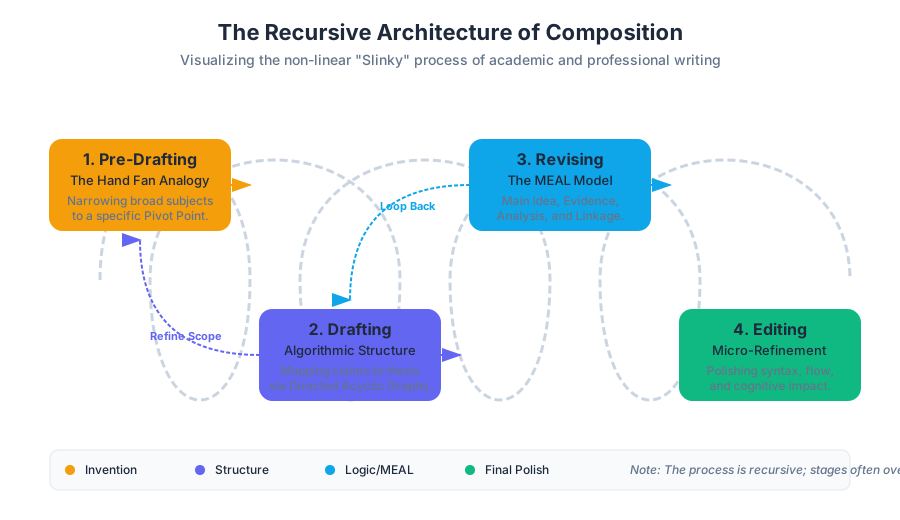
A useful pedagogical tool for visualizing this is the Slinky Metaphor. Consider a Slinky toy: it consists of a single, continuous wire coiled into many loops. When it "walks" down a flight of stairs, it moves forward, but it does so by flipping its coils back over themselves.
The Slinky Principle: Writing is a singular journey (the forward motion) composed of smaller, overlapping cycles (the coils). To move forward in a draft, a writer must frequently "loop back" to refine a thesis, re-research a point, or reorganize a paragraph.
Linear vs. Recursive Modeling
| Feature | Linear Model (Traditional) | Recursive Model (Modern) |
|---|---|---|
| Direction | Unidirectional ($A \to B \to C$) | Multidirectional/Cyclical |
| Error Handling | Correction occurs only at the end | Correction is continuous and formative |
| Idea Development | Static; ideas are fixed at the start | Dynamic; ideas evolve through the act of writing |
| Cognitive Load | High at the end (Editing) | Distributed throughout the process |
| Outcome | Often superficial or "filled in" | Deeply synthesized and structurally sound |
Phase 1: Developing Ideas and Creative Entropy
Before a single sentence is structured, a writer must engage in Idea Development. In an academic or professional context, this is the transition from "summary" to "original analysis." College-level writing, in particular, demands that the author contribute unique observations rather than merely aggregating existing data.
Prewriting Strategies
Prewriting is the "entropy" phase, where the goal is to generate a high volume of raw material without the interference of the "internal critic."
- Brainstorming: Rapid, non-judgmental listing of all possible angles on a topic.
- Mapping/Clustering: A visual representation of ideas showing how sub-concepts radiate from a central node.
- Journaling/Freewriting: Continuous writing for a set period to bypass cognitive blocks and reach deeper subconscious connections.
The Creative vs. Critical Tension
Writing requires a delicate balance between two cognitive modes:
- Creative Thinking: Generative, expansive, and messy. It prioritizes "what if" and "more."
- Critical Thinking: Evaluative, reductive, and precise. It prioritizes "so what" and "less."
To model this programmatically, we can view the writing process as a state machine where the transition between states is governed by the quality of the current output.
import random

class WritingProcess:
    def __init__(self, topic):
        self.topic = topic
        self.state = "PREWRITING"
        self.draft_quality = 0.0
        self.ideas = []

    def iterate(self):
        if self.state == "PREWRITING":
            self.ideas.extend([f"Idea_{random.randint(1, 100)}" for _ in range(5)])
            print(f"Generated ideas: {self.ideas}")
            self.state = "DRAFTING"

        elif self.state == "DRAFTING":
            self.draft_quality += random.uniform(0.1, 0.3)
            print(f"Drafting... Quality: {self.draft_quality:.2f}")
            if self.draft_quality < 0.5:
                print("Inconsistent logic detected. Looping back to Prewriting.")
                self.state = "PREWRITING"
            else:
                self.state = "REVISING"

        elif self.state == "REVISING":
            # Revision improves quality but might reveal fundamental flaws
            if random.random() < 0.2:
                print("Structural collapse! Returning to Drafting.")
                self.state = "DRAFTING"
            else:
                self.draft_quality += 0.2
                print(f"Revising... Quality: {self.draft_quality:.2f}")
                if self.draft_quality >= 1.0:
                    self.state = "EDITING"

    def run_to_completion(self):
        while self.state != "FINISHED":
            self.iterate()
            if self.draft_quality >= 1.2: # Final polish
                self.state = "FINISHED"
        print("Manuscript complete.")

writer = WritingProcess("The Impact of Recursive Loops in Cognition")
writer.run_to_completion()
Phase 2: Narrowing the Topic and Feasibility Analysis
A common pitfall for novice writers is selecting a topic that is too broad, leading to a "mile wide and inch deep" analysis. Topic Narrowing is the process of defining a feasible scope that aligns with the assignment’s constraints (word count, audience, and purpose).
The Feasibility Matrix
When narrowing a topic, writers should evaluate their focus against four primary vectors:
| Vector | Requirement | Failure State (Too Broad) | Success State (Narrowed) |
|---|---|---|---|
| Scope | Can it be covered in $X$ pages? | "The History of Warfare" | "The use of longbows at the Battle of Agincourt" |
| Depth | Does it allow for original analysis? | "Global Warming is bad" | "The impact of permafrost melt on Arctic infrastructure" |
| Evidence | Are there specific sources available? | "The thoughts of prehistoric humans" | "Symbolic representation in Lascaux cave paintings" |
| Audience | Is the technical level appropriate? | "Quantum Mechanics" (for 5th graders) | "How magnets work using simple field lines" |
The Mathematical Derivation of Focus
We can represent the relationship between topic breadth ($B$) and analysis depth ($D$) as an inverse relationship relative to the total word count ($W$):
D \approx \frac{W}{B}
As $B$ (the number of sub-topics) increases, $D$ (the depth of analysis per sub-topic) must decrease to satisfy the constraint of $W$. To achieve "Expert-Level" depth ($D_{max}$), the writer must minimize $B$.
Phase 3: Gathering Information and the Hand Fan Analogy
Once a topic is narrowed, the writer enters the Information Gathering phase. This is not a passive collection of facts but a strategic search for evidence that supports or challenges the emerging thesis.
The Hand Fan Analogy
Imagine a folding hand fan.
- The Pivot Point: This is your narrowed topic. Everything must stay connected here.
- The Ribs: These are the primary lines of inquiry or sub-arguments.
- The Leaf (Fabric): This is the gathered information that spans between the ribs, creating a cohesive surface.
If the pivot point is too loose (a broad topic), the fan cannot provide structure. If the ribs are too far apart, the fabric (information) will tear, leaving gaps in the argument.
Academic Research Standards
| Source Type | Utility | Academic Weight |
|---|---|---|
| General Encyclopedias | Preliminary overview; finding keywords | Low (Do not cite) |
| Peer-Reviewed Journals | Primary evidence; current discourse | High |
| Monographs | Deep theoretical frameworks | High |
| Trade Publications | Industry-specific trends and data | Moderate |
| Primary Sources | Raw data, historical documents, interviews | Highest |
Phase 4: Ordering and Drafting
Drafting is the act of translating the "messy" ideas of prewriting into a structured, logical sequence. This stage is often supported by Outlining, which serves as the architectural blueprint of the essay.
The Structural Hierarchy
- Thesis Statement: The "North Star" of the document. Every paragraph must serve the thesis.
- Topic Sentences: The "mini-thesis" for each paragraph.
- Evidence and Analysis: The "meat" that supports the topic sentence.
- Transitions: The "connective tissue" that ensures logical flow.
Logical Flow and Evidence Sufficiency
A draft fails when it lacks Sufficiency. This occurs when a claim is made but the supporting data is either missing, irrelevant, or misinterpreted.
-- Conceptualizing a 'Draft' as a Database Schema
-- Ensuring every Claim is linked to Evidence

CREATE TABLE Thesis (
    id INT PRIMARY KEY,
    statement TEXT NOT NULL
);

CREATE TABLE Paragraphs (
    id INT PRIMARY KEY,
    thesis_id INT,
    topic_sentence TEXT,
    order_index INT,
    FOREIGN KEY (thesis_id) REFERENCES Thesis(id)
);

CREATE TABLE Evidence (
    id INT PRIMARY KEY,
    paragraph_id INT,
    source_citation TEXT,
    data_point TEXT,
    analysis_notes TEXT,
    FOREIGN KEY (paragraph_id) REFERENCES Paragraphs(id)
);

-- A query to check for "Empty Paragraphs" (Claims without Evidence)
SELECT p.topic_sentence
FROM Paragraphs p
LEFT JOIN Evidence e ON p.id = e.paragraph_id
WHERE e.id IS NULL;
Phase 5: Revising vs. Editing
One of the most critical distinctions in the writing process is the difference between Revision and Editing. Confusing these two leads to "polishing a sinking ship"—fixing grammar in a paragraph that should be deleted entirely.
The Revision/Editing Dichotomy
| Feature | Revision (Macro) | Editing (Micro) |
|---|---|---|
| Focus | Content, Logic, Structure, Audience | Grammar, Spelling, Punctuation, Style |
| Action | Adding, deleting, or moving sections | Correcting and refining sentences |
| Perspective | The Reader's understanding | The Writer's precision |
| Timing | Early and mid-process | Final stage only |
The Revision Theorem: The quality of a final manuscript is directly proportional to the number of structural changes made during the revision phase, not the number of typos fixed during editing.
Multiple Editing Passes
Editing should be done in "passes" to avoid cognitive fatigue.
- Pass 1: Clarity and Flow (Sentence structure).
- Pass 2: Technical Accuracy (Grammar and Punctuation).
- Pass 3: Formatting (Citations, Margins, Font).
Phase 6: Framing - Introductions and Conclusions
The Introduction and Conclusion act as the "bookends" of the essay. They provide the necessary context for the reader to enter the argument and the final synthesis for them to leave it.
The Introduction: The Funnel Approach
A successful introduction typically follows a "funnel" structure:
- Hook: Engage the reader.
- Context: Provide background information.
- The Pivot: Identify the central issue or problem.
- Thesis: State the main argument clearly.
The Conclusion: The Reverse Funnel
- Restatement: Reiterate the thesis in a new way (synthesis, not repetition).
- Summary: Briefly touch upon the main points.
- The "So What?": Explain the broader implications of the findings.
- Final Impression: Leave the reader with a provocative thought or a call to action.
Implementation: Document Compilation Pipeline
In professional environments, the "Writing Process" is often managed via automated tools that handle formatting and versioning.
# Example of a Document Build Pipeline (GitHub Actions / GitLab CI)
# This automates the 'Editing' (Formatting) and 'Publishing' stages.

name: Build Manuscript

on:
  push:
    branches: [ main ]

jobs:
  compile:
    runs-on: ubuntu-latest
    steps:
      - name: Checkout Code
        uses: actions/checkout@v2

      - name: Lint Prose
        run: |
          # Use 'write-good' to check for passive voice and weasel words
          npm install -g write-good
          write-good draft.md --severity critical

      - name: Compile PDF via Pandoc
        run: |
          pandoc draft.md \
          --from markdown \
          --to pdf \
          --citeproc \
          --bibliography=references.bib \
          -o final_manuscript.pdf

      - name: Upload Artifact
        uses: actions/upload-artifact@v2
        with:
          name: manuscript
          path: final_manuscript.pdf
Common Pitfalls in the Process
- The "One-and-Done" Fallacy: Believing that the first draft is the final draft. This ignores the recursive nature of thinking.
- Premature Editing: Focusing on commas before the argument is sound. This stifles creative flow and wastes time on text that may be deleted.
- Research Rabbit Holes: Gathering information indefinitely to avoid the "pain" of drafting.
- Ignoring the Audience: Writing for oneself rather than the intended reader, leading to unexplained jargon or missing context.
Summary of the Iterative Cycle
The writing process is not a burden to be bypassed but a framework to be utilized. By separating the creative act of generation from the critical act of revision, and by respecting the recursive "Slinky" motion of development, a writer can transform a chaotic spark of an idea into a rigorous, persuasive, and polished piece of scholarship.
Prewriting and Idea Generation
Key concepts: Freewriting · Brainstorming · Mapping · Journaling · Listing · Defining Questions
Exploration of various creative techniques to generate ideas and overcome writer's block without the pressure of formal constraints.
Prewriting and Idea Generation
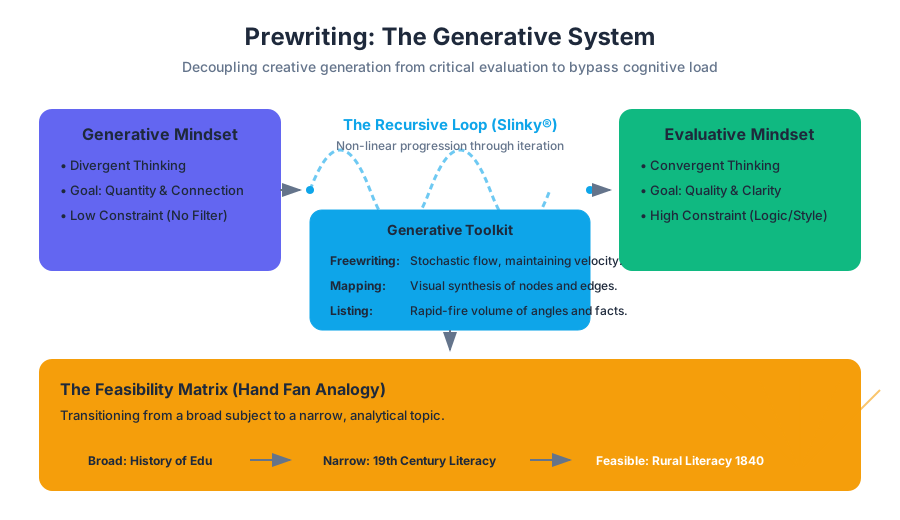
The writing process is frequently misunderstood as a linear progression—a straight line from a blank page to a finished manuscript. In reality, writing is a non-linear, iterative system characterized by recursive loops. A common metaphor for this is the Slinky®: a single coil of material that loops back on itself while moving forward. Prewriting represents the initial, high-entropy phase of this system, where the objective is not polish, but the generation of raw conceptual material.
In academic and professional environments, writing serves as the tangible output of critical and creative thinking. It is an evolutionary process where ideas are refined through successive stages of development. Mastering prewriting is essential because it bridges the gap between vague intuition and structured argument.
The Philosophy of Prewriting: Offloading Cognitive Load
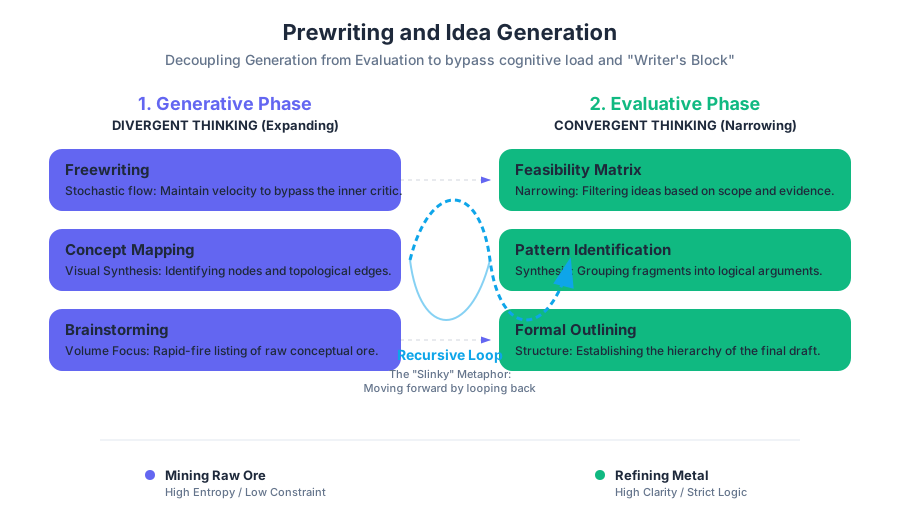
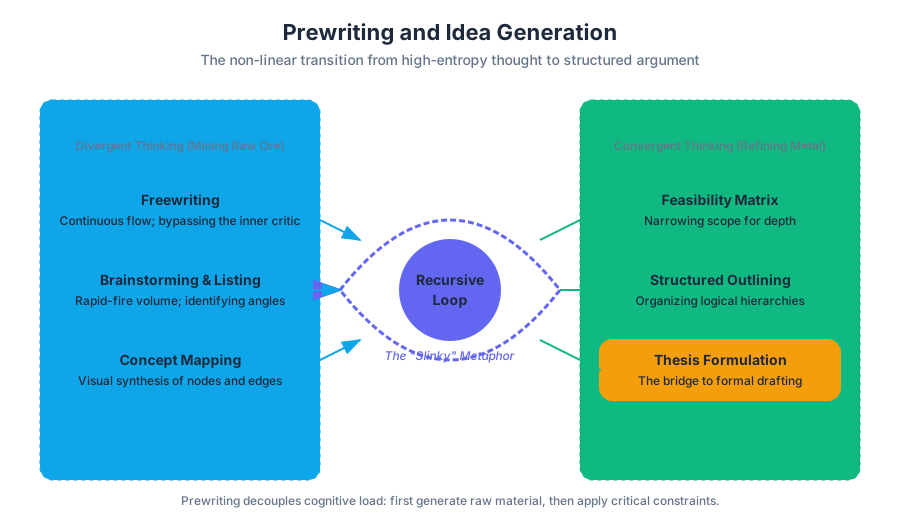
Prewriting is the cognitive process of externalizing internal thought. The primary challenge in the early stages of writing is often "Writer's Block," which is frequently a symptom of attempting to perform generation (creative thinking) and evaluation (critical thinking) simultaneously. Prewriting decouples these processes, allowing the writer to bypass the "inner critic" and focus on idea density.
Definition: Prewriting is the generative stage of the writing process where the writer explores ideas, identifies patterns, and gathers evidence without the constraints of formal structure, grammar, or syntax.
The Generative vs. Evaluative Mindset
| Feature | Generative (Prewriting) | Evaluative (Editing/Revising) |
|---|---|---|
| Primary Goal | Quantity and Connection | Quality and Clarity |
| Constraint Level | Low (Minimal rules) | High (Strict adherence to style/logic) |
| Cognitive Mode | Divergent Thinking: Expanding possibilities | Convergent Thinking: Narrowing to a solution |
| Output Type | Fragments, maps, lists, journals | Polished sentences and paragraphs |
| Metaphor | Mining raw ore | Refining and polishing metal |
Core Prewriting Methodologies
Effective prewriting requires a diverse toolkit. Depending on the complexity of the assignment and the writer's personal cognitive style, different methods may yield better results.
1. Freewriting: Stochastic Idea Generation
Freewriting involves writing continuously for a predetermined period (usually 5–15 minutes) without stopping. If the writer runs out of things to say, they repeat a word or phrase until a new thought emerges. The technical goal is to lower the barrier to entry for the "flow state" by removing the penalty for "bad" writing.
import time
import sys

def freewriting_session(duration_minutes: int):
    """
    A programmatic representation of a freewriting session.
    The goal is to maintain 'velocity'—writing without pausing for evaluation.
    If the user stops typing for more than 3 seconds, a prompt triggers to maintain flow.
    """
    start_time = time.time()
    end_time = start_time + (duration_minutes * 60)
    buffer = []

    print(f"--- SESSION START: {duration_minutes}m ---")

    while time.time() < end_time:
        # Simulate the input stream of consciousness
        line = sys.stdin.readline().strip()
        if not line:
            print("[SYSTEM]: Keep writing. Do not filter. Repeat the last word if stuck.")
            continue

        buffer.append(line)

    print("--- SESSION END ---")
    return " ".join(buffer)

# Implementation of the 'Slinky' recursive loop in logic
# raw_output = freewriting_session(10)
2. Mapping and Diagramming (Visual Synthesis)
Mapping (also known as clustering or concept mapping) is a visual strategy used to identify relationships between disparate ideas. It treats ideas as nodes and relationships as edges, allowing the writer to see the "topology" of their argument. This is particularly effective for writers who struggle with the linear nature of traditional outlines.
In a concept map, the central topic is the root node. Branching nodes represent sub-topics, and cross-links represent interdisciplinary connections. This method helps in identifying "thin" areas of an argument that require more research.
// A Graphviz representation of a Prewriting Map for an essay on "Renewable Energy"
digraph PrewritingMap {
    node [shape=ellipse, style=filled, color=lightblue];

    "Renewable Energy" -> "Solar";
    "Renewable Energy" -> "Wind";
    "Renewable Energy" -> "Policy";

    "Solar" -> "Photovoltaics";
    "Solar" -> "Concentrated Solar";
    "Solar" -> "Grid Storage Issues";

    "Policy" -> "Subsidies";
    "Policy" -> "Carbon Tax";
    "Policy" -> "International Agreements";

    "Grid Storage Issues" -> "Lithium Mining" [label="Environmental Cost"];
    "Subsidies" -> "Economic Growth";
}
3. Brainstorming, Listing, and Journaling
- Brainstorming: A rapid-fire list of every possible angle, fact, or question related to a topic. The focus is on volume.
- Listing: A more structured evolution of brainstorming, often used once a general stance has been identified to organize supporting evidence.
- Journaling: A longitudinal approach where the writer maintains a "Writing Journal" to track the evolution of their thoughts over days or weeks. This is crucial for complex assignments where ideas need time to "incubate."
Narrowing the Focus: The Feasibility Matrix
Once a general subject is selected, it must be narrowed into a feasible topic. A common mistake in college writing is choosing a topic that is too broad (e.g., "The History of Education"), which leads to superficial summaries rather than deep analysis.
The "Hand Fan" Analogy
Imagine a hand fan. The base (the pivot) is your specific, narrow focus. The fan spreads out to cover the breadth of the implications, but everything remains connected to that single, firm point. If the base is too wide, the fan becomes unmanageable and loses its structural integrity.
| Topic Stage | Example | Feasibility Status |
|---|---|---|
| Broad Subject | Climate Change | Infeasible: Too vast for a single paper. |
| Narrowed Subject | Impact of Climate Change on Agriculture | Better: But still covers too many variables. |
| Focused Topic | Impact of rising temperatures on wheat yields in Kansas (2010-2020) | Feasible: Specific, researchable, and allows for original analysis. |
| Niche Topic | Genetic mutations in Kansas winter wheat due to 2012 heatwave | Highly Specific: Requires specialized technical data. |
Key Insight: Specificity is the precursor to depth. A narrow topic allows you to provide the original observations and critical analysis expected in college-level writing.
Gathering Information and Academic Standards
Information gathering is most effective when the topic is already narrowed. This allows for targeted database searches rather than sifting through thousands of irrelevant results.
Database Search Strategies
When moving from prewriting to research, the use of Boolean operators and specific keywords is essential.
-- Conceptual SQL query for an Academic Database Search
SELECT
    article_title,
    author,
    peer_review_status,
    citation_count
FROM
    university_library_db
WHERE
    (keywords LIKE '%wheat yields%' OR keywords LIKE '%crop resilience%')
    AND geographic_region = 'Midwest US'
    AND publication_year >= 2015
    AND source_type = 'Peer-Reviewed Journal'
ORDER BY
    citation_count DESC;
The Role of General Reference Sources
Sources like Wikipedia or general encyclopedias are excellent for preliminary research (understanding the "lay of the land"). However, they are rarely acceptable as primary sources in academic writing. They should be used to find the names of experts, key terms, and foundational events, which can then be used to find scholarly sources.
Ordering and Drafting: Constructing the Framework
After prewriting and research, the writer must transition from a "cloud of ideas" to a linear structure. This is the Ordering phase.
The Utility of Outlining
An outline is a hierarchical map of the essay. It ensures that every paragraph serves a specific purpose in supporting the Thesis Statement.
- Introduction: Context, Problem, and Thesis.
- Body Paragraphs:
- Topic Sentence: The claim.
- Evidence: Data or quotes from research.
- Analysis: The writer's original thought connecting the evidence to the thesis.
- Transition: Linking to the next point.
- Conclusion: Synthesis and Final Impression.
Framing the Argument: Introductions and Conclusions
The introduction and conclusion serve as the frame for the essay. They are the first and last interactions the reader has with the work, making them disproportionately important for the overall impression.
Introduction Purpose
An effective introduction does more than "hook" the reader. It must:
- Identify the central issue.
- Provide necessary background information.
- Establish the author's perspective (tone and stance).
- Present a clear Thesis Statement.
Note: Many professional writers draft the introduction last, ensuring it accurately reflects the final arguments made in the body.
Conclusion Purpose
The conclusion should not merely summarize the paper. It should:
- Synthesize the points made (show how they fit together).
- Reinforce the thesis in light of the evidence presented.
- Leave the reader with a "so what?"—the broader implications of the work.
Revision vs. Editing: The Two-Pass System
A critical distinction in the writing process is the difference between Revision and Editing. Lumping these together often leads to "polishing a sinking ship"—fixing grammar in a paragraph that should be deleted entirely.
| Activity | Focus | Questions to Ask |
|---|---|---|
| Revision | Content, Logic, Structure | Is the thesis supported? Is the order logical? Is there enough evidence? |
| Editing | Mechanics, Style, Syntax | Are there typos? Is the grammar correct? Does the tone match APA/MLA style? |
Theorem of Iteration: The quality of a final manuscript is directly proportional to the number of distinct passes made between the "Generative" and "Evaluative" stages.
The Revision Pipeline
- Macro-Revision: Check the "Big Picture." Does the argument flow?
- Meso-Revision: Check paragraph transitions and evidence sufficiency.
- Micro-Editing: Sentence-level polish and proofreading.
# A CLI-based workflow for a writer using Version Control (Git)
# This treats writing as an iterative 'code' development process

# 1. Create a branch for a new draft
git checkout -b draft-v1-generative

# 2. After freewriting and initial drafting
git add essay_draft.md
git commit -m "Initial generative draft: focusing on logic flow"

# 3. Start the revision pass (Macro-Revision)
# "Refactoring" the structure
git checkout -b revision-pass-logic
# [Perform structural changes]
git commit -m "Revised structure: moved section 3 to section 2 for better flow"

# 4. Final editing pass
git checkout -b final-edit-polish
# [Fix typos and citations]
git commit -m "Final edit: corrected APA citations and fixed syntax errors"
Summary of the Writing System
The writing process is a complex, non-linear system. By utilizing prewriting strategies like mapping and freewriting, narrowing topics to a feasible scope, and strictly separating revision from editing, writers can move from the high-entropy state of "having an idea" to the low-entropy state of a "polished academic argument."
Assignment Analysis and Topic Narrowing
Key concepts: Rhetorical Analysis · Topic Feasibility · Hand Fan Analogy · Information Gathering
How to analyze assignment requirements and narrow a broad subject into a feasible, researchable topic.
Assignment Analysis and Topic Narrowing
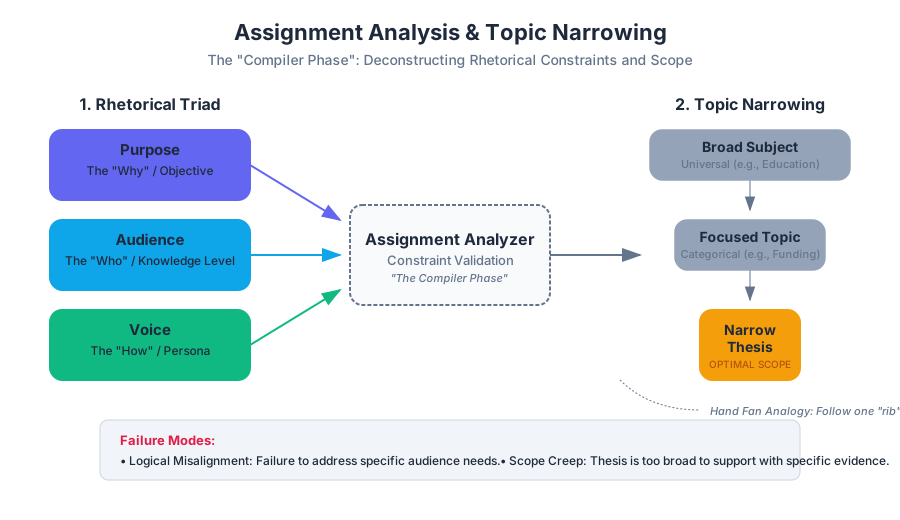
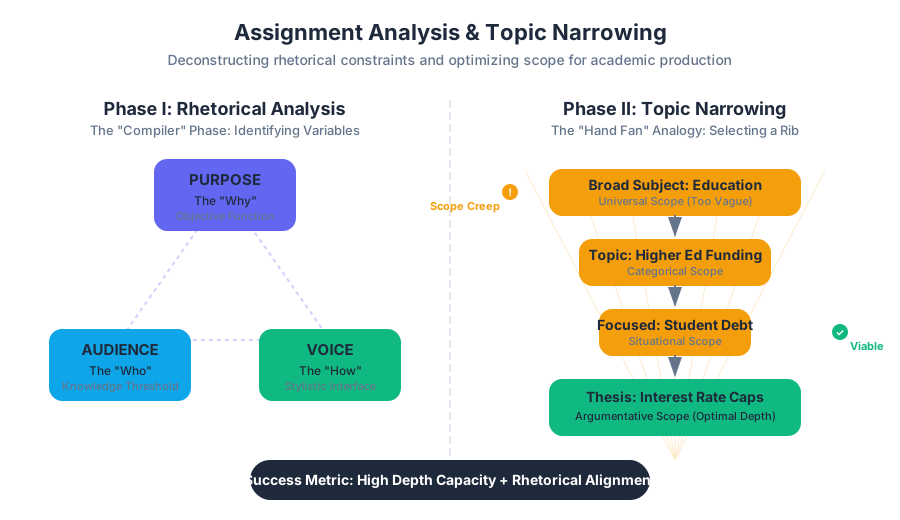
In the lifecycle of academic and professional production, the initial phase—Assignment Analysis and Topic Narrowing—functions as the "pre-processing" or "compilation" stage. Just as a software engineer must analyze system requirements before writing a single line of code, a writer must deconstruct the rhetorical constraints and scope of an assignment to ensure the final output is both viable and impactful. Failure to perform this analysis often results in "scope creep," where a thesis becomes too broad to support, or "logical misalignment," where the writer fails to address the specific needs of the audience.
Rhetorical Analysis: The Compiler Phase
Rhetorical Analysis is the systematic process of evaluating the communicative context of a writing task. It is not merely about understanding the instructions; it is about identifying the underlying variables that will govern the success of the document. These variables are categorized into the Rhetorical Triad: Purpose, Audience, and Voice.
The Rhetorical Triad
Definition: The Rhetorical Triad A framework for evaluating the constraints of a writing task by analyzing the Purpose (the "Why"), the Audience (the "Who"), and the Voice (the "How").
- Purpose: This defines the objective function of the text. Is the goal to persuade, inform, analyze, or narrate? In technical terms, the purpose dictates the schema of the argument.
- Audience: The target demographic determines the "level of abstraction." A senior engineer requires different data density than a layperson or a first-year student.
- Voice: This is the "interface" of the writing. It encompasses the tone, formality, and persona adopted by the writer to establish credibility (ethos).
| Parameter | Technical Focus | Failure Mode | Success Metric |
|---|---|---|---|
| Purpose | Teleology of the task | Goal misalignment (e.g., narrating instead of arguing) | Objective achievement (e.g., reader is persuaded) |
| Audience | Knowledge thresholding | Cognitive overload or oversimplification | High engagement and comprehension |
| Voice | Stylistic consistency | Inappropriate register (e.g., slang in a formal report) | Established authority and trust |
# A conceptual "Rhetorical Constraint Checker" to validate assignment parameters
class AssignmentAnalyzer:
    def __init__(self, purpose, audience, word_count_limit):
        self.purpose = purpose.lower()
        self.audience = audience
        self.limit = word_count_limit
        self.valid_purposes = ["persuade", "inform", "analyze", "narrate"]

    def validate_rhetorical_alignment(self):
        """
        Ensures the purpose matches academic standards for the given audience.
        """
        if self.purpose not in self.valid_purposes:
            raise ValueError(f"Invalid Purpose: {self.purpose}. Must be one of {self.valid_purposes}")

        # Heuristic: Academic audiences usually require 'analyze' or 'persuade'
        if self.audience == "Professor" and self.purpose == "narrate":
            return "WARNING: Narrative purpose may be too informal for a Professor-led assignment."
        return "Rhetorical alignment: OPTIMAL"

    def calculate_depth_capacity(self, topic_complexity_index):
        """
        Heuristic to determine if a topic is too broad for the word count.
        Complexity Index: 1 (Very Narrow) to 10 (Global/Universal)
        """
        # Capacity formula: (Word Count / 500) * (1 / Complexity)
        # A capacity < 1 suggests the topic is too broad for the length.
        capacity = (self.limit / 500) * (1 / topic_complexity_index)

        if capacity < 0.8:
            return "REJECT: Scope Creep Detected. Narrow your topic."
        elif capacity > 2.5:
            return "CAUTION: Topic may be too thin. Add complexity or sub-points."
        return "PASS: Topic feasibility confirmed."

# Example Usage
analyzer = AssignmentAnalyzer(purpose="Persuade", audience="Professor", word_count_limit=1500)
print(analyzer.validate_rhetorical_alignment())
print(analyzer.calculate_depth_capacity(topic_complexity_index=8)) # Too broad
The Hand Fan Analogy: Visualizing Topic Narrowing
A common mistake in topic selection is choosing a "Global Topic"—a subject so vast that any attempt to cover it in a standard essay results in a superficial summary. To visualize the process of narrowing, we use the Hand Fan Analogy.
Imagine a folded hand fan. At the base (the pivot), you have the broad, general subject (e.g., "Climate Change"). As you open the fan, the "ribs" represent specific sub-categories (e.g., "Ocean Acidification," "Carbon Tax Policy," "Arctic Migration"). To write an effective paper, you do not try to write about the entire open fan; instead, you select a single "rib" and follow it to its tip.
From Broad to Narrow: The Funnel Effect
| Stage | Scope | Example | Analytical Utility |
|---|---|---|---|
| Broad Subject | Universal | Education | Too vague; no specific argument possible. |
| Topic | Categorical | Higher Education Funding | Better, but still a multi-volume encyclopedia subject. |
| Focused Topic | Situational | Student Loan Debt in the US | Manageable for a long report or thesis. |
| Narrow Thesis | Argumentative | The impact of interest rate caps on graduate school enrollment. | Optimal: Allows for specific evidence and deep analysis. |
Prewriting Strategies: The Creative Entropy Stage
Before a thesis can be formalized, the writer must engage in Prewriting. This is the "messy" stage of development, characterized by high entropy and low formal constraints. The goal is not to produce polished prose but to generate raw data and identify patterns.
1. Freewriting and Journaling
Freewriting is a stream-of-consciousness technique where the writer writes continuously for a set period (e.g., 10 minutes) without regard for grammar, spelling, or logic. This bypasses the "internal editor" that often causes writer's block. Journaling functions similarly but is more reflective, allowing a writer to probe the why and how of a personal observation over time.
2. Brainstorming and Listing
Brainstorming involves listing every thought related to a topic. It is a "dump" of the subconscious into a structured or semi-structured list. Once the list is generated, the writer performs a Filtering Pass to group related items and discard outliers.
3. Mapping and Diagramming
For visual thinkers, Mapping (or Mind Mapping) creates a non-linear representation of ideas. It allows the writer to see the "topology" of their thoughts—identifying which concepts are central hubs and which are peripheral nodes.
% Mathematical representation of Topic Narrowing via Set Theory
\text{Let } S \text{ be the set of all information regarding a Broad Subject.} \\
\text{Let } T \subset S \text{ be a Focused Topic.} \\
\text{Let } A \text{ be the Analytical Angle applied to } T. \\
\text{The Thesis } \Theta \text{ is defined as: } \\
\Theta = A(T) \text{ such that } \text{length}(\Theta) \propto \frac{1}{\text{scope}(T)}
Information Gathering and Defining Questions
Once a general area of interest is identified, the writer must transition from "generation" to "refinement." This is achieved through Defining Questions. These questions act as filters that catch broad ideas and force them into specific shapes.
The "Why/How" Heuristic If a topic can be answered with a "Yes" or "No," it is not a thesis; it is a fact. A narrow, analytical topic must address how a mechanism works or why a specific phenomenon occurs.
Example: The School Tax Refinement
- Broad Idea: I want to write about school taxes.
- Defining Question: Why do only property owners in New York State pay school taxes, while renters do not?
- Narrowed Focus: The equity gap between property-based school funding and the rising demographic of long-term urban renters.
| Strategy | Action | Best Used When... |
|---|---|---|
| Listing | Create a "Top 10" reasons for a stance. | You have a clear opinion but need supporting pillars. |
| Pros & Cons | Simulate a debate by listing opposing views. | You are writing a persuasive or argumentative piece. |
| Mapping | Draw circles and lines connecting sub-ideas. | You have many ideas but don't see the hierarchy. |
| Defining Questions | Interrogate the "Who, What, Where, When, Why." | Your topic feels "flat" or purely descriptive. |
The Recursive Writing Process: Iteration vs. Linearity
Effective writing is recursive, not linear. A writer does not simply move from Step 1 to Step 5. Instead, the process resembles an Agile Development Loop.
- Prewrite: Generate ideas.
- Analyze: Check against rhetorical constraints.
- Draft: Build a prototype of the argument.
- Review: Realize the topic is still too broad.
- Pivot: Return to the "Hand Fan" and select a narrower rib.
- Refine: Finalize the thesis.
Common Pitfalls in Topic Narrowing
Even experienced writers fall into specific "logical traps" during the narrowing phase. Understanding these failure modes is essential for maintaining project velocity.
1. The "Kitchen Sink" Thesis
The writer attempts to cover every aspect of a subject to be "thorough." This results in a paper that is 20 pages of summary and 0 pages of original analysis.
- Correction: Apply the 1-in-10 Rule. For every ten things you know about a topic, only include the one most relevant to your specific argument.
2. The Descriptive Trap
The topic describes what happened rather than analyzing it.
- Example: "The history of the Steam Engine" (Descriptive) vs. "How the portability of the high-pressure steam engine accelerated westward expansion" (Analytical).
3. Misaligned Audience Abstraction
Writing a highly technical breakdown for a general audience, or a "Intro 101" summary for a professor.
- Correction: Perform a Knowledge Audit. What does the reader already know? What is the "delta" (the new information) you are providing?
-- A conceptual schema for organizing Prewriting "Nodes" and their relationships
CREATE TABLE ResearchNodes (
    node_id INT PRIMARY KEY,
    concept_name VARCHAR(255),
    abstraction_level ENUM('Global', 'Category', 'Focused', 'Thesis'),
    parent_node_id INT,
    is_viable BOOLEAN DEFAULT TRUE,
    FOREIGN KEY (parent_node_id) REFERENCES ResearchNodes(node_id)
);

-- Inserting a "Hand Fan" progression
INSERT INTO ResearchNodes (node_id, concept_name, abstraction_level, parent_node_id)
VALUES
(1, 'Renewable Energy', 'Global', NULL),
(2, 'Solar Power', 'Category', 1),
(3, 'Photovoltaic Efficiency', 'Focused', 2),
(4, 'Perovskite Cell Stability in Humid Climates', 'Thesis', 3);

-- Query to find the "Narrowest" viable topic
SELECT concept_name
FROM ResearchNodes
WHERE abstraction_level = 'Thesis' AND is_viable = TRUE;
Worked Example: From Assignment to Thesis
Assignment: Write a 2,000-word argumentative essay on a modern social issue. Audience: Academic (Professor and Peers).
- Initial Thought (Broad): "Social Media is bad for people." (Too broad, cliché).
- Brainstorming (Listing): Privacy, mental health, misinformation, political polarization, dopamine loops.
- Mapping: Connecting "Dopamine Loops" to "Infinite Scroll" and "Teenage Anxiety."
- Defining Question: "How does the 'Infinite Scroll' UI pattern specifically affect the circadian rhythms of adolescents?"
- Topic Narrowing (The Rib): Instead of "Social Media," the focus is now on a specific UI pattern and a specific biological effect on a specific demographic.
- Final Thesis: "The implementation of non-terminating pagination (Infinite Scroll) in mobile applications functions as a variable-ratio reinforcement schedule that significantly degrades sleep quality among users aged 13-18."
- Rhetorical Triad: The combination of Purpose, Audience, and Voice that defines a writing task's constraints.
- Recursive Process: A non-linear approach to writing where the author moves back and forth between stages like prewriting and revising.
- Hand Fan Analogy: A visual metaphor for narrowing a topic from a broad pivot point to a specific, narrow "rib."
- Freewriting: A prewriting technique involving continuous writing to bypass the internal critic.
- Scope Creep: The tendency for a project or topic to become unmanageably broad over time.
- Ethos: The credibility or authority established through the writer's voice and evidence.
- Defining Questions: Specific inquiries (Who, How, Why) used to transform a broad subject into an analytical thesis.
-
Which part of the Rhetorical Triad determines the "level of abstraction" and technical density of the paper?
- A) Purpose
- B) Voice
- C) Audience
- D) Length
- Answer: C (Audience)
-
In the Hand Fan Analogy, what does a single "rib" represent?
- A) The entire essay
- B) A specific sub-topic or analytical angle
- C) The broad subject
- D) The bibliography
- Answer: B
-
True or False: Prewriting should be strictly governed by grammar and formal structure to save time later.
- Answer: False (Prewriting is a high-entropy, creative stage where formal constraints are minimized.)
-
What is the primary danger of a "Kitchen Sink" thesis?
- A) It is too short.
- B) It lacks a bibliography.
- C) It results in superficial summary rather than deep analysis.
- D) It is too controversial.
- Answer: C
-
Which prewriting technique is best for identifying relationships and hierarchies between different ideas?
- A) Freewriting
- B) Mapping
- C) Listing
- D) Journaling
- Answer: B
Study Guide: Mastering Assignment Analysis
I. The Pre-Processing Checklist
Before writing, answer these four questions:
- What is the "Verb"? (Analyze, Argue, Describe, Summarize) — This is your Purpose.
- Who is the "Reader"? (Expert, Layperson, Skeptic) — This defines your Audience.
- What is the "Constraint"? (Word count, Source requirements) — This defines your Feasibility.
- What is the "Angle"? (The specific 'Why' or 'How') — This is your Narrowed Topic.
II. Topic Narrowing Workflow
- Step 1: Start with a Broad Subject (The Pivot).
- Step 2: Use Brainstorming to find 5-10 sub-topics (The Ribs).
- Step 3: Select ONE rib based on interest and resource availability.
- Step 4: Apply a Defining Question to move from a "What" to a "How/Why."
- Step 5: Test the thesis against the word count (The Complexity Index).
III. Key Heuristics
- The Goldilocks Zone: A topic should not be so broad that it's a "Global Topic," nor so narrow that there is no evidence to find.
- The "So What?" Test: If a reader asks "So what?" after reading your thesis, you haven't identified a significant enough analytical angle.
- Embrace the Mess: Don't skip prewriting. The time spent in "Creative Entropy" saves hours of "Writer's Block" during the drafting phase.
Audience Awareness and Academic Voice
Key concepts: Audience Awareness · Academic Voice · Tone · Objective Tone · Formal vs. Informal
Understanding how to tailor writing style, tone, and vocabulary to meet the expectations of an academic audience.
Audience Awareness and Academic Voice
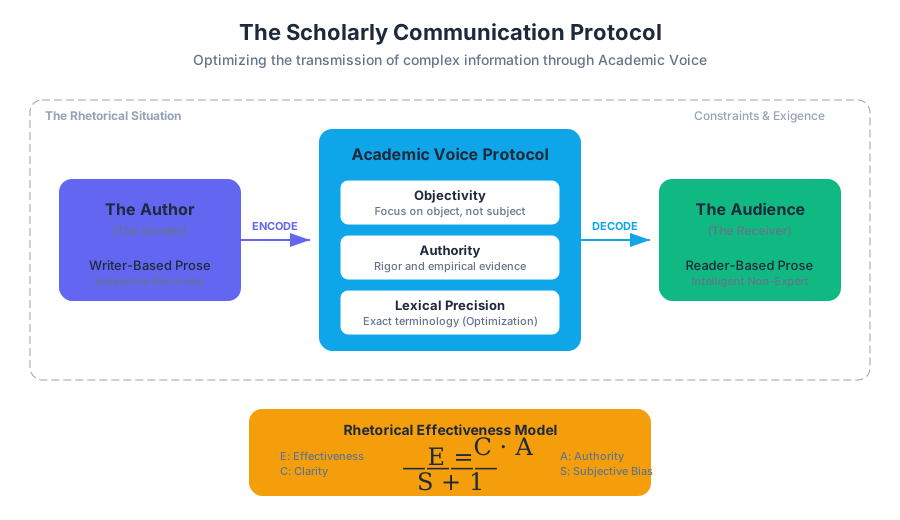
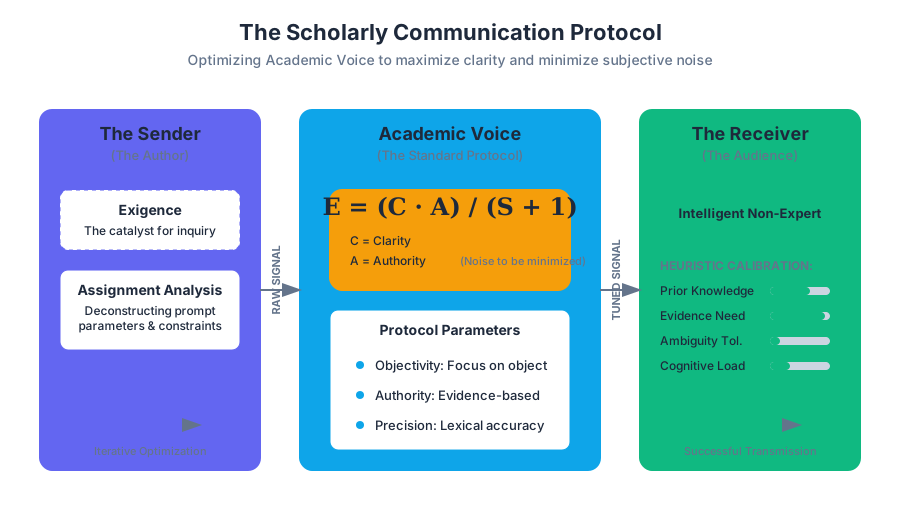
In the domain of scholarly communication, writing is not merely the act of recording thoughts; it is a high-fidelity transmission of complex information from a sender (the author) to a specific receiver (the audience) via a standardized protocol known as Academic Voice. To master this, one must view the writing process as a non-linear, iterative optimization problem where the goal is to maximize clarity and authority while minimizing subjective noise.
The Rhetorical Situation and Audience Awareness
Audience Awareness is the cognitive heuristic a writer uses to calibrate the complexity, tone, and depth of their discourse. In an academic context, the audience is typically modeled as an "intelligent non-expert" or a "peer-reviewer"—individuals who possess high general intelligence but require explicit evidence and logical scaffolding to accept a new claim.
Definition: The Rhetorical Situation The convergence of the Exigence (the need to write), the Audience (the receivers), and the Constraints (the rules of the medium). Effective writing occurs only when the author’s "signal" is tuned to the audience's "frequency."
The Receiver Model
When writing, you must define your audience's parameters. In college-level writing, these parameters are often defined by the assignment rubric, but the underlying expectation is a move toward professionalization. This involves moving away from the "writer-based prose" (writing to figure out what you think) toward "reader-based prose" (writing to explain what you have discovered).
| Audience Parameter | Description | Academic Expectation |
|---|---|---|
| Prior Knowledge | The amount of domain-specific info the reader holds. | Assume foundational knowledge; define specialized terms. |
| Expectation of Evidence | What constitutes "proof" for this reader? | Empirical data, peer-reviewed citations, logical proofs. |
| Tolerance for Ambiguity | How the reader reacts to "I think" or "maybe." | Extremely low. Claims must be definitive and supported. |
| Relationship to Author | The power dynamic between sender and receiver. | Professional, objective, and egalitarian. |
| Cognitive Load | The mental effort required to parse the text. | Minimized through clear structure and logical transitions. |
Analyzing the Assignment
Before a single word is drafted, the writer must perform an Assignment Analysis. This is the process of deconstructing the prompt to identify the rhetorical style (e.g., descriptive, argumentative, analytical), length requirements, and source expectations. Failure to align with these parameters results in "off-protocol" communication, regardless of the quality of the prose.
Academic Voice: The Standard Protocol
Academic Voice is the formal register used in scholarly environments. It is characterized by an Objective Tone, Lexical Precision, and Logical Transparency. Unlike "informal voice," which relies on shared cultural context and emotional resonance, Academic Voice relies on the internal consistency of the argument.
Characteristics of the Academic Protocol
- Objectivity: The focus remains on the object of study, not the subject (the writer). This is why the first-person "I" is often deprecated in favor of third-person constructions.
- Authority: The writer establishes credibility through the rigor of their research rather than the intensity of their feelings.
- Precision: Using the exact word for the exact concept (e.g., using "mitigate" instead of "fix").
The Mathematical Representation of Rhetorical Impact
We can model the effectiveness of academic writing ($E$) as a function of Clarity ($C$), Authority ($A$), and the inverse of Subjective Bias ($S$):
E = \frac{C \cdot A}{S + 1}
In this model, as $S$ (subjective bias, such as "I feel" or "In my opinion") approaches zero, the overall effectiveness $E$ is maximized, allowing the clarity of the argument and the authority of the evidence to dominate the reader's perception.
Implementation: A Lexical Analysis Tool
To visualize the difference between informal and academic voice, we can use a programmatic approach to flag "low-authority" tokens in a draft.
import re

def analyze_academic_voice(text):
    # Tokens that decrease academic authority
    informal_tokens = {
        r"\bI think\b": "Subjective hedging",
        r"\bBasically\b": "Filler word/Oversimplification",
        r"\ba lot of\b": "Imprecise quantification",
        r"\bthings\b": "Vague noun",
        r"\bget\b": "Colloquial verb",
        r"n't\b": "Contraction (informal)"
    }

    findings = []
    for pattern, reason in informal_tokens.items():
        matches = re.findall(pattern, text, flags=re.IGNORECASE)
        if matches:
            findings.append({"pattern": pattern, "count": len(matches), "issue": reason})

    return findings

sample_draft = "I think that a lot of things basically don't get fixed by the new policy."
report = analyze_academic_voice(sample_draft)

# Output:
# [{'pattern': '\\bI think\\b', 'count': 1, 'issue': 'Subjective hedging'},
#  {'pattern': '\\ba lot of\\b', 'count': 1, 'issue': 'Imprecise quantification'}, ...]
Tone and Word Choice: Lexical Optimization
The Tone of a piece is the "acoustic" quality of the prose—the attitude the writer projects toward the subject and the audience. In academic writing, this tone must remain neutral. This is achieved through specific lexical substitutions.
Formal vs. Informal Lexicon
Academic writing avoids colloquialisms, contractions, and "hedging" language that lacks empirical backing.
| Informal/Colloquial | Academic Substitute | Rationale |
|---|---|---|
| "A lot of" | "Substantial," "Numerous" | Quantifiable vs. Vague. |
| "Basically" | "Fundamentally" | Precision of essence. |
| "I think" | "The evidence suggests" | Shifts focus from author to data. |
| "Things" | "Factors," "Variables," "Elements" | Specificity of the object. |
| "Bad" | "Detrimental," "Inadequate" | Evaluative precision. |
| "Find out" | "Ascertain," "Determine" | Professional register. |
The Non-Linear Writing Process: The Slinky Metaphor
A common misconception among novice writers is that writing is a linear progression from Introduction to Conclusion. In reality, writing is a recursive, non-linear process. A useful metaphor is the Slinky®: a single coil of material that loops back on itself. While the "slinky" moves forward in space, it constantly revisits the same longitudinal positions at different altitudes.
Stages of the Iterative Loop
- Prewriting (The Creative Phase): Brainstorming, mapping, and journaling. This is where original analysis begins. College writing demands more than summary; it requires the contribution of new observations.
- Drafting (The Structural Phase): Translating ideas into a logical flow. This is often "messy" and serves as a proof-of-concept for the thesis.
- Revising (The Global Optimization Phase): Re-evaluating the logic, the strength of the evidence, and the clarity of the argument.
- Editing (The Local Optimization Phase): Fixing sentence-level issues, grammar, and typos.
Theorem: The Iteration Necessity The quality of a final manuscript is directly proportional to the number of recursive loops performed between the "Drafting" and "Revising" states. $Q \propto \sum_{i=1}^{n} R_i$, where $R$ is a revision cycle.
Mathematical Representation of the Slinky Process
We can represent the writing process as a vector $\vec{W}$ in a state space where $t$ is time and $D$ is the depth of development.
\vec{W}(t) = \begin{pmatrix} \cos(t) \\ \sin(t) \\ \alpha t \end{pmatrix}
In this helix model, the $z$-axis ($\alpha t$) represents progress toward the final deadline, while the $xy$-plane represents the recursive revisiting of the core thesis and evidence.
Narrowing the Topic and Gathering Information
Effective writing begins with Topic Feasibility. A topic that is too broad (e.g., "The Vietnam War") cannot be covered with sufficient depth in a standard academic paper. A narrowed topic (e.g., "The impact of televised journalism on public perception of the Tet Offensive") allows for the In-depth Writing expected in higher education.
The Hand Fan Analogy
Gathering information follows the structure of a Hand Fan.
- The Pivot Point: Your narrowed, specific topic.
- The Ribs: The various lines of inquiry or sub-topics.
- The Fabric: The gathered evidence that connects the ribs.
As you research, the "fan" opens wide to include various perspectives, but it remains firmly anchored to the central pivot point (the thesis).
Research Standards and Database Strategies
Academic research requires moving beyond general reference sources (like encyclopedias or Wikipedia). While these are excellent for a preliminary overview, they lack the peer-reviewed rigor required for academic citation.
| Source Type | Use Case | Academic Status |
|---|---|---|
| General Reference | Preliminary overview, defining basic terms. | Non-citable in final drafts. |
| Peer-Reviewed Journals | Primary evidence, current scholarly debate. | Gold Standard. |
| Monographs (Books) | Deep historical context, comprehensive theory. | High Authority. |
| Primary Sources | Raw data, historical documents, original experiments. | Essential for original analysis. |
Implementation: Automated Search Query Generation
To narrow a topic effectively, a researcher might use boolean logic to filter database results.
# Example: Narrowing a search from "Climate Change" to a feasible academic topic
# Using a CLI-based tool or simply conceptualizing the logic

SEARCH_TERM="Climate Change"
NARROWED_TERM="${SEARCH_TERM} AND 'Arctic Permafrost' AND 'Methane Release' NOT 'General Warming'"

# Execute search in a hypothetical academic API
curl -X GET "https://api.scholar-database.org/v1/search?q=${NARROWED_TERM}&peer_reviewed=true"
Ordering, Drafting, and Thesis Support
Once information is gathered, the Ordering phase begins. This is where the writer constructs an Outline to ensure logical flow. The outline acts as the "skeleton" of the paper, ensuring that every paragraph serves to support the Thesis Statement.
Paragraph Construction: The Building Blocks
Each paragraph in an academic essay should function as a micro-argument:
- Topic Sentence: States the main point of the paragraph.
- Evidence: Provides data, quotes, or facts from sources.
- Analysis: Explains how the evidence supports the topic sentence and the overall thesis.
- Transition: Links the current idea to the next.
Logic and Evidence Sufficiency
A common pitfall is the "Evidence Gap," where a writer makes a claim but fails to provide sufficient data to bridge the gap between the claim and the conclusion. In academic voice, the writer must assume the reader is a skeptic who requires a 1:1 ratio of claim to evidence.
Structural Framing: Introductions and Conclusions
The Introduction and Conclusion serve as the "frame" for the essay’s body. They are the first and last interactions the reader has with the work, making them critical for establishing and reinforcing the Academic Voice.
The Purpose of the Introduction
Contrary to popular belief, the introduction is often the last thing an expert writes. It must:
- Capture Attention: Engage the reader with the exigence of the topic.
- Provide Context: Offer necessary background info.
- Identify the Central Issue: What problem is being solved?
- State the Thesis: The definitive claim of the paper.
The Purpose of the Conclusion
The conclusion is not a mere summary. It is a synthesis. It should:
- Reinforce the Thesis: Restate the main argument in light of the evidence presented.
- Synthesize Key Points: Show how the individual arguments fit together.
- Provide a Final Impression: Leave the reader with a sense of the topic's significance (the "So What?" factor).
Revising vs. Editing: The Duality of Refinement
One of the most important distinctions in the writing process is the difference between Revising and Editing. Treating them as a single task leads to "cognitive overload," where the writer tries to fix a structural logical flaw and a comma splice at the same time.
The Revision/Editing Matrix
| Feature | Revising (Macro) | Editing (Micro) |
|---|---|---|
| Focus | Content, Logic, Organization. | Grammar, Spelling, Punctuation. |
| Goal | Clarity of Argument. | Accuracy of Mechanics. |
| Action | Adding, deleting, or moving paragraphs. | Changing words, fixing typos. |
| Perspective | The Reader's understanding. | The Language's rules. |
Implementation: A Style-Check Configuration
To maintain academic voice during the editing phase, writers can use "linters" (automated style checkers) configured with academic rules.
# .proselint.yaml - Configuration for Academic Writing
checks:
  # Disable informal checks
  cliches.very: true
  colloquialisms.general: true

  # Enforce objective tone
  first_person.i_me_my: true
  hedging.vague_terms: true

  # Enforce precision
  jargon.unexplained: true
  redundancy.wordy_phrases: true
Common Pitfalls in Academic Writing
- The "Thesaurus Syndrome": Using overly complex words incorrectly in an attempt to sound "academic." True academic voice prioritizes clarity over complexity.
- The Summary Trap: Simply repeating what sources say without providing Original Analysis.
- The "I" Crutch: Relying on personal opinion ("I feel") rather than empirical evidence.
- The Linear Fallacy: Expecting the first draft to be the final draft. Writing is a process of discovery; the thesis often changes as the draft develops.
Drafting, Revising, and Editing
Key concepts: Outlining · Thesis Support · Revision vs. Editing · Paragraph Construction · Logical Flow
The final stages of the writing process, focusing on structural organization, content clarity, and mechanical precision.
Drafting, Revising, and Editing: The Recursive Architecture of Composition
Writing is frequently misunderstood as a linear progression—a straight line from a blank page to a finished manuscript. In reality, professional and academic composition is a recursive, non-linear process. It is best visualized through the Slinky® metaphor: a single coil of material that loops back on itself repeatedly while moving forward. Each loop represents a stage—prewriting, drafting, revising, and editing—that informs and reshapes the others.
As a scholar or practitioner, mastering this process means transitioning from "writing as recording" to "writing as thinking." The tangible result is not just a document, but a refined cognitive model of a complex topic, structured for maximum impact on a specific audience. This article deconstructs the mechanics of this architecture, from the initial narrowing of a topic to the final micro-edits of a manuscript.
The Pre-Drafting Foundation: Narrowing and Gathering
Before a single sentence is drafted, the writer must establish Topic Feasibility. In the university and professional sphere, the goal is rarely to summarize existing knowledge, but to provide original analysis. This requires a transition from a broad subject to a researchable focus.
Narrowing the Scope
A common pitfall for novice writers is selecting a topic too broad for the assigned length. A broad topic leads to superficiality; a narrow topic allows for depth. The "Hand Fan" analogy is useful here: you start at a narrow point (your specific research question) and expand outward to gather supporting data. However, every piece of data must remain "connected" to that central pivot point.
| Aspect | Broad Topic (Ineffective) | Narrowed Focus (Effective) |
|---|---|---|
| Subject | The Vietnam War | The impact of televised reporting on US public opinion in 1968 |
| Scope | Artificial Intelligence | Ethical implications of biased training sets in facial recognition |
| Depth | Summary of events | Analysis of specific causal mechanisms |
| Research | Overwhelming/Unfocused | Targeted/High-utility |
| Outcome | Descriptive/General | Argumentative/Specific |
The Pivot Point and Information Gathering
Effective information gathering is most successful when a topic is narrowed, allowing for more specific and manageable research results. While general reference sources like encyclopedias can provide a necessary broad overview for unfamiliar subjects, they should only serve as preliminary starting points in academic writing.
Definition: The Pivot Point The specific, researchable question or problem statement that anchors all subsequent information gathering and prevents "scope creep" in the drafting phase.
Outlining and Thesis Support
The Outline is the architectural blueprint of the essay. It serves two primary functions: ensuring Logical Flow and verifying Thesis Support. Every major point in the outline must act as a structural pillar for the Thesis Statement—the central argument of the work.
Algorithmic Structuring
In technical writing, we can view the relationship between the thesis and the body paragraphs as a directed acyclic graph (DAG), where each node (paragraph) must have a logical path back to the root (thesis). If a node exists that does not contribute to the root's validity, it is a "dangling pointer" and must be excised.
class DocumentStructure:
    """
    A class to represent the logical mapping of a document.
    Ensures every paragraph (node) supports the central thesis.
    """
    def __init__(self, thesis: str):
        self.thesis = thesis
        self.nodes = []

    def add_claim(self, claim: str, evidence_weight: float, relates_to_thesis: bool):
        """
        Adds a claim to the document structure if it supports the thesis.
        """
        if not relates_to_thesis:
            print(f"CRITICAL ERROR: Claim '{claim}' does not support the thesis.")
            return False

        node = {
            "claim": claim,
            "weight": evidence_weight,
            "validated": False
        }
        self.nodes.append(node)
        return True

    def validate_structure(self):
        # A document is valid only if all claims are relevant and
        # total evidence weight exceeds a threshold.
        total_weight = sum(n['weight'] for n in self.nodes)
        if total_weight > 0.8 and len(self.nodes) >= 3:
            return "LOGICALLY SOUND"
        return "INSUFFICIENT EVIDENCE"

# Example Usage
paper = DocumentStructure("The adoption of Rust reduces memory safety vulnerabilities.")
paper.add_claim("Ownership semantics prevent data races.", 0.9, True)
paper.add_claim("Borrow checker enforces lifetime constraints.", 0.85, True)
paper.add_claim("Rust's logo is aesthetically pleasing.", 0.1, False) # This fails

print(f"Status: {paper.validate_structure()}")
Paragraph Construction and Logical Flow
A paragraph is the fundamental unit of composition. Beyond simple grouping, a paragraph must function as a self-contained logical proof. Professional writers often use the MEAL model (Main Idea, Evidence, Analysis, Link) to ensure each paragraph is robust.
The MEAL Model Components
- Main Idea (Topic Sentence): The "claim" of the paragraph.
- Evidence: Data, quotes, or facts that support the claim.
- Analysis: The writer's original thought explaining how the evidence proves the claim.
- Link: A transition that connects the paragraph back to the thesis or forward to the next point.
Formal Logic in Paragraphs
The transition between paragraphs is where many writers lose their audience. Logical flow is achieved through Syllogistic Progression, where the conclusion of one paragraph provides the premise for the next.
\begin{aligned}
& \text{Let } P_n \text{ be the claim of paragraph } n. \\
& \text{Let } E_n \text{ be the evidence for } P_n. \\
& \text{Let } T \text{ be the Thesis Statement.} \\
\\
& \text{A document is logically coherent if:} \\
& \forall n: (E_n \implies P_n) \land (P_n \implies T) \\
& \text{and } P_n \to P_{n+1} \text{ exists as a semantic transition.}
\end{aligned}
The Drafting Phase: Iterative Development
Drafting is the process of expanding the outline into prose. It is a preliminary step, often requiring "shitty first drafts" to get ideas onto the page. The goal of drafting is not perfection but Evidence Sufficiency.
Strategies for Effective Drafting
- Write the Introduction Last: Since the introduction sets the context and contains the thesis, it often cannot be finalized until the body of the paper is complete and the writer knows exactly what they are introducing.
- The "Slinky" Loop: If you find yourself stuck during drafting, loop back to the prewriting or research phase. You may need more information or a narrower focus.
- Focus on Flow, Not Polish: During the draft, ignore typos and minor grammatical errors. These belong to the editing phase.
Revision vs. Editing: The Macro and Micro
One of the most critical distinctions in professional writing is the difference between Revision and Editing. They are separate cognitive tasks that require different mindsets.
Revision (Macro-level) "Re-seeing" the paper. It involves evaluating the clarity, order, and amount of information from a reader's perspective. It asks: Does this argument make sense? Is the evidence sufficient?
Editing (Micro-level) Polishing the prose. It addresses sentence-level issues like grammar, spelling, punctuation, and style. It asks: Is this sentence clear? Are there typos?
| Feature | Revision | Editing |
|---|---|---|
| Focus | Content, Logic, Structure | Grammar, Syntax, Mechanics |
| Scale | Global (Whole document) | Local (Sentence/Word) |
| Timing | Early to mid-process | Final stage |
| Question | "What am I saying?" | "How am I saying it?" |
| Action | Deleting sections, moving paragraphs | Fixing commas, changing word choice |
The Revision Pipeline
- Wait: Allow at least 24 hours between drafting and revision to gain "distance."
- Reverse Outline: Read the draft and create an outline based on what is actually written. Compare this to the original blueprint.
- Check Transitions: Ensure the "Link" in each MEAL paragraph actually connects to the next "Main Idea."
The Editing Pipeline
Editing should be done in multiple passes, each focusing on a specific type of error.
# A hypothetical CLI workflow for a writer using automated tools
# Pass 1: Check for common stylistic issues (passive voice, clichés)
proselint manuscript.txt

# Pass 2: Check for specific "crutch words" the writer knows they overuse
grep -E "very|really|basically|actually" manuscript.txt | wc -l

# Pass 3: Check for sentence length variety (long sentences can be hard to follow)
style --sentence-length manuscript.txt

# Pass 4: Final spell check
aspell check manuscript.txt
Framing: Introductions and Conclusions
The introduction and conclusion serve as a structural frame. They are the first and last interactions a reader has with the work, making them disproportionately important for the overall impression.
The Introduction's Tasks
An effective introduction must:
- Capture Attention: Use a "hook" (a startling statistic, a relevant anecdote, or a provocative question).
- Establish Context: Provide the necessary background for the reader to understand the issue.
- Identify the Central Issue: Clearly state the problem being addressed.
- Present the Thesis: Offer the author's perspective and the main argument.
The Conclusion's Tasks
A conclusion should not merely summarize; it should synthesize.
- Reinforce the Thesis: Remind the reader of the central argument in light of the evidence presented.
- Provide Closure: Avoid introducing new information.
- Leave a Lasting Impression: Explain the broader implications of the findings or suggest future areas of inquiry.
Common Pitfalls in the Writing Process
Despite a structured approach, several common errors can derail the composition process:
- The "One-and-Done" Fallacy: Attempting to write a final draft in a single sitting. This bypasses the recursive loops necessary for deep thought.
- Lumping Revision and Editing: Trying to fix commas while also trying to fix a logical gap. This leads to cognitive overload and poor results in both areas.
- Scope Creep: Allowing the "Hand Fan" to expand so wide that the connection to the central pivot point is lost.
- Summary vs. Analysis: Providing a book report of what others have said rather than using those sources to support an original claim.
Data-Driven Revision: The Scoring Matrix
For professional or peer-review contexts, using a scoring matrix during the revision phase can provide objective feedback on a draft's readiness.
| Criterion | Weight | Definition |
|---|---|---|
| Thesis Clarity | 25% | Is the central argument specific, debatable, and easy to find? |
| Evidence Quality | 25% | Are sources credible, relevant, and properly cited? |
| Logical Flow | 20% | Do paragraphs follow a syllogistic progression? |
| Voice/Tone | 15% | Is the language appropriate for the target audience? |
| Mechanics | 15% | Is the document free of grammar, spelling, and formatting errors? |
Conclusion: The Iterative Loop
Mastering the writing process is not about reaching a state where the first draft is perfect; it is about developing the discipline to move through the loops of the Slinky. By separating the creative act of drafting from the critical act of revision, and the structural act of outlining from the mechanical act of editing, writers can produce work that is both intellectually deep and professionally polished.
Source Materials
Study Online Writing Lab with AI — Free on Lykke
Sign up for free to generate personalized flashcards, quizzes, and study guides from this course. Chat with an AI tutor that knows the material.
Get Started FreeView this course wiki on Lykke · Browse all public course wikis