From the free course Online Writing Lab on Lykke
Drafting, Revising, and Editing
Key concepts: Outlining · Thesis Support · Revision vs. Editing · Paragraph Construction · Logical Flow
The final stages of the writing process, focusing on structural organization, content clarity, and mechanical precision.
Drafting, Revising, and Editing: The Recursive Architecture of Composition
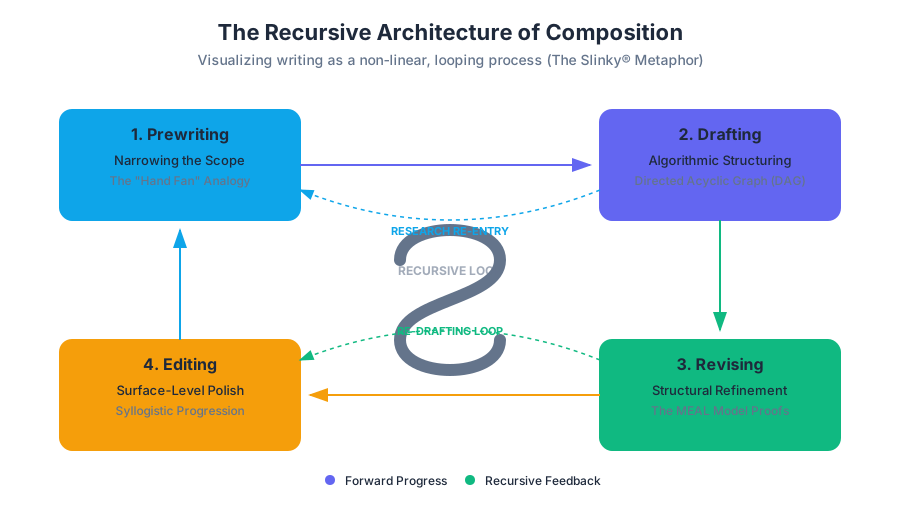
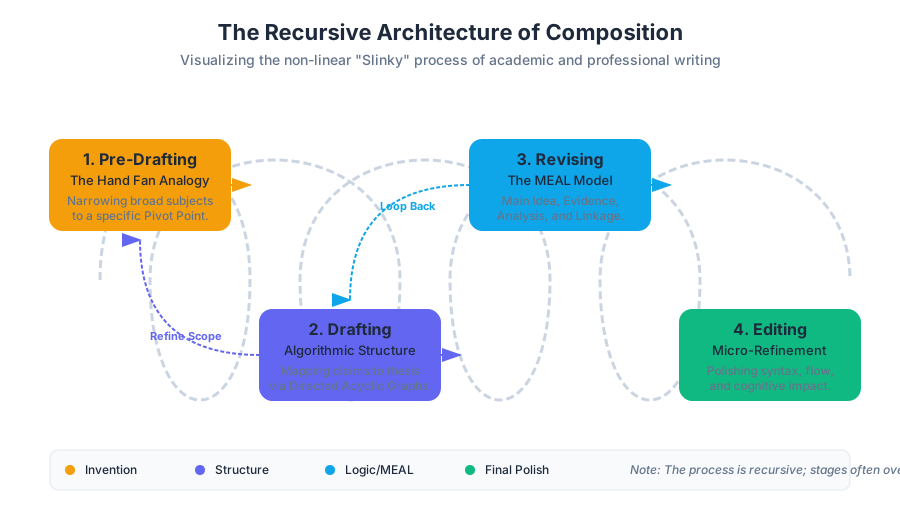
Writing is frequently misunderstood as a linear progression—a straight line from a blank page to a finished manuscript. In reality, professional and academic composition is a recursive, non-linear process. It is best visualized through the Slinky® metaphor: a single coil of material that loops back on itself repeatedly while moving forward. Each loop represents a stage—prewriting, drafting, revising, and editing—that informs and reshapes the others.
As a scholar or practitioner, mastering this process means transitioning from "writing as recording" to "writing as thinking." The tangible result is not just a document, but a refined cognitive model of a complex topic, structured for maximum impact on a specific audience. This article deconstructs the mechanics of this architecture, from the initial narrowing of a topic to the final micro-edits of a manuscript.
The Pre-Drafting Foundation: Narrowing and Gathering
Before a single sentence is drafted, the writer must establish Topic Feasibility. In the university and professional sphere, the goal is rarely to summarize existing knowledge, but to provide original analysis. This requires a transition from a broad subject to a researchable focus.
Narrowing the Scope
A common pitfall for novice writers is selecting a topic too broad for the assigned length. A broad topic leads to superficiality; a narrow topic allows for depth. The "Hand Fan" analogy is useful here: you start at a narrow point (your specific research question) and expand outward to gather supporting data. However, every piece of data must remain "connected" to that central pivot point.
| Aspect | Broad Topic (Ineffective) | Narrowed Focus (Effective) |
|---|---|---|
| Subject | The Vietnam War | The impact of televised reporting on US public opinion in 1968 |
| Scope | Artificial Intelligence | Ethical implications of biased training sets in facial recognition |
| Depth | Summary of events | Analysis of specific causal mechanisms |
| Research | Overwhelming/Unfocused | Targeted/High-utility |
| Outcome | Descriptive/General | Argumentative/Specific |
The Pivot Point and Information Gathering
Effective information gathering is most successful when a topic is narrowed, allowing for more specific and manageable research results. While general reference sources like encyclopedias can provide a necessary broad overview for unfamiliar subjects, they should only serve as preliminary starting points in academic writing.
Definition: The Pivot Point The specific, researchable question or problem statement that anchors all subsequent information gathering and prevents "scope creep" in the drafting phase.
Outlining and Thesis Support
The Outline is the architectural blueprint of the essay. It serves two primary functions: ensuring Logical Flow and verifying Thesis Support. Every major point in the outline must act as a structural pillar for the Thesis Statement—the central argument of the work.
Algorithmic Structuring
In technical writing, we can view the relationship between the thesis and the body paragraphs as a directed acyclic graph (DAG), where each node (paragraph) must have a logical path back to the root (thesis). If a node exists that does not contribute to the root's validity, it is a "dangling pointer" and must be excised.
Paragraph Construction and Logical Flow
A paragraph is the fundamental unit of composition. Beyond simple grouping, a paragraph must function as a self-contained logical proof. Professional writers often use the MEAL model (Main Idea, Evidence, Analysis, Link) to ensure each paragraph is robust.
The MEAL Model Components
- Main Idea (Topic Sentence): The "claim" of the paragraph.
- Evidence: Data, quotes, or facts that support the claim.
- Analysis: The writer's original thought explaining how the evidence proves the claim.
- Link: A transition that connects the paragraph back to the thesis or forward to the next point.
Formal Logic in Paragraphs
The transition between paragraphs is where many writers lose their audience. Logical flow is achieved through Syllogistic Progression, where the conclusion of one paragraph provides the premise for the next.
\begin{aligned}
& \text{Let } P_n \text{ be the claim of paragraph } n. \\
& \text{Let } E_n \text{ be the evidence for } P_n. \\
& \text{Let } T \text{ be the Thesis Statement.} \\
\\
& \text{A document is logically coherent if:} \\
& \forall n: (E_n \implies P_n) \land (P_n \implies T) \\
& \text{and } P_n \to P_{n+1} \text{ exists as a semantic transition.}
\end{aligned}
The Drafting Phase: Iterative Development
Drafting is the process of expanding the outline into prose. It is a preliminary step, often requiring "shitty first drafts" to get ideas onto the page. The goal of drafting is not perfection but Evidence Sufficiency.
Strategies for Effective Drafting
- Write the Introduction Last: Since the introduction sets the context and contains the thesis, it often cannot be finalized until the body of the paper is complete and the writer knows exactly what they are introducing.
- The "Slinky" Loop: If you find yourself stuck during drafting, loop back to the prewriting or research phase. You may need more information or a narrower focus.
- Focus on Flow, Not Polish: During the draft, ignore typos and minor grammatical errors. These belong to the editing phase.
Revision vs. Editing: The Macro and Micro
One of the most critical distinctions in professional writing is the difference between Revision and Editing. They are separate cognitive tasks that require different mindsets.
Revision (Macro-level) "Re-seeing" the paper. It involves evaluating the clarity, order, and amount of information from a reader's perspective. It asks: Does this argument make sense? Is the evidence sufficient?
Editing (Micro-level) Polishing the prose. It addresses sentence-level issues like grammar, spelling, punctuation, and style. It asks: Is this sentence clear? Are there typos?
| Feature | Revision | Editing |
|---|---|---|
| Focus | Content, Logic, Structure | Grammar, Syntax, Mechanics |
| Scale | Global (Whole document) | Local (Sentence/Word) |
| Timing | Early to mid-process | Final stage |
| Question | "What am I saying?" | "How am I saying it?" |
| Action | Deleting sections, moving paragraphs | Fixing commas, changing word choice |
The Revision Pipeline
- Wait: Allow at least 24 hours between drafting and revision to gain "distance."
- Reverse Outline: Read the draft and create an outline based on what is actually written. Compare this to the original blueprint.
- Check Transitions: Ensure the "Link" in each MEAL paragraph actually connects to the next "Main Idea."
The Editing Pipeline
Editing should be done in multiple passes, each focusing on a specific type of error.
Framing: Introductions and Conclusions
The introduction and conclusion serve as a structural frame. They are the first and last interactions a reader has with the work, making them disproportionately important for the overall impression.
The Introduction's Tasks
An effective introduction must:
- Capture Attention: Use a "hook" (a startling statistic, a relevant anecdote, or a provocative question).
- Establish Context: Provide the necessary background for the reader to understand the issue.
- Identify the Central Issue: Clearly state the problem being addressed.
- Present the Thesis: Offer the author's perspective and the main argument.
The Conclusion's Tasks
A conclusion should not merely summarize; it should synthesize.
- Reinforce the Thesis: Remind the reader of the central argument in light of the evidence presented.
- Provide Closure: Avoid introducing new information.
- Leave a Lasting Impression: Explain the broader implications of the findings or suggest future areas of inquiry.
Common Pitfalls in the Writing Process
Despite a structured approach, several common errors can derail the composition process:
- The "One-and-Done" Fallacy: Attempting to write a final draft in a single sitting. This bypasses the recursive loops necessary for deep thought.
- Lumping Revision and Editing: Trying to fix commas while also trying to fix a logical gap. This leads to cognitive overload and poor results in both areas.
- Scope Creep: Allowing the "Hand Fan" to expand so wide that the connection to the central pivot point is lost.
- Summary vs. Analysis: Providing a book report of what others have said rather than using those sources to support an original claim.
Data-Driven Revision: The Scoring Matrix
For professional or peer-review contexts, using a scoring matrix during the revision phase can provide objective feedback on a draft's readiness.
| Criterion | Weight | Definition |
|---|---|---|
| Thesis Clarity | 25% | Is the central argument specific, debatable, and easy to find? |
| Evidence Quality | 25% | Are sources credible, relevant, and properly cited? |
| Logical Flow | 20% | Do paragraphs follow a syllogistic progression? |
| Voice/Tone | 15% | Is the language appropriate for the target audience? |
| Mechanics | 15% | Is the document free of grammar, spelling, and formatting errors? |
Conclusion: The Iterative Loop
Mastering the writing process is not about reaching a state where the first draft is perfect; it is about developing the discipline to move through the loops of the Slinky. By separating the creative act of drafting from the critical act of revision, and the structural act of outlining from the mechanical act of editing, writers can produce work that is both intellectually deep and professionally polished.
Source Materials
Study Online Writing Lab on Lykke
This course page is free to open: signed out, you can read its first two sections, and signing in, on any plan, opens the rest. The free Lykke Chrome extension syncs your own Canvas courses, so ChatGPT, Claude and Muse can answer from your classes and deadlines. It only reads Canvas.
Add the free extensionSign in to open every sectionAll sections of Online Writing Lab · Browse more course pages