From the free course Online Writing Lab on Lykke
Assignment Analysis and Topic Narrowing
Key concepts: Rhetorical Analysis · Topic Feasibility · Hand Fan Analogy · Information Gathering
How to analyze assignment requirements and narrow a broad subject into a feasible, researchable topic.
Assignment Analysis and Topic Narrowing
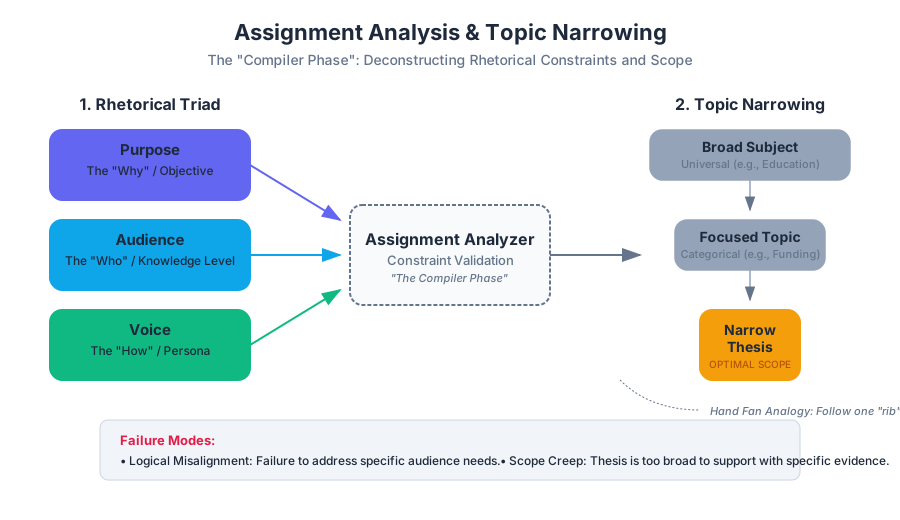
In the lifecycle of academic and professional production, the initial phase—Assignment Analysis and Topic Narrowing—functions as the "pre-processing" or "compilation" stage. Just as a software engineer must analyze system requirements before writing a single line of code, a writer must deconstruct the rhetorical constraints and scope of an assignment to ensure the final output is both viable and impactful. Failure to perform this analysis often results in "scope creep," where a thesis becomes too broad to support, or "logical misalignment," where the writer fails to address the specific needs of the audience.
Rhetorical Analysis: The Compiler Phase
Rhetorical Analysis is the systematic process of evaluating the communicative context of a writing task. It is not merely about understanding the instructions; it is about identifying the underlying variables that will govern the success of the document. These variables are categorized into the Rhetorical Triad: Purpose, Audience, and Voice.
The Rhetorical Triad
Definition: The Rhetorical Triad A framework for evaluating the constraints of a writing task by analyzing the Purpose (the "Why"), the Audience (the "Who"), and the Voice (the "How").
- Purpose: This defines the objective function of the text. Is the goal to persuade, inform, analyze, or narrate? In technical terms, the purpose dictates the schema of the argument.
- Audience: The target demographic determines the "level of abstraction." A senior engineer requires different data density than a layperson or a first-year student.
- Voice: This is the "interface" of the writing. It encompasses the tone, formality, and persona adopted by the writer to establish credibility (ethos).
| Parameter | Technical Focus | Failure Mode | Success Metric |
|---|---|---|---|
| Purpose | Teleology of the task | Goal misalignment (e.g., narrating instead of arguing) | Objective achievement (e.g., reader is persuaded) |
| Audience | Knowledge thresholding | Cognitive overload or oversimplification | High engagement and comprehension |
| Voice | Stylistic consistency | Inappropriate register (e.g., slang in a formal report) | Established authority and trust |
The Hand Fan Analogy: Visualizing Topic Narrowing
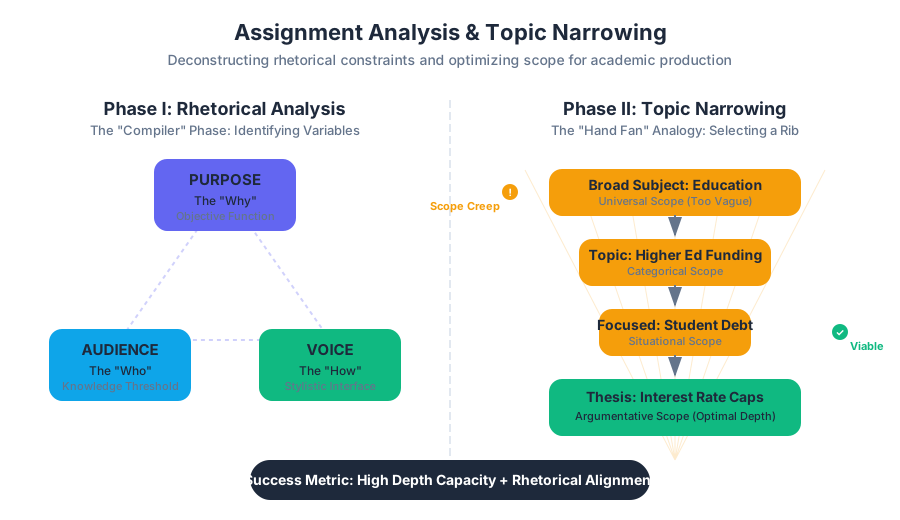
A common mistake in topic selection is choosing a "Global Topic"—a subject so vast that any attempt to cover it in a standard essay results in a superficial summary. To visualize the process of narrowing, we use the Hand Fan Analogy.
Imagine a folded hand fan. At the base (the pivot), you have the broad, general subject (e.g., "Climate Change"). As you open the fan, the "ribs" represent specific sub-categories (e.g., "Ocean Acidification," "Carbon Tax Policy," "Arctic Migration"). To write an effective paper, you do not try to write about the entire open fan; instead, you select a single "rib" and follow it to its tip.
From Broad to Narrow: The Funnel Effect
| Stage | Scope | Example | Analytical Utility |
|---|---|---|---|
| Broad Subject | Universal | Education | Too vague; no specific argument possible. |
| Topic | Categorical | Higher Education Funding | Better, but still a multi-volume encyclopedia subject. |
| Focused Topic | Situational | Student Loan Debt in the US | Manageable for a long report or thesis. |
| Narrow Thesis | Argumentative | The impact of interest rate caps on graduate school enrollment. | Optimal: Allows for specific evidence and deep analysis. |
Prewriting Strategies: The Creative Entropy Stage
Before a thesis can be formalized, the writer must engage in Prewriting. This is the "messy" stage of development, characterized by high entropy and low formal constraints. The goal is not to produce polished prose but to generate raw data and identify patterns.
1. Freewriting and Journaling
Freewriting is a stream-of-consciousness technique where the writer writes continuously for a set period (e.g., 10 minutes) without regard for grammar, spelling, or logic. This bypasses the "internal editor" that often causes writer's block. Journaling functions similarly but is more reflective, allowing a writer to probe the why and how of a personal observation over time.
2. Brainstorming and Listing
Brainstorming involves listing every thought related to a topic. It is a "dump" of the subconscious into a structured or semi-structured list. Once the list is generated, the writer performs a Filtering Pass to group related items and discard outliers.
3. Mapping and Diagramming
For visual thinkers, Mapping (or Mind Mapping) creates a non-linear representation of ideas. It allows the writer to see the "topology" of their thoughts—identifying which concepts are central hubs and which are peripheral nodes.
% Mathematical representation of Topic Narrowing via Set Theory
\text{Let } S \text{ be the set of all information regarding a Broad Subject.} \\
\text{Let } T \subset S \text{ be a Focused Topic.} \\
\text{Let } A \text{ be the Analytical Angle applied to } T. \\
\text{The Thesis } \Theta \text{ is defined as: } \\
\Theta = A(T) \text{ such that } \text{length}(\Theta) \propto \frac{1}{\text{scope}(T)}
Information Gathering and Defining Questions
Once a general area of interest is identified, the writer must transition from "generation" to "refinement." This is achieved through Defining Questions. These questions act as filters that catch broad ideas and force them into specific shapes.
The "Why/How" Heuristic If a topic can be answered with a "Yes" or "No," it is not a thesis; it is a fact. A narrow, analytical topic must address how a mechanism works or why a specific phenomenon occurs.
Example: The School Tax Refinement
- Broad Idea: I want to write about school taxes.
- Defining Question: Why do only property owners in New York State pay school taxes, while renters do not?
- Narrowed Focus: The equity gap between property-based school funding and the rising demographic of long-term urban renters.
| Strategy | Action | Best Used When... |
|---|---|---|
| Listing | Create a "Top 10" reasons for a stance. | You have a clear opinion but need supporting pillars. |
| Pros & Cons | Simulate a debate by listing opposing views. | You are writing a persuasive or argumentative piece. |
| Mapping | Draw circles and lines connecting sub-ideas. | You have many ideas but don't see the hierarchy. |
| Defining Questions | Interrogate the "Who, What, Where, When, Why." | Your topic feels "flat" or purely descriptive. |
The Recursive Writing Process: Iteration vs. Linearity
Effective writing is recursive, not linear. A writer does not simply move from Step 1 to Step 5. Instead, the process resembles an Agile Development Loop.
- Prewrite: Generate ideas.
- Analyze: Check against rhetorical constraints.
- Draft: Build a prototype of the argument.
- Review: Realize the topic is still too broad.
- Pivot: Return to the "Hand Fan" and select a narrower rib.
- Refine: Finalize the thesis.
Common Pitfalls in Topic Narrowing
Even experienced writers fall into specific "logical traps" during the narrowing phase. Understanding these failure modes is essential for maintaining project velocity.
1. The "Kitchen Sink" Thesis
The writer attempts to cover every aspect of a subject to be "thorough." This results in a paper that is 20 pages of summary and 0 pages of original analysis.
- Correction: Apply the 1-in-10 Rule. For every ten things you know about a topic, only include the one most relevant to your specific argument.
2. The Descriptive Trap
The topic describes what happened rather than analyzing it.
- Example: "The history of the Steam Engine" (Descriptive) vs. "How the portability of the high-pressure steam engine accelerated westward expansion" (Analytical).
3. Misaligned Audience Abstraction
Writing a highly technical breakdown for a general audience, or a "Intro 101" summary for a professor.
- Correction: Perform a Knowledge Audit. What does the reader already know? What is the "delta" (the new information) you are providing?
Worked Example: From Assignment to Thesis
Assignment: Write a 2,000-word argumentative essay on a modern social issue. Audience: Academic (Professor and Peers).
- Initial Thought (Broad): "Social Media is bad for people." (Too broad, cliché).
- Brainstorming (Listing): Privacy, mental health, misinformation, political polarization, dopamine loops.
- Mapping: Connecting "Dopamine Loops" to "Infinite Scroll" and "Teenage Anxiety."
- Defining Question: "How does the 'Infinite Scroll' UI pattern specifically affect the circadian rhythms of adolescents?"
- Topic Narrowing (The Rib): Instead of "Social Media," the focus is now on a specific UI pattern and a specific biological effect on a specific demographic.
- Final Thesis: "The implementation of non-terminating pagination (Infinite Scroll) in mobile applications functions as a variable-ratio reinforcement schedule that significantly degrades sleep quality among users aged 13-18."
- Rhetorical Triad: The combination of Purpose, Audience, and Voice that defines a writing task's constraints.
- Recursive Process: A non-linear approach to writing where the author moves back and forth between stages like prewriting and revising.
- Hand Fan Analogy: A visual metaphor for narrowing a topic from a broad pivot point to a specific, narrow "rib."
- Freewriting: A prewriting technique involving continuous writing to bypass the internal critic.
- Scope Creep: The tendency for a project or topic to become unmanageably broad over time.
- Ethos: The credibility or authority established through the writer's voice and evidence.
- Defining Questions: Specific inquiries (Who, How, Why) used to transform a broad subject into an analytical thesis.
-
Which part of the Rhetorical Triad determines the "level of abstraction" and technical density of the paper?
- A) Purpose
- B) Voice
- C) Audience
- D) Length
- Answer: C (Audience)
-
In the Hand Fan Analogy, what does a single "rib" represent?
- A) The entire essay
- B) A specific sub-topic or analytical angle
- C) The broad subject
- D) The bibliography
- Answer: B
-
True or False: Prewriting should be strictly governed by grammar and formal structure to save time later.
- Answer: False (Prewriting is a high-entropy, creative stage where formal constraints are minimized.)
-
What is the primary danger of a "Kitchen Sink" thesis?
- A) It is too short.
- B) It lacks a bibliography.
- C) It results in superficial summary rather than deep analysis.
- D) It is too controversial.
- Answer: C
-
Which prewriting technique is best for identifying relationships and hierarchies between different ideas?
- A) Freewriting
- B) Mapping
- C) Listing
- D) Journaling
- Answer: B
Study Guide: Mastering Assignment Analysis
I. The Pre-Processing Checklist
Before writing, answer these four questions:
- What is the "Verb"? (Analyze, Argue, Describe, Summarize) — This is your Purpose.
- Who is the "Reader"? (Expert, Layperson, Skeptic) — This defines your Audience.
- What is the "Constraint"? (Word count, Source requirements) — This defines your Feasibility.
- What is the "Angle"? (The specific 'Why' or 'How') — This is your Narrowed Topic.
II. Topic Narrowing Workflow
- Step 1: Start with a Broad Subject (The Pivot).
- Step 2: Use Brainstorming to find 5-10 sub-topics (The Ribs).
- Step 3: Select ONE rib based on interest and resource availability.
- Step 4: Apply a Defining Question to move from a "What" to a "How/Why."
- Step 5: Test the thesis against the word count (The Complexity Index).
III. Key Heuristics
- The Goldilocks Zone: A topic should not be so broad that it's a "Global Topic," nor so narrow that there is no evidence to find.
- The "So What?" Test: If a reader asks "So what?" after reading your thesis, you haven't identified a significant enough analytical angle.
- Embrace the Mess: Don't skip prewriting. The time spent in "Creative Entropy" saves hours of "Writer's Block" during the drafting phase.
Source Materials
Study Online Writing Lab on Lykke
This course page is free to open: signed out, you can read its first two sections, and signing in, on any plan, opens the rest. The free Lykke Chrome extension syncs your own Canvas courses, so ChatGPT, Claude and Muse can answer from your classes and deadlines. It only reads Canvas.
Add the free extensionSign in to open every sectionAll sections of Online Writing Lab · Browse more course pages