From the free course Java Programming and Algorithmic Thinking Fundamentals on Lykke
Searching and Sorting Algorithms
Key concepts: Binary Search · Selection Sort · Insertion Sort · Merge Sort · Algorithm Complexity Analysis
Implementation and performance analysis of fundamental algorithms for organizing and finding data.
Searching and Sorting Algorithms
In the realm of computer science, the ability to organize and retrieve data efficiently is not merely a convenience—it is a fundamental requirement for scalable systems. Whether you are building a search engine, a financial trading platform, or a simple mobile application, the choice of searching and sorting algorithms dictates the performance boundaries of your software. This section explores the mechanics, mathematical foundations, and practical implementations of the industry's most essential algorithms, alongside the analytical tools used to measure their efficacy.
Algorithm Complexity Analysis
Before examining specific algorithms, we must establish a rigorous framework for evaluation. Algorithm Complexity Analysis is the study of how the resource requirements of an algorithm (typically time and memory) scale as the size of the input data, denoted as $n$, increases.
The Big O Notation
We use Big O Notation to describe the "asymptotic upper bound" of an algorithm. It allows us to ignore constant factors and hardware-specific variations, focusing instead on the growth rate.
Definition: An algorithm is $O(f(n))$ if there exist constants $c$ and $n_0$ such that the execution time $T(n) \le c \cdot f(n)$ for all $n > n_0$.
Common Complexity Classes
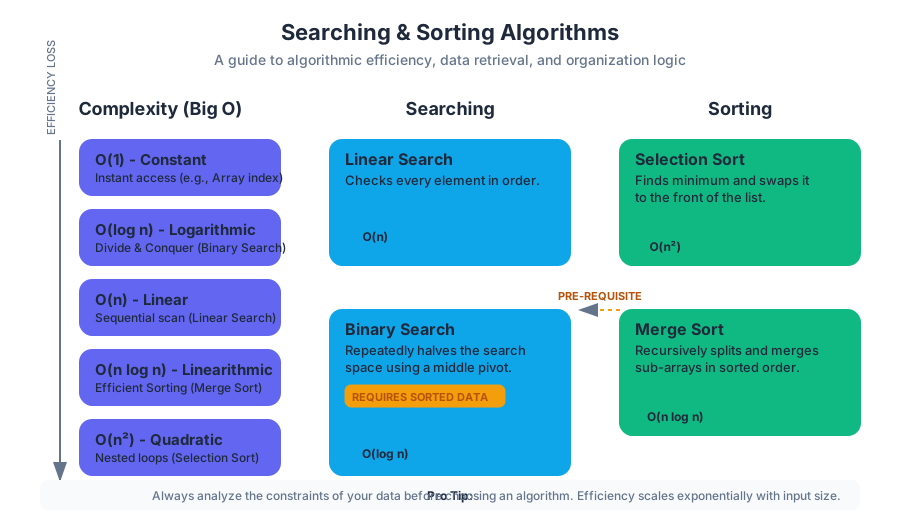
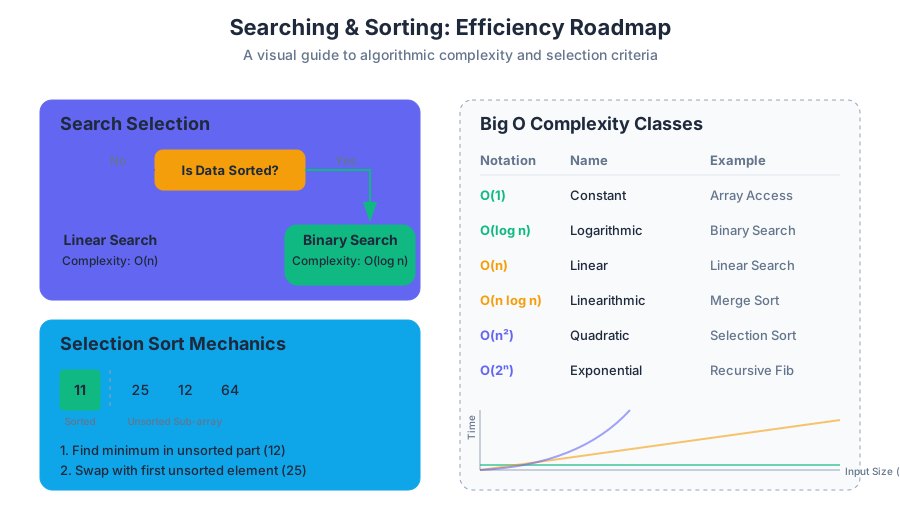
| Notation | Name | Description | Example |
|---|---|---|---|
| $O(1)$ | Constant | Time remains the same regardless of $n$. | Accessing an array element by index. |
| $O(\log n)$ | Logarithmic | Time increases linearly as $n$ increases exponentially. | Binary Search. |
| $O(n)$ | Linear | Time increases in direct proportion to $n$. | Linear Search. |
| $O(n \log n)$ | Linearithmic | The standard for efficient sorting. | Merge Sort. |
| $O(n^2)$ | Quadratic | Time increases with the square of $n$. | Selection Sort, Insertion Sort. |
| $O(2^n)$ | Exponential | Time doubles with each additional element. | Recursive Fibonacci (naive). |
Why Complexity Matters
Consider an input size of $n = 1,000,000$. An $O(n)$ algorithm might take a fraction of a second, while an $O(n^2)$ algorithm would perform $1,000,000,000,000$ operations, potentially taking hours or days on standard hardware. As a professor would emphasize: Efficiency is not about saving microseconds; it is about making the impossible possible.
Linear Search
Linear Search (or Sequential Search) is the most intuitive method for finding a target value within a collection. It involves examining each element of the array one by one until the target is found or the end of the array is reached.
How it Works
- Start at the first element (index 0).
- Compare the current element with the target
key. - If they match, return the current index.
- If they do not match, move to the next index.
- If the end of the array is reached without a match, return -1.
Java Implementation
public class SearchUtils {
    /**
     * Performs a linear search on an integer array.
     * @param a the array to search
     * @param key the value to find
     * @return the index of the key, or -1 if not found
     */
    public static int linearSearch(int[] a, int key) {
        for (int i = 0; i < a.length; i++) {
            if (a[i] == key) {
                return i; // Found the key
            }
        }
        return -1; // Key not present
    }
}
Complexity Analysis
- Best Case: $O(1)$ (The key is the first element).
- Worst Case: $O(n)$ (The key is the last element or not present).
- Average Case: $O(n/2)$, which simplifies to $O(n)$.
Common Pitfalls: Linear search is inefficient for large datasets. However, it is the only option if the data is unsorted and we have no additional information about the structure.
Binary Search
Binary Search is a vastly more efficient algorithm that operates on the "divide and conquer" principle. However, it carries a strict prerequisite: the array must be sorted.
The Logic of Halving
Imagine searching for a name in a physical phone book. You don't start at page one; you open to the middle. If the name you seek is alphabetically "less than" the names on the page, you discard the entire right half of the book and repeat the process with the left half.
How it Works
- Maintain two pointers,
lowandhigh, representing the current search range. - Calculate the middle index:
mid = low + (high - low) / 2. - Compare
a[mid]with thekey:- If
a[mid] == key, returnmid. - If
a[mid] < key, setlow = mid + 1(search the right half). - If
a[mid] > key, sethigh = mid - 1(search the left half).
- If
- Repeat until
low > high.
Java Implementation
public static int binarySearch(int[] a, int key) {
    int low = 0;
    int high = a.length - 1;

    while (low <= high) {
        int mid = low + (high - low) / 2; // Prevents integer overflow
        if (key < a[mid]) {
            high = mid - 1;
        } else if (key > a[mid]) {
            low = mid + 1;
        } else {
            return mid;
        }
    }
    return -1;
}
Mathematical Derivation of Complexity
In each step, we reduce the search space by half. After $k$ steps, the remaining search space is $n / 2^k$. The algorithm terminates when the search space is reduced to 1. $$n / 2^k = 1 \implies n = 2^k \implies k = \log_2 n$$ Thus, the complexity is $O(\log n)$.
Selection Sort
Selection Sort is a simple, comparison-based sorting algorithm. It maintains two sub-arrays in a given array: one which is already sorted and the other which is unsorted.
Mechanics
In every iteration of selection sort, the minimum element (considering ascending order) from the unsorted sub-array is picked and moved to the beginning of the sorted sub-array.
Worked Example
Array: [64, 25, 12, 22, 11]
- Find the min in
[64, 25, 12, 22, 11]. It's11. Swap with64. Result:[11, 25, 12, 22, 64] - Find the min in
[25, 12, 22, 64]. It's12. Swap with25. Result:[11, 12, 25, 22, 64] - Find the min in
[25, 22, 64]. It's22. Swap with25. Result:[11, 12, 22, 25, 64] - Array is sorted.
Java Implementation
public static void selectionSort(double[] a) {
    int n = a.length;
    for (int i = 0; i < n - 1; i++) {
        int minIdx = i;
        for (int j = i + 1; j < n; j++) {
            if (a[j] < a[minIdx]) {
                minIdx = j;
            }
        }
        // Swap the found minimum element with the first element
        double temp = a[minIdx];
        a[minIdx] = a[i];
        a[i] = temp;
    }
}
Complexity and Performance
- Time Complexity: $O(n^2)$ in all cases (best, average, worst) because the nested loops always execute.
- Space Complexity: $O(1)$ (In-place).
- Pitfall: It is inefficient on large lists and generally performs worse than insertion sort.
Insertion Sort
Insertion Sort works similarly to the way you sort playing cards in your hands. The array is virtually split into a sorted and an unsorted part. Values from the unsorted part are picked and placed at the correct position in the sorted part.
How it Works
- Iterate from
index 1ton-1. - Compare the current element (
key) to its predecessor. - If the
keyelement is smaller than its predecessor, compare it to the elements before. Move the greater elements one position up to make space for the swapped element.
Java Implementation
public static void insertionSort(double[] a) {
    int n = a.length;
    for (int i = 1; i < n; i++) {
        double key = a[i];
        int j = i - 1;

        // Move elements of a[0..i-1] that are greater than key
        // to one position ahead of their current position
        while (j >= 0 && a[j] > key) {
            a[j + 1] = a[j];
            j = j - 1;
        }
        a[j + 1] = key;
    }
}
Variations and Extensions
Insertion sort is highly efficient for nearly sorted data. In such cases, the inner while loop rarely runs, leading to a near $O(n)$ performance. This makes it a popular choice as a "base case" for more complex algorithms like Timsort or Quicksort.
| Feature | Selection Sort | Insertion Sort |
|---|---|---|
| Best Case | $O(n^2)$ | $O(n)$ |
| Swaps | $O(n)$ | $O(n^2)$ |
| Stability | Usually Unstable | Stable |
| Use Case | When memory writes are costly | Small or nearly sorted arrays |
Merge Sort
Merge Sort is a sophisticated, recursive algorithm that exemplifies the "Divide, Conquer, and Combine" strategy. It is significantly faster than selection or insertion sort for large datasets.
The Divide and Conquer Strategy
- Divide: Divide the unsorted list into $n$ sub-lists, each containing one element (a list of one element is considered sorted).
- Conquer: Repeatedly merge sub-lists to produce new sorted sub-lists until there is only one sub-list remaining.
The Merge Step
The core of the algorithm is the merge() function, which takes two sorted arrays and combines them into a single sorted array.
Java Implementation
public class MergeSort {
    public static void sort(double[] a) {
        if (a.length <= 1) return;
        double[] aux = new double[a.length];
        sort(a, aux, 0, a.length - 1);
    }

    private static void sort(double[] a, double[] aux, int lo, int hi) {
        if (hi <= lo) return;
        int mid = lo + (hi - lo) / 2;
        sort(a, aux, lo, mid);       // Sort left half
        sort(a, aux, mid + 1, hi);   // Sort right half
        merge(a, aux, lo, mid, hi);  // Merge results
    }

    private static void merge(double[] a, double[] aux, int lo, int mid, int hi) {
        // Copy to aux[]
        for (int k = lo; k <= hi; k++) {
            aux[k] = a[k];
        }

        // Merge back to a[]
        int i = lo, j = mid + 1;
        for (int k = lo; k <= hi; k++) {
            if      (i > mid)           a[k] = aux[j++];
            else if (j > hi)            a[k] = aux[i++];
            else if (aux[j] < aux[i])   a[k] = aux[j++];
            else                        a[k] = aux[i++];
        }
    }
}
Complexity Analysis
Merge sort consistently performs at $O(n \log n)$ time complexity.
- Log n levels: The array is split in half $\log n$ times.
- N work per level: At each level of the recursion tree, the total number of comparisons and movements is proportional to $n$.
- Space Complexity: Unlike the previous sorts, Merge Sort requires $O(n)$ additional space for the auxiliary array.
Comparative Summary of Sorting Algorithms
Choosing the right algorithm depends on the specific constraints of your environment (e.g., memory limits, data size, initial order).
| Algorithm | Best Time | Avg Time | Worst Time | Space | Stable? |
|---|---|---|---|---|---|
| Selection Sort | $O(n^2)$ | $O(n^2)$ | $O(n^2)$ | $O(1)$ | No |
| Insertion Sort | $O(n)$ | $O(n^2)$ | $O(n^2)$ | $O(1)$ | Yes |
| Merge Sort | $O(n \log n)$ | $O(n \log n)$ | $O(n \log n)$ | $O(n)$ | Yes |
Key Insights for Engineers
- Stability: A sort is stable if it preserves the relative order of equal elements. This is crucial when sorting objects by multiple criteria (e.g., sorting a list of transactions by date, then by amount).
- In-place: An algorithm is in-place if it requires only a constant amount of extra memory ($O(1)$). Selection and Insertion sort are in-place; Merge Sort is not.
- Adaptive: An algorithm is adaptive if its performance improves when the input is partially sorted. Insertion sort is the quintessential adaptive algorithm.
Common Pitfalls in Implementation
- Integer Overflow: In Binary Search, calculating
mid = (low + high) / 2can cause an overflow iflow + highexceedsInteger.MAX_VALUE. Uselow + (high - low) / 2instead. - Off-by-One Errors: Pay close attention to loop boundaries (e.g.,
i < nvsi <= n) and the calculation of themidpoint in recursive calls. - Recursion Depth: For extremely large arrays, recursive algorithms like Merge Sort can trigger a
StackOverflowErrorif the recursion depth is too great, though this is rare for $O(\log n)$ depth.
Source Materials
- Week 12 - Searching and Sorting.pdf
- Week 12 - Searching and Sorting.pdf
- Week 12 - Searching and Sorting.pdf
- Searching and Sorting Pre Recitation Quiz.html
- Recitation #13, Searching and Sorting | Week 15.html
- Searching and Sorting Post Recitation Quiz.html
- Week 14 - Searching and Sorting.pdf
- 13-Searching_Sorting.pdf
Study Java Programming and Algorithmic Thinking Fundamentals on Lykke
This course page is free to open: signed out, you can read its first two sections, and signing in, on any plan, opens the rest. The free Lykke Chrome extension syncs your own Canvas courses, so ChatGPT, Claude and Muse can answer from your classes and deadlines. It only reads Canvas.
Add the free extensionSign in to open every sectionAll sections of Java Programming and Algorithmic Thinking Fundamentals · Browse more course pages