From the free course Introduction to Philosophy: Ethics on Lykke
Foundations of Philosophical Ethics
Key concepts: Philosophical ethics · Moral judgment · Western cultural tradition
An introduction to the nature of ethics, moral judgments, and the historical context of the Western philosophical tradition.
Foundations of Philosophical Ethics
Philosophical ethics, often referred to as moral philosophy, is the systematic and critical study of the values, principles, and reasoning used to determine what is "right" and "wrong," "good" and "bad." Unlike descriptive ethics—which merely observes how people behave—philosophical ethics is normative and evaluative. It seeks to establish the "source code" of human conduct, providing a rigorous framework for justifying moral claims rather than relying on intuition, tradition, or emotional response.
In the Western cultural tradition, ethics has evolved from the virtue-centric inquiries of Ancient Greece to the rule-based systems of the Enlightenment and the contemporary critiques of biology and gender theory. At its core, the discipline functions as a meta-analysis of the human decision-making process, treating moral judgments as propositions that must survive the scrutiny of logic and empirical reality.
The Taxonomy of Ethical Inquiry
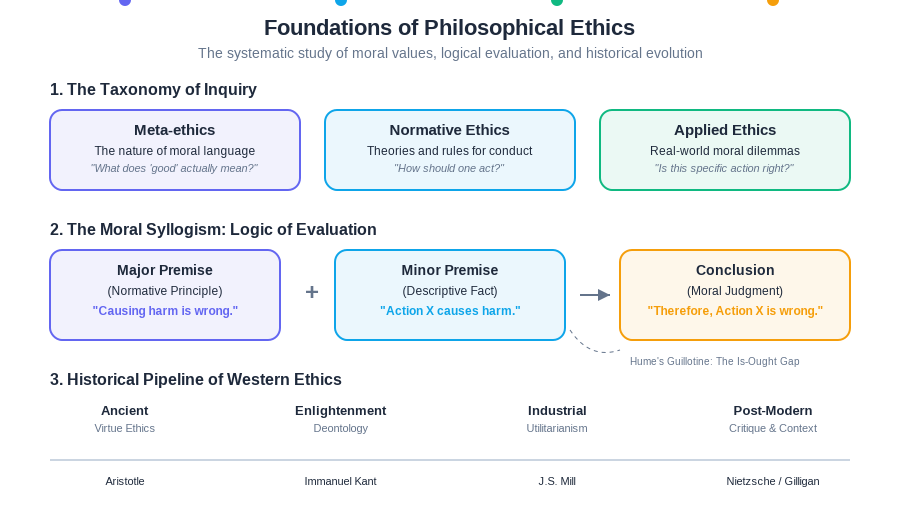
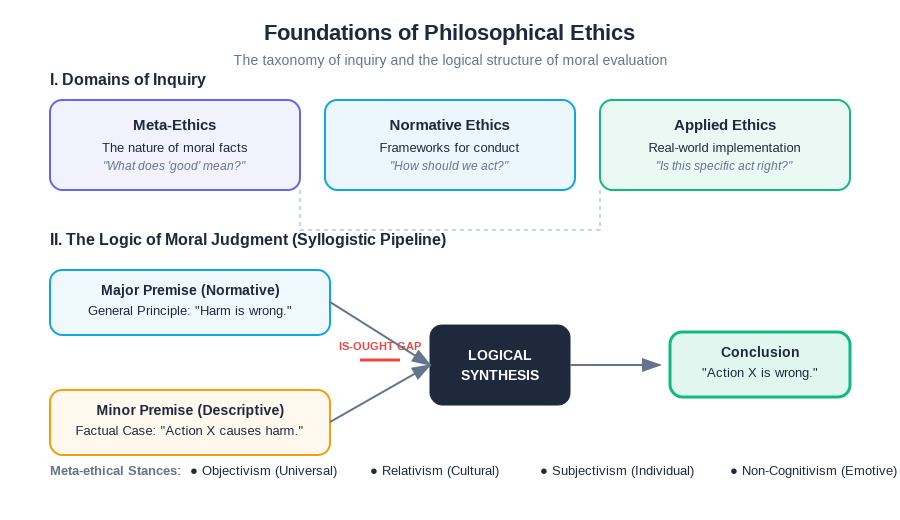
To understand the foundations, one must first categorize the layers of ethical abstraction. Philosophical ethics is generally divided into three distinct but interconnected domains:
| Domain | Focus | Key Question |
|---|---|---|
| Meta-ethics | The nature of moral language and properties. | What does "good" actually mean? Are moral facts objective? |
| Normative Ethics | The development of general theories or "rules" for conduct. | How should we act? Is the outcome or the intent more important? |
| Applied Ethics | The application of ethical theory to specific, real-world issues. | Is capital punishment justifiable? How should AI handle the Trolley Problem? |
1. Moral Judgment: The Logic of Evaluation
A moral judgment is a cognitive act that assigns a moral value to a specific action, person, or state of affairs. In philosophical terms, a moral judgment is not merely a statement of preference (e.g., "I dislike lying") but a claim to a universal or objective truth (e.g., "Lying is wrong").
The Structure of a Moral Argument
Most moral judgments follow a syllogistic structure where a general moral principle is applied to a specific factual case to reach a conclusion.
The Moral Syllogism:
- Major Premise (Normative): Causing unnecessary suffering is wrong.
- Minor Premise (Descriptive): Action X causes unnecessary suffering.
- Conclusion (Judgment): Therefore, action X is wrong.
2. The Western Cultural Tradition: A Historical Pipeline
The Western tradition of ethics is characterized by a shift from teleological (purpose-driven) views to deontological (duty-driven) and consequentialist (outcome-driven) views.
Historical Epochs of Ethical Thought
| Era | Primary Focus | Key Figure | Core Concept |
|---|---|---|---|
| Ancient | Virtue Ethics | Aristotle | Eudaimonia (Flourishing) through character. |
| Medieval | Natural Law | Aquinas | Moral law is derived from divine/natural order. |
| Enlightenment | Deontology | Kant | The Categorical Imperative; duty for duty's sake. |
| Industrial | Utilitarianism | Mill / Bentham | The Greatest Happiness Principle. |
| Post-Modern | Critique | Nietzsche / Gilligan | Deconstruction of "universal" moral truths. |
3. Moral Objectivity vs. Subjectivity
One of the most contentious debates in philosophical ethics is whether moral truths exist independently of human opinion. This is the divide between Moral Realism and Moral Anti-Realism.
The Is-Ought Problem
Proposed by David Hume, the Is-Ought Problem (or Hume's Guillotine) asserts that one cannot logically derive a statement of what ought to be solely from statements about what is.
$$ \forall x (Is(x) \nRightarrow Ought(x)) $$
Comparison of Meta-ethical Stances
| Stance | Description | Technical Analogy |
|---|---|---|
| Objectivism | Moral truths are like mathematical constants (e.g., $\pi$). | Hard-coded constants in the universe. |
| Relativism | Moral truths are relative to culture or context. | Local environment variables or "locale" settings. |
| Subjectivism | Morality is a matter of individual sentiment. | User-level configuration files (.dotfiles). |
| Non-Cognitivism | Moral claims are neither true nor false; they are emotional outbursts. | stderr logs that don't return a value. |
4. Ethics and Religion: The Euthyphro Dilemma
Historically, ethics was inextricably linked to religion. However, philosophical ethics seeks a rational basis for morality that does not rely on divine revelation. This tension is best captured by the Euthyphro Dilemma, originally posed by Socrates.
The Dilemma: "Is the pious loved by the gods because it is pious, or is it pious because it is loved by the gods?"
The Logic of the Dilemma
This can be modeled as a dependency check. If God commands "Good" because it is inherently good, then "Good" exists independently of God (making God a messenger, not the source). If "Good" is good simply because God commands it, then morality is arbitrary (if God commanded murder, it would be "good").
% Pseudocode representation of the Euthyphro Dilemma
IF (Commanded(Action) -> IsGood(Action))
    THEN Morality = Arbitrary_Power;
ELSE IF (IsGood(Action) -> Commanded(Action))
    THEN Morality = Independent_Standard;
5. Self-Interest and Egoism
The relationship between ethics and self-interest is a foundational problem. If humans are naturally self-interested, why should they be moral when it doesn't benefit them?
- Psychological Egoism: The descriptive claim that humans always act in their own self-interest.
- Ethical Egoism: The normative claim that humans should act in their own self-interest.
The Prisoner’s Dilemma: A Technical Case Study
In game theory, the Prisoner's Dilemma demonstrates how individual rational self-interest can lead to a sub-optimal collective outcome. This is often used to justify the "Social Contract"—a system of moral rules that constrain self-interest for mutual gain.
| Player B: Cooperate | Player B: Defect | |
|---|---|---|
| Player A: Cooperate | Both: -1 (Reward) | A: -10, B: 0 (Sucker) |
| Player A: Defect | A: 0, B: -10 (Temptation) | Both: -5 (Punishment) |
6. Evolutionary Biology and Ethics
Modern ethics increasingly incorporates insights from Evolutionary Biology. This field seeks to explain the origins of "moral" behaviors like altruism through the lens of natural selection.
Kin Selection and Reciprocal Altruism
Evolutionary ethics suggests that what we call "morality" is actually a set of evolved heuristics for survival.
- Kin Selection: Helping those with shared genes ($rB > C$, where $r$ is relatedness, $B$ is benefit, and $C$ is cost).
- Reciprocal Altruism: "I'll scratch your back if you scratch mine."
7. Gender and Ethics: The Ethics of Care
In the late 20th century, Carol Gilligan challenged the traditional Western focus on abstract rules and justice, arguing that it reflected a male-centric bias. She proposed the Ethics of Care.
Justice vs. Care
- Justice Perspective: Focuses on autonomy, rights, and universal rules (e.g., Kant, Rawls).
- Care Perspective: Focuses on relationships, responsibilities, and particular contexts.
| Feature | Justice-Based Ethics | Care-Based Ethics |
|---|---|---|
| Core Value | Fairness / Equality | Compassion / Connection |
| Logic | Deductive (Apply rule to case) | Inductive (Understand context) |
| View of Person | Independent individual | Interdependent being |
| Goal | Protecting rights | Maintaining relationships |
Common Pitfalls in Ethical Reasoning
- The Naturalistic Fallacy: Assuming that because something is "natural," it is "good." (e.g., "Animals eat each other, so humans should be aggressive.")
- Relativist Circularity: Arguing that "we should be tolerant of all cultures because morality is relative." If morality is truly relative, then "tolerance" is also just a relative value, not a universal obligation.
- Confusing Legality with Morality: Assuming that because an action is legal, it is ethical (and vice-versa). Law is a social consensus; ethics is a philosophical standard.
- The False Dilemma: Reducing complex ethical issues to only two choices (e.g., "Either we ban all AI or we lose our humanity").
Summary and Synthesis
Foundational philosophical ethics provides the tools to move from unexamined intuition to reasoned conviction. By understanding the Western tradition, the logic of moral judgment, and the challenges posed by biology and gender, we can construct more robust frameworks for the complex decisions of the modern world. Whether we are coding an autonomous vehicle's safety protocol or debating social policy, we are operating within the architecture established by these philosophical foundations.
Source Materials
Study Introduction to Philosophy: Ethics on Lykke
This course page is free to open: signed out, you can read its first two sections, and signing in, on any plan, opens the rest. The free Lykke Chrome extension syncs your own Canvas courses, so ChatGPT, Claude and Muse can answer from your classes and deadlines. It only reads Canvas.
Add the free extensionSign in to open every sectionAll sections of Introduction to Philosophy: Ethics · Browse more course pages