From the free course Introduction to Philosophy: Ethics on Lykke
Moral Objectivity and the Role of Religion
Key concepts: Moral objectivity · Ethics and religion · Divine Command Theory
Explores the debate between moral universalism and relativism, as well as the historical and logical relationship between religious faith and ethical systems.
Moral Objectivity and the Role of Religion
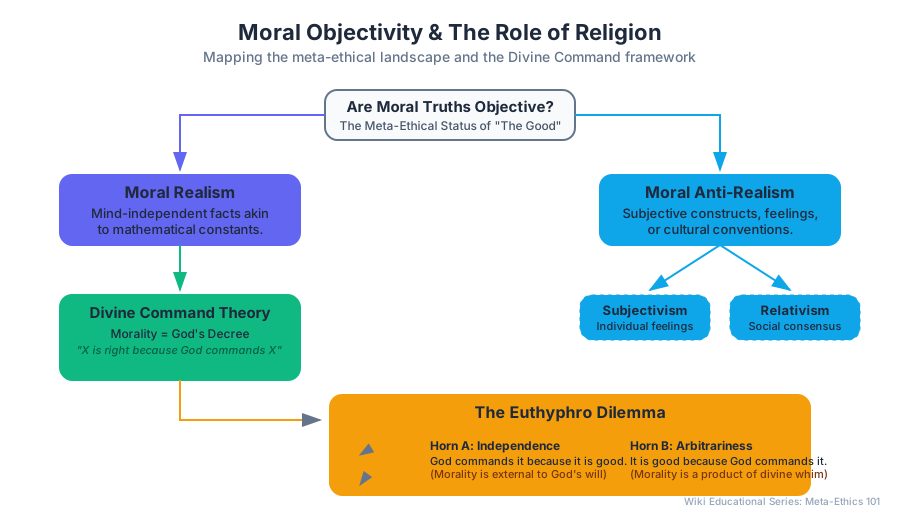
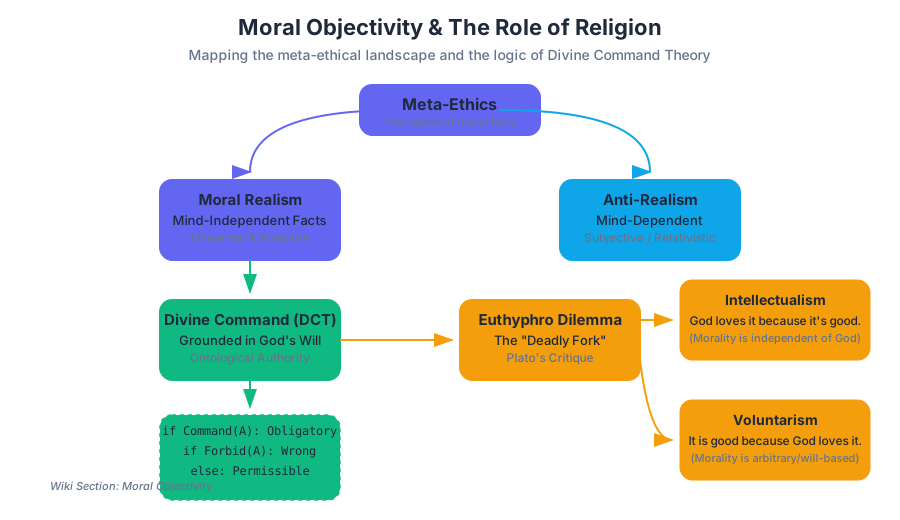
The debate over Moral Objectivity represents the foundational "systems architecture" of human value. At its core, the question is whether moral truths possess a mind-independent reality—akin to the laws of physics or mathematical constants—or whether they are social constructs, individual preferences, or evolutionary artifacts. Historically and conceptually, this debate is inextricably linked to the Role of Religion, specifically through the lens of Divine Command Theory (DCT).
In this deep dive, we analyze the ontological status of morality, the logical structure of religious ethics, and the classic dilemmas that arise when attempting to ground "the Good" in "the Divine."
1. The Meta-Ethical Landscape: Objectivity vs. Subjectivity
To understand moral objectivity, we must first categorize the competing meta-ethical frameworks. Meta-ethics does not ask "What is right?" but rather "What does it mean for something to be right?" and "Are there moral facts?"
1.1 Moral Realism (Objectivism)
Moral Realism is the thesis that moral propositions refer to objective features of the world. Under this view, the statement "Torture is wrong" is true in the same way that "The Earth is an oblate spheroid" is true. It is a fact that exists regardless of whether anyone believes it.
1.2 Moral Anti-Realism (Subjectivism and Relativism)
Moral Anti-Realism denies the existence of mind-independent moral facts. This includes:
- Subjectivism: Moral statements are reports of individual feelings or attitudes.
- Cultural Relativism: Moral truths are relative to the conventions of a specific society.
- Non-Cognitivism: Moral statements aren't even "true" or "false"; they are mere expressions of emotion (Emotivism) or prescriptions for behavior (Prescriptivism).
| Position | Ontological Status | Source of Authority | Truth Value |
|---|---|---|---|
| Moral Realism | Objective / Mind-Independent | Universal Reason, Nature, or God | Absolute |
| Subjectivism | Subjective / Mind-Dependent | Individual Preference | Relative to Agent |
| Cultural Relativism | Intersubjective | Social Consensus / Tradition | Relative to Culture |
| Error Theory | Non-Existent | None (Morality is a "false" concept) | Always False |
The Argument from Queerness: Proposed by J.L. Mackie, this is a famous critique of moral objectivity. Mackie argued that if objective moral values existed, they would be entities of a "very strange sort," unlike anything else in the universe. They would have to possess "built-in" motivational power—simply knowing a moral fact would have to compel you to act, which defies standard empirical observation.
2. Ethics and Religion: The Historical Nexus
For the vast majority of human history, ethics and religion were viewed as a single, integrated system. The "Moral Law" was synonymous with "God's Law." This connection serves several functional and philosophical purposes:
- Metaphysical Grounding: Religion provides an answer to why moral facts exist (e.g., they are created by a Transcendent Being).
- Epistemic Access: Religion provides a method for knowing what is right (e.g., scripture, revelation, or divine inspiration).
- Motivational Force: Religion provides a reason to be moral (e.g., divine reward, punishment, or the pursuit of spiritual alignment).
3. Divine Command Theory (DCT)
Divine Command Theory (DCT) is the most direct way to link religion and moral objectivity. It posits that an action's moral status is determined by whether it is commanded by God.
3.1 The Logic of DCT
In a formal sense, DCT defines "obligatory" and "forbidden" through the following mapping:
- Action $A$ is obligatory if and only if God commands $A$.
- Action $A$ is wrong if and only if God forbids $A$.
- Action $A$ is permissible if and only if God does not forbid $A$.
This framework provides a clear, objective standard. If God exists and has issued commands, then morality is objective because it does not depend on human opinion.
4. The Euthyphro Dilemma
The most significant challenge to Divine Command Theory comes from Plato’s Euthyphro. Socrates poses a question that creates a "deadly fork" for any religious ethicist:
"Is the pious loved by the gods because it is pious, or is it pious because it is loved by the gods?"
Modernized for monotheism, the dilemma asks: Is an action right because God commands it, or does God command it because it is right?
4.1 Horn 1: The Arbitrariness Problem
If an action is right simply because God commands it, then morality is arbitrary. If God commanded that "thou shalt kill thy neighbor," then killing would be morally obligatory. Under this horn, God’s commands are not based on reasons; they are the reason. This makes the concept of "God is good" vacuous, as "good" just means "whatever God says."
4.2 Horn 2: The Independence Problem
If God commands an action because it is right, then there is a standard of "Rightness" that exists independently of God. God is simply a "moral expert" who recognizes these objective truths and relays them to us. While this saves morality from being arbitrary, it means God is no longer the source of morality. Morality exists "above" or "beside" the divine.
4.3 Formalizing the Dilemma
We can represent the logical tension of the Euthyphro Dilemma using formal notation to show the contradiction in grounding objectivity solely in will.
Let C(g, a) = God commands action a
Let R(a) = Action a is morally right

Dilemma:
1. R(a) <-> C(g, a)  [Definition of DCT]
2. If (C(g, a) -> R(a)), then:
   ∀a, (C(g, a) is the sufficient and necessary cause of R(a))
   => If God commands 'Cruelty', then 'Cruelty' is Right. (Arbitrariness)
3. If (R(a) -> C(g, a)), then:
   ∃ Standard S such that R(a) is true according to S, and God recognizes S.
   => R(a) is independent of C(g, a). (Independence)
5. Natural Law Theory: An Alternative Synthesis
To escape the Euthyphro Dilemma, many religious philosophers (most notably Thomas Aquinas) turned to Natural Law Theory. This view suggests that morality is objective and grounded in God, but not through arbitrary commands.
5.1 The Mechanics of Natural Law
Natural Law posits that God created the universe with a specific design and purpose (Telos). Human beings have a specific nature, and "the Good" is defined as acting in accordance with that nature.
- The Eternal Law: God's rational plan for the universe.
- The Natural Law: The portion of the Eternal Law that humans can discover through Reason.
In this framework, God doesn't need to issue a "command" for murder to be wrong. Murder is wrong because it violates the fundamental human "inclination" to preserve life and live in a stable society—an inclination designed by God.
| Feature | Divine Command Theory (DCT) | Natural Law Theory |
|---|---|---|
| Source of Morality | God's Will (Voluntarism) | God's Intellect / Nature (Rationalism) |
| Access to Morality | Revelation (Scripture) | Reason and Observation |
| Flexibility | Could change if God wills it | Fixed by human nature and the cosmos |
| Role of Reason | Obedience to authority | Discovery of inherent purpose |
6. Secular Moral Objectivity
Can morality be objective without religion? Many modern philosophers argue yes, using different "anchors" for objectivity.
6.1 Kantian Deontology
Immanuel Kant argued that morality is grounded in the structure of Rationality itself. The Categorical Imperative provides a "test" for moral objectivity: "Act only according to that maxim whereby you can, at the same time, will that it should become a universal law."
6.2 Utilitarianism (Consequentialism)
Utilitarians like John Stuart Mill argue that morality is objective because it is based on the empirical fact of Suffering and Well-being. If we agree that "Pain is bad" and "Pleasure is good" are objective biological/psychological facts, then we can build an objective moral calculus.
6.3 Moral Functionalism
Some contemporary thinkers view morality as a "social technology" designed to solve the problem of cooperation. Just as there are "objectively better" ways to build a bridge (physics), there are "objectively better" ways to structure a society to minimize conflict and maximize flourishing.
7. Common Pitfalls and Misconceptions
7.1 The "No God, No Morality" Fallacy
A common misconception is that if God does not exist, "everything is permitted" (a quote often attributed to Dostoevsky). This ignores the possibility of secular grounding (Kantianism, Utilitarianism) and the fact that social contracts and evolutionary biology provide strong, non-arbitrary reasons for moral behavior.
7.2 Confusing Ontology with Epistemology
- Ontology: Does the moral fact exist?
- Epistemology: How do we know the moral fact? Many people argue that morality is subjective because people disagree about it (epistemology). However, disagreement does not prove lack of objectivity. People disagreed about whether the Earth was flat, but the fact of the Earth's shape remained objective.
7.3 The Is-Ought Problem (Hume's Guillotine)
David Hume famously argued that you cannot derive an "Ought" (a moral claim) from an "Is" (a factual claim). Just because humans are biologically wired to protect their kin (Is), it doesn't automatically mean we ought to protect them (Ought). Bridging this gap is the primary challenge for any objective theory, religious or secular.
Summary of Key Connections
The journey from Moral Objectivity to the Role of Religion reveals a deep-seated human desire for a "firm foundation."
- Objectivity provides the stability we need for justice and social order.
- Religion historically provided the "metaphysical glue" for that objectivity via Divine Command Theory.
- The Euthyphro Dilemma forces us to choose between an arbitrary God and an independent Morality.
- Natural Law and Secular Frameworks attempt to resolve this by finding objectivity in the structure of Reason, Nature, or Human Flourishing.
Whether grounded in the "Starry Heavens above" (God) or the "Moral Law within" (Reason), the pursuit of objective ethics remains the central "operating system" of civilization.
Source Materials
Study Introduction to Philosophy: Ethics on Lykke
This course page is free to open: signed out, you can read its first two sections, and signing in, on any plan, opens the rest. The free Lykke Chrome extension syncs your own Canvas courses, so ChatGPT, Claude and Muse can answer from your classes and deadlines. It only reads Canvas.
Add the free extensionSign in to open every sectionAll sections of Introduction to Philosophy: Ethics · Browse more course pages