From the free course Introduction to Philosophy: Ethics on Lykke
Contemporary Perspectives: Biology and Gender
Key concepts: Ethics and biology · Ethics and gender · Evolutionary ethics · Feminist ethics
Examines how modern scientific understandings of biology and feminist critiques of traditional philosophy have reshaped ethical discourse.
Contemporary Perspectives: Biology and Gender
The landscape of modern ethics has shifted from the purely speculative to the empirical and structural. While traditional ethical frameworks—such as Deontology or Utilitarianism—often treated the "moral agent" as a generic, rational, and disembodied entity, contemporary perspectives demand a more grounded approach. This evolution is driven by two primary vectors: the biological substrate of human behavior (Evolutionary Ethics) and the socio-political critique of gendered moral standards (Feminist Ethics).
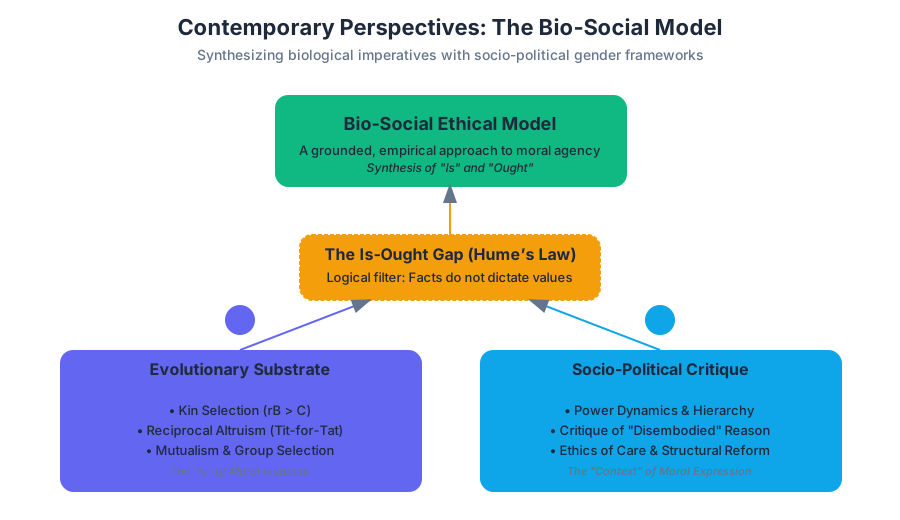
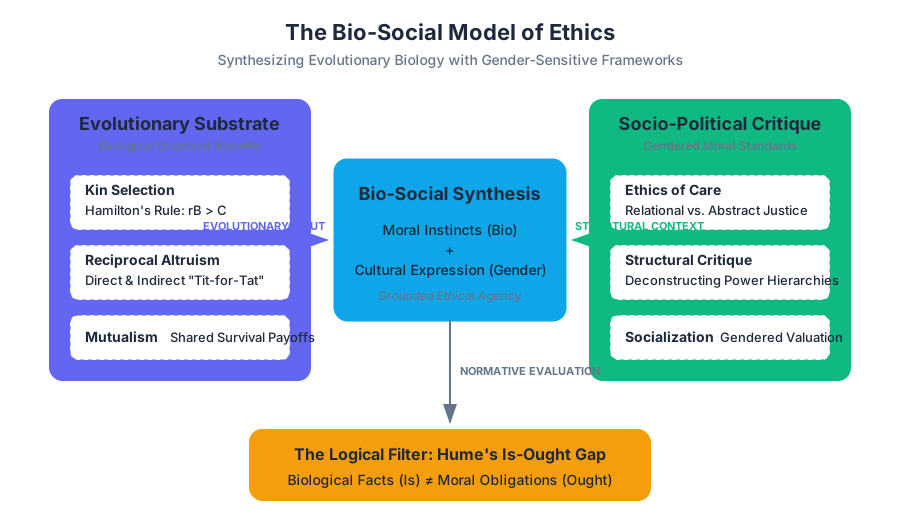
By synthesizing biological imperatives with gender-sensitive frameworks, we move toward a "Bio-Social" model of ethics. This model recognizes that while our moral instincts may be hard-coded by millions of years of evolution, the expression and valuation of those instincts are deeply influenced by cultural constructs of gender and power.
Ethics and Biology: The Evolutionary Substrate
Evolutionary Ethics is the field that seeks to understand the origins of moral behavior through the lens of biological evolution. It posits that morality is not a divine gift or a purely cultural invention, but a set of evolved adaptations that facilitated survival and reproduction in social environments.
The Biological Basis of Altruism
The central puzzle of evolutionary biology was the existence of altruism—behavior that benefits another individual at a cost to the actor. In a strictly Darwinian "survival of the fittest" model, altruism should be selected against. However, several mechanisms explain how "moral" behaviors like cooperation and self-sacrifice became genetically stable.
- Kin Selection (Inclusive Fitness): Formulated by W.D. Hamilton, this theory suggests that individuals can increase the transmission of their genes by helping close relatives.
- Reciprocal Altruism: Proposed by Robert Trivers, this explains cooperation between non-relatives. If $A$ helps $B$ with the expectation that $B$ will help $A$ later, both increase their long-term fitness.
- Group Selection: The controversial idea that groups with more "cooperators" outcompete groups of "cheaters," even if individuals within the group suffer.
Hamilton’s Rule: $rB > C$ Where r is the genetic relatedness, B is the benefit to the recipient, and C is the cost to the actor. Altruism is evolutionarily favored when the genetic benefit outweighs the individual cost.
Evolutionary Mechanisms for Moral Behavior
| Mechanism | Definition | Moral Manifestation | Evolutionary Payoff |
|---|---|---|---|
| Kin Selection | Favoring genetic relatives. | Nepotism, parental care, family loyalty. | Preservation of shared alleles. |
| Direct Reciprocity | "Tit-for-tat" exchanges. | Fairness, gratitude, indignation at "cheaters." | Long-term resource stability. |
| Indirect Reciprocity | Reputation-based cooperation. | Honor, shame, social standing, altruistic signaling. | Access to social networks and mates. |
| Mutualism | Immediate shared benefit. | Teamwork, hunting parties, collective defense. | Immediate survival advantage. |
The Naturalistic Fallacy and the Is-Ought Gap
While biology explains why we have certain moral intuitions, it does not necessarily tell us what we should do. This is the crux of the Naturalistic Fallacy, a term coined by G.E. Moore, building on David Hume’s Is-Ought Gap.
Hume’s Law
Hume famously argued that one cannot derive a statement of value (ought) from a statement of fact (is). Just because humans are biologically wired to be xenophobic (an "is" of evolutionary history) does not mean we ought to be xenophobic (a normative "ought").
The Open Question Argument
Moore proposed that for any natural property (e.g., "pleasure" or "survival"), the question "Is it good?" remains an open question. If "good" were identical to "survival," then "Is survival good?" would be a tautology (like "Is a bachelor unmarried?"). Since it is not a tautology, "good" must be a non-natural property.
% Formalizing the Is-Ought Gap in First-Order Logic
% Let P(x) be a descriptive property (e.g., "x is natural")
% Let G(x) be a normative property (e.g., "x is good")

\forall x (P(x) \implies G(x)) \quad \text{is a logical fallacy without a normative premise.}

\text{Correct derivation requires:}
\text{Premise 1: } P(a) \quad \text{(Descriptive)}
\text{Premise 2: } \forall x (P(x) \implies G(x)) \quad \text{(Normative Bridge)}
\text{Conclusion: } G(a)
Ethics and Gender: The Feminist Critique
Traditional ethics has often been criticized by feminist philosophers for being "gender-blind" in a way that actually favors "masculine" experiences. This critique suggests that the Western philosophical canon—from Plato to Kant—has prioritized the public sphere (law, war, commerce) over the private sphere (caregiving, domestic life, emotional labor).
The Ethics of Care
The Ethics of Care emerged as a distinct normative theory in the 1980s, primarily through the work of Carol Gilligan and Nel Noddings. Gilligan’s research suggested that while men tend to approach moral problems through a "Justice Perspective" (rights, rules, and autonomy), women often approach them through a "Care Perspective" (relationships, responsibilities, and empathy).
Definition: Relational Ontology Feminist ethics often rejects the "atomistic individual" of liberal theory. Instead, it views humans as fundamentally relational beings whose identities and moral obligations are defined by their connections to others.
Comparison: Justice vs. Care Perspectives
| Feature | Ethics of Justice (Traditional) | Ethics of Care (Feminist) |
|---|---|---|
| Core Value | Autonomy and Fairness. | Connection and Responsibility. |
| Moral Logic | Application of universal rules. | Maintenance of specific relationships. |
| Ideal Agent | Disinterested, rational observer. | Engaged, empathetic participant. |
| Context | Abstract, "View from Nowhere." | Concrete, "View from Somewhere." |
| Goal | Resolving conflicts of rights. | Minimizing harm and sustaining ties. |
Feminist Ethics: Beyond Care
While the Ethics of Care was a foundational step, Feminist Ethics as a whole is broader. It is a political and critical project that examines how power dynamics and gender hierarchies influence moral theory.
1. Critique of the "Rational Man"
Feminist ethicists argue that the "Rational Man" of Kantian ethics is a myth. By assuming a self-sufficient agent, traditional ethics ignores the reality of dependency. Every "rational man" was once a child dependent on a caregiver, and many will become elderly or disabled and dependent again. A truly universal ethics must account for dependency as a core human condition.
2. Epistemic Injustice
Coined by Miranda Fricker, this concept highlights how certain groups (often women and marginalized genders) are silenced or dismissed as "unreliable" knowers. In ethics, this means the moral experiences of women—such as the nuances of reproductive labor—have been historically excluded from the "data set" of moral philosophy.
3. Intersectionality
Modern feminist ethics incorporates intersectionality (a term from Kimberlé Crenshaw), acknowledging that gender does not exist in isolation. A woman’s moral experience is shaped by her race, class, ability, and sexual orientation. An ethics that only considers the experience of white, middle-class women is not truly feminist.
Real-World Application: Algorithmic Bias
In the digital age, feminist ethics is applied to AI and data science. If an algorithm is trained on historical data that reflects gender bias, it will perpetuate that bias. A feminist ethical approach would not just ask "Is this algorithm accurate?" but "Who does this algorithm serve, and whose labor is it replacing?"
Synthesizing Biology and Gender
The intersection of biology and gender in ethics creates a complex, multi-layered understanding of human behavior. Biology provides the potential for behavior, while gendered social structures provide the patterning.
The "Nature vs. Nurture" Feedback Loop
It is a mistake to view biology and gender as separate silos. Biological traits (like the capacity for lactation or physical strength) have been used to justify social roles (the domestic/public split). Conversely, social roles can influence biology through epigenetic changes and hormonal responses.
Common Pitfalls in Synthesis
- Biological Determinism: The error of assuming that because a behavior has a biological basis, it is unchangeable or "right." (e.g., "Men are naturally aggressive, so we shouldn't punish violence.")
- Essentialism: The error of assuming all women or all men share a fixed "essence" or moral style. (e.g., "All women are naturally more caring than all men.")
- Ignoring Power: Focusing purely on biological differences while ignoring how those differences are exploited by political systems.
Contemporary Extensions: Evolutionary Psychology and Gender
Evolutionary psychology often attempts to explain gender differences in morality through Parental Investment Theory. This theory suggests that because women have a higher biological investment in offspring (gestation, lactation), they may have evolved different risk-assessment and moral-prioritization strategies than men.
However, feminist critics point out that these "evolutionary" explanations often mirror the prejudices of the time. For instance, early sociobiologists claimed that "coyness" in females was a biological universal—a claim later debunked by more rigorous cross-species and cross-cultural observation.
Complexity and Variation
| Concept | Biological Perspective | Gender/Feminist Perspective | Synthesis/Modern View |
|---|---|---|---|
| Altruism | Driven by genetic relatedness and reciprocity. | Driven by socialized care and relational labor. | Altruism is a biological capacity shaped by social roles. |
| Autonomy | Individual fitness maximization. | A "masculine" myth that ignores dependency. | "Relational Autonomy": we are free only within supportive networks. |
| Justice | A mechanism to prevent "cheating" in groups. | A tool that can be used to ignore specific needs. | Justice must be tempered by care to be truly equitable. |
Conclusion: Toward a Holistic Moral Framework
Contemporary ethics is moving away from "Grand Unified Theories" and toward more nuanced, interdisciplinary approaches. By acknowledging our biological heritage, we understand the "raw materials" of our moral life—our empathy, our tribalism, and our sense of fairness. By acknowledging the feminist critique, we understand how those raw materials have been shaped into systems of power and exclusion.
The future of ethics lies in the integration of these fields. A robust ethical system for the 21st century must be:
- Biologically Informed: Aware of human cognitive biases and evolutionary instincts.
- Socially Situated: Aware of how gender, race, and class influence moral standing.
- Relational: Focused on the health of the connections between individuals, not just the rights of the individuals themselves.
Source Materials
Study Introduction to Philosophy: Ethics on Lykke
This course page is free to open: signed out, you can read its first two sections, and signing in, on any plan, opens the rest. The free Lykke Chrome extension syncs your own Canvas courses, so ChatGPT, Claude and Muse can answer from your classes and deadlines. It only reads Canvas.
Add the free extensionSign in to open every sectionAll sections of Introduction to Philosophy: Ethics · Browse more course pages