Introduction to Philosophy: Ethics
Institution: MIT
1 study materials · 3 sections
This course provides a comprehensive introduction to the field of philosophical ethics, focusing primarily on the Western cultural tradition. It explores the critical examination of moral judgments and the evaluation of human behavior through both historical and contemporary lenses. Students will investigate the foundations of moral objectivity, the relationship between ethics and religion, and modern intersections with biology and gender studies.
Course Sections
Foundations of Philosophical Ethics
Key concepts: Philosophical ethics · Moral judgment · Western cultural tradition
An introduction to the nature of ethics, moral judgments, and the historical context of the Western philosophical tradition.
Foundations of Philosophical Ethics
Philosophical ethics, often referred to as moral philosophy, is the systematic and critical study of the values, principles, and reasoning used to determine what is "right" and "wrong," "good" and "bad." Unlike descriptive ethics—which merely observes how people behave—philosophical ethics is normative and evaluative. It seeks to establish the "source code" of human conduct, providing a rigorous framework for justifying moral claims rather than relying on intuition, tradition, or emotional response.
In the Western cultural tradition, ethics has evolved from the virtue-centric inquiries of Ancient Greece to the rule-based systems of the Enlightenment and the contemporary critiques of biology and gender theory. At its core, the discipline functions as a meta-analysis of the human decision-making process, treating moral judgments as propositions that must survive the scrutiny of logic and empirical reality.
The Taxonomy of Ethical Inquiry
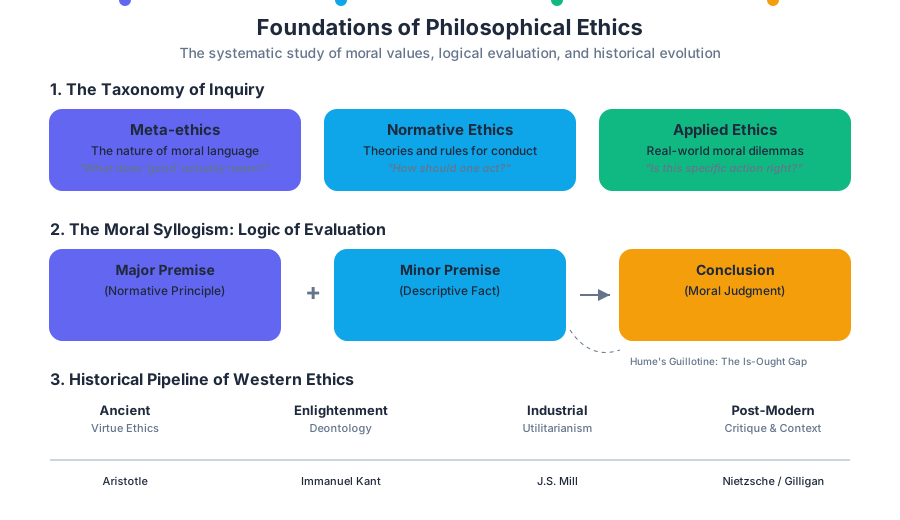
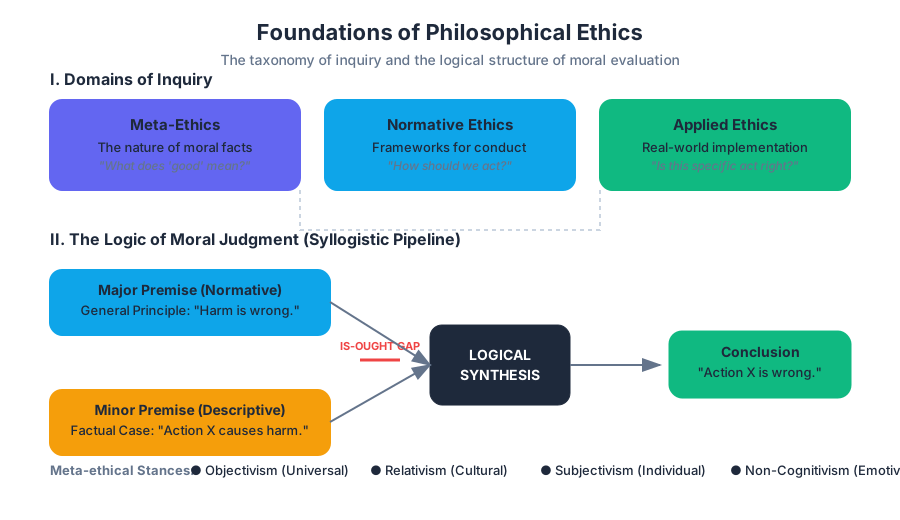
To understand the foundations, one must first categorize the layers of ethical abstraction. Philosophical ethics is generally divided into three distinct but interconnected domains:
| Domain | Focus | Key Question |
|---|---|---|
| Meta-ethics | The nature of moral language and properties. | What does "good" actually mean? Are moral facts objective? |
| Normative Ethics | The development of general theories or "rules" for conduct. | How should we act? Is the outcome or the intent more important? |
| Applied Ethics | The application of ethical theory to specific, real-world issues. | Is capital punishment justifiable? How should AI handle the Trolley Problem? |
1. Moral Judgment: The Logic of Evaluation
A moral judgment is a cognitive act that assigns a moral value to a specific action, person, or state of affairs. In philosophical terms, a moral judgment is not merely a statement of preference (e.g., "I dislike lying") but a claim to a universal or objective truth (e.g., "Lying is wrong").
The Structure of a Moral Argument
Most moral judgments follow a syllogistic structure where a general moral principle is applied to a specific factual case to reach a conclusion.
The Moral Syllogism:
- Major Premise (Normative): Causing unnecessary suffering is wrong.
- Minor Premise (Descriptive): Action X causes unnecessary suffering.
- Conclusion (Judgment): Therefore, action X is wrong.
Implementation: Formalizing Moral Logic
In computational ethics, we can represent these judgments as a set of constraints or a logic-gate system. Below is a C implementation of a basic "Moral Evaluator" that processes actions against a set of predefined ethical "invariants."
#include <stdio.h>
#include <stdbool.h>

typedef struct {
    char* action_name;
    bool causes_harm;
    bool violates_autonomy;
    bool maximizes_utility;
} Action;

typedef enum { PERMITTED, OBLIGATORY, FORBIDDEN } MoralStatus;

// A simple Deontological Evaluator
MoralStatus evaluate_action(Action a) {
    // Invariant: If an action causes harm or violates autonomy, it is forbidden.
    if (a.causes_harm || a.violates_autonomy) {
        return FORBIDDEN;
    }
    // If it maximizes utility without violating the above, it might be obligatory.
    if (a.maximizes_utility) {
        return OBLIGATORY;
    }
    return PERMITTED;
}

int main() {
    Action test_case = {"Data Collection", false, true, true};
    MoralStatus result = evaluate_action(test_case);

    printf("Action: %s | Status: %d\n", test_case.action_name, result);
    return 0;
}
2. The Western Cultural Tradition: A Historical Pipeline
The Western tradition of ethics is characterized by a shift from teleological (purpose-driven) views to deontological (duty-driven) and consequentialist (outcome-driven) views.
Historical Epochs of Ethical Thought
| Era | Primary Focus | Key Figure | Core Concept |
|---|---|---|---|
| Ancient | Virtue Ethics | Aristotle | Eudaimonia (Flourishing) through character. |
| Medieval | Natural Law | Aquinas | Moral law is derived from divine/natural order. |
| Enlightenment | Deontology | Kant | The Categorical Imperative; duty for duty's sake. |
| Industrial | Utilitarianism | Mill / Bentham | The Greatest Happiness Principle. |
| Post-Modern | Critique | Nietzsche / Gilligan | Deconstruction of "universal" moral truths. |
3. Moral Objectivity vs. Subjectivity
One of the most contentious debates in philosophical ethics is whether moral truths exist independently of human opinion. This is the divide between Moral Realism and Moral Anti-Realism.
The Is-Ought Problem
Proposed by David Hume, the Is-Ought Problem (or Hume's Guillotine) asserts that one cannot logically derive a statement of what ought to be solely from statements about what is.
$$ \forall x (Is(x) \nRightarrow Ought(x)) $$
Comparison of Meta-ethical Stances
| Stance | Description | Technical Analogy |
|---|---|---|
| Objectivism | Moral truths are like mathematical constants (e.g., $\pi$). | Hard-coded constants in the universe. |
| Relativism | Moral truths are relative to culture or context. | Local environment variables or "locale" settings. |
| Subjectivism | Morality is a matter of individual sentiment. | User-level configuration files (.dotfiles). |
| Non-Cognitivism | Moral claims are neither true nor false; they are emotional outbursts. | stderr logs that don't return a value. |
4. Ethics and Religion: The Euthyphro Dilemma
Historically, ethics was inextricably linked to religion. However, philosophical ethics seeks a rational basis for morality that does not rely on divine revelation. This tension is best captured by the Euthyphro Dilemma, originally posed by Socrates.
The Dilemma: "Is the pious loved by the gods because it is pious, or is it pious because it is loved by the gods?"
The Logic of the Dilemma
This can be modeled as a dependency check. If God commands "Good" because it is inherently good, then "Good" exists independently of God (making God a messenger, not the source). If "Good" is good simply because God commands it, then morality is arbitrary (if God commanded murder, it would be "good").
% Pseudocode representation of the Euthyphro Dilemma
IF (Commanded(Action) -> IsGood(Action))
    THEN Morality = Arbitrary_Power;
ELSE IF (IsGood(Action) -> Commanded(Action))
    THEN Morality = Independent_Standard;
5. Self-Interest and Egoism
The relationship between ethics and self-interest is a foundational problem. If humans are naturally self-interested, why should they be moral when it doesn't benefit them?
- Psychological Egoism: The descriptive claim that humans always act in their own self-interest.
- Ethical Egoism: The normative claim that humans should act in their own self-interest.
The Prisoner’s Dilemma: A Technical Case Study
In game theory, the Prisoner's Dilemma demonstrates how individual rational self-interest can lead to a sub-optimal collective outcome. This is often used to justify the "Social Contract"—a system of moral rules that constrain self-interest for mutual gain.
| Player B: Cooperate | Player B: Defect | |
|---|---|---|
| Player A: Cooperate | Both: -1 (Reward) | A: -10, B: 0 (Sucker) |
| Player A: Defect | A: 0, B: -10 (Temptation) | Both: -5 (Punishment) |
6. Evolutionary Biology and Ethics
Modern ethics increasingly incorporates insights from Evolutionary Biology. This field seeks to explain the origins of "moral" behaviors like altruism through the lens of natural selection.
Kin Selection and Reciprocal Altruism
Evolutionary ethics suggests that what we call "morality" is actually a set of evolved heuristics for survival.
- Kin Selection: Helping those with shared genes ($rB > C$, where $r$ is relatedness, $B$ is benefit, and $C$ is cost).
- Reciprocal Altruism: "I'll scratch your back if you scratch mine."
Simulation: Modeling Altruism in Python
The following Python snippet uses a simplified agent-based approach to see how "Altruist" genes might survive in a population against "Cheaters."
import random

class Agent:
    def __init__(self, strategy):
        self.strategy = strategy  # 'altruist' or 'cheater'
        self.fitness = 0

    def interact(self, other):
        if self.strategy == 'altruist' and other.strategy == 'altruist':
            self.fitness += 2
            other.fitness += 2
        elif self.strategy == 'altruist' and other.strategy == 'cheater':
            self.fitness -= 1
            other.fitness += 3
        elif self.strategy == 'cheater' and other.strategy == 'altruist':
            self.fitness += 3
            other.fitness -= 1
        else: # Both cheaters
            self.fitness += 0

def run_generation(population):
    for _ in range(len(population) * 2):
        a, b = random.sample(population, 2)
        a.interact(b)

    # Sort by fitness and "reproduce" the top half
    population.sort(key=lambda x: x.fitness, reverse=True)
    new_gen = population[:len(population)//2]
    return new_gen + [Agent(a.strategy) for a in new_gen]

# Initial Population: 90% Altruists, 10% Cheaters
pop = [Agent('altruist') for _ in range(90)] + [Agent('cheater') for _ in range(10)]
for gen in range(10):
    pop = run_generation(pop)
    altruists = len([a for a in pop if a.strategy == 'altruist'])
    print(f"Gen {gen}: Altruists = {altruists}")
7. Gender and Ethics: The Ethics of Care
In the late 20th century, Carol Gilligan challenged the traditional Western focus on abstract rules and justice, arguing that it reflected a male-centric bias. She proposed the Ethics of Care.
Justice vs. Care
- Justice Perspective: Focuses on autonomy, rights, and universal rules (e.g., Kant, Rawls).
- Care Perspective: Focuses on relationships, responsibilities, and particular contexts.
| Feature | Justice-Based Ethics | Care-Based Ethics |
|---|---|---|
| Core Value | Fairness / Equality | Compassion / Connection |
| Logic | Deductive (Apply rule to case) | Inductive (Understand context) |
| View of Person | Independent individual | Interdependent being |
| Goal | Protecting rights | Maintaining relationships |
Common Pitfalls in Ethical Reasoning
- The Naturalistic Fallacy: Assuming that because something is "natural," it is "good." (e.g., "Animals eat each other, so humans should be aggressive.")
- Relativist Circularity: Arguing that "we should be tolerant of all cultures because morality is relative." If morality is truly relative, then "tolerance" is also just a relative value, not a universal obligation.
- Confusing Legality with Morality: Assuming that because an action is legal, it is ethical (and vice-versa). Law is a social consensus; ethics is a philosophical standard.
- The False Dilemma: Reducing complex ethical issues to only two choices (e.g., "Either we ban all AI or we lose our humanity").
Summary and Synthesis
Foundational philosophical ethics provides the tools to move from unexamined intuition to reasoned conviction. By understanding the Western tradition, the logic of moral judgment, and the challenges posed by biology and gender, we can construct more robust frameworks for the complex decisions of the modern world. Whether we are coding an autonomous vehicle's safety protocol or debating social policy, we are operating within the architecture established by these philosophical foundations.
Moral Objectivity and the Role of Religion
Key concepts: Moral objectivity · Ethics and religion · Divine Command Theory
Explores the debate between moral universalism and relativism, as well as the historical and logical relationship between religious faith and ethical systems.
Moral Objectivity and the Role of Religion
The debate over Moral Objectivity represents the foundational "systems architecture" of human value. At its core, the question is whether moral truths possess a mind-independent reality—akin to the laws of physics or mathematical constants—or whether they are social constructs, individual preferences, or evolutionary artifacts. Historically and conceptually, this debate is inextricably linked to the Role of Religion, specifically through the lens of Divine Command Theory (DCT).
In this deep dive, we analyze the ontological status of morality, the logical structure of religious ethics, and the classic dilemmas that arise when attempting to ground "the Good" in "the Divine."
1. The Meta-Ethical Landscape: Objectivity vs. Subjectivity
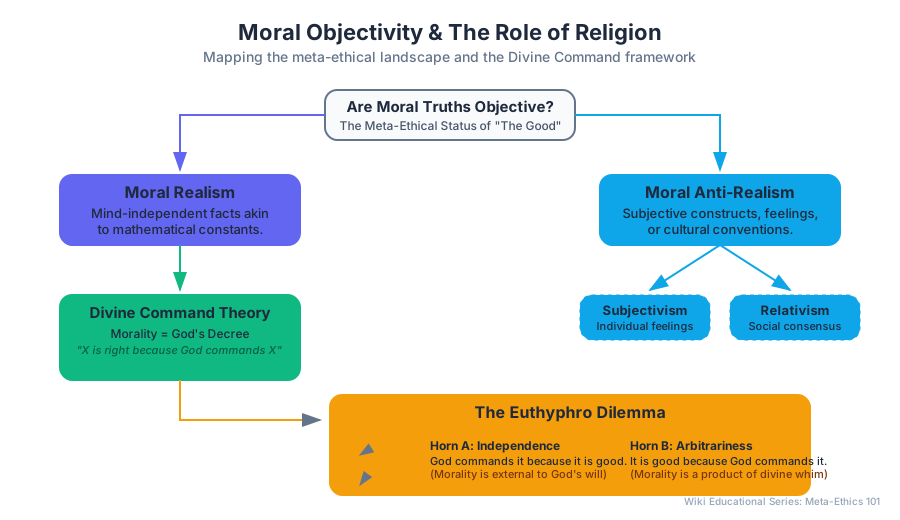
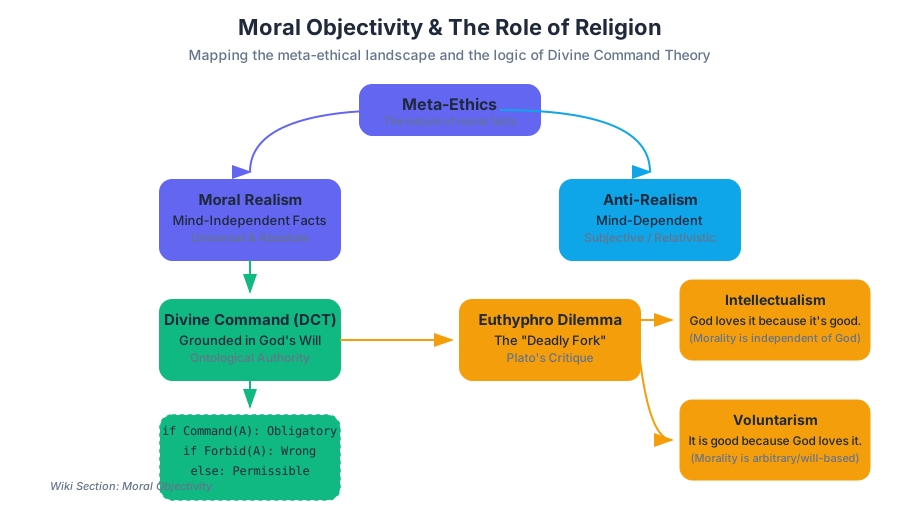
To understand moral objectivity, we must first categorize the competing meta-ethical frameworks. Meta-ethics does not ask "What is right?" but rather "What does it mean for something to be right?" and "Are there moral facts?"
1.1 Moral Realism (Objectivism)
Moral Realism is the thesis that moral propositions refer to objective features of the world. Under this view, the statement "Torture is wrong" is true in the same way that "The Earth is an oblate spheroid" is true. It is a fact that exists regardless of whether anyone believes it.
1.2 Moral Anti-Realism (Subjectivism and Relativism)
Moral Anti-Realism denies the existence of mind-independent moral facts. This includes:
- Subjectivism: Moral statements are reports of individual feelings or attitudes.
- Cultural Relativism: Moral truths are relative to the conventions of a specific society.
- Non-Cognitivism: Moral statements aren't even "true" or "false"; they are mere expressions of emotion (Emotivism) or prescriptions for behavior (Prescriptivism).
| Position | Ontological Status | Source of Authority | Truth Value |
|---|---|---|---|
| Moral Realism | Objective / Mind-Independent | Universal Reason, Nature, or God | Absolute |
| Subjectivism | Subjective / Mind-Dependent | Individual Preference | Relative to Agent |
| Cultural Relativism | Intersubjective | Social Consensus / Tradition | Relative to Culture |
| Error Theory | Non-Existent | None (Morality is a "false" concept) | Always False |
The Argument from Queerness: Proposed by J.L. Mackie, this is a famous critique of moral objectivity. Mackie argued that if objective moral values existed, they would be entities of a "very strange sort," unlike anything else in the universe. They would have to possess "built-in" motivational power—simply knowing a moral fact would have to compel you to act, which defies standard empirical observation.
2. Ethics and Religion: The Historical Nexus
For the vast majority of human history, ethics and religion were viewed as a single, integrated system. The "Moral Law" was synonymous with "God's Law." This connection serves several functional and philosophical purposes:
- Metaphysical Grounding: Religion provides an answer to why moral facts exist (e.g., they are created by a Transcendent Being).
- Epistemic Access: Religion provides a method for knowing what is right (e.g., scripture, revelation, or divine inspiration).
- Motivational Force: Religion provides a reason to be moral (e.g., divine reward, punishment, or the pursuit of spiritual alignment).
3. Divine Command Theory (DCT)
Divine Command Theory (DCT) is the most direct way to link religion and moral objectivity. It posits that an action's moral status is determined by whether it is commanded by God.
3.1 The Logic of DCT
In a formal sense, DCT defines "obligatory" and "forbidden" through the following mapping:
- Action $A$ is obligatory if and only if God commands $A$.
- Action $A$ is wrong if and only if God forbids $A$.
- Action $A$ is permissible if and only if God does not forbid $A$.
This framework provides a clear, objective standard. If God exists and has issued commands, then morality is objective because it does not depend on human opinion.
3.2 Implementation Example: Moral Decision Engine
If we were to model a DCT-based ethical system in software, it would function as a strict authority-validation service.
class DivineCommandEngine:
    """
    A low-level implementation of a Divine Command Theory (DCT)
    decision-making framework.
    """
    def __init__(self, revelation_source):
        self.commands = revelation_source.load_commands()
        self.prohibitions = revelation_source.load_prohibitions()

    def evaluate_action(self, action_id):
        # In DCT, the 'goodness' is not a property of the action's
        # consequences, but of its alignment with the Command.
        if action_id in self.prohibitions:
            return {
                "status": "FORBIDDEN",
                "moral_value": -1.0,
                "justification": "Prohibited by Divine Decree"
            }
        elif action_id in self.commands:
            return {
                "status": "OBLIGATORY",
                "moral_value": 1.0,
                "justification": "Commanded by Divine Decree"
            }
        else:
            return {
                "status": "PERMISSIBLE",
                "moral_value": 0.0,
                "justification": "Indifferent/Permissible"
            }

# Usage:
# engine = DivineCommandEngine(DecalogueSource())
# result = engine.evaluate_action("BEAR_FALSE_WITNESS")
4. The Euthyphro Dilemma
The most significant challenge to Divine Command Theory comes from Plato’s Euthyphro. Socrates poses a question that creates a "deadly fork" for any religious ethicist:
"Is the pious loved by the gods because it is pious, or is it pious because it is loved by the gods?"
Modernized for monotheism, the dilemma asks: Is an action right because God commands it, or does God command it because it is right?
4.1 Horn 1: The Arbitrariness Problem
If an action is right simply because God commands it, then morality is arbitrary. If God commanded that "thou shalt kill thy neighbor," then killing would be morally obligatory. Under this horn, God’s commands are not based on reasons; they are the reason. This makes the concept of "God is good" vacuous, as "good" just means "whatever God says."
4.2 Horn 2: The Independence Problem
If God commands an action because it is right, then there is a standard of "Rightness" that exists independently of God. God is simply a "moral expert" who recognizes these objective truths and relays them to us. While this saves morality from being arbitrary, it means God is no longer the source of morality. Morality exists "above" or "beside" the divine.
4.3 Formalizing the Dilemma
We can represent the logical tension of the Euthyphro Dilemma using formal notation to show the contradiction in grounding objectivity solely in will.
Let C(g, a) = God commands action a
Let R(a) = Action a is morally right

Dilemma:
1. R(a) <-> C(g, a)  [Definition of DCT]
2. If (C(g, a) -> R(a)), then:
   ∀a, (C(g, a) is the sufficient and necessary cause of R(a))
   => If God commands 'Cruelty', then 'Cruelty' is Right. (Arbitrariness)
3. If (R(a) -> C(g, a)), then:
   ∃ Standard S such that R(a) is true according to S, and God recognizes S.
   => R(a) is independent of C(g, a). (Independence)
5. Natural Law Theory: An Alternative Synthesis
To escape the Euthyphro Dilemma, many religious philosophers (most notably Thomas Aquinas) turned to Natural Law Theory. This view suggests that morality is objective and grounded in God, but not through arbitrary commands.
5.1 The Mechanics of Natural Law
Natural Law posits that God created the universe with a specific design and purpose (Telos). Human beings have a specific nature, and "the Good" is defined as acting in accordance with that nature.
- The Eternal Law: God's rational plan for the universe.
- The Natural Law: The portion of the Eternal Law that humans can discover through Reason.
In this framework, God doesn't need to issue a "command" for murder to be wrong. Murder is wrong because it violates the fundamental human "inclination" to preserve life and live in a stable society—an inclination designed by God.
| Feature | Divine Command Theory (DCT) | Natural Law Theory |
|---|---|---|
| Source of Morality | God's Will (Voluntarism) | God's Intellect / Nature (Rationalism) |
| Access to Morality | Revelation (Scripture) | Reason and Observation |
| Flexibility | Could change if God wills it | Fixed by human nature and the cosmos |
| Role of Reason | Obedience to authority | Discovery of inherent purpose |
6. Secular Moral Objectivity
Can morality be objective without religion? Many modern philosophers argue yes, using different "anchors" for objectivity.
6.1 Kantian Deontology
Immanuel Kant argued that morality is grounded in the structure of Rationality itself. The Categorical Imperative provides a "test" for moral objectivity: "Act only according to that maxim whereby you can, at the same time, will that it should become a universal law."
6.2 Utilitarianism (Consequentialism)
Utilitarians like John Stuart Mill argue that morality is objective because it is based on the empirical fact of Suffering and Well-being. If we agree that "Pain is bad" and "Pleasure is good" are objective biological/psychological facts, then we can build an objective moral calculus.
6.3 Moral Functionalism
Some contemporary thinkers view morality as a "social technology" designed to solve the problem of cooperation. Just as there are "objectively better" ways to build a bridge (physics), there are "objectively better" ways to structure a society to minimize conflict and maximize flourishing.
# A declarative representation of a Secular Objective Framework
framework: Secular_Functionalism
version: 1.0
axioms:
  - suffering_is_negative: true
  - cooperation_is_optimal: true
  - agency_is_valuable: true

rules:
  - id: universal_reciprocity
    logic: "if action(A) scaled to population(P) collapses society(S), then A = WRONG"
    example: "Theft (If everyone steals, property and trade cease to exist)"

  - id: harm_reduction
    logic: "minimize(sum(physical_pain + psychological_trauma))"
    parameters:
      - scope: all_sentient_beings
      - weighting: equal_per_unit_of_suffering
7. Common Pitfalls and Misconceptions
7.1 The "No God, No Morality" Fallacy
A common misconception is that if God does not exist, "everything is permitted" (a quote often attributed to Dostoevsky). This ignores the possibility of secular grounding (Kantianism, Utilitarianism) and the fact that social contracts and evolutionary biology provide strong, non-arbitrary reasons for moral behavior.
7.2 Confusing Ontology with Epistemology
- Ontology: Does the moral fact exist?
- Epistemology: How do we know the moral fact? Many people argue that morality is subjective because people disagree about it (epistemology). However, disagreement does not prove lack of objectivity. People disagreed about whether the Earth was flat, but the fact of the Earth's shape remained objective.
7.3 The Is-Ought Problem (Hume's Guillotine)
David Hume famously argued that you cannot derive an "Ought" (a moral claim) from an "Is" (a factual claim). Just because humans are biologically wired to protect their kin (Is), it doesn't automatically mean we ought to protect them (Ought). Bridging this gap is the primary challenge for any objective theory, religious or secular.
Summary of Key Connections
The journey from Moral Objectivity to the Role of Religion reveals a deep-seated human desire for a "firm foundation."
- Objectivity provides the stability we need for justice and social order.
- Religion historically provided the "metaphysical glue" for that objectivity via Divine Command Theory.
- The Euthyphro Dilemma forces us to choose between an arbitrary God and an independent Morality.
- Natural Law and Secular Frameworks attempt to resolve this by finding objectivity in the structure of Reason, Nature, or Human Flourishing.
Whether grounded in the "Starry Heavens above" (God) or the "Moral Law within" (Reason), the pursuit of objective ethics remains the central "operating system" of civilization.
Contemporary Perspectives: Biology and Gender
Key concepts: Ethics and biology · Ethics and gender · Evolutionary ethics · Feminist ethics
Examines how modern scientific understandings of biology and feminist critiques of traditional philosophy have reshaped ethical discourse.
Contemporary Perspectives: Biology and Gender
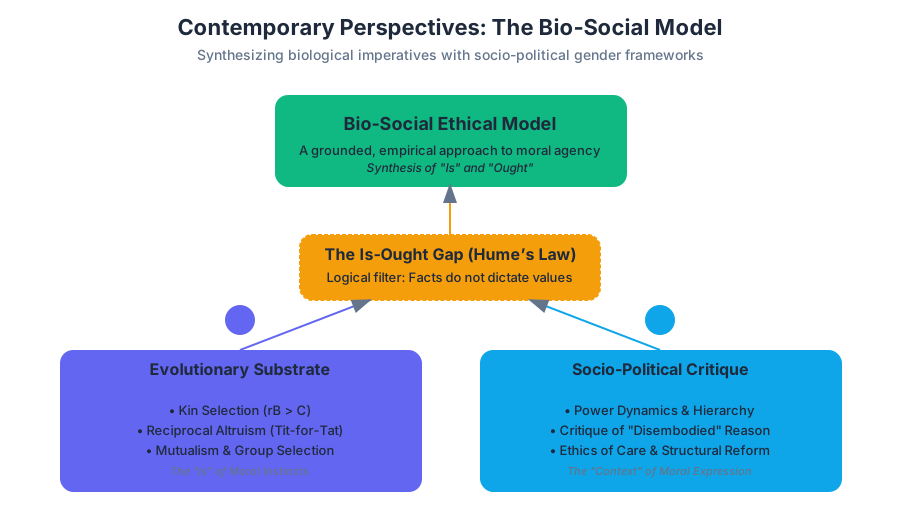
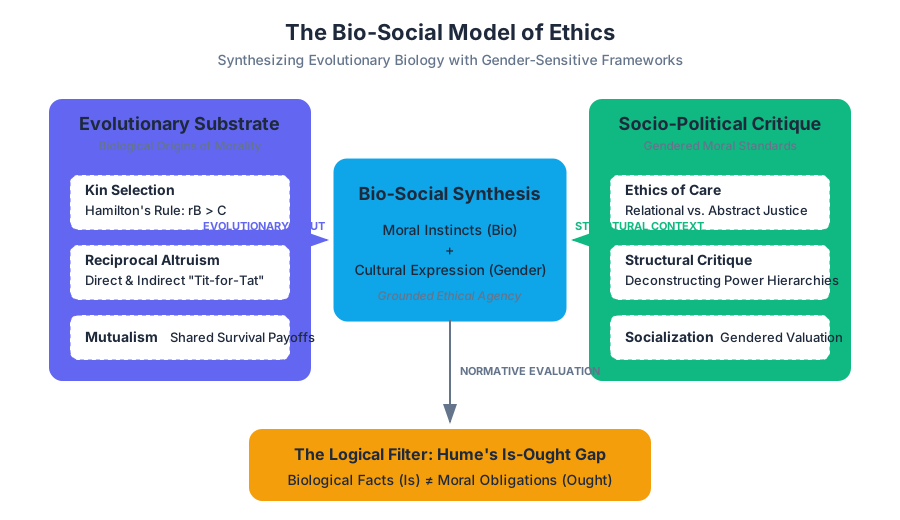
The landscape of modern ethics has shifted from the purely speculative to the empirical and structural. While traditional ethical frameworks—such as Deontology or Utilitarianism—often treated the "moral agent" as a generic, rational, and disembodied entity, contemporary perspectives demand a more grounded approach. This evolution is driven by two primary vectors: the biological substrate of human behavior (Evolutionary Ethics) and the socio-political critique of gendered moral standards (Feminist Ethics).
By synthesizing biological imperatives with gender-sensitive frameworks, we move toward a "Bio-Social" model of ethics. This model recognizes that while our moral instincts may be hard-coded by millions of years of evolution, the expression and valuation of those instincts are deeply influenced by cultural constructs of gender and power.
Ethics and Biology: The Evolutionary Substrate
Evolutionary Ethics is the field that seeks to understand the origins of moral behavior through the lens of biological evolution. It posits that morality is not a divine gift or a purely cultural invention, but a set of evolved adaptations that facilitated survival and reproduction in social environments.
The Biological Basis of Altruism
The central puzzle of evolutionary biology was the existence of altruism—behavior that benefits another individual at a cost to the actor. In a strictly Darwinian "survival of the fittest" model, altruism should be selected against. However, several mechanisms explain how "moral" behaviors like cooperation and self-sacrifice became genetically stable.
- Kin Selection (Inclusive Fitness): Formulated by W.D. Hamilton, this theory suggests that individuals can increase the transmission of their genes by helping close relatives.
- Reciprocal Altruism: Proposed by Robert Trivers, this explains cooperation between non-relatives. If $A$ helps $B$ with the expectation that $B$ will help $A$ later, both increase their long-term fitness.
- Group Selection: The controversial idea that groups with more "cooperators" outcompete groups of "cheaters," even if individuals within the group suffer.
Hamilton’s Rule: $rB > C$ Where r is the genetic relatedness, B is the benefit to the recipient, and C is the cost to the actor. Altruism is evolutionarily favored when the genetic benefit outweighs the individual cost.
Evolutionary Mechanisms for Moral Behavior
| Mechanism | Definition | Moral Manifestation | Evolutionary Payoff |
|---|---|---|---|
| Kin Selection | Favoring genetic relatives. | Nepotism, parental care, family loyalty. | Preservation of shared alleles. |
| Direct Reciprocity | "Tit-for-tat" exchanges. | Fairness, gratitude, indignation at "cheaters." | Long-term resource stability. |
| Indirect Reciprocity | Reputation-based cooperation. | Honor, shame, social standing, altruistic signaling. | Access to social networks and mates. |
| Mutualism | Immediate shared benefit. | Teamwork, hunting parties, collective defense. | Immediate survival advantage. |
Implementation: Simulating Moral Strategies
To understand how these biological pressures translate into behavior, we can model them using game theory. The following Python snippet simulates a population of "Cooperators" and "Defectors" in a Prisoner's Dilemma scenario, demonstrating how "moral" (cooperative) strategies can dominate under certain conditions.
import random

class Agent:
    def __init__(self, strategy):
        self.strategy = strategy  # 'cooperate' or 'defect'
        self.score = 0

    def act(self, opponent):
        if self.strategy == 'cooperate':
            return 'C'
        return 'D'

def simulate_generation(population, rounds=10):
    """
    Simulates interactions between agents.
    Payoff Matrix:
    (C, C) -> 3 each | (D, D) -> 1 each | (D, C) -> D gets 5, C gets 0
    """
    for _ in range(rounds):
        a, b = random.sample(population, 2)
        move_a = a.act(b)
        move_b = b.act(a)

        if move_a == 'C' and move_b == 'C':
            a.score += 3; b.score += 3
        elif move_a == 'D' and move_b == 'C':
            a.score += 5; b.score += 0
        elif move_a == 'C' and move_b == 'D':
            a.score += 0; b.score += 5
        else:
            a.score += 1; b.score += 1

# Initialize a population with a mix of strategies
population = [Agent('cooperate') for _ in range(70)] + [Agent('defect') for _ in range(30)]
simulate_generation(population)

# Sort by score to see which strategy 'won' the evolutionary round
population.sort(key=lambda x: x.score, reverse=True)
print(f"Top 5 strategies: {[a.strategy for a in population[:5]]}")
The Naturalistic Fallacy and the Is-Ought Gap
While biology explains why we have certain moral intuitions, it does not necessarily tell us what we should do. This is the crux of the Naturalistic Fallacy, a term coined by G.E. Moore, building on David Hume’s Is-Ought Gap.
Hume’s Law
Hume famously argued that one cannot derive a statement of value (ought) from a statement of fact (is). Just because humans are biologically wired to be xenophobic (an "is" of evolutionary history) does not mean we ought to be xenophobic (a normative "ought").
The Open Question Argument
Moore proposed that for any natural property (e.g., "pleasure" or "survival"), the question "Is it good?" remains an open question. If "good" were identical to "survival," then "Is survival good?" would be a tautology (like "Is a bachelor unmarried?"). Since it is not a tautology, "good" must be a non-natural property.
% Formalizing the Is-Ought Gap in First-Order Logic
% Let P(x) be a descriptive property (e.g., "x is natural")
% Let G(x) be a normative property (e.g., "x is good")

\forall x (P(x) \implies G(x)) \quad \text{is a logical fallacy without a normative premise.}

\text{Correct derivation requires:}
\text{Premise 1: } P(a) \quad \text{(Descriptive)}
\text{Premise 2: } \forall x (P(x) \implies G(x)) \quad \text{(Normative Bridge)}
\text{Conclusion: } G(a)
Ethics and Gender: The Feminist Critique
Traditional ethics has often been criticized by feminist philosophers for being "gender-blind" in a way that actually favors "masculine" experiences. This critique suggests that the Western philosophical canon—from Plato to Kant—has prioritized the public sphere (law, war, commerce) over the private sphere (caregiving, domestic life, emotional labor).
The Ethics of Care
The Ethics of Care emerged as a distinct normative theory in the 1980s, primarily through the work of Carol Gilligan and Nel Noddings. Gilligan’s research suggested that while men tend to approach moral problems through a "Justice Perspective" (rights, rules, and autonomy), women often approach them through a "Care Perspective" (relationships, responsibilities, and empathy).
Definition: Relational Ontology Feminist ethics often rejects the "atomistic individual" of liberal theory. Instead, it views humans as fundamentally relational beings whose identities and moral obligations are defined by their connections to others.
Comparison: Justice vs. Care Perspectives
| Feature | Ethics of Justice (Traditional) | Ethics of Care (Feminist) |
|---|---|---|
| Core Value | Autonomy and Fairness. | Connection and Responsibility. |
| Moral Logic | Application of universal rules. | Maintenance of specific relationships. |
| Ideal Agent | Disinterested, rational observer. | Engaged, empathetic participant. |
| Context | Abstract, "View from Nowhere." | Concrete, "View from Somewhere." |
| Goal | Resolving conflicts of rights. | Minimizing harm and sustaining ties. |
Feminist Ethics: Beyond Care
While the Ethics of Care was a foundational step, Feminist Ethics as a whole is broader. It is a political and critical project that examines how power dynamics and gender hierarchies influence moral theory.
1. Critique of the "Rational Man"
Feminist ethicists argue that the "Rational Man" of Kantian ethics is a myth. By assuming a self-sufficient agent, traditional ethics ignores the reality of dependency. Every "rational man" was once a child dependent on a caregiver, and many will become elderly or disabled and dependent again. A truly universal ethics must account for dependency as a core human condition.
2. Epistemic Injustice
Coined by Miranda Fricker, this concept highlights how certain groups (often women and marginalized genders) are silenced or dismissed as "unreliable" knowers. In ethics, this means the moral experiences of women—such as the nuances of reproductive labor—have been historically excluded from the "data set" of moral philosophy.
3. Intersectionality
Modern feminist ethics incorporates intersectionality (a term from Kimberlé Crenshaw), acknowledging that gender does not exist in isolation. A woman’s moral experience is shaped by her race, class, ability, and sexual orientation. An ethics that only considers the experience of white, middle-class women is not truly feminist.
Real-World Application: Algorithmic Bias
In the digital age, feminist ethics is applied to AI and data science. If an algorithm is trained on historical data that reflects gender bias, it will perpetuate that bias. A feminist ethical approach would not just ask "Is this algorithm accurate?" but "Who does this algorithm serve, and whose labor is it replacing?"
# Hypothetical Schema for a Feminist Ethical Audit of an AI Model
audit_framework:
  version: 2.1
  target_model: "Recruitment_Ranker_v4"
  criteria:
    - dimension: "Relational Impact"
      question: "Does the model penalize gaps in employment related to caregiving?"
      weight: 0.4
    - dimension: "Epistemic Diversity"
      question: "Was the training data sourced from diverse socioeconomic backgrounds?"
      weight: 0.3
    - dimension: "Power Dynamics"
      question: "Does the model's deployment shift power from workers to management?"
      weight: 0.3
  mitigation_strategy:
    type: "Counterfactual Fairness"
    action: "Ensure P(outcome | gender=F) == P(outcome | gender=M)"
Synthesizing Biology and Gender
The intersection of biology and gender in ethics creates a complex, multi-layered understanding of human behavior. Biology provides the potential for behavior, while gendered social structures provide the patterning.
The "Nature vs. Nurture" Feedback Loop
It is a mistake to view biology and gender as separate silos. Biological traits (like the capacity for lactation or physical strength) have been used to justify social roles (the domestic/public split). Conversely, social roles can influence biology through epigenetic changes and hormonal responses.
Common Pitfalls in Synthesis
- Biological Determinism: The error of assuming that because a behavior has a biological basis, it is unchangeable or "right." (e.g., "Men are naturally aggressive, so we shouldn't punish violence.")
- Essentialism: The error of assuming all women or all men share a fixed "essence" or moral style. (e.g., "All women are naturally more caring than all men.")
- Ignoring Power: Focusing purely on biological differences while ignoring how those differences are exploited by political systems.
Contemporary Extensions: Evolutionary Psychology and Gender
Evolutionary psychology often attempts to explain gender differences in morality through Parental Investment Theory. This theory suggests that because women have a higher biological investment in offspring (gestation, lactation), they may have evolved different risk-assessment and moral-prioritization strategies than men.
However, feminist critics point out that these "evolutionary" explanations often mirror the prejudices of the time. For instance, early sociobiologists claimed that "coyness" in females was a biological universal—a claim later debunked by more rigorous cross-species and cross-cultural observation.
Complexity and Variation
| Concept | Biological Perspective | Gender/Feminist Perspective | Synthesis/Modern View |
|---|---|---|---|
| Altruism | Driven by genetic relatedness and reciprocity. | Driven by socialized care and relational labor. | Altruism is a biological capacity shaped by social roles. |
| Autonomy | Individual fitness maximization. | A "masculine" myth that ignores dependency. | "Relational Autonomy": we are free only within supportive networks. |
| Justice | A mechanism to prevent "cheating" in groups. | A tool that can be used to ignore specific needs. | Justice must be tempered by care to be truly equitable. |
Conclusion: Toward a Holistic Moral Framework
Contemporary ethics is moving away from "Grand Unified Theories" and toward more nuanced, interdisciplinary approaches. By acknowledging our biological heritage, we understand the "raw materials" of our moral life—our empathy, our tribalism, and our sense of fairness. By acknowledging the feminist critique, we understand how those raw materials have been shaped into systems of power and exclusion.
The future of ethics lies in the integration of these fields. A robust ethical system for the 21st century must be:
- Biologically Informed: Aware of human cognitive biases and evolutionary instincts.
- Socially Situated: Aware of how gender, race, and class influence moral standing.
- Relational: Focused on the health of the connections between individuals, not just the rights of the individuals themselves.
Source Materials
Study Introduction to Philosophy: Ethics with AI — Free on Lykke
Sign up for free to generate personalized flashcards, quizzes, and study guides from this course. Chat with an AI tutor that knows the material.
Get Started FreeView this course wiki on Lykke · Browse all public course wikis