From the free course Introduction to Computer Science and Programming in Python on Lykke
String Manipulation and Slicing
Key concepts: String Indexing · String Slicing · Concatenation · Negative Stepping
Focuses on techniques for accessing and modifying text data in Python.
String Manipulation and Slicing
In the hierarchy of computational data types, the string occupies a unique position. While mathematically a string is simply a finite sequence of symbols chosen from an alphabet, in practical computer science, it represents the primary interface between human-readable information and machine-executable logic. Understanding string manipulation is not merely about learning syntax; it is about mastering the mechanics of memory buffers, sequence algebra, and the efficiency of data retrieval.
At its core, a string in modern high-level languages like Python is an immutable sequence object. This immutability is a critical design choice, ensuring that strings can be used as keys in hash maps (dictionaries) and shared across different parts of a program without the risk of side effects. However, this architectural decision necessitates a deep understanding of how to "manipulate" what cannot be changed—leading us to the sophisticated world of indexing, slicing, and concatenation.
String Indexing: The Mechanics of Position
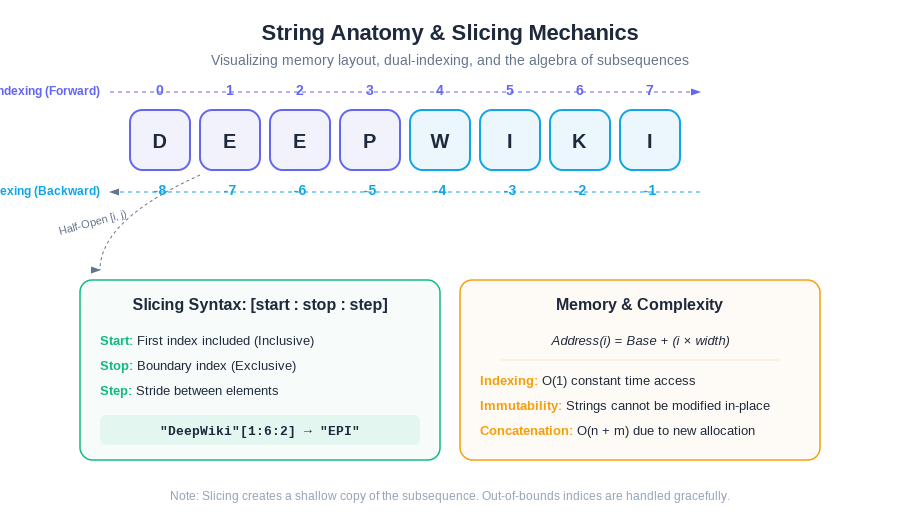
Indexing is the process of accessing a specific element within a sequence based on its ordinal position. In Python, and most modern systems languages, strings use zero-based indexing. This convention is not arbitrary; it stems from the way memory addresses are calculated at the hardware level.
The Zero-Indexing Theorem: If a string starts at memory address $B$ and each character occupies $w$ bytes, the address of the $i$-th character is given by the formula: $Address(i) = B + (i \times w)$ By starting $i$ at 0, the first element resides exactly at the base address $B$, eliminating the need for a subtraction operation during every pointer calculation.
Positive vs. Negative Indexing
Python extends the traditional indexing model by introducing negative indexing, which allows for relative positioning from the end of the sequence. This is particularly useful for accessing trailing data without explicitly calculating the string's length.
| Index Type | Direction | Range (Length $n$) | Use Case |
|---|---|---|---|
| Positive | Forward (Left-to-Right) | $0$ to $n-1$ | Standard iteration, fixed-format parsing. |
| Negative | Backward (Right-to-Left) | $-1$ to $-n$ | Accessing file extensions, suffixes, or last elements. |
Low-Level Implementation of Indexing
To understand why indexing is an $O(1)$ (constant time) operation, we must look at how a string is represented in memory. In a systems-level context, a string is a contiguous block of memory.
/*
 * A low-level representation of a fixed-width character string.
 * This demonstrates how indexing is a direct pointer offset calculation.
 */

#include <stdio.h>

int main() {
    // A string literal stored in the data segment
    const char *str = "DeepWiki";

    // Accessing index 4 ('W')
    // In C, str[4] is syntactic sugar for *(str + 4)
    char element = str[4];

    printf("Base Address: %p\n", (void*)str);
    printf("Address of index 4: %p\n", (void*)(str + 4));
    printf("Value at index 4: %c\n", element);

    return 0;
}
String Slicing: The Algebra of Subsequences
While indexing retrieves a single character, Slicing allows a programmer to extract a contiguous or patterned subsequence. The syntax string[start:stop:step] defines a half-open interval $[start, stop)$, meaning the element at the start index is included, but the element at the stop index is not.
The Anatomy of a Slice
- Start: The index where the slice begins (inclusive). Defaults to 0.
- Stop: The index where the slice ends (exclusive). Defaults to the length of the string.
- Step: The stride between elements. Defaults to 1.
The mathematical beauty of the half-open interval $[i, j)$ is that the length of the resulting slice is simply $j - i$. This avoids the "off-by-one" errors common in languages that use inclusive boundaries.
Slicing Logic and Defaults
The behavior of slicing is governed by a set of internal rules that handle out-of-bounds indices gracefully, unlike standard indexing which raises an IndexError.
| Parameter | Default (Positive Step) | Default (Negative Step) | Behavior if Out of Bounds |
|---|---|---|---|
start |
0 |
len(s) - 1 |
Clamped to string boundaries. |
stop |
len(s) |
-len(s) - 1 |
Clamped to string boundaries. |
step |
1 |
-1 |
Cannot be 0 (raises ValueError). |
Formal Derivation of Slicing
In pseudocode, the slicing operation for s[i:j:k] can be visualized as a loop that constructs a new string object:
Algorithm: StringSlicing(S, start, stop, step)
    Input: String S, Integers start, stop, step
    Output: A new String R

    1. If step > 0:
        lower = max(0, start)
        upper = min(length(S), stop)
    2. Else if step < 0:
        lower = min(length(S) - 1, start)
        upper = max(-1, stop)
    3. Initialize R as empty string
    4. Current = lower
    5. While (step > 0 and Current < upper) or (step < 0 and Current > upper):
        Append S[Current] to R
        Current = Current + step
    6. Return R
Concatenation: Building Sequences
Concatenation is the algebraic operation of joining two character strings end-to-end. In Python, this is achieved via the + operator or the += augmented assignment.
The Performance Trap: Immutability and Memory
Because strings are immutable, every time you concatenate two strings, the runtime must:
- Calculate the total length of the new string.
- Allocate a new block of memory.
- Copy the characters from the first string into the new block.
- Copy the characters from the second string into the new block.
This leads to a classic algorithmic pitfall known as Schlemiel the Painter's algorithm. If you concatenate strings in a loop (e.g., s = s + char), the complexity becomes $O(n^2)$, where $n$ is the final length of the string.
Pro Tip: For large-scale string building, always use the
.join()method or aio.StringIObuffer. The.join()method pre-calculates the required memory and performs the copy in a single pass, maintaining $O(n)$ efficiency.
Real-World Usage: Log Parsing and Path Construction
In professional environments, string manipulation is rarely about simple "Hello World" examples. It is used for parsing structured data from raw streams.
import os

def process_log_entry(raw_line):
    """
    Example of slicing and concatenation in a production context.
    Extracts a timestamp and appends a status code.
    """
    # Assume log format: "2023-10-27 10:00:00 [INFO] User logged in"
    # Extracting the ISO timestamp (first 19 characters)
    timestamp = raw_line[:19]

    # Extracting the log level using slicing
    # We look for the index of '[' and ']'
    start_idx = raw_line.find("[") + 1
    end_idx = raw_line.find("]")
    log_level = raw_line[start_idx:end_idx]

    # Concatenation to form a structured record
    # Using f-strings (modern concatenation) for readability and speed
    return f"{timestamp} | STATUS: {log_level}"

# Example invocation
log = "2023-10-27 14:30:05 [ERROR] Database connection failed"
print(process_log_entry(log))
Negative Stepping and String Reversal
The step parameter in slicing is a powerful tool for data transformation. When the step is negative, the slicing engine traverses the string from right to left.
The Reversal Idiom
The most common use of negative stepping is the "reversal idiom": s[::-1].
startdefaults to the end of the string.stopdefaults to the beginning (and includes the first character).stepis-1.
Advanced Stepping: Downsampling and Striding
Negative stepping can be combined with specific start and stop values to extract patterns in reverse. For example, s[10:2:-2] would start at index 10 and move toward index 2, taking every second character.
Common Pitfalls and Edge Cases
- IndexError vs. Slicing Grace: Accessing
s[100]on a 10-character string will crash your program. However,s[0:100]will simply return the whole string. This "silent clamping" can sometimes hide logic errors in your code. - Off-by-One in Slicing: Remember that the
stopindex is not included. If you want the first three characters, you uses[0:3], which returns indices 0, 1, and 2. - Memory Overhead: Slicing creates a copy of the data (in Python). If you are slicing a 1GB string in a loop, you will quickly exhaust your system's RAM. In such cases, consider using
memoryvieworbytearrayfor zero-copy operations.
Comparison of String Access Methods
| Method | Syntax | Result Type | Complexity | Out-of-Bounds Behavior |
|---|---|---|---|---|
| Indexing | s[i] |
Single Char | $O(1)$ | Raises IndexError |
| Slicing | s[i:j] |
Substring | $O(k)$* | Returns empty string or partial |
| Stride Slicing | s[i:j:k] |
Patterned Substring | $O(n/k)$ | Returns empty string or partial |
| Concatenation | s1 + s2 |
New String | $O(n+m)$ | N/A |
*where k is the length of the slice.
Practical Application: Data Sanitization
In DevOps and Infrastructure, string manipulation is frequently used to sanitize inputs or transform configuration strings.
#!/bin/bash
# A shell script demonstrating string manipulation for environment variables

RAW_URL="https://user:password@internal-service.cluster.local:8080/api/v1"

# 1. Extracting the Protocol (Slicing via parameter expansion)
# Syntax: ${variable%%suffix}
PROTOCOL="${RAW_URL%%://*}"

# 2. Extracting the Hostname
# Remove everything up to '@' and everything after ':'
TEMP="${RAW_URL#*@}"
HOSTNAME="${TEMP%:*}"

# 3. Concatenation to build a new connection string
NEW_URL="${PROTOCOL}://${HOSTNAME}/health"

echo "Original: $RAW_URL"
echo "Sanitized: $NEW_URL"
Summary of Theoretical Constraints
When we discuss string manipulation, we are essentially discussing the management of linear arrays of bytes. The high-level abstractions provided by Python (like negative stepping) are built upon low-level pointer arithmetic. The efficiency of your code depends on minimizing the number of allocations (avoiding + in loops) and understanding the boundaries of your sequences.
Source Materials
- Introduction to Computer Science and Programming in Python
- Introduction to Computer Science and Programming in Python
- Introduction to Computer Science and Programming in Python
- Introduction to Computer Science and Programming in Python
- Introduction to Computer Science and Programming in Python
- Introduction to Computer Science and Programming in Python
- Introduction to Computer Science and Programming in Python
- Introduction to Computer Science and Programming in Python
Study Introduction to Computer Science and Programming in Python on Lykke
This course page is free to open: signed out, you can read its first two sections, and signing in, on any plan, opens the rest. The free Lykke Chrome extension syncs your own Canvas courses, so ChatGPT, Claude and Muse can answer from your classes and deadlines. It only reads Canvas.
Add the free extensionSign in to open every sectionAll sections of Introduction to Computer Science and Programming in Python · Browse more course pages