From the free course Introduction to Computer Science and Programming in Python on Lykke
Higher-Order Functions
Key concepts: Functions as Arguments · Parameter Mapping · Execution Flow
Explores advanced function usage where functions act as data.
Higher-Order Functions
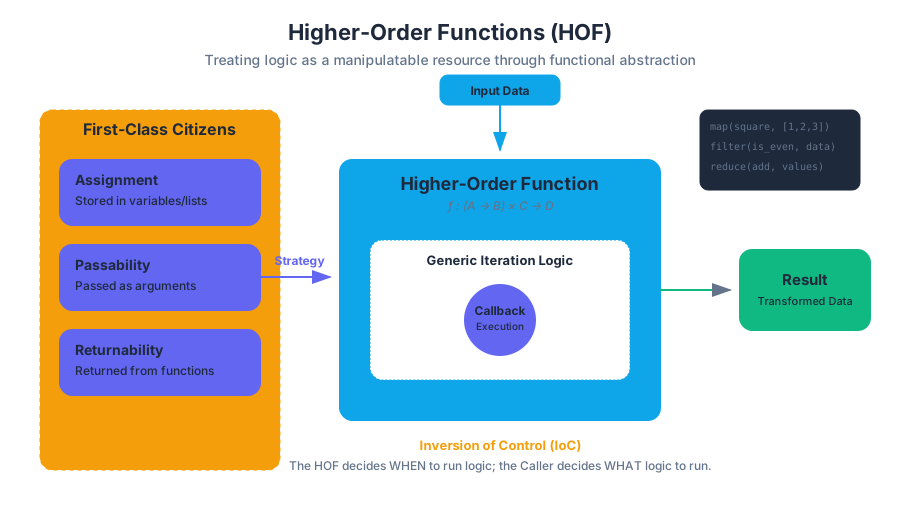
In the landscape of computational abstraction, the transition from treating data as passive entities to treating logic as a manipulatable resource marks the threshold of advanced programming. Higher-Order Functions (HOFs) represent this transition. In languages like Python, JavaScript, and Swift, functions are categorized as first-class objects, a designation that elevates them from mere subroutines to entities that can be stored in variables, passed as arguments, and returned from other functions.
At its core, a higher-order function is defined by a simple but profound criterion: it must either take one or more functions as arguments or return a function as its result. This capability allows for the creation of "meta-programs"—code that describes how other code should be executed. By decoupling the iteration logic from the transformation logic, HOFs enable a level of modularity that is impossible with standard procedural flow.
The Foundation: Functions as First-Class Citizens
Before exploring the mechanics of HOFs, we must establish the prerequisite: the First-Class Object. In a programming language, an object is "first-class" if it supports all the operations generally available to other entities. This includes being passed as an argument, returned from a function, and assigned to a variable.
| Property | Description | Impact on Functions |
|---|---|---|
| Assignment | Can be assigned to a variable name or stored in a data structure. | func_ptr = my_function allows aliasing and dynamic selection. |
| Passability | Can be passed as an argument to a procedure. | Enables "Inversion of Control" (IoC) and callbacks. |
| Returnability | Can be the return value of a procedure. | Enables factory patterns and closures. |
| Identity | Has a distinct identity and type (e.g., <class 'function'>). |
Allows for runtime introspection and type checking. |
Definition: Higher-Order Function (HOF) A function $f$ is higher-order if it satisfies the mapping $f: (A \to B) \times C \to D$, where at least one input or the output is itself a function mapping.
Functions as Arguments: Inversion of Control
The most common application of HOFs is passing a function as an argument. This pattern is often referred to as Inversion of Control (IoC). Instead of a function deciding exactly how to process every piece of data, it accepts a "strategy" (in the form of another function) from the caller.
Why It Matters
Consider a scenario where you need to compute the sum of integers in a list. Later, you need the sum of their squares, and then the sum of their absolute values. Without HOFs, you would write three distinct loops. With HOFs, you write one accumulate function that accepts a transform function as a parameter.
Mechanics of Implementation
When a function is passed as an argument, the receiving function does not execute it immediately. Instead, it receives a reference to the function's entry point in memory. The execution happens "later," within the scope of the higher-order function, often repeatedly.
# First code block: Low-level implementation of a generic accumulator
# This demonstrates the primary mechanism of HOFs in Python.

def apply_and_sum(data_list, transform_func):
    """
    A higher-order function that applies transform_func to each
    element in data_list and returns the aggregate sum.
    """
    total = 0
    for item in data_list:
        # The 'transform_func' is invoked here, inside the HOF's scope.
        # This is the 'callback' mechanism.
        total += transform_func(item)
    return total

def square(x):
    return x * x

def cube(x):
    return x ** 3

# Usage
numbers = [1, 2, 3, 4, 5]
sum_of_squares = apply_and_sum(numbers, square)
sum_of_cubes = apply_and_sum(numbers, cube)

print(f"Squares: {sum_of_squares}, Cubes: {sum_of_cubes}")
Parameter Mapping and Binding
A critical aspect of HOFs is Parameter Mapping—the process by which the arguments of the higher-order function are bound to the formal parameters of the passed function. This requires a strict contract between the HOF and the function it receives.
Formal vs. Actual Parameters
When we define apply_and_sum(data_list, transform_func), transform_func is a formal parameter. When we call it with apply_and_sum(my_list, square), square is the actual parameter. The HOF must know the arity (number of arguments) that the transform_func expects. If apply_and_sum passes one argument but transform_func requires two, the program will raise a TypeError.
Trace Table: Execution Flow of apply_and_sum(numbers, square)
Assuming numbers = [1, 2]:
| Step | Scope | Variable | Value/Action |
|---|---|---|---|
| 1 | Global | numbers |
[1, 2] |
| 2 | Global | square |
<function square at 0x...> |
| 3 | apply_and_sum |
data_list |
Reference to numbers |
| 4 | apply_and_sum |
transform_func |
Reference to square |
| 5 | Loop Iter 1 | item |
1 |
| 6 | square |
x |
1 (Bound from item) |
| 7 | Loop Iter 1 | total |
0 + 1 = 1 |
| 8 | Loop Iter 2 | item |
2 |
| 9 | square |
x |
2 (Bound from item) |
| 10 | Loop Iter 2 | total |
1 + 4 = 5 |
Mathematical Derivation: Functional Abstraction
In mathematical terms, HOFs are akin to operators in calculus. Consider the derivative operator $D$. It does not take a number as an input; it takes a function $f(x)$ and returns another function $f'(x)$.
% Second code block: Mathematical representation of HOFs
% Representing the Derivative as a Higher-Order Function

Let F be the set of all differentiable functions.
The derivative operator D is a mapping:
D: F -> F

Where for any f ∈ F:
(D(f))(x) = lim_{h -> 0} [f(x + h) - f(x)] / h

In pseudocode, this HOF 'derivative' would look like:
function derivative(f, dx):
    return function(x):
        return (f(x + dx) - f(x)) / dx
This derivation highlights the "Function as Return Value" aspect of HOFs. The derivative function doesn't return a number; it returns a new function that can be evaluated at any $x$.
Execution Flow and the Call Stack
The execution flow of a higher-order function involves complex movements within the Call Stack. When a HOF calls its argument function, a new Activation Record (or stack frame) is pushed onto the stack.
- HOF Entry: The stack frame for the HOF is created, containing its local variables and the references to the passed functions.
- Callback Invocation: The HOF pauses its execution to call the argument function. A new frame is pushed for the callback.
- Callback Exit: The callback completes, its frame is popped, and the return value is passed back to the HOF.
- HOF Resumption: The HOF uses the returned value to continue its logic.
Visualizing the Stack
Theorem: The Principle of Least Knowledge A higher-order function should not need to know the internal implementation of the function it calls. It only requires that the function adheres to the expected interface (input types and return types). This is the basis for Polymorphism in functional programming.
Real-World Application: Middleware and Event Handling
In modern software engineering, HOFs are the backbone of asynchronous programming and web frameworks. In JavaScript, for example, the addEventListener function is a classic HOF that takes an event type and a callback function.
// Third code block: Real-world usage in Web APIs
// Demonstrating HOFs in an Express.js-style middleware pipeline.

const loggerMiddleware = (req, res, next) => {
    console.log(`${new Date().toISOString()} - ${req.method} ${req.url}`);
    // 'next' is a function passed as an argument.
    // Calling it passes control to the next HOF in the chain.
    next();
};

const authMiddleware = (req, res, next) => {
    if (req.headers.authorization) {
        next();
    } else {
        res.status(401).send('Unauthorized');
    }
};

// A HOF that 'composes' multiple middleware into one
const compose = (fns) => (req, res) => {
    const dispatch = (i) => {
        const fn = fns[i];
        if (!fn) return;
        fn(req, res, () => dispatch(i + 1));
    };
    dispatch(0);
};

// Usage in a hypothetical server
const appPipeline = compose([loggerMiddleware, authMiddleware]);
The Functional Trinity: Map, Filter, and Reduce
Most HOF usage centers around three fundamental patterns. These patterns replace explicit loops with declarative transformations.
| Pattern | Mathematical Analogy | Purpose | Result Type |
|---|---|---|---|
| Map | $f(x) \forall x \in S$ | Transforms every element in a collection. | Collection of same size. |
| Filter | ${x \in S \mid P(x)}$ | Selects elements that satisfy a predicate $P$. | Collection of equal or smaller size. |
| Reduce | $\sum$ or $\prod$ | Aggregates a collection into a single value. | Single value (scalar/object). |
Map: The Transformer
map takes a function and a list, applying the function to every element. It is the purest form of "Parameter Mapping" where the HOF manages the iteration and the callback manages the logic.
Filter: The Gatekeeper
filter takes a predicate (a function that returns a Boolean). It constructs a new list containing only elements for which the predicate returns True.
Reduce: The Folding Operator
reduce (or fold) is the most complex. It takes a binary function, a collection, and an optional initial value. It "folds" the collection by repeatedly applying the function to an accumulator and the next element.
Common Pitfalls and Edge Cases
While HOFs are powerful, they introduce specific categories of bugs that are often difficult to trace.
1. Late Binding and Closures
In many languages (like Python), variables used inside a nested function are looked up when the function is called, not when it is defined. This can lead to unexpected behavior in loops.
2. Side Effects in Callbacks
HOFs assume that the passed function is pure (produces no side effects). If a callback modifies a global variable or performs I/O, the HOF's behavior becomes unpredictable, especially in parallel execution environments.
3. Arity Mismatch
As mentioned in the Parameter Mapping section, passing a function that expects three arguments to a HOF that only provides two will cause a runtime crash.
4. Performance Overhead
Each function call involves stack operations. In performance-critical systems (like embedded C), excessive use of HOFs (via function pointers) can introduce overhead compared to inlined loops.
/* Fourth code block: Low-level C implementation showing function pointers */
/* This illustrates how HOFs are handled at the machine level. */

#include <stdio.h>

// Define a type for a function that takes an int and returns an int
typedef int (*transformer)(int);

// The Higher-Order Function in C
void process_array(int *arr, int size, transformer func) {
    for (int i = 0; i < size; i++) {
        // Dereferencing the function pointer to execute the logic
        arr[i] = (*func)(arr[i]);
    }
}

int increment(int x) { return x + 1; }
int double_val(int x) { return x * 2; }

int main() {
    int data[] = {10, 20, 30};
    // Passing the address of the 'double_val' function
    process_array(data, 3, double_val);

    for(int i=0; i<3; i++) printf("%d ", data[i]); // Output: 20 40 60
    return 0;
}
Summary of Execution Flow
When a Higher-Order Function executes, it creates a dynamic bridge between different layers of abstraction. The "Execution Flow" is not linear; it is a series of jumps:
- Entry: The HOF captures the environment.
- Mapping: The HOF prepares the data for the callback.
- Dispatch: Control is handed to the callback.
- Collection: The HOF retrieves the result and integrates it into the larger computation.
This cycle repeats for every element in the data structure, effectively "outsourcing" the core logic while maintaining control over the process structure.
Source Materials
- Introduction to Computer Science and Programming in Python
- Introduction to Computer Science and Programming in Python
- Download transcript
- Introduction to Computer Science and Programming in Python
- Introduction to Computer Science and Programming in Python
- Introduction to Computer Science and Programming in Python
- Introduction to Computer Science and Programming in Python
- Download transcript
Study Introduction to Computer Science and Programming in Python on Lykke
This course page is free to open: signed out, you can read its first two sections, and signing in, on any plan, opens the rest. The free Lykke Chrome extension syncs your own Canvas courses, so ChatGPT, Claude and Muse can answer from your classes and deadlines. It only reads Canvas.
Add the free extensionSign in to open every sectionAll sections of Introduction to Computer Science and Programming in Python · Browse more course pages