From the free course Introduction to Computer Science and Programming in Python on Lykke
Recursion, Efficiency, and OOP
Key concepts: Recursion · Algorithmic Efficiency · Object-Oriented Programming (OOP) · Data Structures (Dictionaries)
An introduction to more complex computer science topics including recursive functions and object-oriented design.
Recursion, Efficiency, and OOP
The transition from writing "scripts" to engineering "software" is marked by a fundamental shift in how a programmer perceives data and control flow. In the early stages of learning, we focus on imperative logic—telling the computer exactly what to do, step-by-step. However, as the complexity of problems scales, these linear approaches become brittle and inefficient.
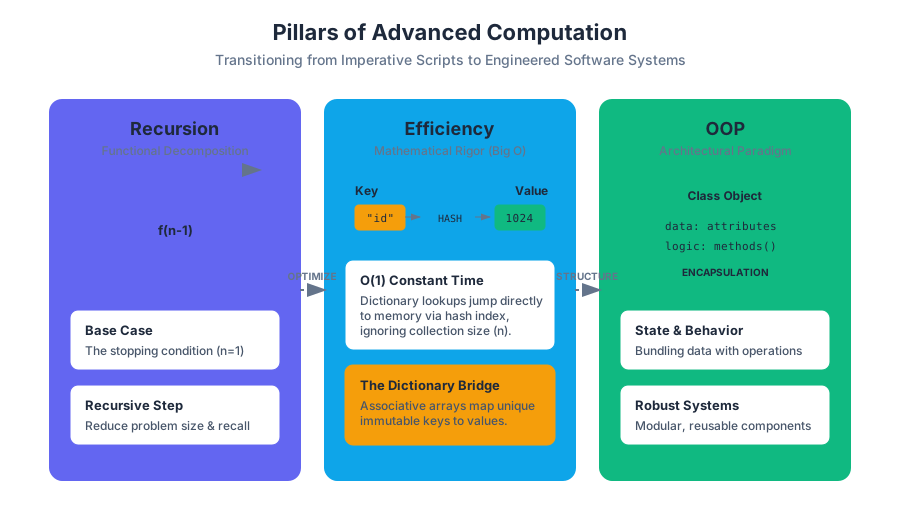
To build robust systems, we must master three pillars of advanced computation: Recursion (a functional approach to decomposition), Algorithmic Efficiency (the mathematical rigor of performance), and Object-Oriented Programming (the architectural paradigm of data encapsulation). Interlinking these is the Dictionary, a data structure that serves as the backbone for high-performance data retrieval.
The Power of Mapping: Dictionaries and Associative Arrays
In Python, the Dictionary (dict) is arguably the most important built-in data structure. Unlike a list, which is an ordered collection indexed by integers, a dictionary is an associative array. It maps unique keys to specific values.
What it is
A dictionary is a collection of key-value pairs where each key must be hashable (immutable). Mathematically, it represents a function $f: K \to V$, where $K$ is the set of keys and $V$ is the set of values.
Why it matters
The primary motivation for using dictionaries is lookup speed. In a list of $n$ elements, finding a specific item requires, on average, searching through $n/2$ items—an $O(n)$ operation. In a dictionary, the time complexity for a lookup is effectively $O(1)$, or constant time, regardless of how many millions of items are stored.
| Feature | List (list) |
Dictionary (dict) |
|---|---|---|
| Access Method | Integer Index (0, 1, 2...) | Unique Key (String, Int, Tuple) |
| Ordering | Ordered (Maintains insertion sequence) | Unordered (Python 3.7+ maintains insertion, but logic is key-based) |
| Lookup Speed | $O(n)$ (Linear search) | $O(1)$ (Hash table lookup) |
| Mutability | Mutable | Mutable |
| Common Use Case | Sequences, Stacks, Queues | Databases, JSON-like structures, Frequency counters |
How it works: The Hash Table
Under the hood, Python dictionaries use a Hash Table. When you provide a key, Python applies a hash function to transform that key into an integer. This integer corresponds to an index in a hidden array. This allows the computer to jump directly to the memory location of the value without scanning the entire structure.
# First code block: Low-level implementation of a frequency counter
# This demonstrates the efficiency of O(1) lookups in a real-world scenario

def analyze_word_frequency(text: str) -> dict:
    """
    Analyzes a block of text and returns a dictionary of word counts.
    Demonstrates the 'Get-and-Update' pattern common in data processing.
    """
    clean_text = text.lower().replace('.', '').replace(',', '')
    words = clean_text.split()

    frequency_map = {}

    for word in words:
        # The dictionary lookup happens in O(1) time
        if word in frequency_map:
            frequency_map[word] += 1
        else:
            frequency_map[word] = 1

    return frequency_map

# Example usage
sample_data = "Recursion is powerful. Efficiency is vital. OOP is structural."
print(analyze_word_frequency(sample_data))
Common Pitfalls
- KeyErrors: Attempting to access a key that does not exist. Use
.get(key, default)to handle missing keys gracefully. - Mutable Keys: You cannot use a list as a dictionary key because lists are mutable. If the list changes, its hash would change, making the value unretrievable.
Recursion: The "Divide and Conquer" Philosophy
Recursion is a method of solving a problem where the solution depends on solutions to smaller instances of the same problem. It is the programmatic implementation of Mathematical Induction.
The Anatomy of a Recursive Function
Every valid recursive function must possess two components:
- The Base Case: The simplest possible instance of the problem, which can be solved directly without further recursion. This prevents infinite loops (and the dreaded
RecursionError: maximum recursion depth exceeded). - The Recursive Step: The part of the function where the problem is reduced in size and the function calls itself.
The Recursive Leap of Faith: To write a recursive function, assume that the recursive call to the smaller problem "just works." Your only job is to handle the base case and combine the result of the smaller problem into the solution for the current problem.
Mathematical Derivation: The Factorial
The factorial of $n$ (denoted $n!$) is defined as: $n! = n \times (n-1) \times (n-2) \times \dots \times 1$
This can be expressed recursively as: $$ f(n) = \begin{cases} 1 & \text{if } n = 0 \text{ or } 1 \text{ (Base Case)} \ n \times f(n-1) & \text{if } n > 1 \text{ (Recursive Step)} \end{cases} $$
// Second code block: Pseudocode and Logic Flow
// Visualizing the Call Stack for factorial(3)

FUNCTION factorial(n):
    IF n == 1:
        RETURN 1  // Base case reached
    ELSE:
        // Recursive step: n * (n-1)!
        RESULT = n * factorial(n - 1)
        RETURN RESULT

/*
Stack Execution Trace:
1. factorial(3) calls factorial(2) -> waits
2. factorial(2) calls factorial(1) -> waits
3. factorial(1) returns 1          -> resolves
4. factorial(2) receives 1, returns 2 * 1 = 2
5. factorial(3) receives 2, returns 3 * 2 = 6
*/
Recursion vs. Iteration
While any recursive algorithm can be written iteratively (using loops), recursion is often more intuitive for problems involving hierarchical data (trees, graphs) or combinatorial problems (Towers of Hanoi, Permutations).
| Aspect | Recursion | Iteration |
|---|---|---|
| Implementation | Function calls itself | for or while loops |
| State | Stored in the Call Stack | Stored in local variables |
| Memory | High (each call adds a stack frame) | Low (constant space overhead) |
| Readability | Often cleaner for complex logic | Generally more straightforward for simple loops |
Algorithmic Efficiency: Big O Notation
As a computer scientist, it is not enough to know that a program works; you must know how well it scales. Algorithmic Efficiency is the study of how the execution time and memory requirements of an algorithm grow as the input size ($n$) increases.
Big O Notation ($O$)
We use Big O Notation to describe the upper bound of an algorithm's complexity. It ignores constants and lower-order terms to focus on the "order of growth."
Common Complexity Classes
| Notation | Name | Description | Example |
|---|---|---|---|
| $O(1)$ | Constant | Time does not change with input size. | Dictionary lookup, array indexing. |
| $O(\log n)$ | Logarithmic | Input size is halved each step. | Binary Search. |
| $O(n)$ | Linear | Time grows proportionally to input. | Simple loop through a list. |
| $O(n \log n)$ | Log-Linear | Efficient sorting. | Merge Sort, Quick Sort. |
| $O(n^2)$ | Quadratic | Nested loops. | Bubble Sort, comparing all pairs. |
| $O(2^n)$ | Exponential | Doubling with each addition. | Recursive Fibonacci (without memoization). |
Why Constants Don't Matter
In Big O, $O(2n)$ and $O(100n)$ are both simplified to $O(n)$. This is because, as $n$ approaches infinity, the multiplicative constant becomes insignificant compared to the growth of $n$ itself. We are interested in the asymptotic behavior.
# Third code block: Real-world performance profiling
# Using the 'timeit' module to compare O(n) vs O(1)

# Comparing list search vs dictionary search for 1,000,000 elements
python3 -m timeit -s "data = list(range(1000000))" "999999 in data"
# Result: ~10-20 milliseconds (Linear Search)

python3 -m timeit -s "data = {i: i for i in range(1000000)}" "999999 in data"
# Result: ~0.00005 milliseconds (Hash Lookup)
Object-Oriented Programming (OOP): The Architecture of Data
Object-Oriented Programming is a paradigm based on the concept of "objects," which can contain data (attributes) and code (methods). It is designed to manage the complexity of large software systems by grouping related data and behaviors together.
The Four Pillars of OOP
- Encapsulation: Bundling data and methods that work on that data within a single unit (a class) and restricting access to some of the object's components.
- Abstraction: Hiding complex implementation details and showing only the necessary features of an object.
- Inheritance: A mechanism where a new class (subclass) inherits properties and behaviors from an existing class (superclass).
- Polymorphism: The ability of different classes to be treated as instances of the same general class through the same interface (e.g., a
Circleand aSquareboth having an.area()method).
Classes vs. Instances
A Class is a blueprint (e.g., the concept of a "Car"). An Instance is a specific object created from that blueprint (e.g., "Your 2022 Blue Toyota").
// Fourth code block: OOP Implementation in Java
// Demonstrating Inheritance and Encapsulation

// Superclass
class Employee {
    private String name; // Encapsulation: private variable
    protected double salary;

    public Employee(String name, double salary) {
        this.name = name;
        this.salary = salary;
    }

    public void work() {
        System.out.println(name + " is working...");
    }
}

// Subclass inheriting from Employee
class Developer extends Employee {
    private String language;

    public Developer(String name, double salary, String language) {
        super(name, salary); // Call superclass constructor
        this.language = language;
    }

    @Override
    public void work() {
        System.out.println("Coding in " + language);
    }
}
Method Resolution and self
In Python, every method in a class must take self as its first argument. self refers to the specific instance of the object being manipulated. When you call my_object.method(), Python automatically passes my_object as the self argument.
| Term | Definition |
|---|---|
| Attribute | A variable belonging to an object (e.g., car.color). |
| Method | A function belonging to an object (e.g., car.drive()). |
| Constructor | A special method (__init__ in Python) called when an object is instantiated. |
| Super | A keyword used to access methods or constructors from a parent class. |
Integrating the Concepts: A Case Study in Efficiency
Consider the problem of calculating the $n$-th Fibonacci number. A naive recursive solution has a complexity of $O(2^n)$ because it recalculates the same values thousands of times.
- Recursion: Provides the logic ($fib(n) = fib(n-1) + fib(n-2)$).
- Dictionaries: Can be used for Memoization (storing previously calculated results).
- Efficiency: Memoization turns an $O(2^n)$ problem into an $O(n)$ problem.
- OOP: We can wrap this logic in a
FibonacciCalculatorclass to encapsulate the cache.
The Memoization Pattern
By checking a dictionary before performing a recursive calculation, we eliminate redundant work. This is a classic example of the Space-Time Tradeoff: we use a little more memory (the dictionary) to gain a massive increase in speed.
# Final Example: Optimized Recursive OOP
class FibonacciCalculator:
    def __init__(self):
        # Dictionary to store calculated values (Memoization)
        self.cache = {0: 0, 1: 1}

    def get_fib(self, n: int) -> int:
        # O(1) check in dictionary
        if n in self.cache:
            return self.cache[n]

        # Recursive step
        self.cache[n] = self.get_fib(n - 1) + self.get_fib(n - 2)
        return self.cache[n]

calc = FibonacciCalculator()
print(calc.get_fib(100)) # This would take centuries without the dictionary
Source Materials
- Introduction to Computer Science and Programming in Python
- Introduction to Computer Science and Programming in Python
- Introduction to Computer Science and Programming in Python
- Introduction to Computer Science and Programming in Python
- Introduction to Computer Science and Programming in Python
- Introduction to Computer Science and Programming in Python
- Introduction to Computer Science and Programming in Python
- Introduction to Computer Science and Programming in Python
Study Introduction to Computer Science and Programming in Python on Lykke
This course page is free to open: signed out, you can read its first two sections, and signing in, on any plan, opens the rest. The free Lykke Chrome extension syncs your own Canvas courses, so ChatGPT, Claude and Muse can answer from your classes and deadlines. It only reads Canvas.
Add the free extensionSign in to open every sectionAll sections of Introduction to Computer Science and Programming in Python · Browse more course pages