From the free course Interdisciplinary Foundations of Academic and Professional Literacy on Lykke
Logic and Business Administration Foundations
Key concepts: Critical Thinking · Business Ethics · Corporate Social Responsibility · Financial and Managerial Accounting
Explores the intersection of philosophical reasoning and the fundamental principles of business management and ethics.
Logic and Business Administration Foundations
The synthesis of formal logic and business administration forms the bedrock of modern organizational theory. While business is often perceived through the lens of intuition and "gut feeling," professional management is a rigorous discipline rooted in the systematic application of critical thinking, ethical frameworks, and the precise quantification of economic events. This section explores the convergence of these fields, providing a technical deep-dive into how logical structures govern corporate governance, financial reporting, and strategic decision-making.
Critical Thinking: The Logic of Decision-Making
Critical Thinking in a business context is the intellectually disciplined process of actively and skillfully conceptualizing, applying, analyzing, synthesizing, and evaluating information gathered from observation, experience, reflection, or communication. It serves as a guide to belief and action, moving beyond mere "problem-solving" into the realm of structural analysis.
Formal Logic and Sentential Calculus
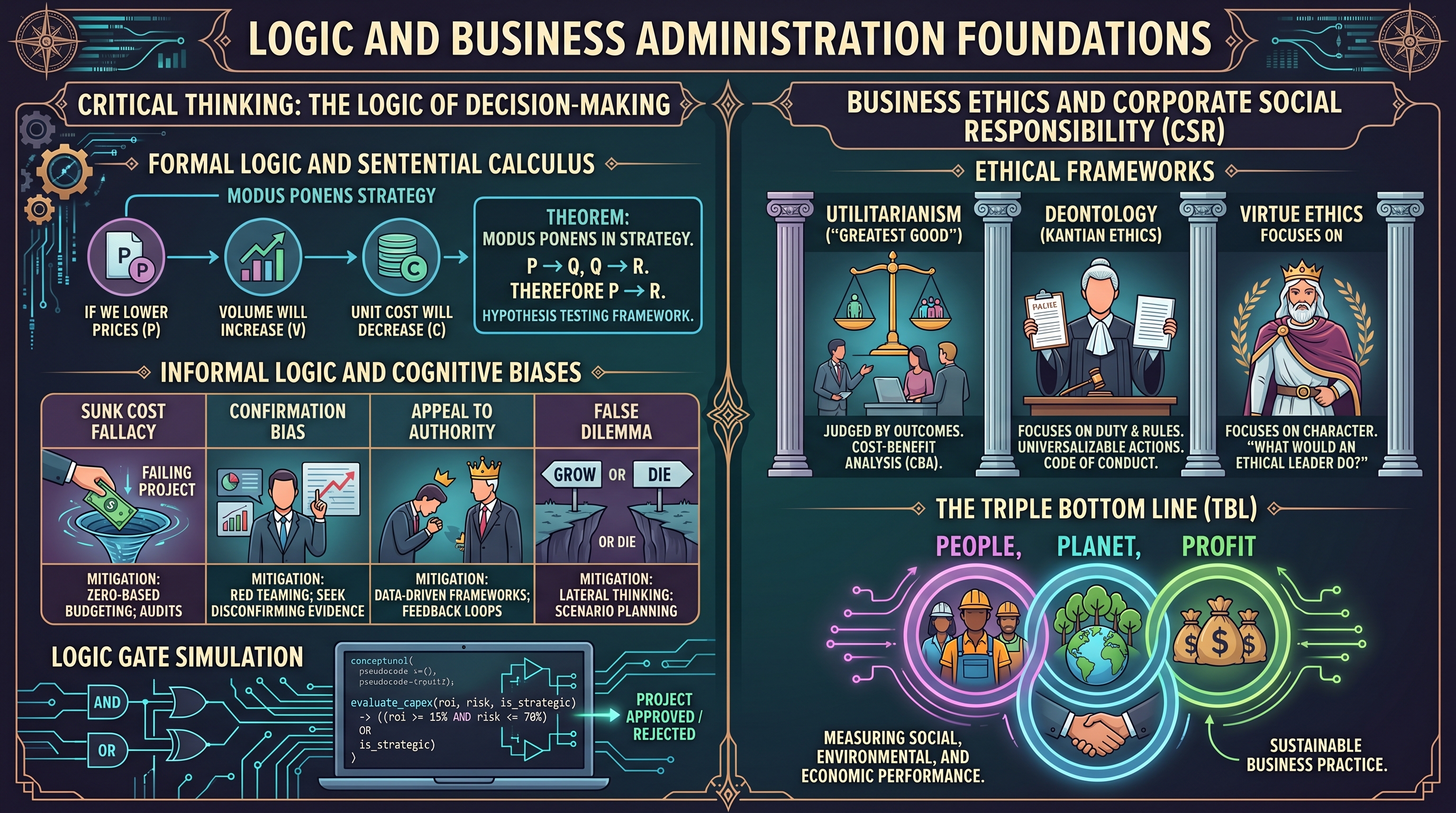
At the core of critical thinking lies Sentential Logic (or Propositional Logic). In business strategy, complex decisions are often decomposed into a series of logical propositions. If a firm's strategy is "If we lower prices ($P$), then volume will increase ($V$)," and "If volume increases ($V$), then unit cost will decrease ($C$)," we can derive the logical conclusion $P \implies C$.
Theorem: Modus Ponens in Strategy If the antecedent $P$ is true, and the conditional $P \implies Q$ is true, then the consequent $Q$ must be true. In business, this provides the framework for hypothesis testing in market research.
Informal Logic and Cognitive Biases
While formal logic deals with the structure of arguments, Informal Logic addresses the content. Business leaders must navigate a landscape of logical fallacies and cognitive biases that can distort financial data or strategic outlooks.
| Fallacy/Bias | Business Manifestation | Mitigation Strategy |
|---|---|---|
| Sunk Cost Fallacy | Continuing to fund a failing project because of past investment. | Zero-based budgeting; independent project audits. |
| Confirmation Bias | Seeking only market data that supports a pre-conceived product launch. | "Red Teaming"; seeking disconfirming evidence. |
| Appeal to Authority | Adopting a strategy solely because a high-ranking executive proposed it. | Data-driven decision frameworks; anonymous feedback loops. |
| False Dilemma | Assuming only two strategic paths exist (e.g., "Grow or Die"). | Lateral thinking; scenario planning (Best/Worst/Most Likely). |
Business Ethics and Corporate Social Responsibility (CSR)
Business Ethics is the study of appropriate business policies and practices regarding potentially controversial subjects including corporate governance, insider trading, bribery, discrimination, and fiduciary responsibilities. Corporate Social Responsibility (CSR) extends this by suggesting that a corporation has a duty to the society at large, not just its shareholders.
Ethical Frameworks
- Utilitarianism: The "Greatest Good" principle. Decisions are judged by their outcomes. In a business context, this often translates to Cost-Benefit Analysis (CBA).
- Deontology (Kantian Ethics): Focuses on duty and rules. An action is right if it can be universalized. This forms the basis for strict compliance and "Code of Conduct" documents.
- Virtue Ethics: Focuses on the character of the decision-maker. It asks: "What would an ethical leader do?"
The Triple Bottom Line (TBL)
The TBL framework moves beyond the traditional measure of profits to include social and environmental impact.
\text{Total Organizational Value} = \text{Profit} + \text{People} + \text{Planet}
Stakeholder vs. Shareholder Theory
- Shareholder Primacy (Friedman): The sole social responsibility of business is to increase its profits while staying within the rules of the game.
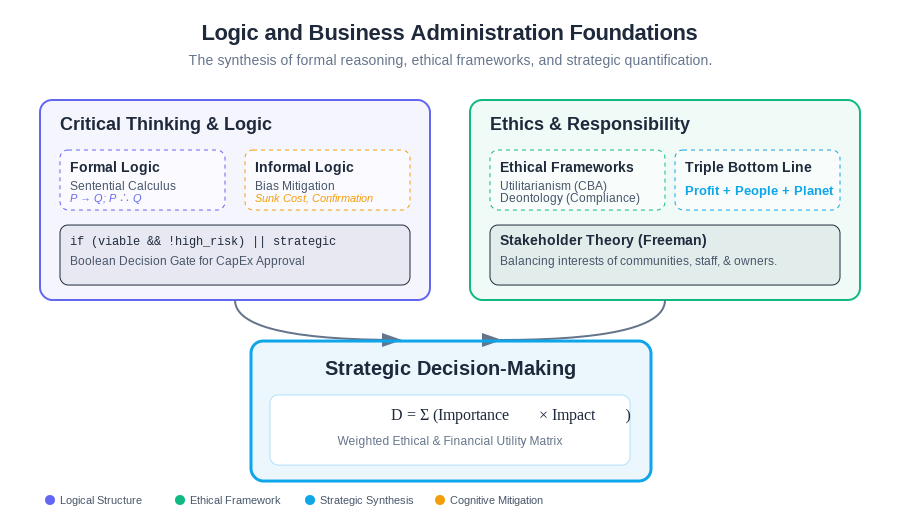
- Stakeholder Theory (Freeman): Managers must balance the interests of all parties who have a "stake" in the firm: employees, customers, suppliers, communities, and shareholders.
Decision Matrix for Ethical Dilemmas
When faced with a conflict, managers use a weighted scoring model to evaluate the ethical "utility" of various options.
% Representation of a Weighted Ethical Decision Matrix
Decision(D) = \sum_{i=1}^{n} (Importance_i \times Impact_{i,D})

Where:
n = Number of Stakeholders
Importance = Weight assigned to stakeholder group
Impact = Predicted outcome for that group under decision D
Financial Accounting: The Language of Business
Financial Accounting is the process of recording, summarizing, and reporting the myriad of transactions resulting from business operations over a period of time. These transactions are summarized in the preparation of financial statements.
The Fundamental Accounting Equation
The entire system of double-entry bookkeeping is built upon a single logical identity:
Assets (A) = Liabilities (L) + Equity (E)
- Assets: Resources owned or controlled by the entity (Cash, Inventory, PPE).
- Liabilities: Obligations to external parties (Loans, Accounts Payable).
- Equity: The residual interest in the assets after deducting liabilities (Retained Earnings, Common Stock).
The Four Primary Financial Statements
Financial accounting produces four standardized outputs, typically governed by GAAP (Generally Accepted Accounting Principles) or IFRS (International Financial Reporting Standards).
| Statement | Purpose | Key Components |
|---|---|---|
| Balance Sheet | Snapshot of financial position at a specific point in time. | Assets, Liabilities, Shareholders' Equity. |
| Income Statement | Measures financial performance over a specific period. | Revenue, Expenses, Net Income (Profit/Loss). |
| Statement of Cash Flows | Tracks the movement of cash in and out of the business. | Operating, Investing, and Financing activities. |
| Statement of Retained Earnings | Details changes in equity over a period. | Beginning Equity + Net Income - Dividends. |
Managerial Accounting: Internal Decision Support
Unlike financial accounting, which is geared toward external stakeholders, Managerial Accounting provides information to internal managers for planning, controlling, and decision-making.
Cost-Volume-Profit (CVP) Analysis
CVP analysis is a tool that helps managers understand the relationships between cost, volume, and profit. It is essential for determining the Break-Even Point.
- Fixed Costs (FC): Costs that do not change with production levels (Rent, Salaries).
- Variable Costs (VC): Costs that vary directly with production (Raw materials, Direct labor).
- Contribution Margin (CM): $Sales - Variable Costs$.
The Break-Even Formula
To find the number of units ($Q$) required to break even:
Q = \frac{Fixed Costs}{Price per Unit - Variable Cost per Unit}
Variations and Extensions
Environmental Ethics and Justice
In the 21st century, the logic of business has expanded to include Environmental Justice. This field examines the fair treatment and meaningful involvement of all people regardless of race, color, national origin, or income with respect to the development, implementation, and enforcement of environmental laws and policies. For a corporation, this means analyzing the disparate impact of factory placement or waste disposal on marginalized communities.
Existentialism in Management
While seemingly abstract, Existentialism (the study of individual existence, freedom, and choice) influences modern leadership theory. It emphasizes "Authentic Leadership"—the idea that managers must take radical responsibility for their choices in an inherently uncertain ("absurd") market environment, rather than hiding behind corporate bureaucracy.
Common Pitfalls in Logic and Administration
- Confusing Cash with Profit: A common error in managerial accounting. A company can be profitable on an Income Statement (accrual basis) but go bankrupt because it lacks liquid cash to pay its bills (Cash Flow).
- The "Ethics Check-Box" Mentality: Treating CSR as a marketing exercise (Greenwashing) rather than a core strategic logic. This often leads to long-term reputational damage.
- Over-Reliance on Quantitative Logic: While data is vital, "McNamara's Fallacy" involves making decisions based solely on quantitative metrics and ignoring qualitative factors (like employee morale or brand sentiment) that cannot be easily measured.
- Logical Circularity in Budgeting: Using last year's budget as the only justification for next year's (Incremental Budgeting) without questioning the underlying logic of the expenditures.
Source Materials
Study Interdisciplinary Foundations of Academic and Professional Literacy on Lykke
This course page is free to open: signed out, you can read its first two sections, and signing in, on any plan, opens the rest. The free Lykke Chrome extension syncs your own Canvas courses, so ChatGPT, Claude and Muse can answer from your classes and deadlines. It only reads Canvas.
Add the free extensionSign in to open every sectionAll sections of Interdisciplinary Foundations of Academic and Professional Literacy · Browse more course pages