From the free course Interdisciplinary Foundations of Academic and Professional Literacy on Lykke
Institutional Foundations and the Humanities
Key concepts: Open Education · Creative Commons Licensing · Art Appreciation · Visual Language Principles
An introduction to the open education environment and the cultural context provided by the arts and humanities.
Institutional Foundations and the Humanities
The intersection of institutional structures and the humanities represents the bedrock of modern intellectual development. While technical disciplines provide the "how" of societal progress, the humanities provide the "why," and institutional foundations—specifically through the lens of Open Education—provide the "for whom." This section explores the systematic frameworks used to catalog human knowledge, the methodologies for analyzing visual and written communication, and the ethical structures that govern professional and environmental interactions.
The Architecture of Open Education
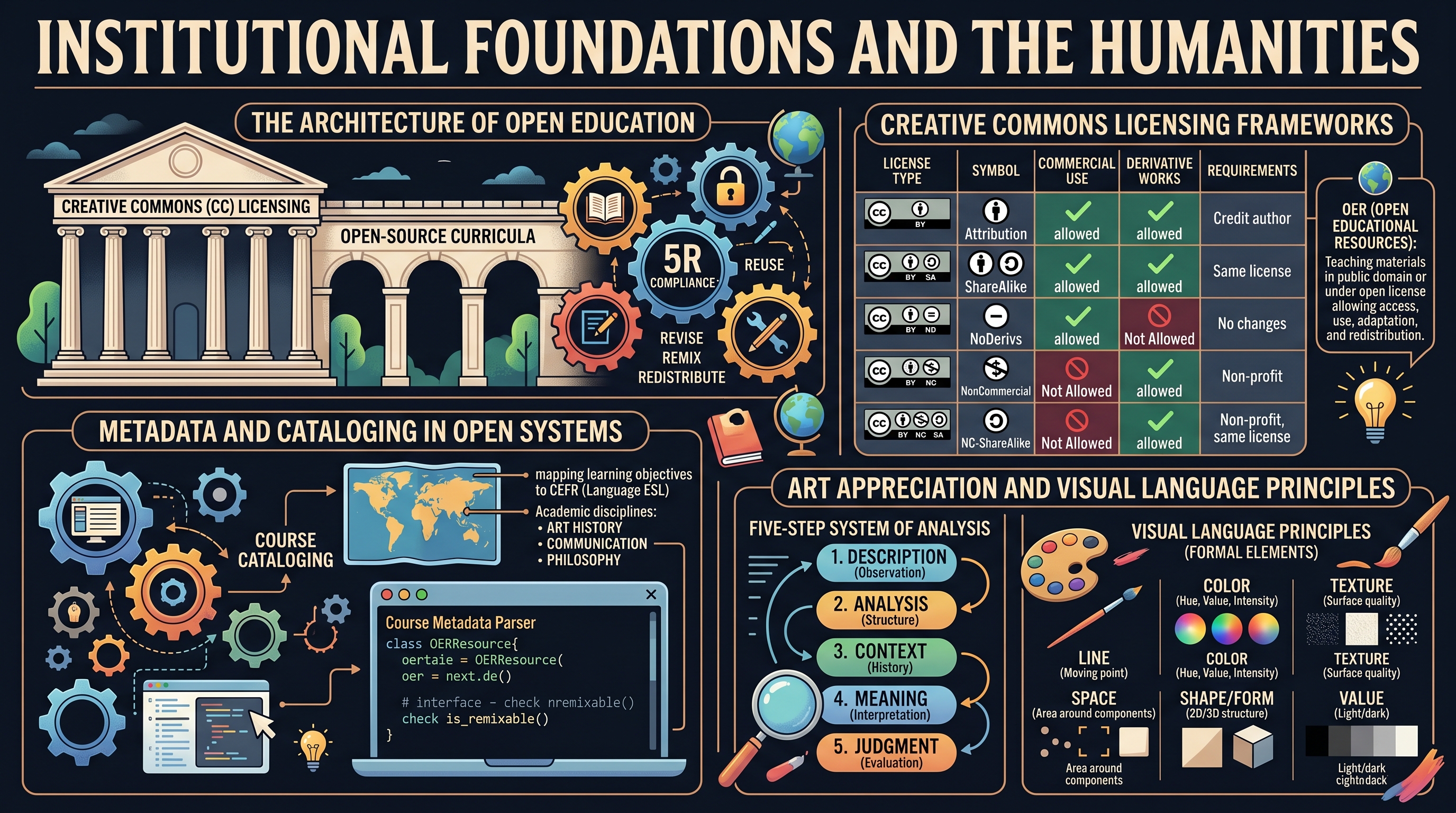
Open Education is a philosophical and institutional movement aimed at removing barriers to learning through the use of open-source curricula and Creative Commons (CC) Licensing. Unlike traditional proprietary education, which treats knowledge as a gated commodity, open education views it as a public good.
Creative Commons Licensing Frameworks
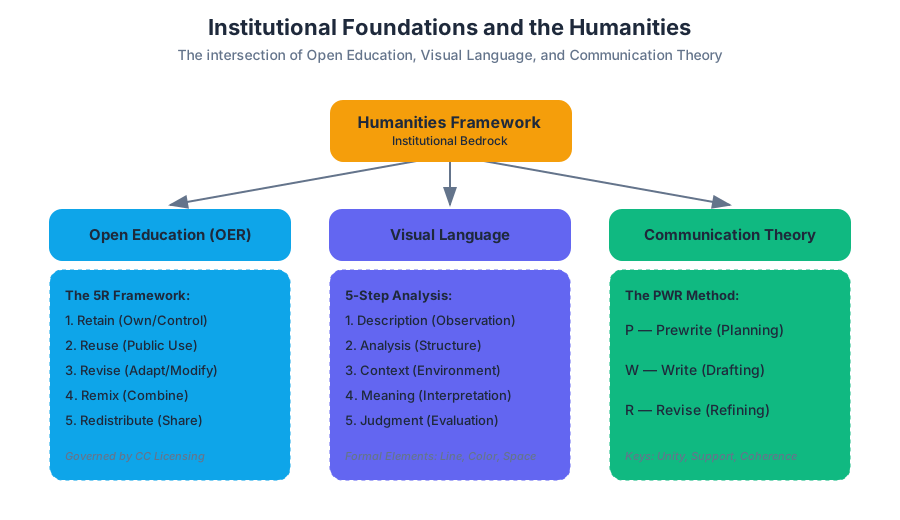
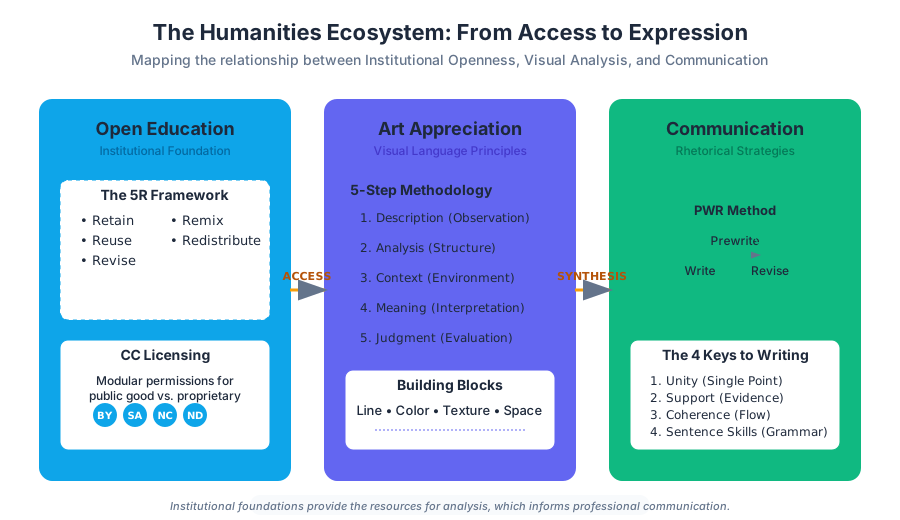
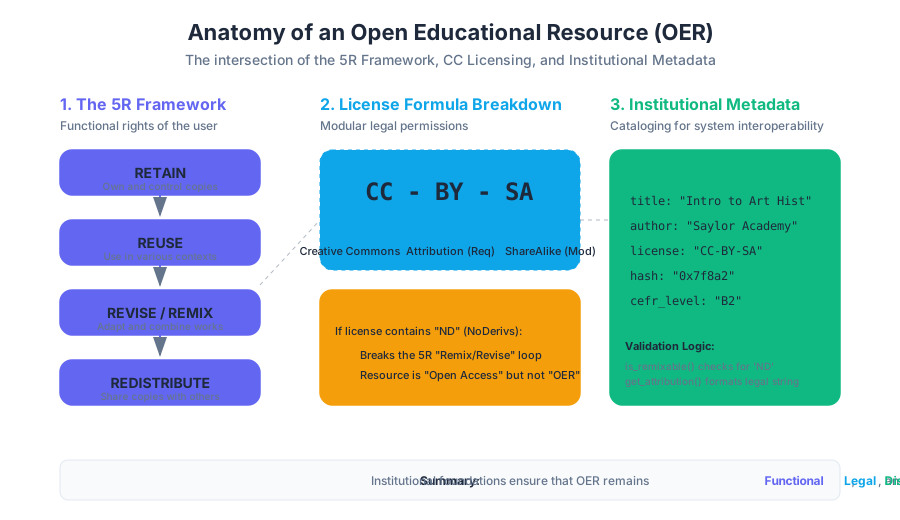
Institutions like Saylor University leverage CC licenses to ensure that high-quality academic content is "5R" compliant: Retain, Reuse, Revise, Remix, and Redistribute. The licensing model is modular, allowing creators to specify the level of freedom granted to the end-user.
| License Type | Symbol | Commercial Use | Derivative Works | Requirements |
|---|---|---|---|---|
| CC BY | Attribution | Allowed | Allowed | Credit the author |
| CC BY-SA | ShareAlike | Allowed | Allowed | Must use same license |
| CC BY-ND | NoDerivs | Allowed | Not Allowed | Credit author; no changes |
| CC BY-NC | NonCommercial | Not Allowed | Allowed | Credit author; non-profit |
| CC BY-NC-SA | NC-ShareAlike | Not Allowed | Allowed | Non-profit; same license |
Definition: Open Educational Resources (OER) are teaching, learning, and research materials in any medium that reside in the public domain or have been released under an open license that permits no-cost access, use, adaptation, and redistribution by others with no or limited restrictions.
Metadata and Cataloging in Open Systems
For an institution to function, it must implement rigorous Course Cataloging. This involves mapping learning objectives to the Common European Framework of Reference for Languages (CEFR) for ESL or to specific academic disciplines like Art History, Communication, and Philosophy.
Art Appreciation and Visual Language Principles
The study of Art History is not merely a chronological survey of artifacts; it is the mastery of Visual Language Principles. To appreciate art is to decode the syntax of visual stimuli using a structured analytical framework.
The Five-Step System of Analysis
To move beyond subjective "liking" or "disliking," scholars employ a rigorous five-step methodology to evaluate artistic production.
| Step | Focus | Key Questions |
|---|---|---|
| 1. Description | Pure Observation | What formal elements (line, color, shape) are present? |
| 2. Analysis | Structural Relations | How do the elements interact? (Balance, Rhythm, Contrast) |
| 3. Context | External Factors | What was the historical, social, or political environment? |
| 4. Meaning | Interpretation | What is the artist's message or the work's "content"? |
| 5. Judgment | Evaluation | Is the work successful based on its intent and formal quality? |
Visual Language Principles (The Formal Elements)
Visual art is governed by a set of "building blocks" that dictate how the human eye perceives a composition:
- Line: The path of a moving point; can be organic, geometric, or implied.
- Color: Defined by hue, value (lightness/darkness), and intensity (saturation).
- Texture: The surface quality, either actual (tactile) or visual (illusionary).
- Space: The area around or within components; includes positive and negative space.
Communication Theories and Rhetorical Strategies
Communication is the mechanism through which institutional foundations are expressed and maintained. It spans from Interpersonal Communication to Public Relations Fundamentals.
The PWR-Writing Method
Effective written communication in the humanities and professional world follows the PWR Method: Prewrite, Write, and Revise. This iterative process ensures that the four keys to good writing—Unity, Support, Coherence, and Sentence-level skills—are met.
- Unity: Every paragraph supports a single clear point (the topic sentence).
- Support: Claims are backed by specific evidence, data, or citations.
- Coherence: Ideas flow logically through the use of transitions and organizational patterns.
- Sentence Skills: Mastery of grammar, punctuation, and syntax to ensure clarity.
Rhetorical Analysis and Audience Awareness
In both Technical Writing and Public Relations, the "Rhetorical Triangle" (Ethos, Pathos, Logos) is used to tailor messaging to a specific Audience Analysis.
Key Insight: In a Crisis Response scenario, communication must shift from promotional to informational, prioritizing transparency and ethical responsibility to protect organizational reputation.
% Mathematical representation of a Logical Argument in Sentential Logic
% Used in Philosophy (PHIL102) to evaluate the validity of ethical claims.

\begin{itemize}
    \item P: The institution provides open access.
    \item Q: Education is democratized.
    \item R: Societal inequality decreases.
\end{itemize}

Argument Structure:
1. P \rightarrow Q  (If P, then Q)
2. Q \rightarrow R  (If Q, then R)
3. \therefore P \rightarrow R (Therefore, if P, then R - Hypothetical Syllogism)
Philosophical Foundations: Ethics and Logic
Philosophy provides the critical thinking tools required to navigate complex institutional dilemmas. This includes Formal and Informal Logic, Moral Philosophy, and Environmental Ethics.
Environmental Ethics and Justice
A significant branch of modern philosophy deals with the relationship between human institutions and the natural world. Environmental Justice examines the fair distribution of environmental benefits and burdens, often through the lens of Theory of Justice.
Existentialism and Human Agency
Existentialism posits that individuals are responsible for creating meaning in an inherently indifferent universe. This focus on individual agency is crucial for leadership and entrepreneurship within institutional frameworks.
| Philosophical Branch | Core Concern | Institutional Application |
|---|---|---|
| Logic | Validity of arguments | Decision-making and software architecture |
| Ethics | Moral rightness | Corporate Social Responsibility (CSR) |
| Epistemology | Nature of knowledge | Information Literacy and Research |
| Political Philosophy | Governance and Rights | Legal forms of business and social contracts |
Professional Integration: Business and Computer Science
The humanities are not siloed from technical fields; they are integrated into the "soft skills" required for professional success.
Business Communication and Management
In Business Administration, the principles of human communication are applied to Conflict Management and Multicultural Messaging. A manager must understand the Marketing Mix (Product, Price, Place, Promotion) while maintaining Ethical Communication standards.
Logic in Computer Science
Object-oriented programming (OOP) mirrors the hierarchical classification systems found in biology and art history.
Common Pitfalls in Institutional Analysis
- Ignoring Context: Evaluating a historical artifact or a corporate crisis without considering the social environment of the time (Anachronism).
- Conflating Subjectivity with Analysis: In Art Appreciation, failing to distinguish between "I don't like this" (Judgment) and "This uses a complementary color scheme" (Description).
- Plagiarism in Open Systems: Misunderstanding CC licenses and failing to provide proper MLA Citation, even when the source material is "free."
- Logical Fallacies: Using informal fallacies (like ad hominem or straw man) in communication, which undermines the Support and Coherence of an argument.
The Role of College Success (SDV100)
The final pillar of institutional foundations is the student's ability to navigate the system itself. College Success strategies involve:
- Academic Pathway Planning: Mapping courses to career goals.
- Information Literacy: Evaluating the credibility of sources in a digital age.
- Time Management: Balancing the rigorous requirements of the PWR writing method with technical lab work.
- Diversity and Social Interaction: Understanding multicultural perspectives to enhance group communication.
By synthesizing the analytical rigor of the humanities with the structured accessibility of open education, institutions create a framework where critical thought and technical proficiency coexist. This foundation allows for a more nuanced understanding of global markets, ethical dilemmas, and the human condition.
Source Materials
Study Interdisciplinary Foundations of Academic and Professional Literacy on Lykke
This course page is free to open: signed out, you can read its first two sections, and signing in, on any plan, opens the rest. The free Lykke Chrome extension syncs your own Canvas courses, so ChatGPT, Claude and Muse can answer from your classes and deadlines. It only reads Canvas.
Add the free extensionSign in to open every sectionAll sections of Interdisciplinary Foundations of Academic and Professional Literacy · Browse more course pages