Interdisciplinary Foundations of Academic and Professional Literacy
Institution: MIT
28 study materials · 10 sections
BUS202: Principles of Finance provides a comprehensive introduction to the management of financial resources with the primary goal of maximizing shareholder wealth. The course bridges the gap between accounting data and strategic financial decision-making, covering essential topics such as the time value of money, financial statement analysis, and corporate governance. Students will develop the analytical skills necessary to evaluate corporate performance and understand the ethical and agency-related complexities of modern business environments.
Course Sections
Institutional Foundations and the Humanities
Key concepts: Open Education · Creative Commons Licensing · Art Appreciation · Visual Language Principles
An introduction to the open education environment and the cultural context provided by the arts and humanities.
Institutional Foundations and the Humanities
The intersection of institutional structures and the humanities represents the bedrock of modern intellectual development. While technical disciplines provide the "how" of societal progress, the humanities provide the "why," and institutional foundations—specifically through the lens of Open Education—provide the "for whom." This section explores the systematic frameworks used to catalog human knowledge, the methodologies for analyzing visual and written communication, and the ethical structures that govern professional and environmental interactions.
The Architecture of Open Education
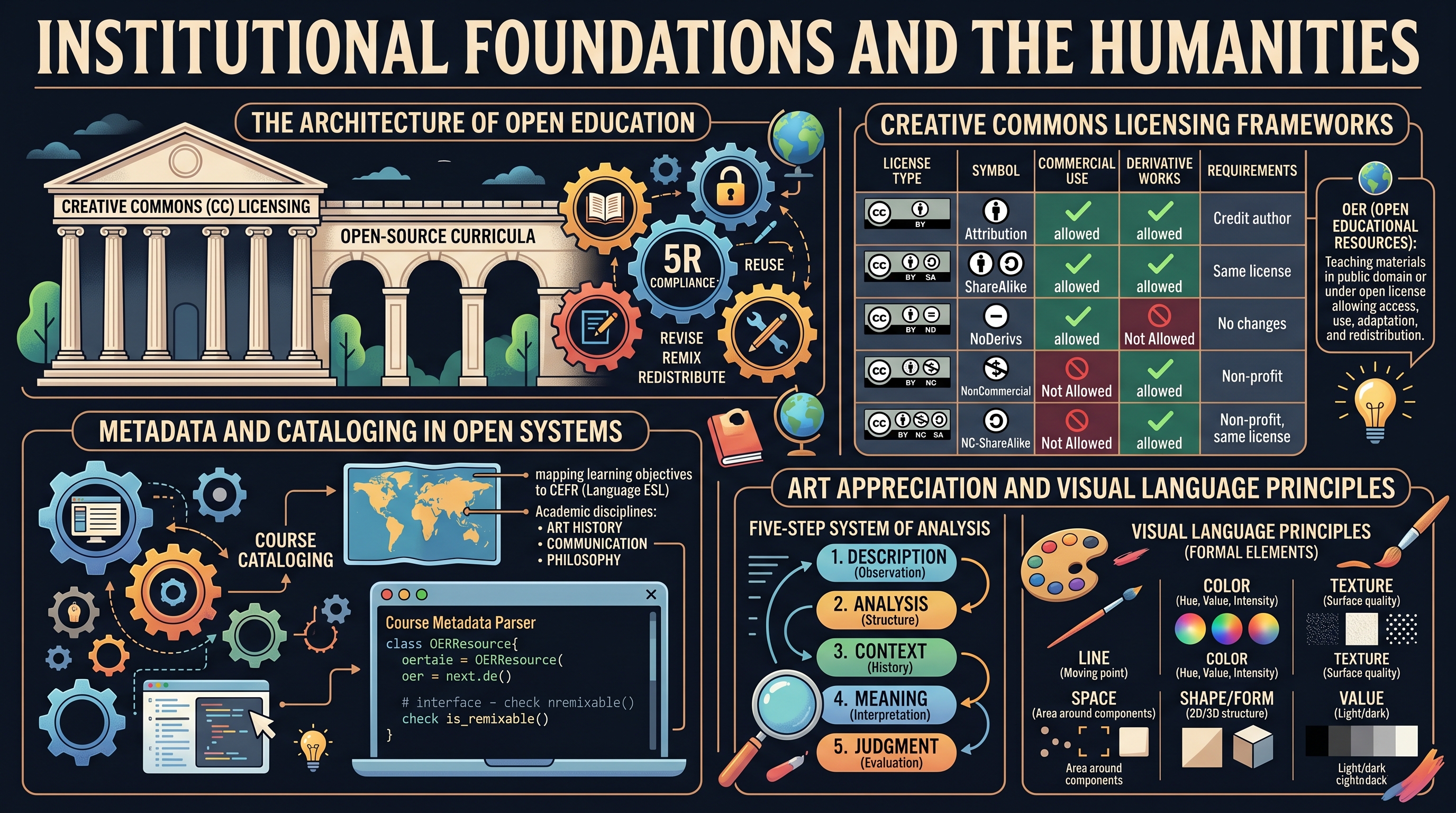
Open Education is a philosophical and institutional movement aimed at removing barriers to learning through the use of open-source curricula and Creative Commons (CC) Licensing. Unlike traditional proprietary education, which treats knowledge as a gated commodity, open education views it as a public good.
Creative Commons Licensing Frameworks
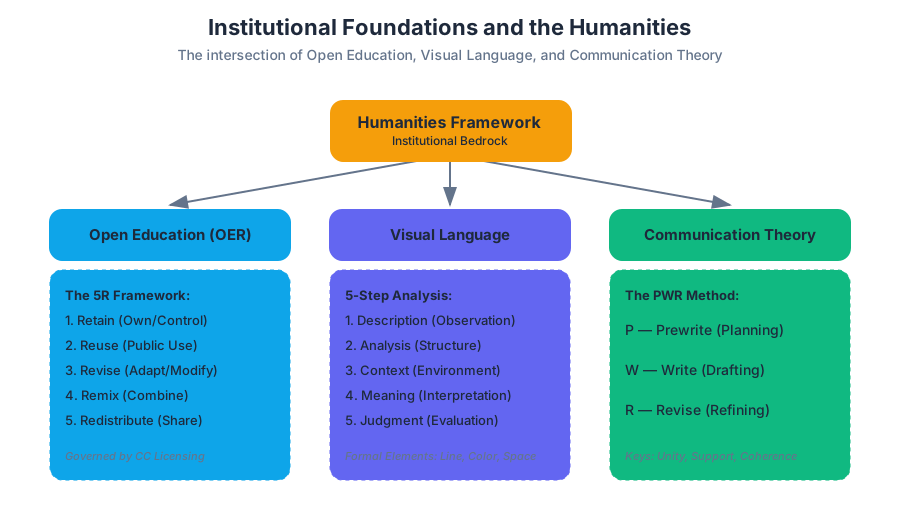
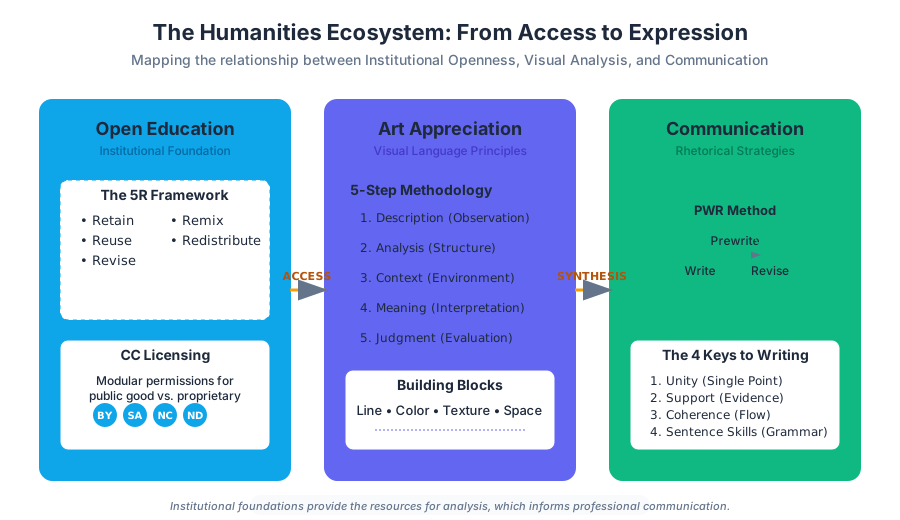
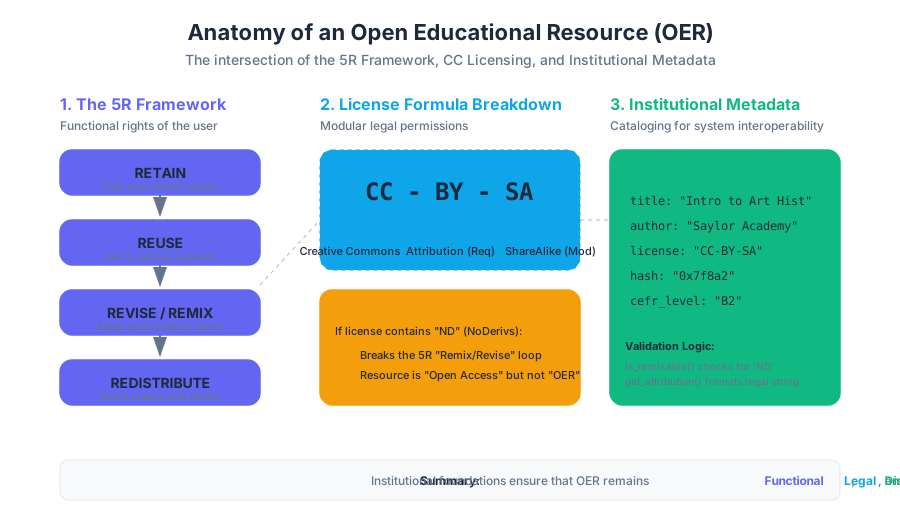
Institutions like Saylor University leverage CC licenses to ensure that high-quality academic content is "5R" compliant: Retain, Reuse, Revise, Remix, and Redistribute. The licensing model is modular, allowing creators to specify the level of freedom granted to the end-user.
| License Type | Symbol | Commercial Use | Derivative Works | Requirements |
|---|---|---|---|---|
| CC BY | Attribution | Allowed | Allowed | Credit the author |
| CC BY-SA | ShareAlike | Allowed | Allowed | Must use same license |
| CC BY-ND | NoDerivs | Allowed | Not Allowed | Credit author; no changes |
| CC BY-NC | NonCommercial | Not Allowed | Allowed | Credit author; non-profit |
| CC BY-NC-SA | NC-ShareAlike | Not Allowed | Allowed | Non-profit; same license |
Definition: Open Educational Resources (OER) are teaching, learning, and research materials in any medium that reside in the public domain or have been released under an open license that permits no-cost access, use, adaptation, and redistribution by others with no or limited restrictions.
Metadata and Cataloging in Open Systems
For an institution to function, it must implement rigorous Course Cataloging. This involves mapping learning objectives to the Common European Framework of Reference for Languages (CEFR) for ESL or to specific academic disciplines like Art History, Communication, and Philosophy.
# Example: A low-level implementation of a Course Metadata Parser
# to validate Creative Commons license compliance in an OER repository.

class OERResource:
    def __init__(self, title, author, license_type, content_hash):
        self.title = title
        self.author = author
        self.license_type = license_type  # e.g., 'CC-BY-SA'
        self.content_hash = content_hash

    def is_remixable(self):
        """
        Determines if the license allows for derivative works (Remix/Revise).
        ND (NoDerivs) licenses prevent this.
        """
        restricted_terms = ['ND']
        return not any(term in self.license_type for term in restricted_terms)

    def get_attribution_string(self):
        return f"This work, '{self.title}', is a derivative of original work by {self.author}, used under {self.license_type}."

# Instantiate a course module
module_101 = OERResource("Intro to Art Hist", "Saylor Academy", "CC-BY", "0x7f8a2")
print(f"Can we edit this? {module_101.is_remixable()}")
print(module_101.get_attribution_string())
Art Appreciation and Visual Language Principles
The study of Art History is not merely a chronological survey of artifacts; it is the mastery of Visual Language Principles. To appreciate art is to decode the syntax of visual stimuli using a structured analytical framework.
The Five-Step System of Analysis
To move beyond subjective "liking" or "disliking," scholars employ a rigorous five-step methodology to evaluate artistic production.
| Step | Focus | Key Questions |
|---|---|---|
| 1. Description | Pure Observation | What formal elements (line, color, shape) are present? |
| 2. Analysis | Structural Relations | How do the elements interact? (Balance, Rhythm, Contrast) |
| 3. Context | External Factors | What was the historical, social, or political environment? |
| 4. Meaning | Interpretation | What is the artist's message or the work's "content"? |
| 5. Judgment | Evaluation | Is the work successful based on its intent and formal quality? |
Visual Language Principles (The Formal Elements)
Visual art is governed by a set of "building blocks" that dictate how the human eye perceives a composition:
- Line: The path of a moving point; can be organic, geometric, or implied.
- Color: Defined by hue, value (lightness/darkness), and intensity (saturation).
- Texture: The surface quality, either actual (tactile) or visual (illusionary).
- Space: The area around or within components; includes positive and negative space.
Communication Theories and Rhetorical Strategies
Communication is the mechanism through which institutional foundations are expressed and maintained. It spans from Interpersonal Communication to Public Relations Fundamentals.
The PWR-Writing Method
Effective written communication in the humanities and professional world follows the PWR Method: Prewrite, Write, and Revise. This iterative process ensures that the four keys to good writing—Unity, Support, Coherence, and Sentence-level skills—are met.
- Unity: Every paragraph supports a single clear point (the topic sentence).
- Support: Claims are backed by specific evidence, data, or citations.
- Coherence: Ideas flow logically through the use of transitions and organizational patterns.
- Sentence Skills: Mastery of grammar, punctuation, and syntax to ensure clarity.
Rhetorical Analysis and Audience Awareness
In both Technical Writing and Public Relations, the "Rhetorical Triangle" (Ethos, Pathos, Logos) is used to tailor messaging to a specific Audience Analysis.
Key Insight: In a Crisis Response scenario, communication must shift from promotional to informational, prioritizing transparency and ethical responsibility to protect organizational reputation.
% Mathematical representation of a Logical Argument in Sentential Logic
% Used in Philosophy (PHIL102) to evaluate the validity of ethical claims.

\begin{itemize}
    \item P: The institution provides open access.
    \item Q: Education is democratized.
    \item R: Societal inequality decreases.
\end{itemize}

Argument Structure:
1. P \rightarrow Q  (If P, then Q)
2. Q \rightarrow R  (If Q, then R)
3. \therefore P \rightarrow R (Therefore, if P, then R - Hypothetical Syllogism)
Philosophical Foundations: Ethics and Logic
Philosophy provides the critical thinking tools required to navigate complex institutional dilemmas. This includes Formal and Informal Logic, Moral Philosophy, and Environmental Ethics.
Environmental Ethics and Justice
A significant branch of modern philosophy deals with the relationship between human institutions and the natural world. Environmental Justice examines the fair distribution of environmental benefits and burdens, often through the lens of Theory of Justice.
Existentialism and Human Agency
Existentialism posits that individuals are responsible for creating meaning in an inherently indifferent universe. This focus on individual agency is crucial for leadership and entrepreneurship within institutional frameworks.
| Philosophical Branch | Core Concern | Institutional Application |
|---|---|---|
| Logic | Validity of arguments | Decision-making and software architecture |
| Ethics | Moral rightness | Corporate Social Responsibility (CSR) |
| Epistemology | Nature of knowledge | Information Literacy and Research |
| Political Philosophy | Governance and Rights | Legal forms of business and social contracts |
Professional Integration: Business and Computer Science
The humanities are not siloed from technical fields; they are integrated into the "soft skills" required for professional success.
Business Communication and Management
In Business Administration, the principles of human communication are applied to Conflict Management and Multicultural Messaging. A manager must understand the Marketing Mix (Product, Price, Place, Promotion) while maintaining Ethical Communication standards.
Logic in Computer Science
The Programming Fundamentals taught in Java, C++, or Python are direct applications of Sentential Logic. Object-oriented programming (OOP) mirrors the hierarchical classification systems found in biology and art history.
# Example: A Course Catalog Schema (YAML)
# Demonstrating the institutional structure of a curriculum.

course_id: ARTH101
title: Art Appreciation
level: Beginner
disciplines:
  - Arts and Humanities
  - Art History
learning_outcomes:
  - Apply the Five-Step System of Analysis
  - Identify Visual Language Principles
  - Contextualize art within historical periods
license: CC-BY-3.0
prerequisites: []
assessment_method: Final_Exam_Proctored
Common Pitfalls in Institutional Analysis
- Ignoring Context: Evaluating a historical artifact or a corporate crisis without considering the social environment of the time (Anachronism).
- Conflating Subjectivity with Analysis: In Art Appreciation, failing to distinguish between "I don't like this" (Judgment) and "This uses a complementary color scheme" (Description).
- Plagiarism in Open Systems: Misunderstanding CC licenses and failing to provide proper MLA Citation, even when the source material is "free."
- Logical Fallacies: Using informal fallacies (like ad hominem or straw man) in communication, which undermines the Support and Coherence of an argument.
The Role of College Success (SDV100)
The final pillar of institutional foundations is the student's ability to navigate the system itself. College Success strategies involve:
- Academic Pathway Planning: Mapping courses to career goals.
- Information Literacy: Evaluating the credibility of sources in a digital age.
- Time Management: Balancing the rigorous requirements of the PWR writing method with technical lab work.
- Diversity and Social Interaction: Understanding multicultural perspectives to enhance group communication.
By synthesizing the analytical rigor of the humanities with the structured accessibility of open education, institutions create a framework where critical thought and technical proficiency coexist. This foundation allows for a more nuanced understanding of global markets, ethical dilemmas, and the human condition.
Communication and Academic Literacy
Key concepts: The PWR-Writing Method · Interpersonal Communication · Public Relations Fundamentals · MLA Citation
Focuses on the essential skills of writing, public relations, and interpersonal communication required for professional success.
Communication and Academic Literacy
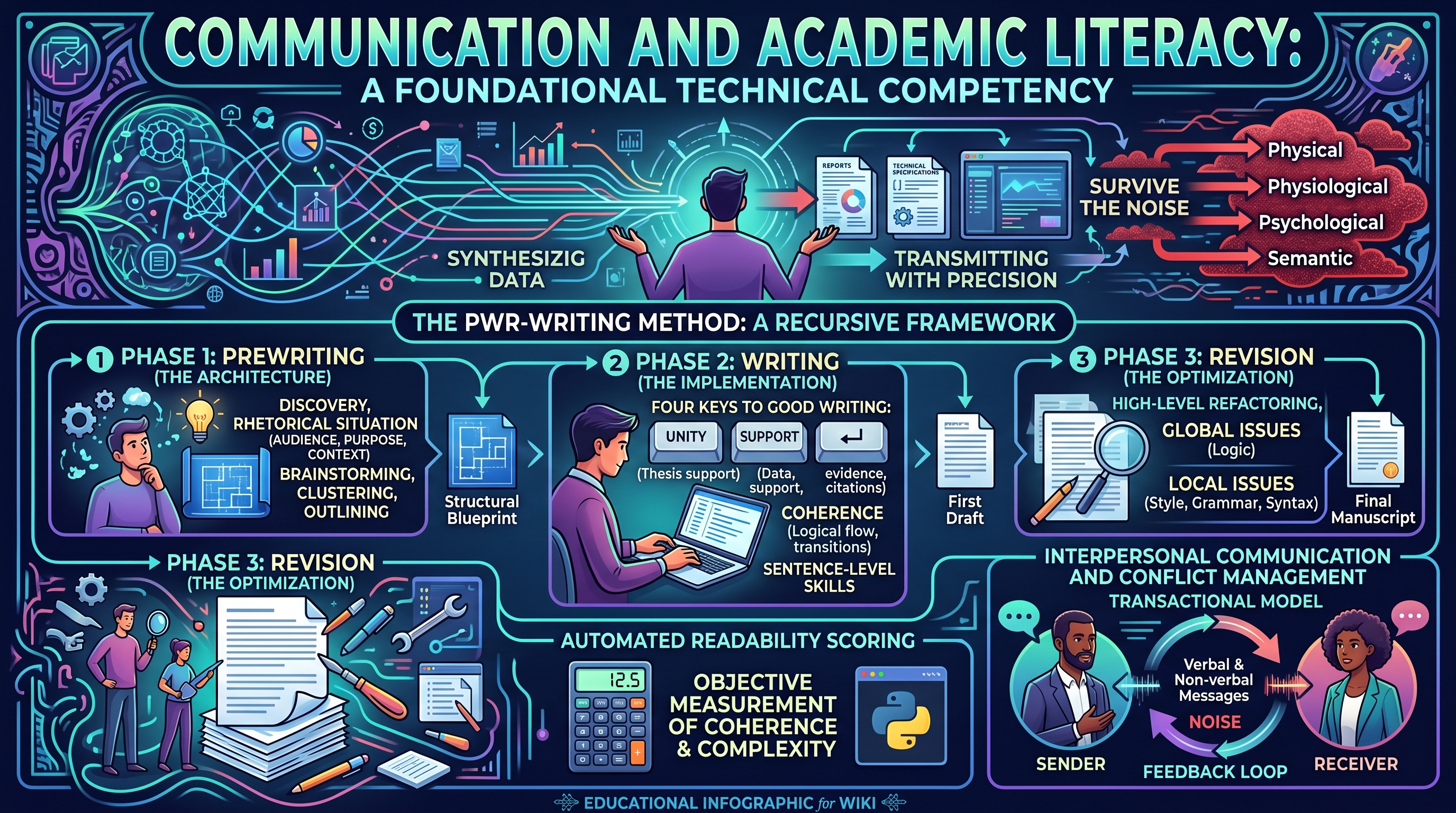
In the modern information economy, the ability to synthesize complex data and transmit it with precision is not merely a "soft skill"—it is a foundational technical competency. Academic literacy and professional communication represent the interface between raw cognition and social impact. Whether drafting a technical specification, a financial report, or a crisis response plan, the practitioner must navigate the recursive process of encoding intent into a medium that survives the "noise" of human interpretation.
The PWR-Writing Method: A Recursive Framework
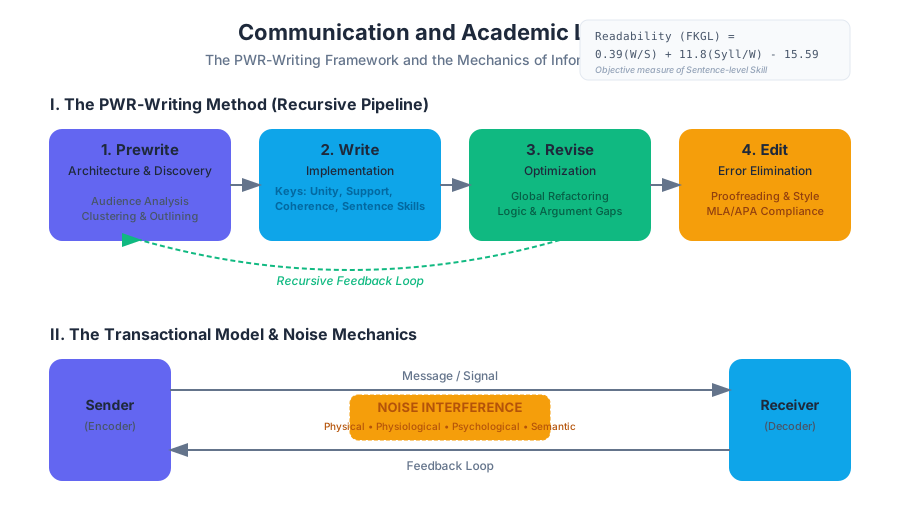
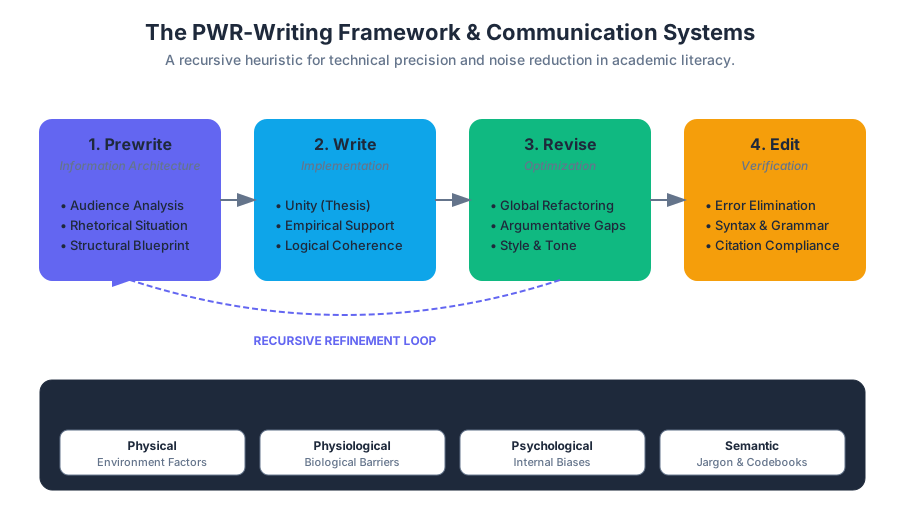
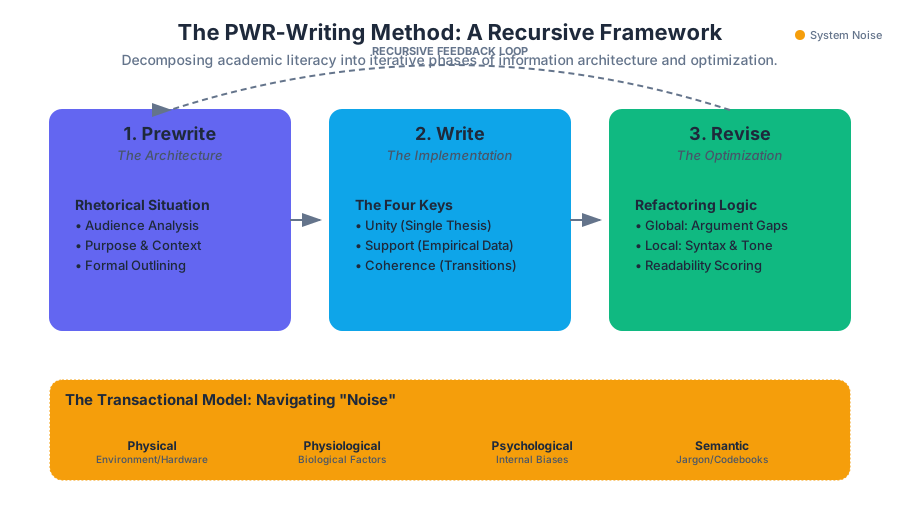
The PWR-Writing Method (Prewrite, Write, Revise) is a structured heuristic designed to decompose the monolithic task of "writing" into manageable, iterative phases. Unlike the linear "stream of consciousness" approach, PWR treats a document as a system that must be engineered for Unity, Support, Coherence, and Sentence-level Skills.
Phase 1: Prewriting (The Architecture)
Prewriting is the discovery phase where the writer establishes the Rhetorical Situation: the intersection of audience, purpose, and context. This involves brainstorming techniques such as clustering, freewriting, and the development of a formal outline.
Phase 2: Writing (The Implementation)
In the writing phase, the focus shifts to the "Four Keys to Good Writing." A successful draft must exhibit:
- Unity: Every paragraph must support a single, clear thesis statement.
- Support: Claims must be backed by empirical evidence, data, or authoritative citations.
- Coherence: Ideas must flow logically using transitional signals and structural consistency.
Phase 3: Revision (The Optimization)
Revision is often misunderstood as mere proofreading. In the PWR framework, revision is a high-level refactoring of the document’s logic. It involves checking for "Global" issues (argumentative gaps) before moving to "Local" issues (grammar and syntax).
| Stage | Primary Goal | Key Activities | Output |
|---|---|---|---|
| Prewrite | Information Architecture | Audience analysis, outlining, research | Structural Blueprint |
| Write | Draft Generation | Paragraph construction, evidence integration | First Draft |
| Revise | Logic & Style Optimization | Refactoring arguments, tone adjustment | Final Manuscript |
| Edit | Error Elimination | Proofreading for grammar, MLA compliance | Publication-Ready |
Implementation Example: Automated Readability Scoring
To objectively measure the "Coherence" and "Sentence-level" complexity of a draft, we can implement a readability algorithm. The following Python script calculates the Flesch-Kincaid Grade Level, a standard metric for assessing whether a text is appropriate for its intended audience.
import re

def calculate_readability(text):
    """
    Calculates the Flesch-Kincaid Grade Level of a given text.
    Formula: 0.39 * (total_words / total_sentences) + 11.8 * (total_syllables / total_words) - 15.59
    """
    sentences = len(re.findall(r'[.!?]+', text))
    words = len(re.findall(r'\w+', text))

    # Simple syllable counter (heuristic-based)
    def count_syllables(word):
        word = word.lower()
        count = 0
        vowels = "aeiouy"
        if word[0] in vowels:
            count += 1
        for index in range(1, len(word)):
            if word[index] in vowels and word[index - 1] not in vowels:
                count += 1
        if word.endswith("e"):
            count -= 1
        if count == 0:
            count = 1
        return count

    syllables = sum(count_syllables(word) for word in text.split())

    if sentences == 0 or words == 0:
        return 0

    grade_level = 0.39 * (words / sentences) + 11.8 * (syllables / words) - 15.59
    return round(grade_level, 2)

# Sample Academic Text
sample_text = "The implementation of the PWR-Writing method ensures that the rhetorical
strategy aligns with the cognitive load of the target audience."
print(f"Flesch-Kincaid Grade Level: {calculate_readability(sample_text)}")
Interpersonal Communication and Conflict Management
Interpersonal communication is the exchange of information, feelings, and meaning through verbal and non-verbal messages. In professional environments, this is governed by the Transactional Model, which posits that communication is a continuous, circular process where both parties are simultaneously senders and receivers.
The Mechanics of Noise
Communication is rarely 100% efficient due to Noise. In a technical context, noise is categorized as:
- Physical Noise: External environment (e.g., a loud server room).
- Physiological Noise: Biological factors (e.g., fatigue or hearing loss).
- Psychological Noise: Internal biases, preconceptions, or emotional states.
- Semantic Noise: Jargon or language barriers where the sender and receiver use different "codebooks."
Conflict Management Strategies
Conflict in academic or professional settings often arises from resource scarcity or goal misalignment. The Thomas-Kilmann Conflict Mode Instrument (TKI) defines five responses based on Assertiveness and Cooperativeness:
| Mode | Assertiveness | Cooperativeness | Best Use Case |
|---|---|---|---|
| Competing | High | Low | Emergency situations requiring quick, decisive action. |
| Collaborating | High | High | Integrating multiple perspectives for a "win-win" solution. |
| Compromising | Medium | Medium | Temporary settlements for complex issues. |
| Avoiding | Low | Low | Trivial issues where the cost of conflict outweighs benefits. |
| Accommodating | Low | High | When harmony is more important than the specific outcome. |
Mathematical Representation of Communication Efficiency
We can model the probability of successful message transmission ($P_s$) as a function of the Signal-to-Noise Ratio ($SNR$).
P_s = \int_{0}^{\infty} f(S, N) dS \approx \frac{1}{1 + e^{-k(S-N)}}
Where $S$ is the clarity of the signal (the message), $N$ is the cumulative noise, and $k$ is the receiver's decoding proficiency.
Public Relations Fundamentals and Strategic Messaging
Public Relations (PR) is the strategic management of relationships between an organization and its diverse publics. Unlike advertising, PR focuses on earned media and the maintenance of a "Crisis Response" infrastructure.
Crisis Communication Plan (CCP)
A CCP is a technical document that outlines the protocols for communicating during an unforeseen event that threatens an organization's reputation or operations. Key components include:
- Stakeholder Mapping: Identifying who needs to know what, and when.
- Message Standardization: Ensuring a "single source of truth" to prevent misinformation.
- Multicultural Messaging: Tailoring the response to account for cultural nuances and linguistic diversity.
Crisis Response Strategy Selection
Organizations must choose a response based on the level of perceived responsibility:
- Denial: The organization claims no responsibility.
- Diminishment: Minimizing the perceived damage or the organization's role.
- Bolstering: Reminding the public of past good works to offset current negativity.
- Mortification: Accepting full responsibility and asking for forgiveness (Atonement).
# Example: Crisis Communication Metadata Configuration
campaign:
  id: "PR_2023_ENV_01"
  type: "Crisis_Response"
  priority: "High"
  stakeholders:
    - group: "Investors"
      channel: "Direct Email / SEC Filing"
      urgency: 1
    - group: "General Public"
      channel: "Social Media / Press Release"
      urgency: 2
  messaging_logic:
    strategy: "Mortification"
    core_values: ["Transparency", "Accountability", "Remediation"]
    legal_review_required: true
Academic Literacy and MLA Citation
Academic literacy is the ability to engage with, evaluate, and produce scholarly discourse. Central to this is the ethical use of information, which is codified through citation styles like the Modern Language Association (MLA) format.
The "Container" System
MLA (9th Edition) uses a universal set of "Core Elements" organized into Containers. This allows for the citation of any source—from a traditional book to a TikTok video—by following a standardized sequence.
Definition: The Container A container is the "larger work" that holds a source. For example, a chapter is a source, and the book it appears in is the container. A television episode is a source, and the streaming service (Netflix) is the second container.
| Element Number | Core Element | Example |
|---|---|---|
| 1 | Author | Smith, John. |
| 2 | Title of Source | "The Ethics of AI." |
| 3 | Title of Container | Journal of Digital Humanities, |
| 4 | Other Contributors | edited by Sarah Doe, |
| 5 | Version | vol. 12, |
| 6 | Number | no. 4, |
| 7 | Publisher | Oxford UP, |
| 8 | Publication Date | 2022, |
| 9 | Location | pp. 45-67. |
Source Evaluation: The CRAAP Test
Before citing a source, it must be vetted using the CRAAP criteria:
- Currency: The timeliness of the information.
- Relevance: The importance of the information for your needs.
- Authority: The source of the information (credentials of the author).
- Accuracy: The reliability, truthfulness, and correctness of the content.
- Purpose: The reason the information exists (bias, persuasion, or fact).
Database Schema for Bibliography Management
To manage these citations at scale, a relational database can be used to store and retrieve source metadata.
-- Schema for an Academic Reference Manager
CREATE TABLE Authors (
    author_id INT PRIMARY KEY,
    last_name VARCHAR(255),
    first_name VARCHAR(255)
);

CREATE TABLE Sources (
    source_id INT PRIMARY KEY,
    title VARCHAR(500),
    pub_date DATE,
    source_type ENUM('Book', 'Journal', 'Web', 'Media'),
    container_title VARCHAR(500),
    doi_or_url VARCHAR(255)
);

CREATE TABLE Source_Authors (
    source_id INT,
    author_id INT,
    FOREIGN KEY (source_id) REFERENCES Sources(source_id),
    FOREIGN KEY (author_id) REFERENCES Authors(author_id)
);

-- Query to generate a basic MLA-style list
SELECT a.last_name, a.first_name, s.title, s.container_title, s.pub_date
FROM Sources s
JOIN Source_Authors sa ON s.source_id = sa.source_id
JOIN Authors a ON sa.author_id = a.author_id
ORDER BY a.last_name ASC;
Critical Thinking and Formal Logic
At the heart of academic literacy is Critical Thinking—the disciplined process of actively and skillfully conceptualizing, applying, analyzing, synthesizing, and evaluating information.
Sentential Logic
In Philosophy and Computer Science, arguments are often broken down into Sentential Logic (or Propositional Logic). This allows for the evaluation of an argument's Validity (the logical structure) independent of its Soundness (the truth of its premises).
- Modus Ponens: If $P \rightarrow Q$, and $P$ is true, then $Q$ must be true.
- Modus Tollens: If $P \rightarrow Q$, and $Q$ is false, then $P$ must be false.
Common Fallacies in Communication
- Ad Hominem: Attacking the person rather than the argument.
- Straw Man: Misrepresenting an opponent's position to make it easier to attack.
- False Dilemma: Presenting only two options when more exist.
- Appeal to Authority: Claiming something is true just because an "expert" said it, without providing evidence.
Summary of Professional Synthesis
Communication and Academic Literacy are not disparate skills but a unified set of tools for navigating the modern world. By applying the PWR-Writing Method, practitioners ensure their output is structured and refined. Through Interpersonal Communication and Conflict Management, they maintain the social fabric of the workplace. By mastering Public Relations and MLA Citation, they protect organizational reputation and maintain intellectual integrity. Finally, by grounding all these in Critical Thinking, they ensure that their contributions are not just loud, but meaningful.
Logic and Business Administration Foundations
Key concepts: Critical Thinking · Business Ethics · Corporate Social Responsibility · Financial and Managerial Accounting
Explores the intersection of philosophical reasoning and the fundamental principles of business management and ethics.
Logic and Business Administration Foundations
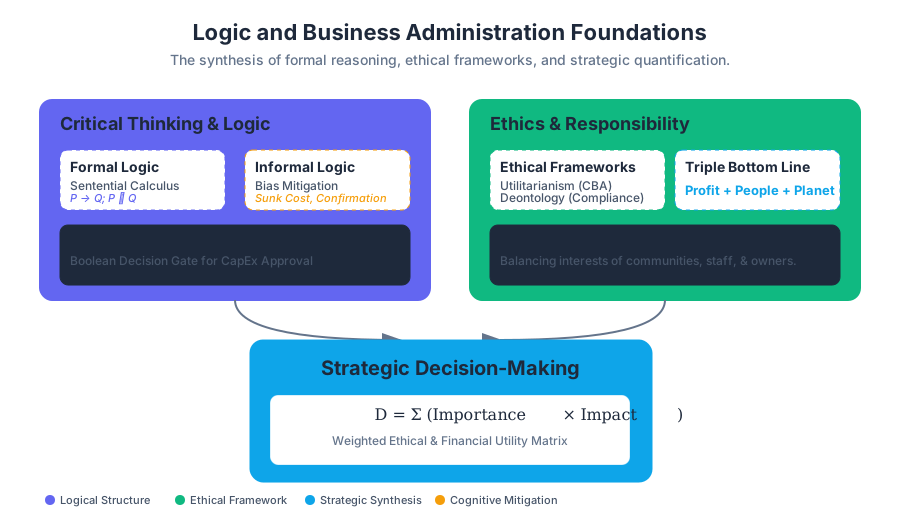
The synthesis of formal logic and business administration forms the bedrock of modern organizational theory. While business is often perceived through the lens of intuition and "gut feeling," professional management is a rigorous discipline rooted in the systematic application of critical thinking, ethical frameworks, and the precise quantification of economic events. This section explores the convergence of these fields, providing a technical deep-dive into how logical structures govern corporate governance, financial reporting, and strategic decision-making.
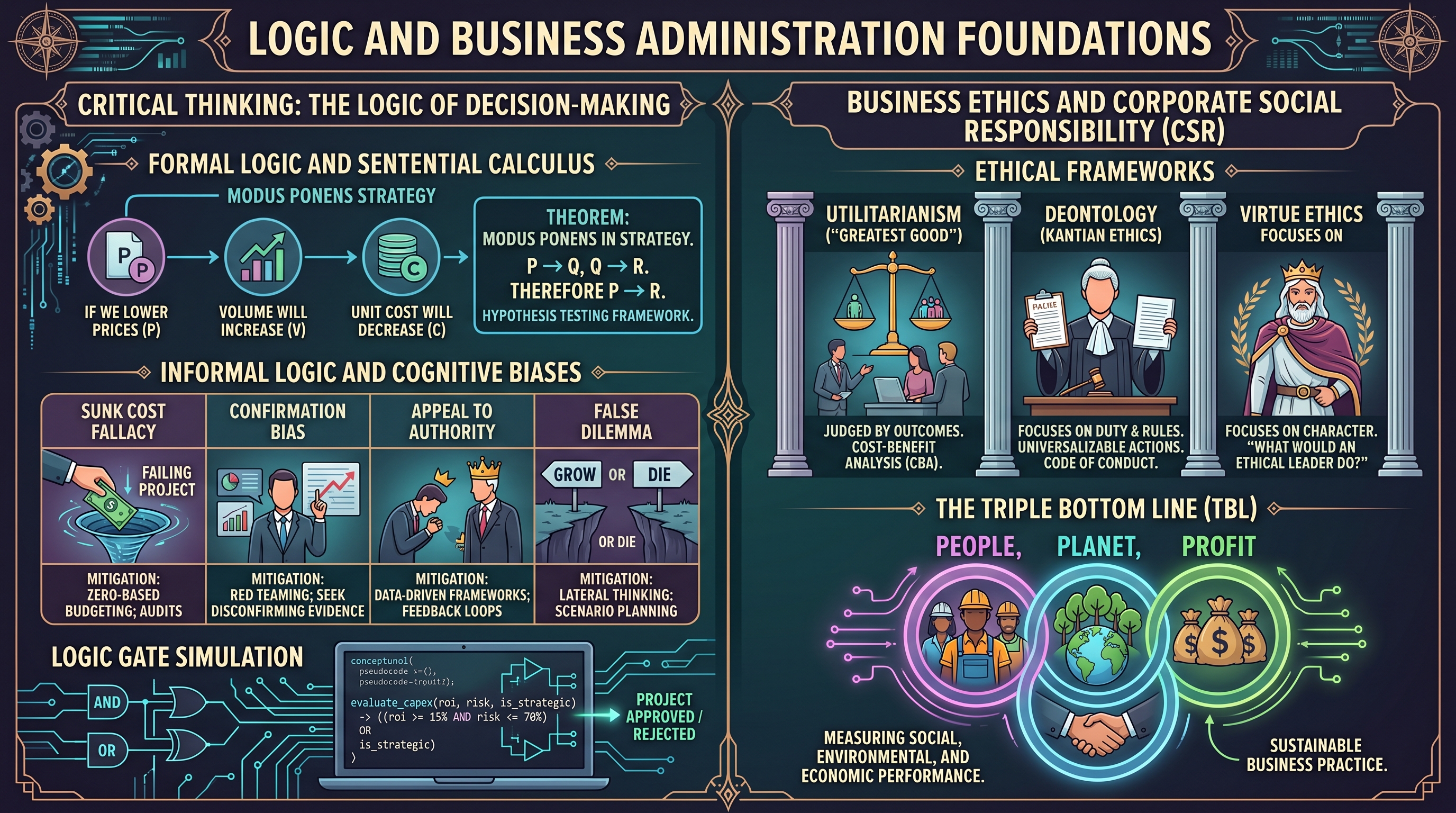
Critical Thinking: The Logic of Decision-Making
Critical Thinking in a business context is the intellectually disciplined process of actively and skillfully conceptualizing, applying, analyzing, synthesizing, and evaluating information gathered from observation, experience, reflection, or communication. It serves as a guide to belief and action, moving beyond mere "problem-solving" into the realm of structural analysis.
Formal Logic and Sentential Calculus
At the core of critical thinking lies Sentential Logic (or Propositional Logic). In business strategy, complex decisions are often decomposed into a series of logical propositions. If a firm's strategy is "If we lower prices ($P$), then volume will increase ($V$)," and "If volume increases ($V$), then unit cost will decrease ($C$)," we can derive the logical conclusion $P \implies C$.
Theorem: Modus Ponens in Strategy If the antecedent $P$ is true, and the conditional $P \implies Q$ is true, then the consequent $Q$ must be true. In business, this provides the framework for hypothesis testing in market research.
Informal Logic and Cognitive Biases
While formal logic deals with the structure of arguments, Informal Logic addresses the content. Business leaders must navigate a landscape of logical fallacies and cognitive biases that can distort financial data or strategic outlooks.
| Fallacy/Bias | Business Manifestation | Mitigation Strategy |
|---|---|---|
| Sunk Cost Fallacy | Continuing to fund a failing project because of past investment. | Zero-based budgeting; independent project audits. |
| Confirmation Bias | Seeking only market data that supports a pre-conceived product launch. | "Red Teaming"; seeking disconfirming evidence. |
| Appeal to Authority | Adopting a strategy solely because a high-ranking executive proposed it. | Data-driven decision frameworks; anonymous feedback loops. |
| False Dilemma | Assuming only two strategic paths exist (e.g., "Grow or Die"). | Lateral thinking; scenario planning (Best/Worst/Most Likely). |
Implementation: Logic Gate Simulation
In systems design and organizational workflows, logic is often implemented via boolean structures. Below is a low-level representation of a decision-gate logic in C, simulating a multi-factor approval process for a corporate capital expenditure.
#include <stdio.h>
#include <stdbool.h>

/**
 * Evaluates a Capital Expenditure (CapEx) request based on logical constraints.
 * Logic: (ROI > Threshold AND Risk < Max) OR (Strategic_Necessity == TRUE)
 */
bool evaluate_capex(float roi, float risk_score, bool is_strategic) {
    const float ROI_THRESHOLD = 0.15f; // 15%
    const float MAX_RISK = 0.70f;      // 70% scale

    // Logical conjunction (AND) for financial viability
    bool financially_viable = (roi >= ROI_THRESHOLD) && (risk_score <= MAX_RISK);

    // Logical disjunction (OR) for strategic override
    if (financially_viable || is_strategic) {
        return true;
    }
    return false;
}

int main() {
    float project_roi = 0.18;
    float project_risk = 0.55;
    bool strategic = false;

    if (evaluate_capex(project_roi, project_risk, strategic)) {
        printf("Project Approved: Logic constraints met.\n");
    } else {
        printf("Project Rejected: Logic constraints failed.\n");
    }
    return 0;
}
Business Ethics and Corporate Social Responsibility (CSR)
Business Ethics is the study of appropriate business policies and practices regarding potentially controversial subjects including corporate governance, insider trading, bribery, discrimination, and fiduciary responsibilities. Corporate Social Responsibility (CSR) extends this by suggesting that a corporation has a duty to the society at large, not just its shareholders.
Ethical Frameworks
- Utilitarianism: The "Greatest Good" principle. Decisions are judged by their outcomes. In a business context, this often translates to Cost-Benefit Analysis (CBA).
- Deontology (Kantian Ethics): Focuses on duty and rules. An action is right if it can be universalized. This forms the basis for strict compliance and "Code of Conduct" documents.
- Virtue Ethics: Focuses on the character of the decision-maker. It asks: "What would an ethical leader do?"
The Triple Bottom Line (TBL)
The TBL framework moves beyond the traditional measure of profits to include social and environmental impact.
\text{Total Organizational Value} = \text{Profit} + \text{People} + \text{Planet}
Stakeholder vs. Shareholder Theory
- Shareholder Primacy (Friedman): The sole social responsibility of business is to increase its profits while staying within the rules of the game.
- Stakeholder Theory (Freeman): Managers must balance the interests of all parties who have a "stake" in the firm: employees, customers, suppliers, communities, and shareholders.
Decision Matrix for Ethical Dilemmas
When faced with a conflict, managers use a weighted scoring model to evaluate the ethical "utility" of various options.
% Representation of a Weighted Ethical Decision Matrix
Decision(D) = \sum_{i=1}^{n} (Importance_i \times Impact_{i,D})

Where:
n = Number of Stakeholders
Importance = Weight assigned to stakeholder group
Impact = Predicted outcome for that group under decision D
Financial Accounting: The Language of Business
Financial Accounting is the process of recording, summarizing, and reporting the myriad of transactions resulting from business operations over a period of time. These transactions are summarized in the preparation of financial statements.
The Fundamental Accounting Equation
The entire system of double-entry bookkeeping is built upon a single logical identity:
Assets (A) = Liabilities (L) + Equity (E)
- Assets: Resources owned or controlled by the entity (Cash, Inventory, PPE).
- Liabilities: Obligations to external parties (Loans, Accounts Payable).
- Equity: The residual interest in the assets after deducting liabilities (Retained Earnings, Common Stock).
The Four Primary Financial Statements
Financial accounting produces four standardized outputs, typically governed by GAAP (Generally Accepted Accounting Principles) or IFRS (International Financial Reporting Standards).
| Statement | Purpose | Key Components |
|---|---|---|
| Balance Sheet | Snapshot of financial position at a specific point in time. | Assets, Liabilities, Shareholders' Equity. |
| Income Statement | Measures financial performance over a specific period. | Revenue, Expenses, Net Income (Profit/Loss). |
| Statement of Cash Flows | Tracks the movement of cash in and out of the business. | Operating, Investing, and Financing activities. |
| Statement of Retained Earnings | Details changes in equity over a period. | Beginning Equity + Net Income - Dividends. |
Implementation: Double-Entry Ledger Schema
In a modern ERP (Enterprise Resource Planning) system, the accounting logic is enforced at the database level to ensure the fundamental equation always balances.
-- A simplified schema for a double-entry accounting system
CREATE TABLE accounts (
    account_id INT PRIMARY KEY,
    account_name VARCHAR(100),
    account_type ENUM('Asset', 'Liability', 'Equity', 'Revenue', 'Expense')
);

CREATE TABLE journal_entries (
    entry_id INT PRIMARY KEY,
    entry_date TIMESTAMP DEFAULT CURRENT_TIMESTAMP,
    description TEXT
);

CREATE TABLE transactions (
    transaction_id INT PRIMARY KEY,
    entry_id INT REFERENCES journal_entries(entry_id),
    account_id INT REFERENCES accounts(account_id),
    debit DECIMAL(15, 2) DEFAULT 0.00,
    credit DECIMAL(15, 2) DEFAULT 0.00,
    -- Logic Constraint: Debits must equal Credits at the Entry level
    CONSTRAINT check_balance CHECK (
        (debit > 0 AND credit = 0) OR (credit > 0 AND debit = 0)
    )
);
Managerial Accounting: Internal Decision Support
Unlike financial accounting, which is geared toward external stakeholders, Managerial Accounting provides information to internal managers for planning, controlling, and decision-making.
Cost-Volume-Profit (CVP) Analysis
CVP analysis is a tool that helps managers understand the relationships between cost, volume, and profit. It is essential for determining the Break-Even Point.
- Fixed Costs (FC): Costs that do not change with production levels (Rent, Salaries).
- Variable Costs (VC): Costs that vary directly with production (Raw materials, Direct labor).
- Contribution Margin (CM): $Sales - Variable Costs$.
The Break-Even Formula
To find the number of units ($Q$) required to break even:
Q = \frac{Fixed Costs}{Price per Unit - Variable Cost per Unit}
Worked Example: CVP Analysis in Python
A manager needs to determine the impact of a 10% reduction in sales price on the company's break-even point.
import pandas as pd

def calculate_break_even(fixed_costs, price_per_unit, variable_cost_per_unit):
    contribution_margin = price_per_unit - variable_cost_per_unit
    if contribution_margin <= 0:
        return float('inf')  # Will never break even
    return fixed_costs / contribution_margin

# Scenario Data
params = {
    "Fixed_Costs": 500000,
    "Current_Price": 150,
    "New_Price": 135, # 10% reduction
    "VC_per_unit": 90
}

current_be = calculate_break_even(params["Fixed_Costs"], params["Current_Price"], params["VC_per_unit"])
new_be = calculate_break_even(params["Fixed_Costs"], params["New_Price"], params["VC_per_unit"])

print(f"Current Break-even Units: {current_be:.2f}")
print(f"New Break-even Units: {new_be:.2f}")
print(f"Increase in required volume: {((new_be/current_be) - 1)*100:.2f}%")
Variations and Extensions
Environmental Ethics and Justice
In the 21st century, the logic of business has expanded to include Environmental Justice. This field examines the fair treatment and meaningful involvement of all people regardless of race, color, national origin, or income with respect to the development, implementation, and enforcement of environmental laws and policies. For a corporation, this means analyzing the disparate impact of factory placement or waste disposal on marginalized communities.
Existentialism in Management
While seemingly abstract, Existentialism (the study of individual existence, freedom, and choice) influences modern leadership theory. It emphasizes "Authentic Leadership"—the idea that managers must take radical responsibility for their choices in an inherently uncertain ("absurd") market environment, rather than hiding behind corporate bureaucracy.
Common Pitfalls in Logic and Administration
- Confusing Cash with Profit: A common error in managerial accounting. A company can be profitable on an Income Statement (accrual basis) but go bankrupt because it lacks liquid cash to pay its bills (Cash Flow).
- The "Ethics Check-Box" Mentality: Treating CSR as a marketing exercise (Greenwashing) rather than a core strategic logic. This often leads to long-term reputational damage.
- Over-Reliance on Quantitative Logic: While data is vital, "McNamara's Fallacy" involves making decisions based solely on quantitative metrics and ignoring qualitative factors (like employee morale or brand sentiment) that cannot be easily measured.
- Logical Circularity in Budgeting: Using last year's budget as the only justification for next year's (Incremental Budgeting) without questioning the underlying logic of the expenditures.
Technical Proficiency and Language Standards
Key concepts: Programming Fundamentals · Object-Oriented Programming · CEFR Proficiency Levels · Academic and Business Writing
Covers computer science fundamentals and language proficiency standards for global business environments.
Technical Proficiency and Language Standards: The Architecture of Modern Competence
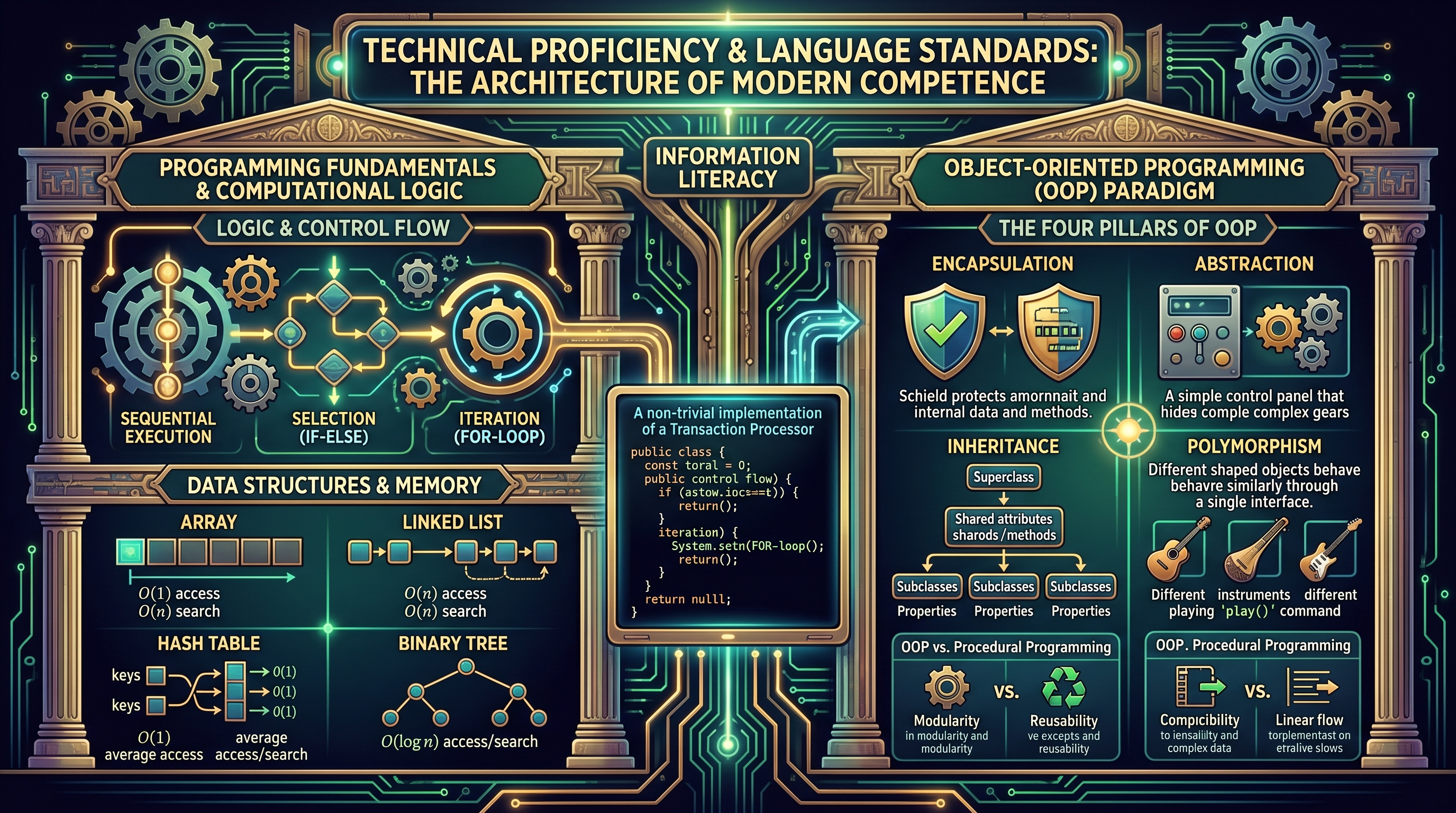
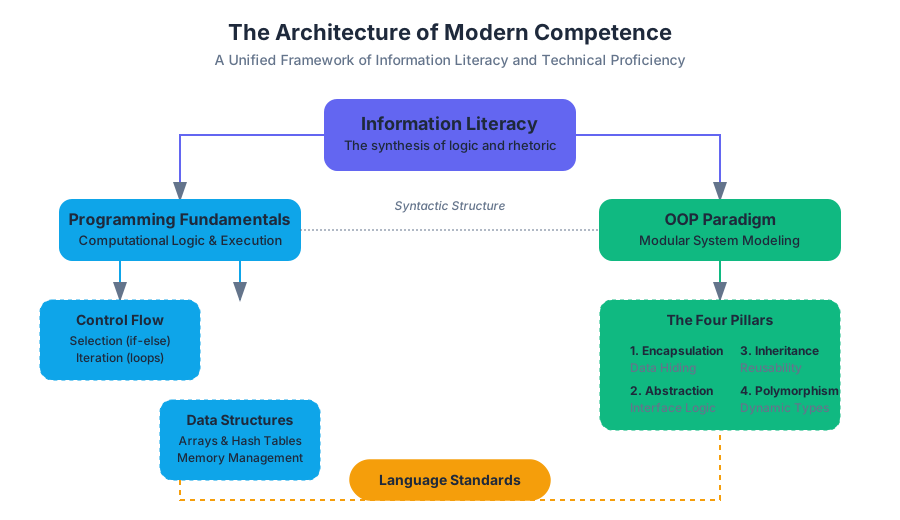
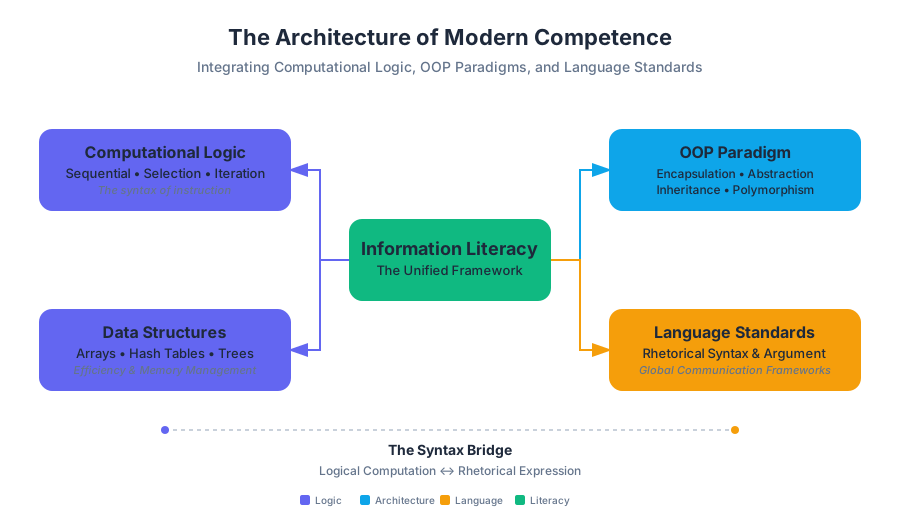
The modern professional landscape is defined by two primary syntaxes: the logical syntax of computation and the rhetorical syntax of human language. Technical proficiency is no longer a siloed skill reserved for engineers, nor is linguistic mastery a luxury for the humanities. Instead, they represent a unified framework of Information Literacy, where the ability to structure a for-loop is as critical as the ability to structure a persuasive argument. This article explores the intersection of programming fundamentals, the Object-Oriented paradigm, and the standardized frameworks of language proficiency that govern global communication.
I. Programming Fundamentals and Computational Logic
At its core, Programming Fundamentals refers to the foundational concepts required to instruct a computer to perform specific tasks. This involves moving beyond mere syntax to understand the underlying logic of Algorithms and Data Structures.
1. Logic and Control Flow
The execution of any program is governed by Control Flow, the order in which individual statements, instructions, or function calls are executed. This is typically managed through:
- Sequential Execution: The default mode where statements run one after another.
- Selection (Conditionals):
if-elsestructures that allow the program to branch based on boolean logic. - Iteration (Loops):
whileandforloops that repeat blocks of code until a specific condition is met.
2. Data Structures and Memory
A program is only as efficient as its data organization. Data Structures are specialized formats for organizing, processing, retrieving, and storing data.
| Structure | Access Complexity | Search Complexity | Best Use Case |
|---|---|---|---|
| Array | $O(1)$ | $O(n)$ | Fixed-size collections, contiguous memory. |
| Linked List | $O(n)$ | $O(n)$ | Dynamic size, frequent insertions/deletions. |
| Hash Table | $O(1)$ average | $O(1)$ average | Key-value mapping, rapid lookups. |
| Binary Tree | $O(\log n)$ | $O(\log n)$ | Hierarchical data, sorted storage. |
3. Implementation: The Low-Level View
In enterprise environments, Java remains a standard for implementing these fundamentals due to its strict typing and memory management.
/**
 * A non-trivial implementation of a Transaction Processor
 * demonstrating control flow, error handling, and data validation.
 */
public class TransactionProcessor {
    private final double MAX_LIMIT = 10000.00;

    public boolean processTransaction(double amount, String currency) {
        // Guard clause: Selection logic
        if (amount <= 0 || amount > MAX_LIMIT) {
            System.err.println("Invalid amount: " + amount);
            return false;
        }

        // Iterative logic for multi-currency validation
        String[] supportedCurrencies = {"USD", "EUR", "GBP", "JPY"};
        boolean isSupported = false;
        for (String c : supportedCurrencies) {
            if (c.equals(currency)) {
                isSupported = true;
                break;
            }
        }

        if (!isSupported) {
            throw new IllegalArgumentException("Currency not supported: " + currency);
        }

        return commitToLedger(amount, currency);
    }

    private boolean commitToLedger(double amount, String currency) {
        // Simulated persistence logic
        return true;
    }
}
II. The Object-Oriented Programming (OOP) Paradigm
Object-Oriented Programming (OOP) is a paradigm based on the concept of "objects," which can contain data (attributes) and code (methods). It was developed to manage the increasing complexity of software systems by modeling them after real-world entities.
The Four Pillars of OOP
- Encapsulation: Bundling the data and the methods that operate on that data within a single unit (class) and restricting access to some of the object's components.
- Abstraction: Hiding the complex implementation details and showing only the necessary features of an object.
- Inheritance: A mechanism where a new class (subclass) acquires the properties and behaviors of an existing class (superclass).
- Polymorphism: The ability of different classes to be treated as instances of the same class through inheritance, specifically the ability of a single interface to represent different underlying forms (data types).
The Liskov Substitution Principle (LSP): A key formalization of inheritance stating that objects of a superclass should be replaceable with objects of its subclasses without breaking the application.
OOP vs. Procedural Programming
The shift from procedural to object-oriented was driven by the need for Modularity and Reusability.
| Feature | Procedural Programming | Object-Oriented Programming |
|---|---|---|
| Focus | Functions/Actions (What is happening?) | Data/Objects (Who is acting?) |
| Data Security | Data is often global and accessible. | Data is hidden via Encapsulation. |
| Maintenance | Difficult to modify large codebases. | Highly modular; changes are localized. |
| Approach | Top-down. | Bottom-up. |
Mathematical Representation of Object State
We can represent an object's state $S$ at time $t$ as a tuple of its attributes $A$: $$S_t = (a_1, a_2, \dots, a_n)$$ A method $M$ acts as a transition function: $$M: S_t \times I \to S_{t+1}$$ where $I$ is the input parameter set.
# Demonstrating Polymorphism and Abstraction in Python
from abc import ABC, abstractmethod

class FinancialInstrument(ABC):
    @abstractmethod
    def calculate_risk(self):
        pass

class Stock(FinancialInstrument):
    def __init__(self, ticker, volatility):
        self.ticker = ticker
        self.volatility = volatility

    def calculate_risk(self):
        # Risk as a function of volatility
        return self.volatility * 1.5

class Bond(FinancialInstrument):
    def __init__(self, rating):
        self.rating = rating # e.g., 1 for AAA, 5 for Junk

    def calculate_risk(self):
        # Risk as a function of credit rating
        return self.rating * 0.5

def assess_portfolio(instruments):
    for instrument in instruments:
        # Polymorphic call: same method, different behavior
        print(f"Risk Factor: {instrument.calculate_risk()}")

# Usage
portfolio = [Stock("AAPL", 0.2), Bond(1)]
assess_portfolio(portfolio)
III. Language Standards: The CEFR Framework
Just as code requires a compiler to validate syntax, human communication requires a framework to validate proficiency. The Common European Framework of Reference for Languages (CEFR) is the international standard for describing language ability.
Proficiency Levels
The CEFR organizes language proficiency into six levels, grouped into three broad categories:
- A1–A2 (Basic User): Can understand and use familiar everyday expressions and very basic phrases.
- B1–B2 (Independent User): Can deal with most situations likely to arise while travelling; can produce simple connected text on topics which are familiar.
- C1–C2 (Proficient User): Can understand a wide range of demanding, longer texts; can express ideas fluently and spontaneously without much obvious searching for expressions.
| Level | Description | Professional Context |
|---|---|---|
| A2 | Waystage | Basic social interactions, simple workplace tasks. |
| B2 | Vantage | Technical discussions in one's field, active participation in meetings. |
| C1 | Effective Operational Proficiency | Drafting complex reports, negotiating contracts, nuanced persuasion. |
| C2 | Mastery | Academic research, high-level diplomacy, crisis communication. |
Standard American English (SAE)
In professional and academic settings, Standard American English serves as the benchmark. It is characterized by specific grammatical rules, a lack of regional slang, and a focus on clarity and "General American" pronunciation. For ESL (English as a Second Language) learners, mastering SAE is essential for integration into global business and healthcare environments.
IV. Academic and Business Writing
Writing is the process of translating complex thoughts into a structured, linear format. Effective writing relies on four key pillars: Unity, Support, Coherence, and Sentence-Level Skills.
1. The PWR Method
The PWR Method (Prewrite, Write, Revise) is a recursive process used to ensure high-quality output.
- Prewrite: Audience analysis, purpose definition, and outlining.
- Write: Drafting the content without over-focusing on perfection.
- Revise: Refining the structure, checking for coherence, and polishing grammar.
2. Academic vs. Technical Writing
While both require precision, their goals and structures differ significantly.
| Attribute | Academic Writing | Technical Writing |
|---|---|---|
| Purpose | To persuade or inform through research. | To instruct or explain a process/product. |
| Audience | Scholars, professors, students. | Users, engineers, stakeholders. |
| Tone | Formal, objective, often complex. | Direct, utilitarian, concise. |
| Citation | Heavy use of MLA/APA/Chicago. | References to documentation/manuals. |
3. Technical Communication and Documentation
In the technical world, writing often takes the form of Documentation. This involves explaining how code works, how to use an API, or how to troubleshoot a system.
# A typical workflow for generating technical documentation using Sphinx
# 1. Install the documentation engine
pip install sphinx

# 2. Initialize the documentation directory
sphinx-quickstart

# 3. Build the HTML documentation from Markdown/reStructuredText source
make html

# 4. Deploy documentation to a web server
scp -r _build/html/* user@server:/var/www/docs/
V. Synthesis: The Interplay of Logic and Language
The intersection of these disciplines is most visible in Technical Communication and Crisis Management. A senior engineer must not only write efficient code (Technical Proficiency) but also explain a system failure to non-technical stakeholders (Language Standards).
1. Audience Analysis
In both programming and writing, the "user" is the priority.
- In Code: Writing readable code for other developers (using OOP principles).
- In Writing: Tailoring the lexical density and tone to the reader's expertise.
2. Information Literacy
This is the ability to recognize when information is needed and have the ability to locate, evaluate, and use effectively the needed information. In the context of the Saylor University curriculum, this bridges the gap between Philosophy (critical thinking), Computer Science (problem-solving), and English (expression).
3. Ethics and Responsibility
Whether it is Environmental Ethics in philosophy or Data Privacy in computer science, the professional must navigate moral landscapes. Standardized language allows for the clear articulation of these ethical boundaries.
Key Insight: Technical proficiency provides the tools for creation, while language standards provide the medium for collaboration and the framework for accountability.
Summary of Key Terms
- Object-Oriented Programming (OOP): A paradigm based on objects and classes.
- CEFR: The global standard for measuring language proficiency (A1-C2).
- Encapsulation: The OOP principle of hiding internal state.
- PWR Method: Prewrite, Write, Revise—the standard writing workflow.
- Standard American English (SAE): The linguistic benchmark for global business and academia.
- Control Flow: The order in which instructions are executed in a program.
- Polymorphism: The ability of different types to be accessed through the same interface.
Professional Development and College Success
Key concepts: Time Management · Crisis Communication Plan (CCP) · Data Visualization · Learning Styles
Strategies for academic success and professional career building, including crisis communication and data presentation.
Professional Development and College Success
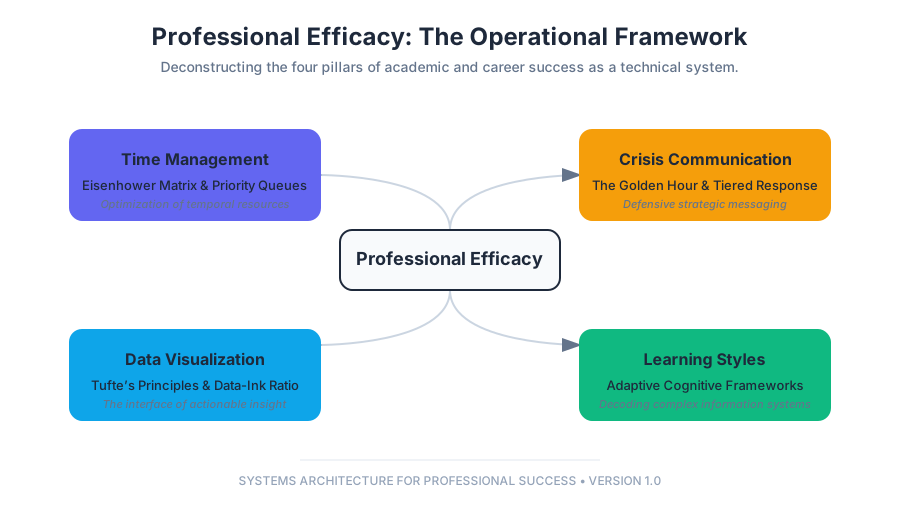
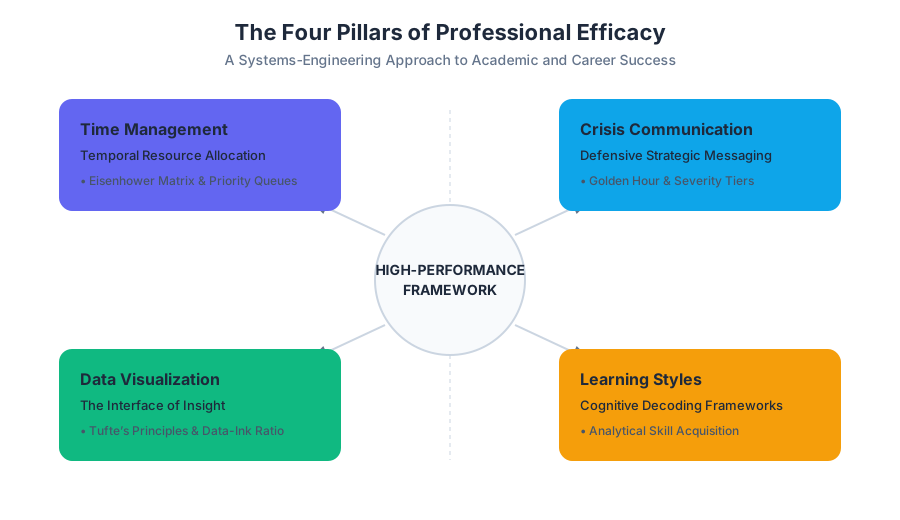
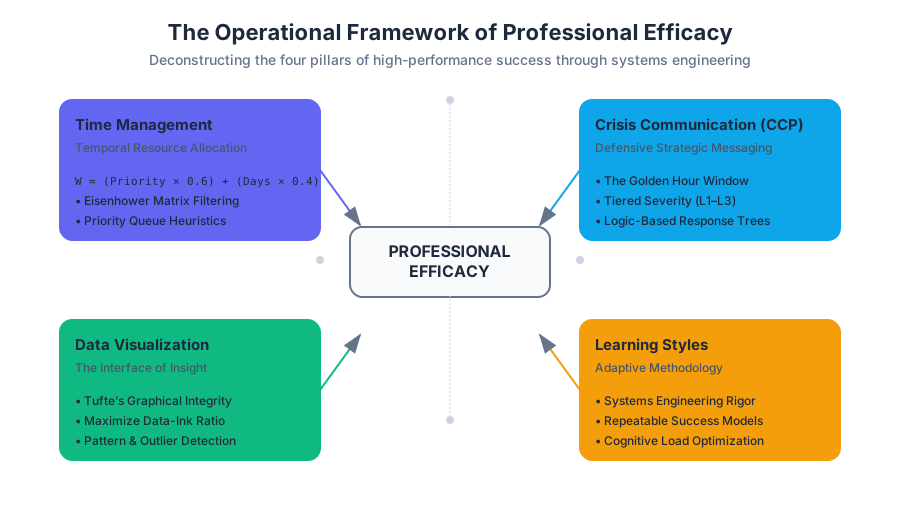
Professional development and academic success are often mischaracterized as a collection of "soft skills." In reality, they constitute the operational framework through which technical expertise is applied. Whether navigating a rigorous collegiate environment or managing high-stakes corporate projects, the ability to optimize temporal resources, decode complex information, and communicate during systemic failures is what separates high-performers from the median.
This article deconstructs the four pillars of professional efficacy: Time Management, Crisis Communication Planning (CCP), Data Visualization, and Learning Styles. By treating these concepts with the same analytical rigor as a systems engineer treats a network architecture, we can derive a repeatable methodology for success.
Time Management: The Optimization of Temporal Resources
At its core, Time Management is the process of planning and exercising conscious control over the amount of time spent on specific activities—especially to increase effectiveness, efficiency, and productivity. In a professional or academic context, it is a resource allocation problem where the "cost" is a non-renewable asset.
The Mechanics of Prioritization
The primary challenge of time management is not the lack of time, but the abundance of "noise." We utilize the Eisenhower Matrix to categorize tasks based on two vectors: Urgency and Importance.
The Eisenhower Principle: "What is important is seldom urgent and what is urgent is seldom important."
Technical Implementation: Priority Queues
To understand time management algorithmically, we can view it as a Priority Queue where tasks are processed based on a weighted heuristic of deadline proximity and impact.
import heapq
import datetime

class Task:
    def __init__(self, name, priority, deadline, duration):
        self.name = name
        self.priority = priority  # 1 (High) to 5 (Low)
        self.deadline = deadline
        self.duration = duration

    def calculate_weight(self):
        # Heuristic: Weight = (Priority * 0.6) + (Days_Remaining * 0.4)
        days_remaining = (self.deadline - datetime.date.today()).days
        return (self.priority * 10) + days_remaining

    def __lt__(self, other):
        return self.calculate_weight() < other.calculate_weight()

# Simulation of a student's task load
task_list = [
    Task("Calculus Final", 1, datetime.date(2023, 12, 15), 20),
    Task("Emailing Professor", 4, datetime.date(2023, 11, 20), 0.5),
    Task("Research Paper Draft", 2, datetime.date(2023, 11, 25), 10)
]

heapq.heapify(task_list)
print(f"Next optimal task: {heapq.heappop(task_list).name}")
Variations in Frameworks
Different environments require different temporal strategies. A student might favor the Pomodoro Technique for deep focus, while a manager might favor Getting Things Done (GTD) for high-volume task triage.
| Framework | Core Philosophy | Best For |
|---|---|---|
| Eisenhower Matrix | Quadrant-based filtering | Strategic planning and delegation |
| Pomodoro | Time-boxing (25m work/5m break) | Combating procrastination/Deep work |
| GTD (Allen) | Externalizing all tasks to a system | High-complexity, multi-project roles |
| Pareto (80/20) | Focus on the 20% of tasks yielding 80% results | Efficiency optimization |
Crisis Communication Plan (CCP): Defensive Strategic Messaging
A Crisis Communication Plan (CCP) is a set of guidelines used to prepare a business or individual for an emergency or unexpected event that could cause damage to its reputation. In the professional world, a crisis is not a matter of "if," but "when."
The Anatomy of a Crisis Response
The efficacy of a CCP is measured by the Golden Hour—the window of time immediately following a crisis where the organization has the most power to shape the narrative.
- Identification: Recognizing the trigger event (e.g., data breach, financial scandal).
- Activation: Mobilizing the Crisis Management Team (CMT).
- Messaging: Deploying pre-approved templates tailored to the specific incident.
- Monitoring: Real-time analysis of public and stakeholder sentiment.
Crisis Severity Levels
Effective CCPs utilize a tiered response system to ensure resources are not over-allocated to minor incidents.
| Level | Description | Response Protocol |
|---|---|---|
| Level 1 | Minor incident; localized impact. | Internal memo; standard social monitoring. |
| Level 2 | Moderate issue; potential for media pickup. | Department head involvement; prepared statement. |
| Level 3 | Critical failure; threat to organizational viability. | CEO-led press conference; 24/7 war room. |
Implementation: Logic-Based Response
In a technical environment, a CCP can be represented as a state machine or a logic tree.
# Crisis Response Workflow Configuration
crisis_levels:
  - id: level_3_critical
    triggers:
      - data_breach_over_10k_records
      - legal_injunction
    actions:
      - notify: [CEO, Legal_Counsel, PR_Director]
      - halt_external_marketing: true
      - deploy_landing_page: "/status/emergency-update"
      - response_sla: 60 # minutes
Data Visualization: The Interface of Insight
Data Visualization is the graphical representation of information and data. By using visual elements like charts, graphs, and maps, data visualization tools provide an accessible way to see and understand trends, outliers, and patterns in data.
Tufte’s Principles of Graphical Integrity
Professor Edward Tufte, a pioneer in the field, argues that excellence in statistical graphics consists of complex ideas communicated with clarity, precision, and efficiency.
- Data-Ink Ratio: Maximize the "ink" used to represent actual data; minimize "chartjunk" (gridlines, shadows, 3D effects).
- Lie Factor: The size of the effect shown in the graphic divided by the size of the effect in the data. It should be as close to 1 as possible.
Mathematical Derivation of the Lie Factor
The Lie Factor ($LF$) is calculated as: $$LF = \frac{\text{Size of effect shown in graphic}}{\text{Size of effect in data}}$$ If $LF > 1.05$ or $LF < 0.95$, the graphic is considered distorted.
Technical Visualization with D3.js
For professional-grade visualizations, static charts are often insufficient. Interactive layers allow stakeholders to explore data dimensions.
// D3.js snippet for a dynamic linear scale
const data = [10, 25, 50, 80, 120];
const width = 500;
const margin = 20;

const xScale = d3.scaleLinear()
    .domain([0, d3.max(data)]) // Input data range
    .range([margin, width - margin]); // Output pixel range

// Result: xScale(50) returns the precise pixel coordinate
console.log("Coordinate for value 50:", xScale(50));
Choosing the Right Visualization
The choice of chart depends entirely on the relationship between variables.
| Relationship | Recommended Chart | Avoid |
|---|---|---|
| Comparison | Bar Chart, Bullet Graph | Pie Charts (too many slices) |
| Distribution | Histogram, Box Plot | Line Charts (implies continuity) |
| Correlation | Scatter Plot, Heatmap | Dual-axis charts (can be misleading) |
| Temporal (Time) | Line Chart, Area Chart | Bar Charts (if intervals are dense) |
Learning Styles and Cognitive Strategies
Success in both college and professional life requires Metacognition—the ability to think about how one thinks. While the popular VARK model (Visual, Auditory, Read/Write, Kinesthetic) is a useful starting point, modern educational psychology emphasizes Multimodal Learning and Active Recall.
The Forgetting Curve and Spaced Repetition
The Ebbinghaus Forgetting Curve posits that humans lose 50% of new information within 24 hours unless it is consciously reviewed. The solution is Spaced Repetition, an evidence-based learning technique that increases the interval between reviews of previously learned material.
The Spaced Repetition Algorithm (Pseudocode)
The most famous implementation of this is the SuperMemo-2 (SM-2) algorithm, which calculates the next interval ($I$) based on a quality score ($q$).
ALGORITHM SpacedRepetition(card, quality_score):
    IF quality_score >= 3:
        IF card.repetitions == 0:
            card.interval = 1
        ELSE IF card.repetitions == 1:
            card.interval = 6
        ELSE:
            card.interval = round(card.previous_interval * card.easiness_factor)

        card.repetitions += 1
        card.easiness_factor = card.easiness_factor + (0.1 - (5 - q) * (0.08 + (5 - q) * 0.02))
    ELSE:
        card.repetitions = 0
        card.interval = 1

    RETURN card.next_review_date = current_date + card.interval
Strategic Study Techniques
Beyond "styles," certain techniques have higher empirical efficacy than others.
| Technique | Description | Efficacy |
|---|---|---|
| Active Recall | Testing yourself rather than re-reading. | High |
| Interleaving | Mixing different topics or subjects in one session. | High |
| Elaborative Interrogation | Asking "Why?" and "How?" for every concept. | Moderate-High |
| Summarization | Writing a summary of the material. | Low-Moderate |
Information Literacy: The Foundation of Professional Research
In an era of information ubiquity, the ability to find, evaluate, and use information ethically is a critical professional competency. This is known as Information Literacy.
The CRAAP Test
A standard heuristic for evaluating sources (especially in academic and financial research) is the CRAAP Test:
- Currency: The timeliness of the information.
- Relevance: The importance of the information for your needs.
- Authority: The source of the information (credentials of the author).
- Accuracy: The reliability, truthfulness, and correctness of the content.
- Purpose: The reason the information exists (bias, propaganda, or fact).
Professional Research Pipeline
A senior analyst or researcher follows a structured pipeline to move from a raw query to a defensible conclusion:
- Query Formulation: Using Boolean operators (
AND,OR,NOT) to narrow the search space. - Source Triage: Applying the CRAAP test to filter out low-signal data.
- Synthesis: Integrating disparate data points into a cohesive narrative.
- Citation: Using frameworks like MLA or APA to provide a recursive path for others to verify the data.
# Example of a command-line research tool (e.g., searching an academic database API)
curl -X GET "https://api.academic-database.org/v1/search?query=crisis+communication+AND+social+media&limit=10" \
     -H "Authorization: Bearer YOUR_API_KEY" \
     -H "Accept: application/json" | jq '.results[] | {title: .title, author: .author, year: .published_year}'
Conclusion: Synthesis of Skills
Professional development is not a static destination but a dynamic optimization process. By treating Time Management as an algorithmic priority problem, Crisis Communication as a strategic state machine, Data Visualization as a mathematical mapping of truth, and Learning Styles as a cognitive feedback loop, individuals can achieve a level of "College Success" that translates directly into long-term career mastery.
The modern professional must be a "T-shaped" individual: possessing deep technical expertise in one area (like Finance or Computer Science) while maintaining a broad horizontal bar of professional competencies that allow that expertise to be effectively deployed in the real world.
Digital Literacy and Applied Soft Skills
Key concepts: Spreadsheet Operations · Bitcoin Economics · Professional Writing · Financial Literacy
Advanced spreadsheet mastery, grant writing, and the fundamentals of digital currency.
Digital Literacy and Applied Soft Skills
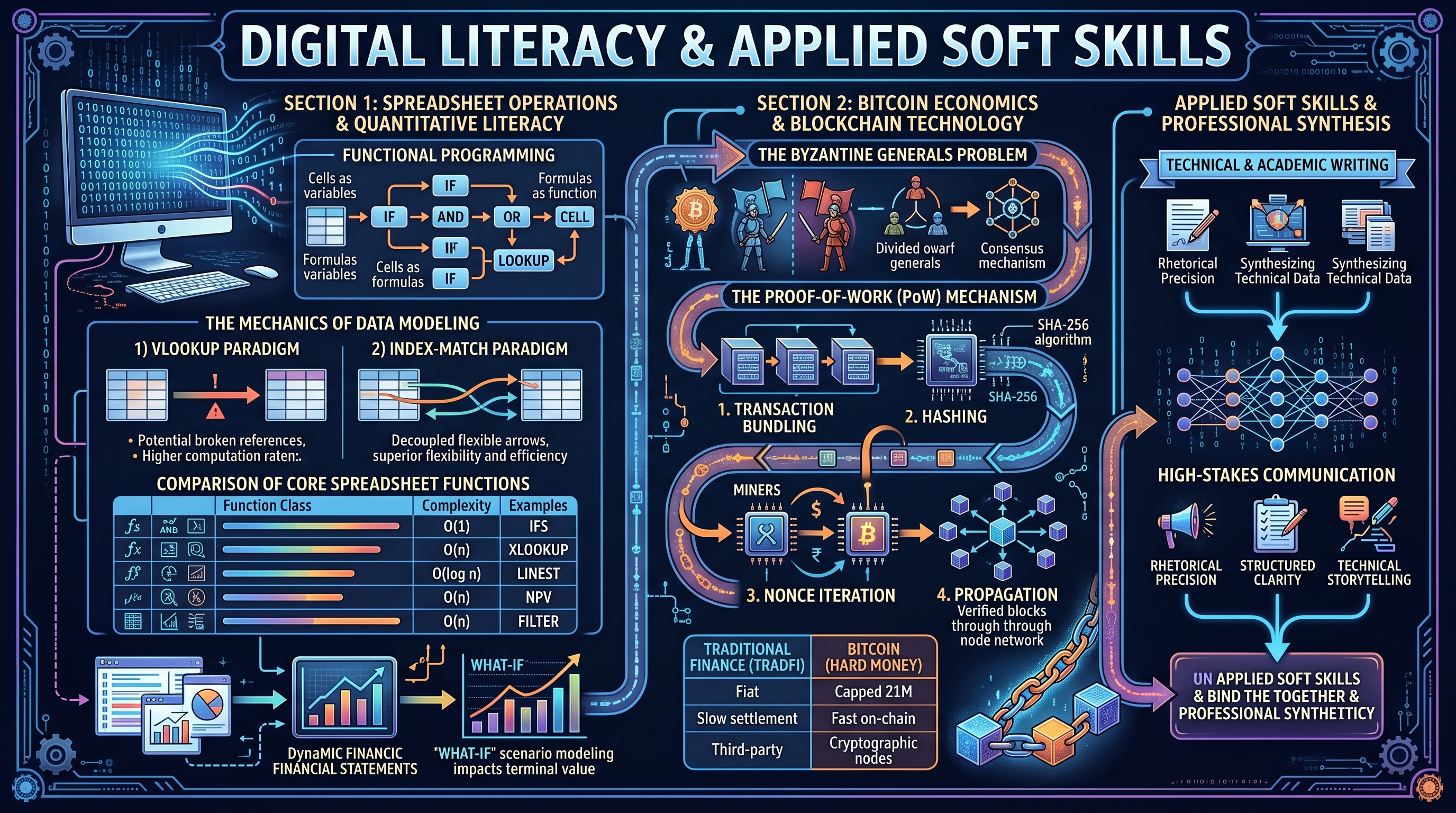
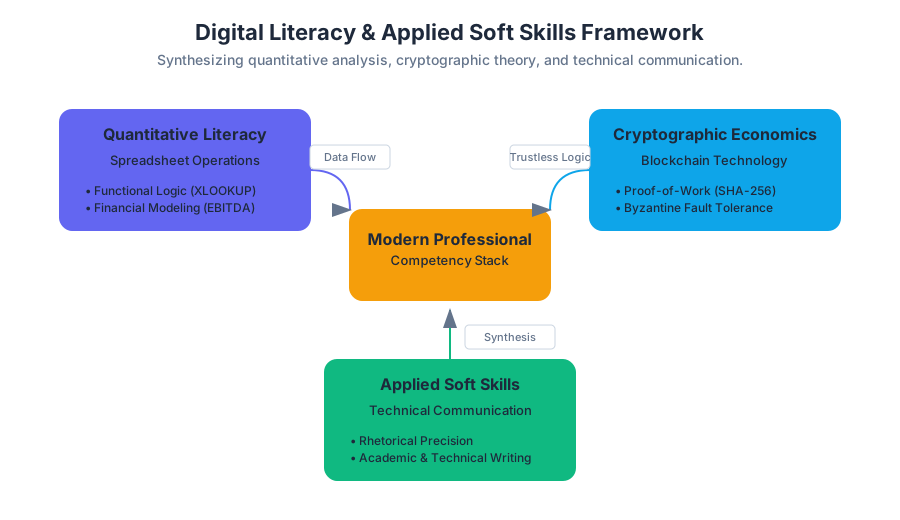
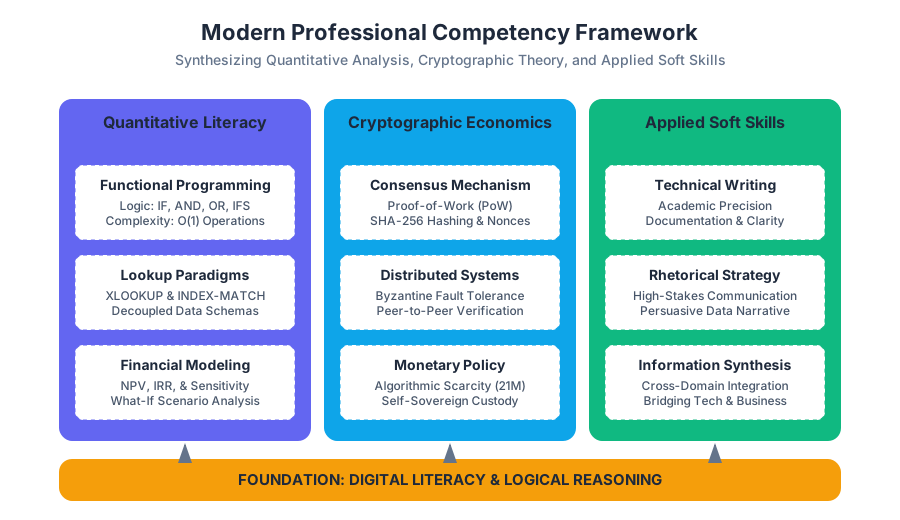
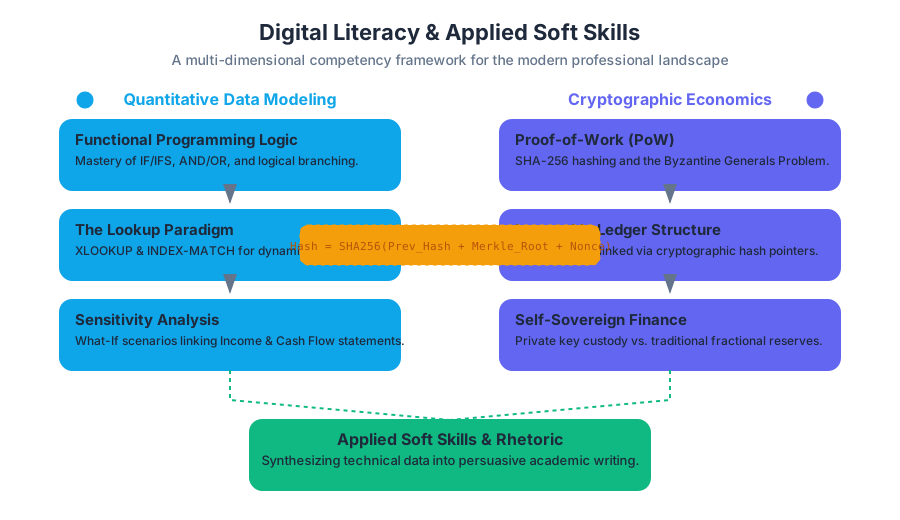
Digital literacy in the contemporary professional landscape transcends the mere ability to operate a computer. It represents a multi-dimensional competency framework that synthesizes quantitative analysis, cryptographic economic theory, and high-stakes communication. As the boundary between "technical" and "non-technical" roles continues to blur, the modern professional must master a stack that includes spreadsheet-driven data modeling, an understanding of decentralized financial protocols, and the rhetorical precision required for technical and academic writing.
Spreadsheet Operations and Quantitative Literacy
At the core of business intelligence and financial management lies the spreadsheet. While often perceived as a simple grid for data entry, modern spreadsheet software (Microsoft Excel, Google Sheets) serves as a Turing-complete environment for complex financial modeling, statistical analysis, and data visualization.
The Mechanics of Data Modeling
Spreadsheet operations are governed by the logic of functional programming. Every cell is a variable, and every formula is a function that maps inputs to outputs. Advanced literacy in this domain requires moving beyond basic arithmetic to master lookup logic, logical branching, and array manipulation.
Definition: The VLOOKUP/INDEX-MATCH Paradigm A lookup operation is a method of retrieving data from a specific column in a table based on a matching value in the first column. While
VLOOKUPis the legacy standard,INDEX-MATCH(and the newerXLOOKUP) provides superior flexibility by decoupling the return array from the lookup array, reducing computational overhead and preventing "broken" references during schema changes.
Comparison of Core Spreadsheet Functions
| Function Class | Examples | Complexity | Use Case |
|---|---|---|---|
| Logical | IF, AND, OR, IFS |
O(1) | Conditional formatting and branching logic. |
| Lookup | VLOOKUP, INDEX, MATCH, XLOOKUP |
O(n) or O(log n) | Joining disparate data sets based on unique identifiers. |
| Statistical | STDEV.P, CORREL, LINEST |
O(n) | Trend analysis and predictive modeling. |
| Financial | NPV, IRR, PMT |
Iterative | Calculating the time value of money and project viability. |
| Array Functions | FILTER, UNIQUE, SORT |
O(n log n) | Dynamic data manipulation without manual filtering. |
Implementation: Financial Statement Analysis
In a professional context, these tools are used to perform Financial Statement Analysis. By linking Income Statements, Balance Sheets, and Cash Flow Statements, an analyst can perform "What-If" scenarios to predict how a 5% increase in COGS (Cost of Goods Sold) impacts the company's terminal value.
import pandas as pd
import numpy as np

# A Pythonic representation of a Spreadsheet 'What-If' Analysis
def calculate_ebitda_sensitivity(revenue, cogs_ratio, opex_fixed):
    """
    Simulates spreadsheet logic for EBITDA sensitivity analysis.
    """
    revenue_range = np.linspace(revenue * 0.8, revenue * 1.2, 5)
    results = []

    for r in revenue_range:
        variable_costs = r * cogs_ratio
        ebitda = r - variable_costs - opex_fixed
        margin = ebitda / r
        results.append({'Revenue': r, 'EBITDA': ebitda, 'Margin': margin})

    return pd.DataFrame(results)

# Example: $1M Revenue, 40% COGS, $200k Fixed OPEX
analysis_df = calculate_ebitda_sensitivity(1000000, 0.40, 200000)
print(analysis_df)
Bitcoin Economics and Blockchain Technology
Bitcoin represents the intersection of computer science, cryptography, and Austrian economics. To understand Bitcoin is to understand the Byzantine Generals Problem—a fundamental challenge in distributed systems where participants must reach a consensus on a single truth without a central authority.
The Proof-of-Work (PoW) Mechanism
Bitcoin operates on a Proof-of-Work consensus algorithm. This is a cryptographic competition where "miners" use specialized hardware (ASICs) to find a hash that meets a specific difficulty target.
- Transaction Bundling: Transactions are gathered into a candidate block.
- Hashing: The block header is hashed using the SHA-256 algorithm.
- Nonce Iteration: Miners change a small variable (the
nonce) and re-hash until the resulting hash starts with a required number of zeros. - Propagation: The first miner to find the hash broadcasts it to the network for verification.
Bitcoin vs. Traditional Financial Systems
| Feature | Traditional Finance (TradFi) | Bitcoin (DeFi/Hard Money) |
|---|---|---|
| Issuance | Central Bank Discretion (Fiat) | Algorithmic (Capped at 21M) |
| Settlement | T+2 to T+5 Days (Interbank) | ~10-60 Minutes (On-chain) |
| Verification | Audited by Third Parties | Cryptographic (Nodes) |
| Custody | Fractional Reserve Banks | Self-Sovereign (Private Keys) |
| Governance | Regulatory/Political | Code-based / Consensus |
Technical Derivation: The Block Header
The security of the Bitcoin network relies on the immutability of the chain. Each block contains the hash of the previous block, creating a linked list where altering one record requires re-calculating every subsequent block—an economically impossible task.
\text{Block\_Hash} = \text{SHA-256}(\text{SHA-256}(\text{Version} + \text{Prev\_Block\_Hash} + \text{Merkle\_Root} + \text{Timestamp} + \text{Bits} + \text{Nonce}))
Common Pitfalls in Cryptocurrency
- Confusing Bitcoin with Blockchain: Blockchain is the ledger technology; Bitcoin is the specific implementation of decentralized money.
- Key Mismanagement: In Bitcoin, "Not your keys, not your coins." Losing a private key results in the permanent loss of assets, as there is no "password reset" in a decentralized system.
- Misunderstanding Volatility: Professional financial literacy requires distinguishing between price volatility (short-term fluctuation) and monetary debasement (long-term loss of purchasing power).
Professional Writing and Technical Communication
Digital literacy is incomplete without the ability to communicate complex ideas effectively. Professional writing is not merely about grammar; it is about rhetorical strategy—aligning the message with the audience's needs and the author's purpose.
The PWR Method: Prewrite, Write, Revise
The PWR Method is a structured approach to document creation that mirrors the software development lifecycle (SDLC).
- Prewriting: This stage involves Audience Analysis. Who is the stakeholder? What is their technical baseline? For a grant proposal, the audience is a review committee; for a technical manual, it is an end-user.
- Writing: Focus on the Four Keys to Good Writing:
- Unity: Every paragraph supports a single main idea.
- Support: Claims are backed by data or evidence.
- Coherence: Logical transitions connect ideas.
- Sentence Skills: Clarity, conciseness, and correct grammar.
- Revising: This is the "optimization" phase. It involves "killing your darlings"—removing unnecessary jargon and ensuring the document meets its objective.
Comparison of Writing Styles
| Style | Objective | Key Characteristics |
|---|---|---|
| Academic | Contribute to a body of knowledge. | Formal, heavily cited (MLA/APA), complex syntax. |
| Technical | Instruct or explain a process. | Imperative mood, bulleted lists, high clarity. |
| Business | Persuade or inform for decision-making. | "Bottom Line Up Front" (BLUF), concise, action-oriented. |
| Grant Writing | Secure funding for a project. | Highly structured, persuasive, evidence-based. |
Example: A Crisis Communication Plan (CCP)
In the event of an organizational failure (e.g., a data breach), a professional must execute a Crisis Communication Plan. This requires a blend of ethical communication and strategic messaging.
# A CLI-style checklist for Crisis Response Deployment
$ status --check-systems
$ identify --impact "Data Breach - 50k records"
$ draft --template "Stakeholder_Notification.md" --tone "Apologetic/Action-Oriented"
$ verify --legal-compliance --ethics-review
$ deploy --channels "Email, Press Release, Social Media"
Critical Thinking and Academic Disciplines
The synthesis of these skills occurs within the framework of Critical Thinking. Whether evaluating an artistic movement in Art History or analyzing a moral dilemma in Philosophy, the underlying cognitive process remains the same: the systematic evaluation of information to form a judgment.
Formal and Informal Logic
Professional decision-making relies on both Sentential Logic (the logic of "if-then" statements) and the avoidance of Informal Fallacies (e.g., Ad Hominem, Straw Man, or Sunk Cost Fallacy).
Key Insight: The Theory of Justice In business ethics, John Rawls' "Veil of Ignorance" suggests that a just system is one that we would agree to if we did not know our place in it. This philosophical framework is essential for developing Corporate Social Responsibility (CSR) programs and equitable HR policies.
The Five-Step System of Art Analysis
Even "soft" subjects like Art Appreciation utilize structured analytical systems. The five-step system—Description, Analysis, Context, Meaning, and Judgment—parallels the scientific method and the data analysis process:
- Description (Data Collection)
- Analysis (Pattern Recognition)
- Context (Environmental Variables)
- Meaning (Hypothesis Generation)
- Judgment (Conclusion/Decision)
Synthesis: The Integrated Professional
The modern professional does not use these skills in isolation. A successful project manager might use Spreadsheet Operations to track a budget, Bitcoin Technology to understand new payment rails, Professional Writing to draft the project charter, and Critical Thinking to navigate the ethical implications of the work.
The Workflow Pipeline
- Information Literacy: Researching the problem using academic databases and evaluating source credibility.
- Quantitative Analysis: Processing raw data into actionable insights via Excel.
- Strategic Communication: Presenting those insights to stakeholders using data visualization and the PWR method.
- Ethical Evaluation: Ensuring the solution aligns with moral philosophy and organizational values.
Common Pitfalls in Applied Skills
- The "Tool-First" Fallacy: Using a complex tool (like a blockchain) when a simple database would suffice. Always match the technology to the problem.
- Ignoring the Audience: Writing a technical report for an executive board without translating the jargon.
- Data Overload: Presenting a spreadsheet with 50 columns when the stakeholder only needs to see the net profit. Literacy includes the ability to filter information, not just generate it.
Quantitative and Natural Sciences
Key concepts: Algebraic Operations · Statistical Concepts · Scientific Method · Classical Mechanics
Foundational studies in mathematics, biology, chemistry, and physics to build scientific reasoning and mathematical rigor.
Quantitative and Natural Sciences
Overview
Finance is a quantitative discipline. This section builds the necessary mathematical and scientific background, from basic algebra to the laws of motion and thermodynamics.
Key Concepts
- Algebraic Thinking: Solving linear equations and understanding geometric relationships, essential for financial modeling.
- Statistics: The study of data interpretation and probability, which underpins risk assessment in finance.
- The Scientific Method: A systematic approach to problem-solving that can be applied to market hypotheses.
Why This Matters
Mathematical rigor is the foundation of the Time Value of Money and other core financial formulas.
Economic Theory and Social Context
Key concepts: Supply and Demand · Gross Domestic Product (GDP) · Austrian Economics · Sociological Imagination
An overview of microeconomics, macroeconomics, and the social structures that influence market behavior.
Economic Theory and Social Context
The study of economics and social context represents the intersection of human agency and systemic structure. To understand the financial landscape, one must look beyond mere balance sheets and delve into the mechanics of value creation, the metrics of national health, and the sociological frameworks that define our collective existence. This section provides a rigorous examination of the forces that govern resource allocation and the social lenses through which we interpret economic phenomena.
Supply and Demand: The Mechanics of Market Equilibrium
At the core of microeconomic theory lies the Law of Supply and Demand, a model of price determination in a market. It posits that, in a competitive market, the unit price for a particular good will vary until it settles at a point where the quantity demanded by consumers equals the quantity supplied by producers, resulting in an economic equilibrium.
The Mathematical Foundation
The relationship is typically modeled using linear or non-linear functions where quantity ($Q$) is a function of price ($P$).
- Demand Function: $Q_d = \alpha - \beta P$ (where $\beta > 0$, reflecting the inverse relationship between price and quantity demanded).
- Supply Function: $Q_s = \gamma + \delta P$ (where $\delta > 0$, reflecting the direct relationship between price and quantity supplied).
Equilibrium occurs where $Q_d = Q_s$. Solving for $P$ (Equilibrium Price, $P^$): $$\alpha - \beta P = \gamma + \delta P \implies P^ = \frac{\alpha - \gamma}{\beta + \delta}$$
Determinants and Elasticity
While price is the primary driver, other factors shift the entire curve. For demand, these include consumer income, tastes, and the price of substitutes/complements. For supply, they include input costs, technology, and expectations.
A critical concept here is Price Elasticity of Demand (PED), which measures the responsiveness of quantity demanded to a change in price: $$\epsilon_d = \frac{% \Delta Q_d}{% \Delta P} = \frac{dQ}{dP} \cdot \frac{P}{Q}$$
| Elasticity Type | Value | Description | Example |
|---|---|---|---|
| Perfectly Inelastic | $\epsilon = 0$ | Quantity demanded does not change with price. | Life-saving medication (Insulin). |
| Inelastic | $0 < \epsilon < 1$ | % change in $Q$ is less than % change in $P$. | Gasoline, salt, basic utilities. |
| Unitary | $\epsilon = 1$ | % change in $Q$ equals % change in $P$. | Theoretical benchmark. |
| Elastic | $\epsilon > 1$ | % change in $Q$ is greater than % change in $P$. | Luxury cars, specific brands of cereal. |
| Perfectly Elastic | $\epsilon = \infty$ | Any price increase drops demand to zero. | Pure commodities in a perfect market. |
Implementation: Market Clearing Simulation
In computational economics, we often need to find the equilibrium point for complex, non-linear supply and demand curves where analytical solutions are difficult.
import numpy as np
from scipy.optimize import fsolve

def market_system(p, alpha, beta, gamma, delta, exponent):
    """
    Defines a non-linear market system.
    Demand: Q = alpha * P^(-beta)
    Supply: Q = gamma + delta * P^exponent
    """
    demand = alpha * np.power(p, -beta)
    supply = gamma + delta * np.power(p, exponent)
    return demand - supply

# Parameters
alpha_val = 1000  # Demand constant
beta_val = 0.5    # Demand elasticity
gamma_val = 10    # Supply intercept
delta_val = 2     # Supply slope
exp_val = 1.2     # Supply curvature

# Initial guess for price
initial_p = 10.0

# Solve for Equilibrium Price (P*)
p_star = fsolve(market_system, initial_p, args=(alpha_val, beta_val, gamma_val, delta_val, exp_val))[0]
q_star = alpha_val * np.power(p_star, -beta_val)

print(f"Equilibrium Price: {p_star:.2f}")
print(f"Equilibrium Quantity: {q_star:.2f}")
Common Pitfalls
- Confusing Shifts with Movements: A change in price causes a movement along the curve (change in quantity demanded). A change in an external factor (like a sudden health craze for kale) causes a shift of the entire curve (change in demand).
- Ignoring Time Horizons: Demand is usually more elastic in the long run as consumers find substitutes.
Gross Domestic Product (GDP): Measuring National Output
Gross Domestic Product (GDP) is the total market value of all final goods and services produced within a country's borders in a specific time period. It serves as the primary scorecard of a nation’s economic health.
The Expenditure Approach
The most common way to calculate GDP is the expenditure method, which sums the spending by different sectors of the economy: $$Y = C + I + G + (X - M)$$
| Component | Symbol | Definition |
|---|---|---|
| Consumption | $C$ | Household spending on goods and services (excludes new housing). |
| Investment | $I$ | Business spending on capital, inventories, and household spending on new housing. |
| Government | $G$ | Spending on goods/services by all levels of government (excludes transfer payments). |
| Net Exports | $NX$ | Exports ($X$) minus Imports ($M$). |
Nominal vs. Real GDP
Because GDP is measured in currency, inflation can distort the figures.
- Nominal GDP: Measured in current prices.
- Real GDP: Adjusted for inflation using a base year’s prices.
- GDP Deflator: A price index used to convert nominal GDP to real GDP.
Derivation: The GDP Deflator
The relationship between Nominal and Real GDP is expressed as: $$\text{Real GDP} = \frac{\text{Nominal GDP}}{\text{GDP Deflator}} \times 100$$
ALGORITHM: Calculate_Real_GDP_and_Growth
-----------------------------------------
INPUT:
  - Price_List[Year_N, Year_0]
  - Quantity_List[Year_N, Year_0]

STEP 1: Calculate Nominal GDP (Year N)
  Nominal_GDP_N = Σ (Price_N * Quantity_N)

STEP 2: Calculate Real GDP (Year N at Year 0 Prices)
  Real_GDP_N = Σ (Price_0 * Quantity_N)

STEP 3: Calculate GDP Deflator
  Deflator = (Nominal_GDP_N / Real_GDP_N) * 100

STEP 4: Calculate Annual Growth Rate
  Growth = ((Real_GDP_N - Real_GDP_0) / Real_GDP_0) * 100

OUTPUT: Real_GDP, Deflator, Growth_Rate
Why GDP Matters (and its Limitations)
GDP is a measure of production, not well-being. It ignores:
- Non-market transactions: Volunteer work, domestic labor.
- The Underground Economy: Unreported income.
- Externalities: Environmental degradation caused by production.
- Inequality: GDP per capita is an average that can hide massive wealth gaps.
Austrian Economics: The Praxeological Approach
Austrian Economics is a school of economic thought that departs from the mathematical modeling of the Neoclassical school, emphasizing instead the logic of individual human action (Praxeology).
Key Tenets
- Methodological Individualism: Economic phenomena result from the subjective choices of individuals.
- Subjective Theory of Value: Value is not inherent in an object (like the labor required to make it) but is determined by the importance an individual places on it for the fulfillment of their ends.
- The Calculation Problem: Formulated by Ludwig von Mises and Friedrich Hayek, this argument states that a central planner cannot rationally allocate resources because they lack the price signals generated by private ownership and exchange.
The Market as a Discovery Procedure
Austrians view the market not as a static equilibrium but as a dynamic process. Prices are "knowledge signals" that encapsulate the dispersed, tacit information held by millions of individuals.
| Concept | Austrian View | Neoclassical View |
|---|---|---|
| Methodology | Deductive (Praxeology). | Inductive (Econometrics/Modeling). |
| Competition | A dynamic process of discovery. | A static state (Perfect Competition). |
| Interest Rates | Determined by Time Preference. | Determined by Supply/Demand of Loanable Funds. |
| Business Cycle | Caused by bank credit expansion (ABCT). | Caused by aggregate demand shocks. |
Worked Example: Time Preference and Interest
In Austrian theory, interest is the "agio" (premium) on present goods over future goods. If an individual has a high Time Preference, they value current consumption much more than future consumption, leading to higher natural interest rates. When a central bank artificially lowers rates by expanding the money supply, it creates a "mismatch" between consumer saving intentions and business investment, leading to Malinvestment (the root of the boom-bust cycle).
Modeling Decentralized Knowledge
To illustrate the Austrian concept of local knowledge, consider a decentralized system where agents only know their immediate environment, yet a global order emerges.
// A simplified model of an Austrian Market Agent
// demonstrating local knowledge and subjective valuation.

struct MarketAgent {
    id: u32,
    inventory: f64,
    subjective_value: f64, // How much the agent values the good
}

impl MarketAgent {
    fn evaluate_bid(&self, offer_price: f64) -> bool {
        // An agent only trades if the price exceeds their
        // subjective valuation (marginal utility).
        offer_price > self.subjective_value
    }

    fn update_valuation(&mut self, market_signal: f64) {
        // Agents adjust based on local signals, not global data.
        self.subjective_value = (self.subjective_value + market_signal) / 2.0;
    }
}

fn main() {
    let mut agent_801 = MarketAgent { id: 801, inventory: 10.0, subjective_value: 50.0 };
    let market_price = 55.0;

    if agent_801.evaluate_bid(market_price) {
        println!("Agent {} accepts the trade based on subjective utility.", agent_801.id);
    } else {
        println!("Agent {} rejects the trade; price is below subjective value.", agent_801.id);
    }
}
Sociological Imagination: The Social Context of Economics
While economics often treats individuals as rational utility-maximizers, sociology reminds us that these individuals exist within a web of social structures. C. Wright Mills’ Sociological Imagination is the ability to see the connection between "personal troubles" and "public issues."
Personal Troubles vs. Public Issues
- Personal Trouble: An individual loses their job because they were late to work.
- Public Issue: 15% of the national workforce is unemployed due to a structural shift in manufacturing.
The Sociological Imagination forces us to look at the Social Stratification—the hierarchical arrangement of individuals into social classes, castes, or strata—that dictates economic opportunity.
Frameworks of Analysis
Sociologists use different lenses to view the economy:
- Structural Functionalism: The economy is a subsystem that provides for the physical needs of society. Inequality is "functional" because it incentivizes the most talented people to fill the most difficult roles.
- Conflict Theory: The economy is an arena of struggle between the powerful (who own the means of production) and the powerless (who provide labor). Economic structures are designed to maintain the status quo.
- Symbolic Interactionism: Economic reality is "socially constructed" through daily interactions. Concepts like "money," "debt," or "career" only have meaning because we collectively agree they do.
| Perspective | View of Economic Inequality | Key Focus |
|---|---|---|
| Functionalism | Necessary for social stability. | Meritocracy and role allocation. |
| Conflict Theory | Result of exploitation. | Power dynamics and class struggle. |
| Interactionism | Result of social labeling. | Meaning of work and consumption. |
The Impact of Social Capital
Economic success is not merely a product of financial capital (money) or human capital (skills). It is also driven by Social Capital—the networks of relationships that provide access to information and opportunities. A "Sociological Imagination" reveals that an individual's "choice" to enter a high-paying field is often constrained or enabled by their social network and cultural upbringing.
Synthesis: The Integrated Economic Landscape
Understanding the "Economic Theory and Social Context" requires a multi-disciplinary approach.
- Microeconomics provides the tools to understand price and choice.
- Macroeconomics (GDP) provides the metrics for systemic health.
- Austrian Economics provides a warning against the limits of centralized knowledge and the importance of subjective value.
- Sociological Imagination provides the context, reminding us that economic actors are social beings influenced by history and structure.
Comparative Summary of Economic Indicators
| Indicator | Focus | Primary Use | Major Critique |
|---|---|---|---|
| GDP | Aggregate Production | Policy planning, international ranking. | Ignores distribution and quality of life. |
| CPI (Inflation) | Purchasing Power | Adjusting wages and interest rates. | Substitution bias; quality changes. |
| Unemployment Rate | Labor Market | Assessing economic slack. | Misses "discouraged workers" and underemployment. |
| Gini Coefficient | Wealth Distribution | Measuring inequality. | Does not show absolute wealth levels. |
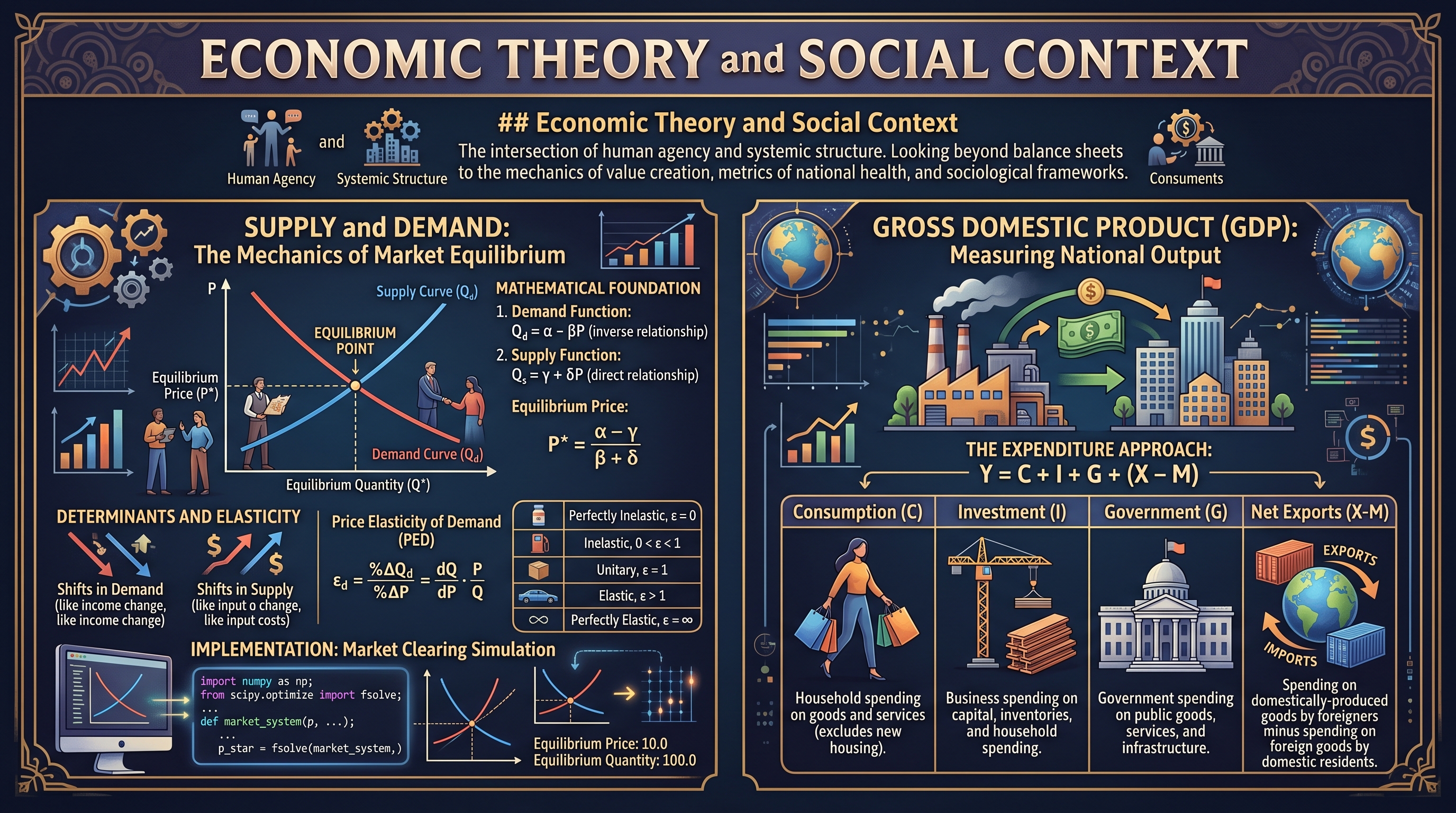
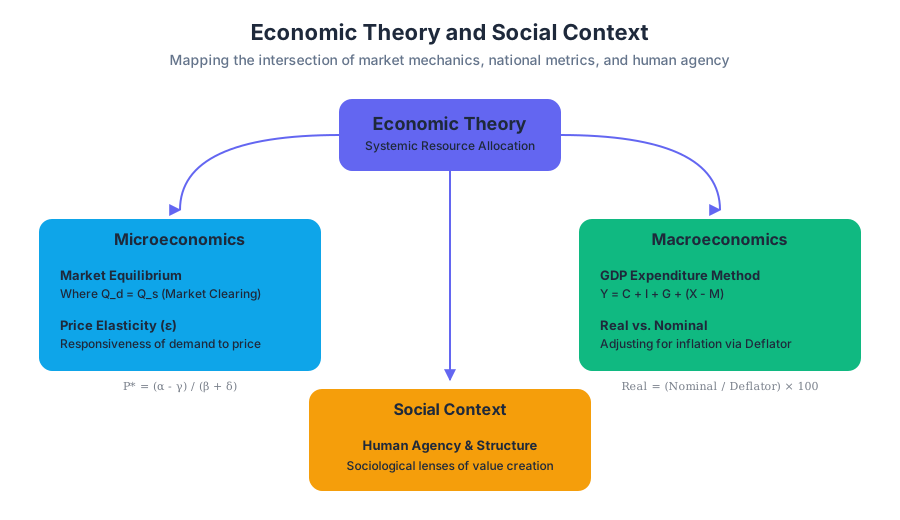
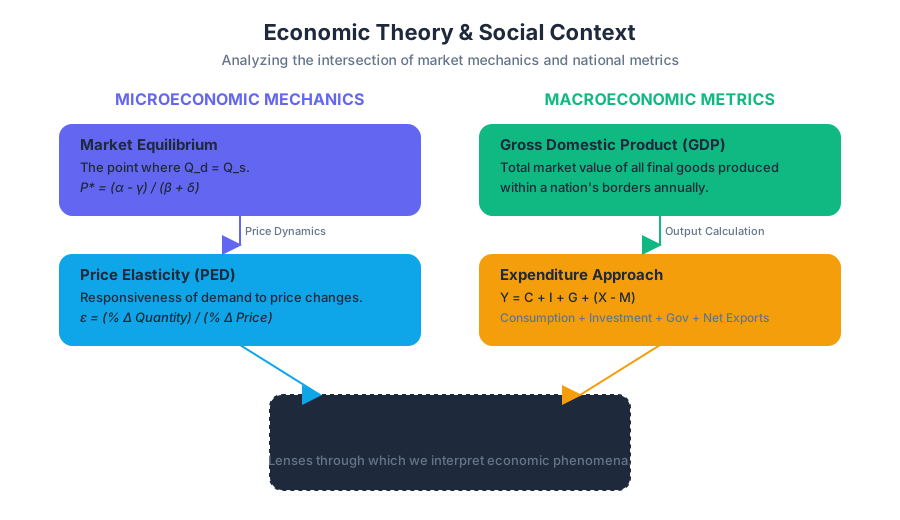
Global Perspectives and Human Behavior
Key concepts: Globalization · Political Ideologies · Nature vs. Nurture · Industrialization
Explores geography, history, and psychology to understand the global and individual drivers of political and economic change.
Global Perspectives and Human Behavior
Overview
To navigate the complexities of the modern world—whether in finance, technology, or the arts—one must synthesize regional geography, historical power dynamics, and the psychological drivers of human behavior. This section explores the intersection of global systems and individual action, examining how macro-level forces like Globalization and Industrialization collide with micro-level realities such as Political Ideologies and the Nature vs. Nurture debate.
Understanding these concepts requires a multi-disciplinary approach, drawing from the analytical rigor of Philosophy, the strategic frameworks of Business Administration, and the expressive power of Art History and Communication.
Globalization: The Compression of Time and Space
Globalization refers to the increasing integration of economies, cultures, and populations across the globe, driven by international trade, technological advancement, and the flow of information. It is not merely an economic phenomenon but a spatial restructuring that alters how humans perceive distance and community.
The Mechanics of Global Integration
Globalization operates through several vectors, often categorized into economic, political, and cultural dimensions. In the context of Business Administration, globalization is measured through economic indicators and the "Marketing Mix" (Product, Price, Place, Promotion) adapted for multicultural audiences.
Definition: The Gravity Model of Trade The Gravity Model predicts bilateral trade flows based on the economic sizes (GDP) of two entities and the distance between them. Mathematically, it is expressed as: $F_{ij} = G \frac{M_i M_j}{D_{ij}}$ Where $F$ is the trade flow, $M$ represents the economic mass, $D$ is the distance, and $G$ is a constant.
Dimensions of Globalization
| Dimension | Key Drivers | Primary Outcome |
|---|---|---|
| Economic | Free trade agreements, MNCs, FDI | Global supply chains and market interdependence. |
| Cultural | Digital media, tourism, English as a Lingua Franca | "Glocalization" (local adaptation of global trends). |
| Political | Intergovernmental organizations (UN, WTO, EU) | Shift of sovereignty from nation-states to global bodies. |
| Technological | Internet, blockchain, rapid transport | Near-instantaneous data transfer and reduced "friction." |
Implementation: Measuring Economic Openness
To analyze a nation's position within the global framework, economists often use Python to process trade datasets.
import pandas as pd
import numpy as np

def calculate_trade_openness(exports, imports, gdp):
    """
    Calculates the Trade Openness Index for a given nation.
    Formula: (Total Exports + Total Imports) / GDP
    """
    if gdp <= 0:
        raise ValueError("GDP must be a positive non-zero value.")

    total_trade = exports + imports
    openness_index = total_trade / gdp

    return {
        "total_trade_volume": total_trade,
        "openness_index": round(openness_index, 4),
        "percentage": f"{round(openness_index * 100, 2)}%"
    }

# Example: Analyzing a hypothetical emerging market
data = {
    'country': 'Aethelgard',
    'exports': 450_000_000,
    'imports': 380_000_000,
    'gdp': 1_200_000_000
}

result = calculate_trade_openness(data['exports'], data['imports'], data['gdp'])
print(f"Trade Analysis for {data['country']}: {result}")
Political Ideologies and the Nation-State
The Nation-State remains the primary unit of global governance, yet its authority is defined and contested by various Political Ideologies. These ideologies provide the moral and philosophical framework for how power is distributed and how justice is defined.
Power, Legitimacy, and Authority
In Moral and Political Philosophy, a distinction is made between power (the ability to influence) and authority (the recognized right to rule). Legitimacy is the bridge between the two.
- Liberalism: Emphasizes individual rights, democracy, and free markets.
- Realism: Views the international system as anarchic, where states must prioritize security and self-interest.
- Marxism: Analyzes global relations through the lens of class struggle and economic exploitation.
- Constructivism: Suggests that international relations are socially constructed through shared ideas and identities.
Formal Logic in Political Discourse
Political arguments often rely on Sentential Logic to establish validity. Philosophers use these tools to deconstruct policy positions and ethical claims.
Premise 1 (P): If a state provides security, it gains legitimacy.
Premise 2 (Q): The state provides security.
Conclusion (R): Therefore, the state is legitimate.

Symbolic Representation:
(P → Q)
P
∴ Q (Modus Ponens)

Truth Table for Implication (P → Q):
| P | Q | P → Q |
|---|---|-------|
| T | T |   T   |
| T | F |   F   |
| F | T |   T   |
| F | F |   T   |
Comparative Political Frameworks
| Ideology | View of Human Nature | Role of State | Key Philosophers |
|---|---|---|---|
| Hobbesian Realism | Competitive/Selfish | Absolute Sovereign (Leviathan) | Thomas Hobbes |
| Lockean Liberalism | Rational/Cooperative | Protector of Natural Rights | John Locke |
| Existentialism | Radically Free | Secondary to Individual Choice | Sartre, Camus |
| Social Justice | Socially Contingent | Redstributor of Equity | John Rawls |
Nature vs. Nurture: The Behavioral Foundations
At the core of human behavior lies the debate between Nature (biological/genetic determinants) and Nurture (environmental/social influences). This dichotomy influences everything from Interpersonal Communication to Consumer Behavior.
The Biological Basis of Behavior
Behavioral psychology examines how neurobiology and evolutionary traits drive decision-making. In finance, this manifests as "market irrationality," where biological fight-or-flight responses override rational analysis.
The Social Construct and Communication
Conversely, the Nurture perspective emphasizes that human behavior is learned through social interaction. Communication Theory suggests that our reality is co-created through symbols and language.
- Audience Analysis: Understanding the cultural and environmental background of a receiver to ensure the message is decoded as intended.
- Multicultural Messaging: Adapting communication strategies to account for high-context vs. low-context cultures.
The Five-Step System of Analysis (Art History Context) When evaluating human expression (Art), we use a structured approach that bridges nature (perception) and nurture (context):
- Description: Purely visual/sensory input.
- Analysis: How the elements are organized.
- Context: Historical and social environment.
- Meaning: The intended or perceived message.
- Judgment: Critical evaluation of success.
Nature vs. Nurture in Learning and Success
In College Success strategies, the focus is often on moving from a "fixed mindset" (nature-dominant) to a "growth mindset" (nurture-dominant). This involves mastering Information Literacy and Critical Thinking to reshape one's cognitive environment.
Industrialization and the Technological Shift
Industrialization is the historical process of transforming an economy from primarily agricultural to one based on the manufacturing of goods. This shift has not only altered economic structures but also redefined human labor, art, and communication.
The Four Industrial Revolutions
The progression of industrialization is often categorized into four distinct phases, each marked by a "General Purpose Technology."
| Phase | Key Technology | Impact on Human Behavior |
|---|---|---|
| 1st (1760s) | Steam Engine, Mechanization | Urbanization; shift from home to factory. |
| 2nd (1870s) | Electricity, Assembly Line | Mass production; rise of consumer culture. |
| 3rd (1960s) | Computers, Automation | The Information Age; globalization of services. |
| 4th (Present) | AI, IoT, Cyber-Physical Systems | Hyper-connectivity; blurring of physical/digital. |
Industrialization of Knowledge: Computer Science and Technical Writing
In the modern era, industrialization has moved into the realm of "knowledge work." The principles of the assembly line are now applied to software development through Object-Oriented Programming (OOP) and Data Structures, and to documentation through Technical Writing.
Technical Communication requires a focus on:
- Unity: Every part of the document supports one main idea.
- Support: Providing evidence and data for claims.
- Coherence: Logical flow between concepts.
- Sentence-level Skills: Precision in grammar and syntax to avoid ambiguity.
Real-World Usage: The Modern Assembly Line (CI/CD)
In software "industrialization," the manual process of building and testing is replaced by automated pipelines. This is the digital equivalent of the 2nd Industrial Revolution's assembly line.
# Example of a Modern Industrialized Workflow (GitHub Actions)
name: Global_Deployment_Pipeline

on:
  push:
    branches: [ main ]

jobs:
  build-and-test:
    runs-on: ubuntu-latest
    steps:
      - name: Checkout Code
        uses: actions/checkout@v3

      - name: Set up Python Environment
        uses: actions/setup-python@v4
        with:
          python-version: '3.10'

      - name: Install Dependencies
        run: |
          python -m pip install --upgrade pip
          pip install -r requirements.txt

      - name: Execute Logic Validation
        run: |
          pytest tests/test_political_logic.py
          pytest tests/test_economic_models.py

      - name: Deploy to Global Edge Nodes
        run: echo "Deploying to AWS/Azure regions..."
Synthesis: The Global Human
The intersection of these concepts creates a complex landscape for the modern professional. A successful leader must be a "Global Human"—someone who understands the Economic Indicators of globalization, the Ethical Responsibility of political ideologies, the Psychological Drivers of behavior, and the Technological Frameworks of industrialization.
Common Pitfalls in Global Analysis
- Ethnocentrism: Assuming one's own cultural "nurture" is the universal "nature."
- Reductionism: Attributing complex global shifts to a single cause (e.g., "it's only about the economy").
- Anachronism: Applying modern political ideologies to historical contexts without adjustment.
- Ignoring the "Digital Divide": Assuming globalization and industrialization have reached all populations equally.
- Globalization: The integration of world economies and cultures.
- Nation-State: A sovereign territory inhabited by a relatively homogeneous group of people who share a feeling of common nationality.
- Sentential Logic: A branch of logic that deals with propositions and their logical relationships.
- Existentialism: A philosophical theory that emphasizes the existence of the individual person as a free and responsible agent.
- Marketing Mix: The set of actions (Product, Price, Place, Promotion) that a company uses to promote its brand or product.
- CEFR: Common European Framework of Reference for Languages, used to describe language proficiency.
- MLA Citation: Modern Language Association style for documenting sources in academic writing.
- Gini Coefficient: A statistical measure of distribution intended to represent the income or wealth inequality within a nation.
-
Which component of the Gravity Model of Trade is inversely proportional to the trade flow between two countries?
- A) GDP of Country A
- B) GDP of Country B
- C) Distance between the countries
- D) The constant G
-
In the context of Art History, which step of the Five-Step System involves looking at the historical and social environment of the work?
- A) Description
- B) Analysis
- C) Context
- D) Judgment
-
Which Industrial Revolution is characterized by the rise of Artificial Intelligence and the Internet of Things (IoT)?
- A) First
- B) Second
- C) Third
- D) Fourth
-
True or False: Existentialism argues that human nature is biologically predetermined and unchangeable.
- (Answer: False. Existentialism emphasizes radical freedom and choice.)
-
Which political ideology suggests that the international system is inherently anarchic and states must prioritize their own security?
- A) Liberalism
- B) Realism
- C) Marxism
- D) Constructivism
Key Learning Objectives
- Synthesize Global Trends: Be able to explain how economic globalization influences local cultural production (Art and Communication).
- Apply Logical Frameworks: Use sentential logic to evaluate the validity of political and ethical arguments.
- Analyze Human Behavior: Distinguish between biological drivers (Nature) and social constructs (Nurture) in professional settings.
- Master Professional Communication: Implement the PWR-Writing Method (Prewrite, Write, Revise) to create coherent technical and business documents.
- Navigate Industrial Shifts: Understand the historical progression of industrialization and its impact on modern software development and data management.
Recommended Review
- Review ARTH101 for the Five-Step System of Analysis to improve critical observation skills.
- Study PHIL102 (Moral and Political Philosophy) to deepen understanding of justice and legitimacy.
- Practice CS101 logic exercises to sharpen analytical thinking for complex problem-solving.
- Revisit BUS101 economic indicators to ground global perspectives in quantitative data.
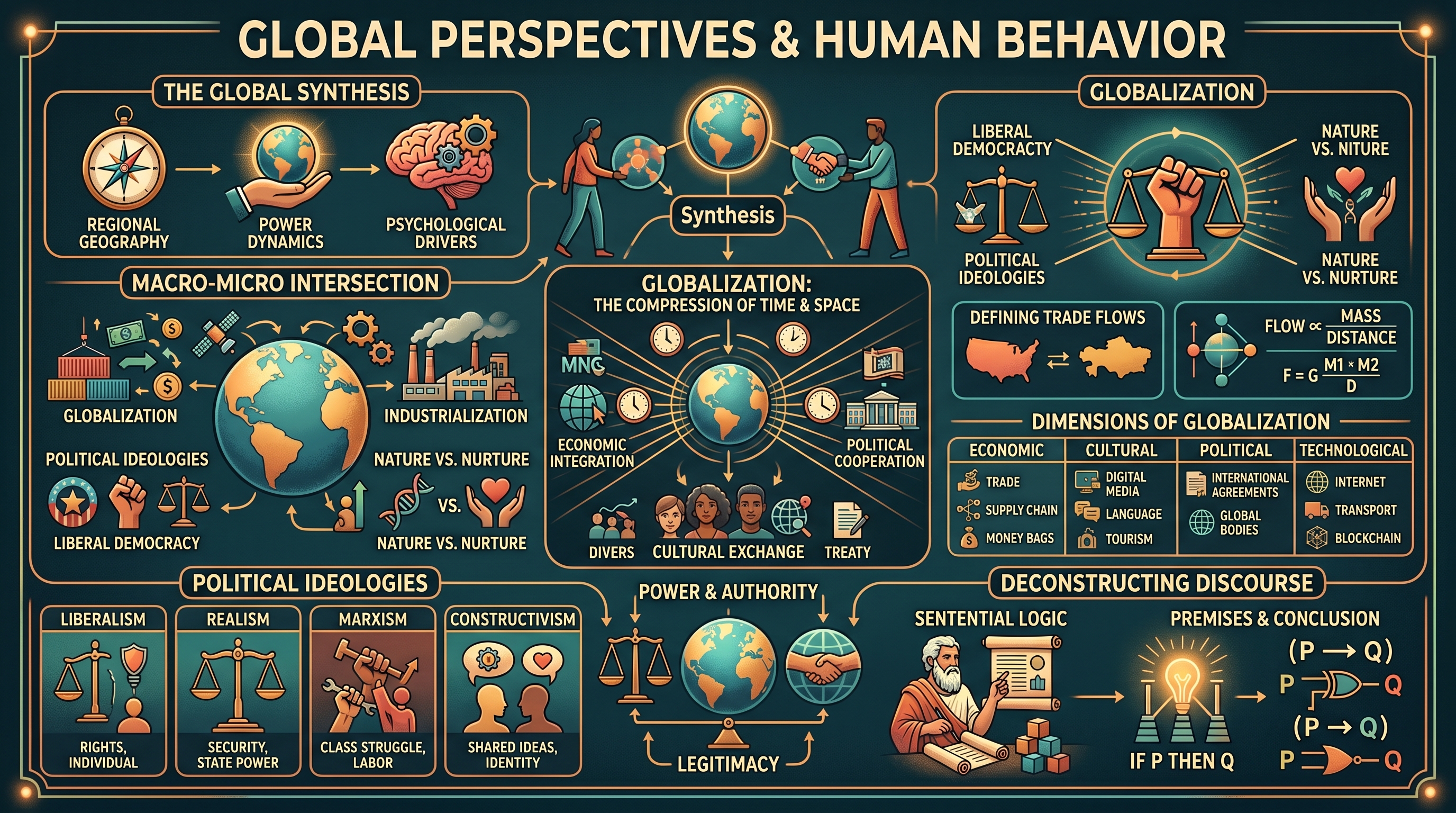
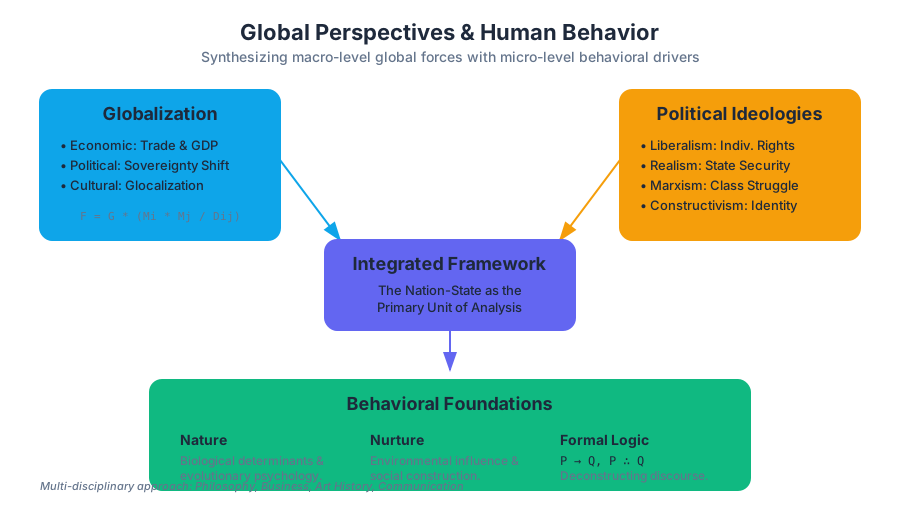
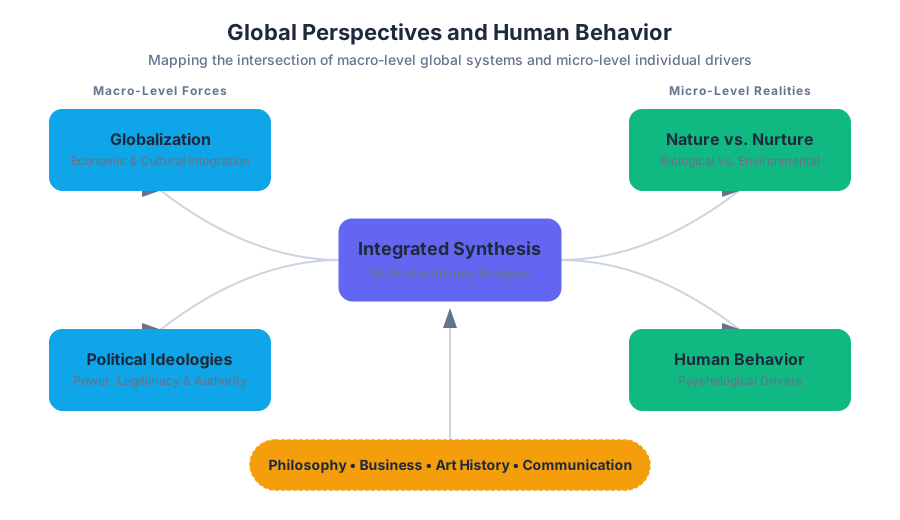
BUS202: Principles of Finance
Key concepts: Maximize Shareholder Wealth · Time Value of Money (TVM) · Financial Statement Analysis · Agency Theory · Corporate Governance
The core course content focusing on wealth maximization, financial analysis, and the time value of money.
BUS202: Principles of Finance
Finance is often described as the "science of money management." While accounting focuses on the historical recording of transactions (the "scorekeeping" of business), finance is inherently forward-looking. It is the study of how individuals and institutions allocate resources over time, accounting for the risks and uncertainties inherent in the future. In the context of BUS202, we transition from understanding what happened in the past to making strategic decisions that determine the future value of a firm.
Maximize Shareholder Wealth
In the classical theory of the firm, the primary objective of financial management is to Maximize Shareholder Wealth. This is specifically defined as maximizing the current market value of the firm's outstanding common stock.
What it is
Unlike "profit maximization," which can be manipulated by accounting choices and ignores the timing of returns, shareholder wealth maximization focuses on the Net Present Value (NPV) of all expected future cash flows. It accounts for the magnitude, timing, and risk of those cash flows.
Why it matters
Profit maximization is a flawed goal for several reasons:
- Timing: It doesn't distinguish between receiving $1 million today versus $1 million in ten years.
- Cash Flow vs. Profit: Accounting profits do not equal cash available to pay dividends or reinvest.
- Risk: It ignores the volatility of earnings. A high-profit project with a 50% chance of bankruptcy is often worse than a lower-profit, stable project.
How it works
The market price of a stock serves as a continuous "report card" on management's performance. When managers make decisions that increase the expected future cash flows or decrease the firm's risk (cost of capital), the stock price rises.
| Goal | Focus | Consideration of Risk | Consideration of Timing |
|---|---|---|---|
| Profit Maximization | Earnings Per Share (EPS) | No | No |
| Wealth Maximization | Share Price / Market Cap | Yes | Yes |
Common Pitfalls: Short-termism
A common mistake is confusing wealth maximization with short-term stock price manipulation. True wealth maximization involves sustainable, long-term value creation. Cutting R&D to boost this quarter's earnings might raise the stock price temporarily, but it destroys long-term shareholder wealth.
Time Value of Money (TVM)
The Time Value of Money (TVM) is the most fundamental concept in finance. It states that a dollar received today is worth more than a dollar received in the future because of its potential earning capacity.
What it is
TVM is the mathematical framework used to compare cash flows occurring at different points in time. The core variables are:
- PV (Present Value): The current value of a future sum.
- FV (Future Value): The value of a current sum at a specific date in the future.
- r (Interest Rate/Discount Rate): The cost of capital or opportunity cost.
- n (Number of Periods): The time horizon.
How it works: The Mechanics of Compounding and Discounting
Compounding moves money forward in time (finding FV), while discounting moves money backward in time (finding PV).
The Fundamental Theorem of TVM: $$FV = PV \times (1 + r)^n$$ $$PV = \frac{FV}{(1 + r)^n}$$
Code Example: Financial Solver Implementation
The following Python implementation demonstrates a robust TVM solver capable of handling compounding frequencies and solving for different variables.
import math

class TVMSolver:
    """
    A high-level financial solver for Time Value of Money calculations.
    Supports discrete compounding.
    """
    @staticmethod
    def future_value(pv, r, n, compounding_periods=1):
        """Calculates FV = PV * (1 + r/m)^(n*m)"""
        return pv * (1 + r/compounding_periods)**(n * compounding_periods)

    @staticmethod
    def present_value(fv, r, n, compounding_periods=1):
        """Calculates PV = FV / (1 + r/m)^(n*m)"""
        return fv / (1 + r/compounding_periods)**(n * compounding_periods)

    @staticmethod
    def calculate_ear(apr, m):
        """
        Converts Annual Percentage Rate (APR) to Effective Annual Rate (EAR).
        EAR = (1 + APR/m)^m - 1
        """
        return (1 + apr/m)**m - 1

# Example: $10,000 invested for 5 years at 8% APR compounded quarterly
solver = TVMSolver()
fv_amount = solver.future_value(pv=10000, r=0.08, n=5, compounding_periods=4)
print(f"Future Value: ${fv_amount:,.2f}") # Output: $14,859.47
Mathematical Derivation: The Perpetuity Formula
A perpetuity is a constant stream of identical cash flows that continues forever. To derive its present value, we use the sum of a geometric series:
PV = \sum_{t=1}^{\infty} \frac{C}{(1+r)^t}
PV = C \left[ \frac{1}{(1+r)} + \frac{1}{(1+r)^2} + \frac{1}{(1+r)^3} + \dots \right]
This is a geometric series with first term a = C/(1+r) and ratio k = 1/(1+r).
The sum S = a / (1 - k)
PV = \frac{C/(1+r)}{1 - 1/(1+r)}
PV = \frac{C/(1+r)}{(r/(1+r))}
PV = \frac{C}{r}
Financial Statement Analysis
Financial Statement Analysis involves evaluating a firm's past, present, and projected performance through the lens of its financial reports (Balance Sheet, Income Statement, and Cash Flow Statement).
What it is
We use Ratio Analysis to standardize financial data, allowing for comparisons across time (trend analysis) and across different firms (benchmarking).
Major Ratio Categories
Financial analysts typically group ratios into five categories:
| Category | Purpose | Key Metric | Formula |
|---|---|---|---|
| Liquidity | Ability to meet short-term obligations | Current Ratio | Current Assets / Current Liabilities |
| Asset Mgmt | Efficiency of asset utilization | Inventory Turnover | COGS / Average Inventory |
| Solvency | Long-term debt-paying ability | Debt-to-Equity | Total Debt / Total Equity |
| Profitability | Effectiveness of generating returns | Net Profit Margin | Net Income / Sales |
| Market Value | Stock price relative to fundamentals | P/E Ratio | Price per Share / Earnings per Share |
The DuPont System
The DuPont Analysis is a powerful diagnostic tool that breaks down Return on Equity (ROE) into three component parts to identify the source of a firm's performance.
ROE = Profit Margin × Total Asset Turnover × Equity Multiplier
- Profit Margin: Operating efficiency.
- Total Asset Turnover: Asset use efficiency.
- Equity Multiplier: Financial leverage.
Real-World Usage: SQL for Financial Auditing
In modern corporate environments, analysts often query data warehouses to generate these ratios dynamically.
-- Calculating Liquidity and Profitability Ratios from a standardized schema
WITH FinancialData AS (
    SELECT
        company_id,
        fiscal_year,
        SUM(CASE WHEN account_type = 'Current Asset' THEN balance ELSE 0 END) as total_ca,
        SUM(CASE WHEN account_type = 'Current Liability' THEN balance ELSE 0 END) as total_cl,
        SUM(CASE WHEN account_name = 'Net Income' THEN balance ELSE 0 END) as net_income,
        SUM(CASE WHEN account_name = 'Revenue' THEN balance ELSE 0 END) as total_revenue
    FROM general_ledger
    WHERE fiscal_year = 2023
    GROUP BY company_id, fiscal_year
)
SELECT
    company_id,
    total_ca / NULLIF(total_cl, 0) AS current_ratio,
    net_income / NULLIF(total_revenue, 0) AS profit_margin
FROM FinancialData;
Agency Theory and Corporate Governance
In large corporations, there is a separation of ownership and control. Shareholders own the firm, but professional managers run it. This separation leads to the Principal-Agent Problem.
What it is
Agency Theory explores the conflicts of interest between the Principal (shareholders) and the Agent (managers). Managers may be tempted to act in their own best interests (e.g., excessive perks, empire building) rather than maximizing shareholder wealth.
Agency Costs
These are the costs incurred to align the interests of the two parties:
- Monitoring Costs: Auditing, reporting, and board oversight.
- Bonding Costs: Insurance or structures that protect the principal.
- Residual Loss: The inherent inefficiency that remains because interests can never be perfectly aligned.
Corporate Governance Mechanisms
Corporate Governance is the system of rules and processes used to direct and control the firm.
- Internal Mechanisms:
- Board of Directors: Elected by shareholders to oversee management.
- Executive Compensation: Using stock options and performance bonuses to align incentives.
- External Mechanisms:
- The Market for Corporate Control: The threat of a hostile takeover if the stock price is undervalued due to poor management.
- Regulatory Environment: Laws like Sarbanes-Oxley (SOX) that mandate transparency.
Common Pitfalls: Information Asymmetry
A major hurdle in governance is Information Asymmetry, where managers possess more or better information than shareholders. This allows for "moral hazard," where managers take risks because the shareholders bear the cost of failure.
Synthesis: The Capital Budgeting Process
All the concepts above culminate in Capital Budgeting—the process of planning and managing a firm's long-term investments.
- Identify Opportunities: Managers look for projects that align with the firm's strategy.
- Estimate Cash Flows: Using financial analysis to project incremental cash flows (not accounting profits).
- Apply TVM: Discount those cash flows at the firm's Weighted Average Cost of Capital (WACC).
- Decision Rule: If the Net Present Value (NPV) > 0, the project is expected to increase shareholder wealth.
| Method | Decision Rule | Pros | Cons |
|---|---|---|---|
| NPV | Accept if > 0 | Accounts for TVM and Risk | Requires accurate WACC |
| IRR | Accept if > WACC | Intuitive (percentage return) | Can give multiple answers for non-normal cash flows |
| Payback | Accept if < X years | Simple, focuses on liquidity | Ignores TVM and cash flows after the cutoff |
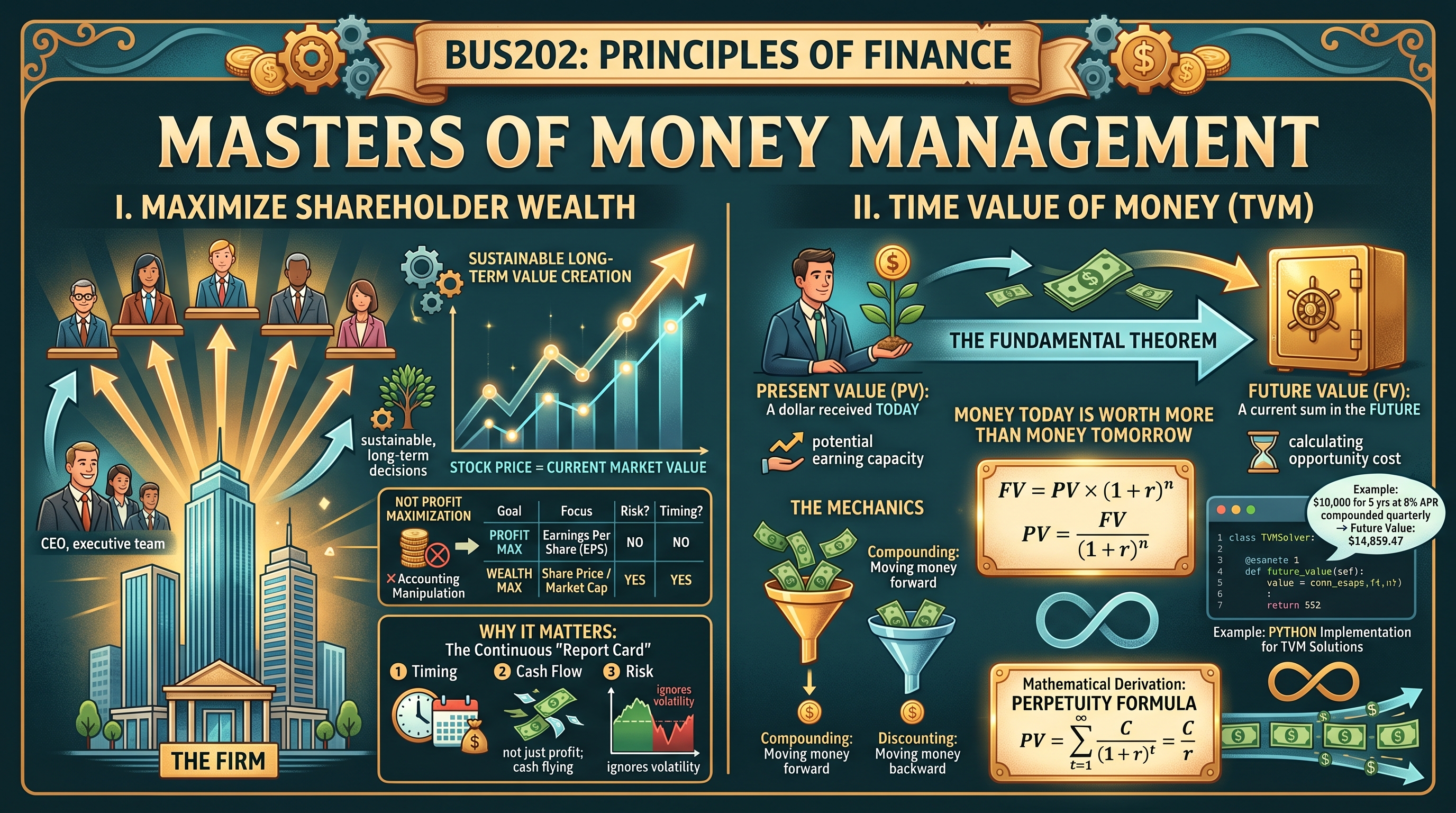
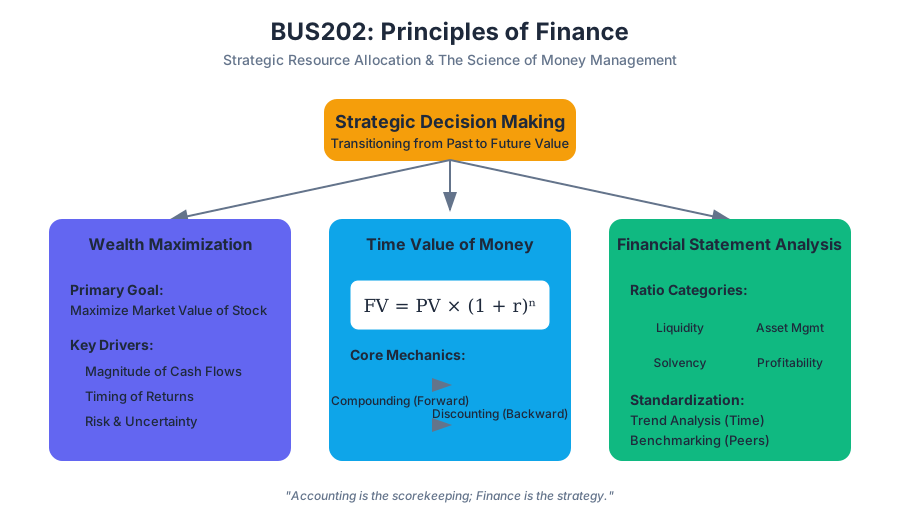
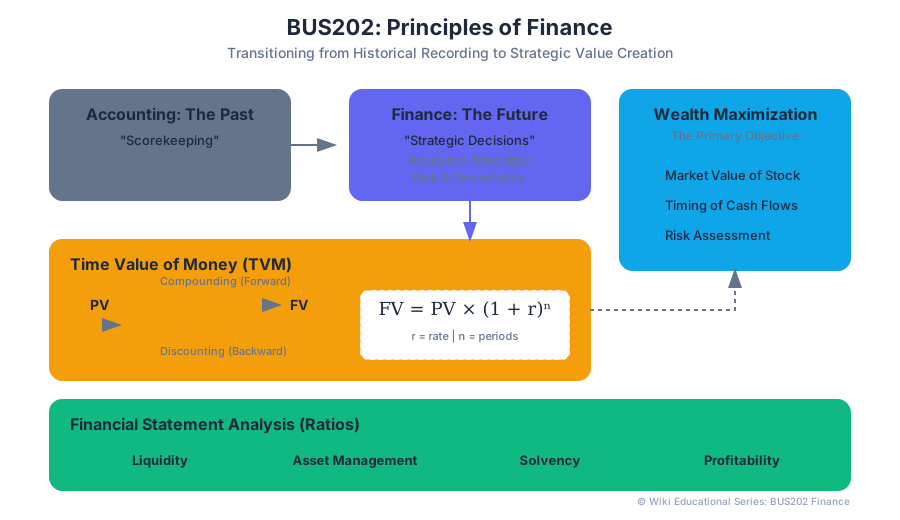
Source Materials
Study Interdisciplinary Foundations of Academic and Professional Literacy with AI — Free on Lykke
Sign up for free to generate personalized flashcards, quizzes, and study guides from this course. Chat with an AI tutor that knows the material.
Get Started FreeView this course wiki on Lykke · Browse all public course wikis