From the free course Interdisciplinary Foundations of Academic and Professional Literacy on Lykke
Economic Theory and Social Context
Key concepts: Supply and Demand · Gross Domestic Product (GDP) · Austrian Economics · Sociological Imagination
An overview of microeconomics, macroeconomics, and the social structures that influence market behavior.
Economic Theory and Social Context
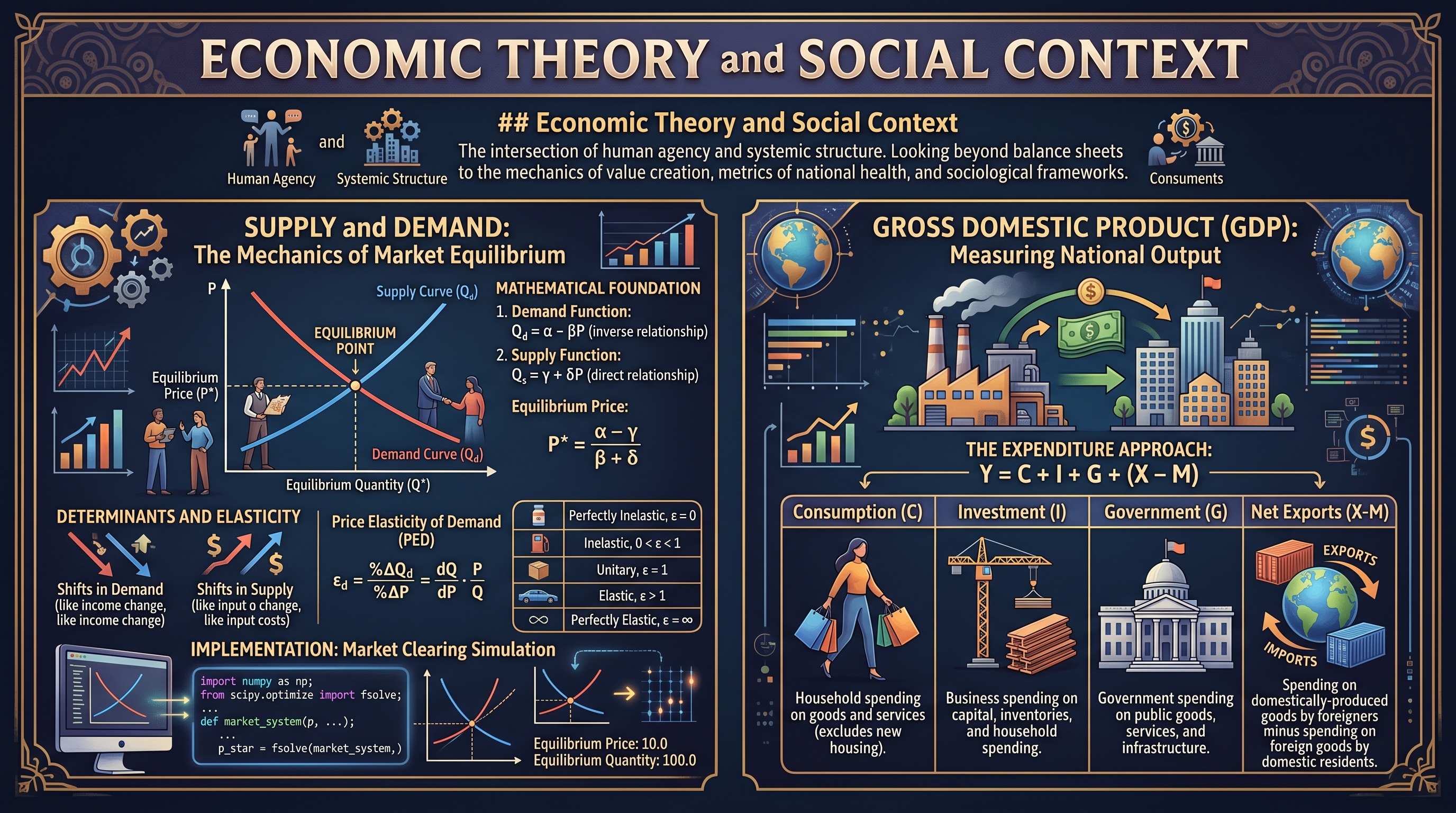
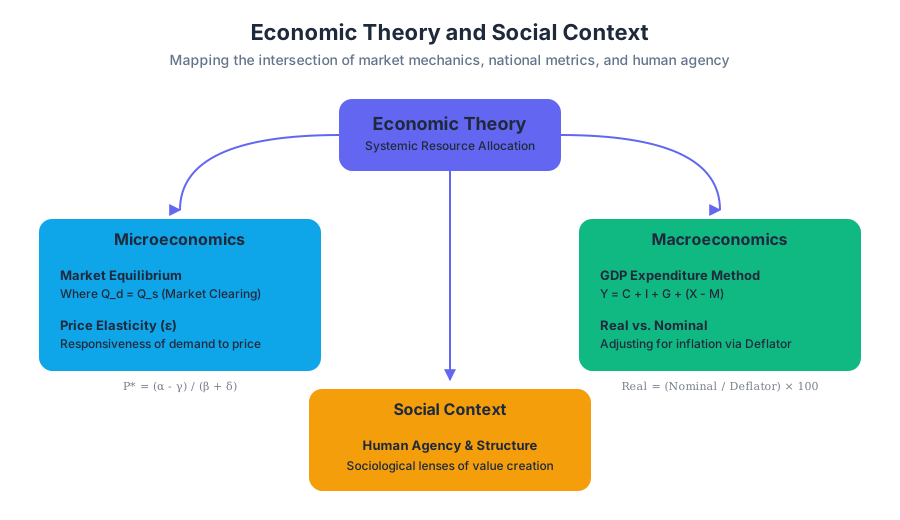
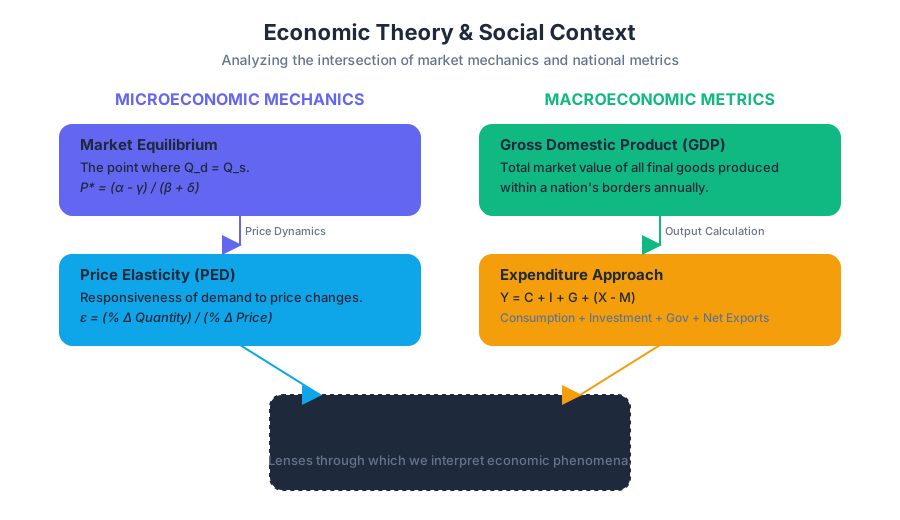
The study of economics and social context represents the intersection of human agency and systemic structure. To understand the financial landscape, one must look beyond mere balance sheets and delve into the mechanics of value creation, the metrics of national health, and the sociological frameworks that define our collective existence. This section provides a rigorous examination of the forces that govern resource allocation and the social lenses through which we interpret economic phenomena.
Supply and Demand: The Mechanics of Market Equilibrium
At the core of microeconomic theory lies the Law of Supply and Demand, a model of price determination in a market. It posits that, in a competitive market, the unit price for a particular good will vary until it settles at a point where the quantity demanded by consumers equals the quantity supplied by producers, resulting in an economic equilibrium.
The Mathematical Foundation
The relationship is typically modeled using linear or non-linear functions where quantity ($Q$) is a function of price ($P$).
- Demand Function: $Q_d = \alpha - \beta P$ (where $\beta > 0$, reflecting the inverse relationship between price and quantity demanded).
- Supply Function: $Q_s = \gamma + \delta P$ (where $\delta > 0$, reflecting the direct relationship between price and quantity supplied).
Equilibrium occurs where $Q_d = Q_s$. Solving for $P$ (Equilibrium Price, $P^$): $$\alpha - \beta P = \gamma + \delta P \implies P^ = \frac{\alpha - \gamma}{\beta + \delta}$$
Determinants and Elasticity
While price is the primary driver, other factors shift the entire curve. For demand, these include consumer income, tastes, and the price of substitutes/complements. For supply, they include input costs, technology, and expectations.
A critical concept here is Price Elasticity of Demand (PED), which measures the responsiveness of quantity demanded to a change in price: $$\epsilon_d = \frac{% \Delta Q_d}{% \Delta P} = \frac{dQ}{dP} \cdot \frac{P}{Q}$$
| Elasticity Type | Value | Description | Example |
|---|---|---|---|
| Perfectly Inelastic | $\epsilon = 0$ | Quantity demanded does not change with price. | Life-saving medication (Insulin). |
| Inelastic | $0 < \epsilon < 1$ | % change in $Q$ is less than % change in $P$. | Gasoline, salt, basic utilities. |
| Unitary | $\epsilon = 1$ | % change in $Q$ equals % change in $P$. | Theoretical benchmark. |
| Elastic | $\epsilon > 1$ | % change in $Q$ is greater than % change in $P$. | Luxury cars, specific brands of cereal. |
| Perfectly Elastic | $\epsilon = \infty$ | Any price increase drops demand to zero. | Pure commodities in a perfect market. |
Common Pitfalls
- Confusing Shifts with Movements: A change in price causes a movement along the curve (change in quantity demanded). A change in an external factor (like a sudden health craze for kale) causes a shift of the entire curve (change in demand).
- Ignoring Time Horizons: Demand is usually more elastic in the long run as consumers find substitutes.
Gross Domestic Product (GDP): Measuring National Output
Gross Domestic Product (GDP) is the total market value of all final goods and services produced within a country's borders in a specific time period. It serves as the primary scorecard of a nation’s economic health.
The Expenditure Approach
The most common way to calculate GDP is the expenditure method, which sums the spending by different sectors of the economy: $$Y = C + I + G + (X - M)$$
| Component | Symbol | Definition |
|---|---|---|
| Consumption | $C$ | Household spending on goods and services (excludes new housing). |
| Investment | $I$ | Business spending on capital, inventories, and household spending on new housing. |
| Government | $G$ | Spending on goods/services by all levels of government (excludes transfer payments). |
| Net Exports | $NX$ | Exports ($X$) minus Imports ($M$). |
Nominal vs. Real GDP
Because GDP is measured in currency, inflation can distort the figures.
- Nominal GDP: Measured in current prices.
- Real GDP: Adjusted for inflation using a base year’s prices.
- GDP Deflator: A price index used to convert nominal GDP to real GDP.
Derivation: The GDP Deflator
The relationship between Nominal and Real GDP is expressed as: $$\text{Real GDP} = \frac{\text{Nominal GDP}}{\text{GDP Deflator}} \times 100$$
ALGORITHM: Calculate_Real_GDP_and_Growth
-----------------------------------------
INPUT:
  - Price_List[Year_N, Year_0]
  - Quantity_List[Year_N, Year_0]

STEP 1: Calculate Nominal GDP (Year N)
  Nominal_GDP_N = Σ (Price_N * Quantity_N)

STEP 2: Calculate Real GDP (Year N at Year 0 Prices)
  Real_GDP_N = Σ (Price_0 * Quantity_N)

STEP 3: Calculate GDP Deflator
  Deflator = (Nominal_GDP_N / Real_GDP_N) * 100

STEP 4: Calculate Annual Growth Rate
  Growth = ((Real_GDP_N - Real_GDP_0) / Real_GDP_0) * 100

OUTPUT: Real_GDP, Deflator, Growth_Rate
Why GDP Matters (and its Limitations)
GDP is a measure of production, not well-being. It ignores:
- Non-market transactions: Volunteer work, domestic labor.
- The Underground Economy: Unreported income.
- Externalities: Environmental degradation caused by production.
- Inequality: GDP per capita is an average that can hide massive wealth gaps.
Austrian Economics: The Praxeological Approach
Austrian Economics is a school of economic thought that departs from the mathematical modeling of the Neoclassical school, emphasizing instead the logic of individual human action (Praxeology).
Key Tenets
- Methodological Individualism: Economic phenomena result from the subjective choices of individuals.
- Subjective Theory of Value: Value is not inherent in an object (like the labor required to make it) but is determined by the importance an individual places on it for the fulfillment of their ends.
- The Calculation Problem: Formulated by Ludwig von Mises and Friedrich Hayek, this argument states that a central planner cannot rationally allocate resources because they lack the price signals generated by private ownership and exchange.
The Market as a Discovery Procedure
Austrians view the market not as a static equilibrium but as a dynamic process. Prices are "knowledge signals" that encapsulate the dispersed, tacit information held by millions of individuals.
| Concept | Austrian View | Neoclassical View |
|---|---|---|
| Methodology | Deductive (Praxeology). | Inductive (Econometrics/Modeling). |
| Competition | A dynamic process of discovery. | A static state (Perfect Competition). |
| Interest Rates | Determined by Time Preference. | Determined by Supply/Demand of Loanable Funds. |
| Business Cycle | Caused by bank credit expansion (ABCT). | Caused by aggregate demand shocks. |
Worked Example: Time Preference and Interest
In Austrian theory, interest is the "agio" (premium) on present goods over future goods. If an individual has a high Time Preference, they value current consumption much more than future consumption, leading to higher natural interest rates. When a central bank artificially lowers rates by expanding the money supply, it creates a "mismatch" between consumer saving intentions and business investment, leading to Malinvestment (the root of the boom-bust cycle).
Modeling Decentralized Knowledge
To illustrate the Austrian concept of local knowledge, consider a decentralized system where agents only know their immediate environment, yet a global order emerges.
Sociological Imagination: The Social Context of Economics
While economics often treats individuals as rational utility-maximizers, sociology reminds us that these individuals exist within a web of social structures. C. Wright Mills’ Sociological Imagination is the ability to see the connection between "personal troubles" and "public issues."
Personal Troubles vs. Public Issues
- Personal Trouble: An individual loses their job because they were late to work.
- Public Issue: 15% of the national workforce is unemployed due to a structural shift in manufacturing.
The Sociological Imagination forces us to look at the Social Stratification—the hierarchical arrangement of individuals into social classes, castes, or strata—that dictates economic opportunity.
Frameworks of Analysis
Sociologists use different lenses to view the economy:
- Structural Functionalism: The economy is a subsystem that provides for the physical needs of society. Inequality is "functional" because it incentivizes the most talented people to fill the most difficult roles.
- Conflict Theory: The economy is an arena of struggle between the powerful (who own the means of production) and the powerless (who provide labor). Economic structures are designed to maintain the status quo.
- Symbolic Interactionism: Economic reality is "socially constructed" through daily interactions. Concepts like "money," "debt," or "career" only have meaning because we collectively agree they do.
| Perspective | View of Economic Inequality | Key Focus |
|---|---|---|
| Functionalism | Necessary for social stability. | Meritocracy and role allocation. |
| Conflict Theory | Result of exploitation. | Power dynamics and class struggle. |
| Interactionism | Result of social labeling. | Meaning of work and consumption. |
The Impact of Social Capital
Economic success is not merely a product of financial capital (money) or human capital (skills). It is also driven by Social Capital—the networks of relationships that provide access to information and opportunities. A "Sociological Imagination" reveals that an individual's "choice" to enter a high-paying field is often constrained or enabled by their social network and cultural upbringing.
Synthesis: The Integrated Economic Landscape
Understanding the "Economic Theory and Social Context" requires a multi-disciplinary approach.
- Microeconomics provides the tools to understand price and choice.
- Macroeconomics (GDP) provides the metrics for systemic health.
- Austrian Economics provides a warning against the limits of centralized knowledge and the importance of subjective value.
- Sociological Imagination provides the context, reminding us that economic actors are social beings influenced by history and structure.
Comparative Summary of Economic Indicators
| Indicator | Focus | Primary Use | Major Critique |
|---|---|---|---|
| GDP | Aggregate Production | Policy planning, international ranking. | Ignores distribution and quality of life. |
| CPI (Inflation) | Purchasing Power | Adjusting wages and interest rates. | Substitution bias; quality changes. |
| Unemployment Rate | Labor Market | Assessing economic slack. | Misses "discouraged workers" and underemployment. |
| Gini Coefficient | Wealth Distribution | Measuring inequality. | Does not show absolute wealth levels. |
Source Materials
Study Interdisciplinary Foundations of Academic and Professional Literacy on Lykke
This course page is free to open: signed out, you can read its first two sections, and signing in, on any plan, opens the rest. The free Lykke Chrome extension syncs your own Canvas courses, so ChatGPT, Claude and Muse can answer from your classes and deadlines. It only reads Canvas.
Add the free extensionSign in to open every sectionAll sections of Interdisciplinary Foundations of Academic and Professional Literacy · Browse more course pages