From the free course Interdisciplinary Foundations of Academic and Professional Literacy on Lykke
Digital Literacy and Applied Soft Skills
Key concepts: Spreadsheet Operations · Bitcoin Economics · Professional Writing · Financial Literacy
Advanced spreadsheet mastery, grant writing, and the fundamentals of digital currency.
Digital Literacy and Applied Soft Skills
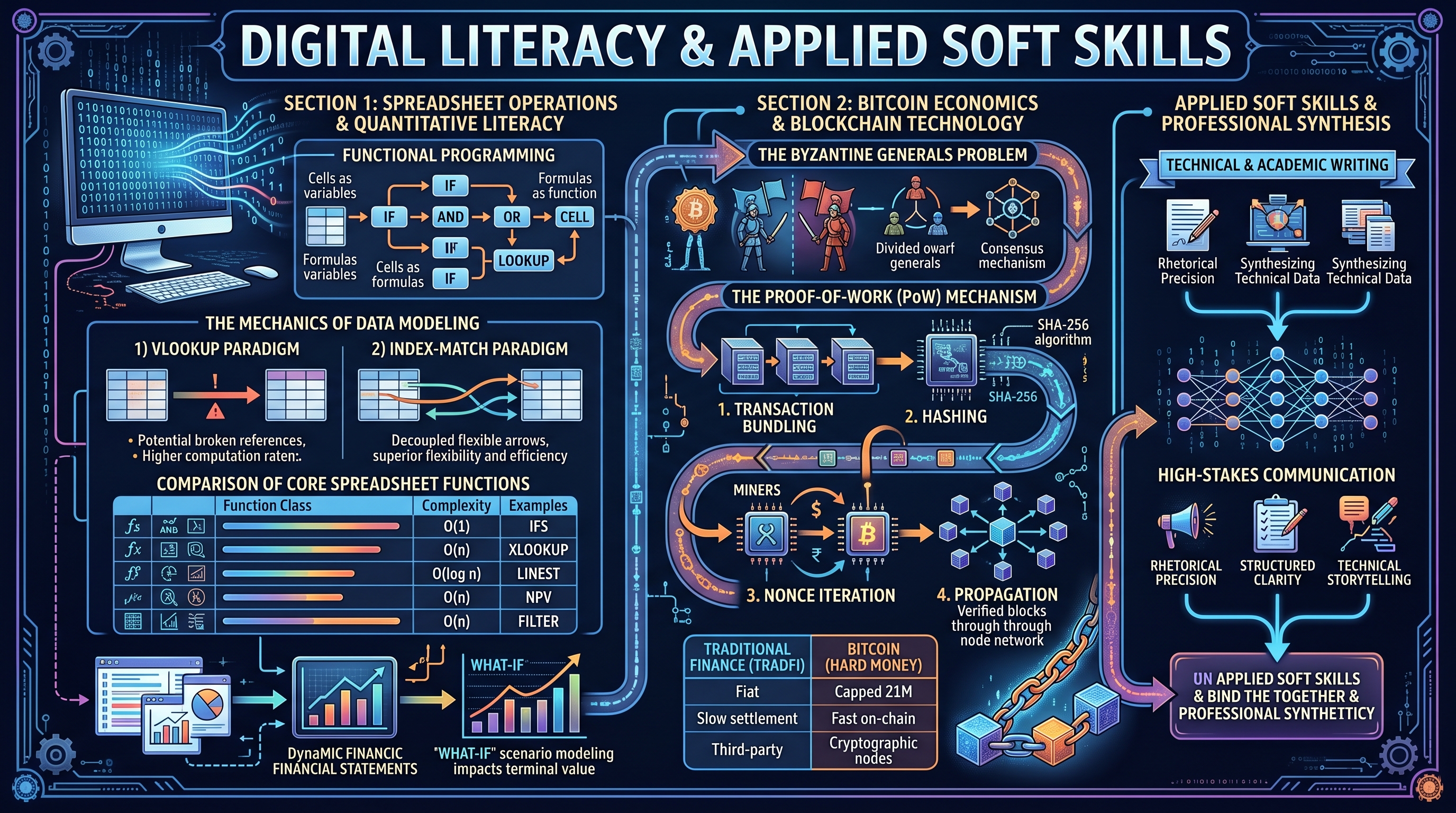
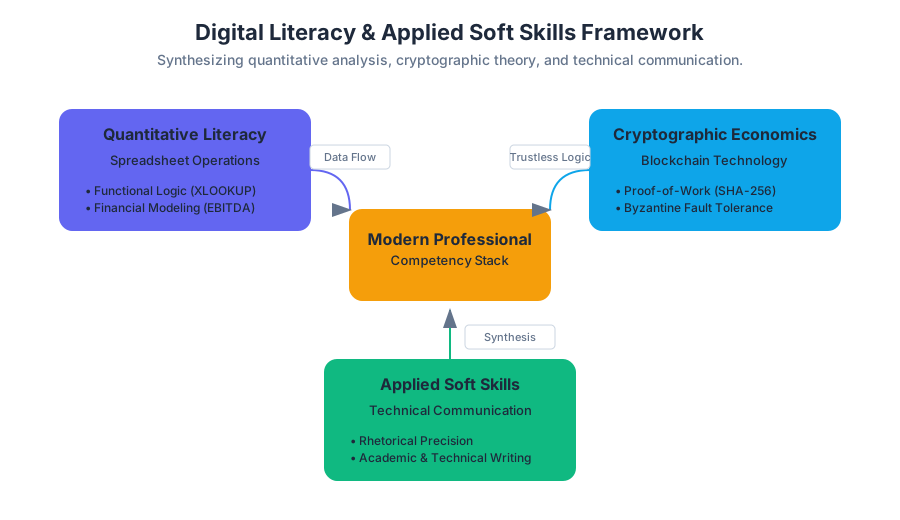
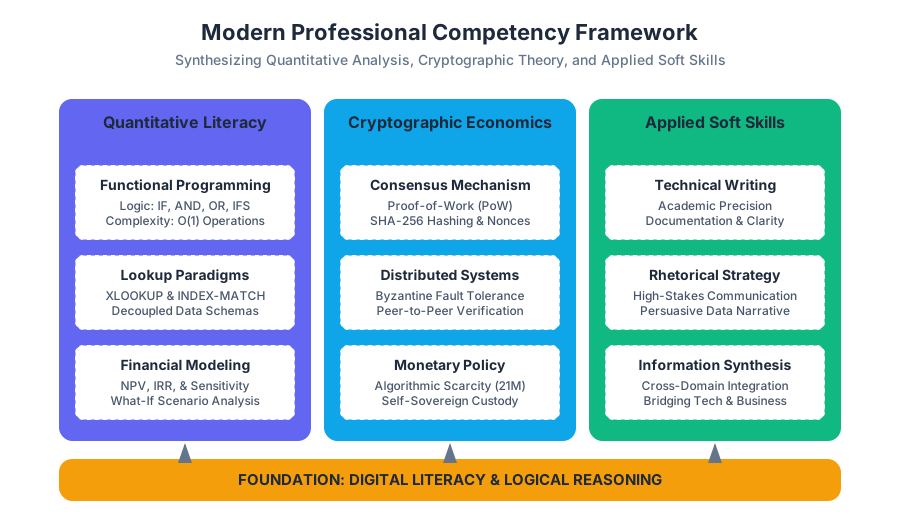
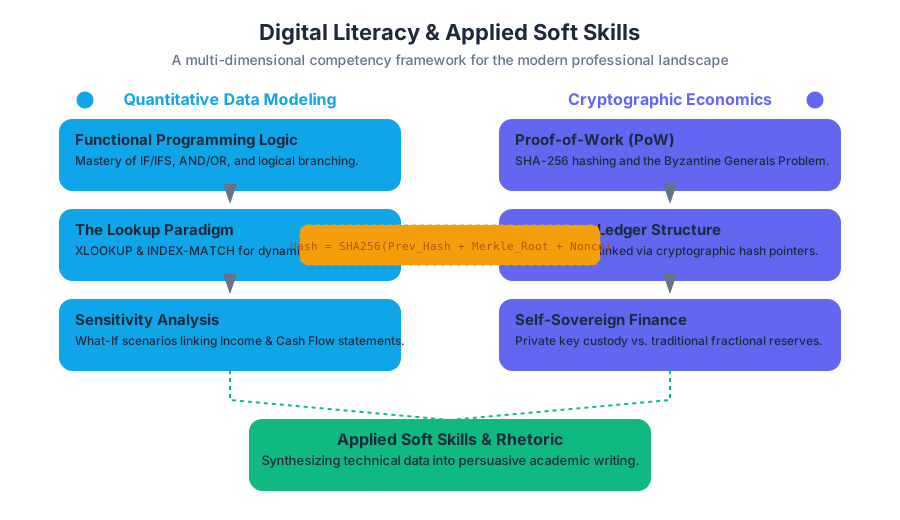
Digital literacy in the contemporary professional landscape transcends the mere ability to operate a computer. It represents a multi-dimensional competency framework that synthesizes quantitative analysis, cryptographic economic theory, and high-stakes communication. As the boundary between "technical" and "non-technical" roles continues to blur, the modern professional must master a stack that includes spreadsheet-driven data modeling, an understanding of decentralized financial protocols, and the rhetorical precision required for technical and academic writing.
Spreadsheet Operations and Quantitative Literacy
At the core of business intelligence and financial management lies the spreadsheet. While often perceived as a simple grid for data entry, modern spreadsheet software (Microsoft Excel, Google Sheets) serves as a Turing-complete environment for complex financial modeling, statistical analysis, and data visualization.
The Mechanics of Data Modeling
Spreadsheet operations are governed by the logic of functional programming. Every cell is a variable, and every formula is a function that maps inputs to outputs. Advanced literacy in this domain requires moving beyond basic arithmetic to master lookup logic, logical branching, and array manipulation.
Definition: The VLOOKUP/INDEX-MATCH Paradigm A lookup operation is a method of retrieving data from a specific column in a table based on a matching value in the first column. While
VLOOKUPis the legacy standard,INDEX-MATCH(and the newerXLOOKUP) provides superior flexibility by decoupling the return array from the lookup array, reducing computational overhead and preventing "broken" references during schema changes.
Comparison of Core Spreadsheet Functions
| Function Class | Examples | Complexity | Use Case |
|---|---|---|---|
| Logical | IF, AND, OR, IFS |
O(1) | Conditional formatting and branching logic. |
| Lookup | VLOOKUP, INDEX, MATCH, XLOOKUP |
O(n) or O(log n) | Joining disparate data sets based on unique identifiers. |
| Statistical | STDEV.P, CORREL, LINEST |
O(n) | Trend analysis and predictive modeling. |
| Financial | NPV, IRR, PMT |
Iterative | Calculating the time value of money and project viability. |
| Array Functions | FILTER, UNIQUE, SORT |
O(n log n) | Dynamic data manipulation without manual filtering. |
Bitcoin Economics and Blockchain Technology
Bitcoin represents the intersection of computer science, cryptography, and Austrian economics. To understand Bitcoin is to understand the Byzantine Generals Problem—a fundamental challenge in distributed systems where participants must reach a consensus on a single truth without a central authority.
The Proof-of-Work (PoW) Mechanism
Bitcoin operates on a Proof-of-Work consensus algorithm. This is a cryptographic competition where "miners" use specialized hardware (ASICs) to find a hash that meets a specific difficulty target.
- Transaction Bundling: Transactions are gathered into a candidate block.
- Hashing: The block header is hashed using the SHA-256 algorithm.
- Nonce Iteration: Miners change a small variable (the
nonce) and re-hash until the resulting hash starts with a required number of zeros. - Propagation: The first miner to find the hash broadcasts it to the network for verification.
Bitcoin vs. Traditional Financial Systems
| Feature | Traditional Finance (TradFi) | Bitcoin (DeFi/Hard Money) |
|---|---|---|
| Issuance | Central Bank Discretion (Fiat) | Algorithmic (Capped at 21M) |
| Settlement | T+2 to T+5 Days (Interbank) | ~10-60 Minutes (On-chain) |
| Verification | Audited by Third Parties | Cryptographic (Nodes) |
| Custody | Fractional Reserve Banks | Self-Sovereign (Private Keys) |
| Governance | Regulatory/Political | Code-based / Consensus |
Technical Derivation: The Block Header
The security of the Bitcoin network relies on the immutability of the chain. Each block contains the hash of the previous block, creating a linked list where altering one record requires re-calculating every subsequent block—an economically impossible task.
\text{Block\_Hash} = \text{SHA-256}(\text{SHA-256}(\text{Version} + \text{Prev\_Block\_Hash} + \text{Merkle\_Root} + \text{Timestamp} + \text{Bits} + \text{Nonce}))
Common Pitfalls in Cryptocurrency
- Confusing Bitcoin with Blockchain: Blockchain is the ledger technology; Bitcoin is the specific implementation of decentralized money.
- Key Mismanagement: In Bitcoin, "Not your keys, not your coins." Losing a private key results in the permanent loss of assets, as there is no "password reset" in a decentralized system.
- Misunderstanding Volatility: Professional financial literacy requires distinguishing between price volatility (short-term fluctuation) and monetary debasement (long-term loss of purchasing power).
Professional Writing and Technical Communication
Digital literacy is incomplete without the ability to communicate complex ideas effectively. Professional writing is not merely about grammar; it is about rhetorical strategy—aligning the message with the audience's needs and the author's purpose.
The PWR Method: Prewrite, Write, Revise
The PWR Method is a structured approach to document creation that mirrors the software development lifecycle (SDLC).
- Prewriting: This stage involves Audience Analysis. Who is the stakeholder? What is their technical baseline? For a grant proposal, the audience is a review committee; for a technical manual, it is an end-user.
- Writing: Focus on the Four Keys to Good Writing:
- Unity: Every paragraph supports a single main idea.
- Support: Claims are backed by data or evidence.
- Coherence: Logical transitions connect ideas.
- Sentence Skills: Clarity, conciseness, and correct grammar.
- Revising: This is the "optimization" phase. It involves "killing your darlings"—removing unnecessary jargon and ensuring the document meets its objective.
Comparison of Writing Styles
| Style | Objective | Key Characteristics |
|---|---|---|
| Academic | Contribute to a body of knowledge. | Formal, heavily cited (MLA/APA), complex syntax. |
| Technical | Instruct or explain a process. | Imperative mood, bulleted lists, high clarity. |
| Business | Persuade or inform for decision-making. | "Bottom Line Up Front" (BLUF), concise, action-oriented. |
| Grant Writing | Secure funding for a project. | Highly structured, persuasive, evidence-based. |
Example: A Crisis Communication Plan (CCP)
In the event of an organizational failure (e.g., a data breach), a professional must execute a Crisis Communication Plan. This requires a blend of ethical communication and strategic messaging.
Critical Thinking and Academic Disciplines
The synthesis of these skills occurs within the framework of Critical Thinking. Whether evaluating an artistic movement in Art History or analyzing a moral dilemma in Philosophy, the underlying cognitive process remains the same: the systematic evaluation of information to form a judgment.
Formal and Informal Logic
Professional decision-making relies on both Sentential Logic (the logic of "if-then" statements) and the avoidance of Informal Fallacies (e.g., Ad Hominem, Straw Man, or Sunk Cost Fallacy).
Key Insight: The Theory of Justice In business ethics, John Rawls' "Veil of Ignorance" suggests that a just system is one that we would agree to if we did not know our place in it. This philosophical framework is essential for developing Corporate Social Responsibility (CSR) programs and equitable HR policies.
The Five-Step System of Art Analysis
Even "soft" subjects like Art Appreciation utilize structured analytical systems. The five-step system—Description, Analysis, Context, Meaning, and Judgment—parallels the scientific method and the data analysis process:
- Description (Data Collection)
- Analysis (Pattern Recognition)
- Context (Environmental Variables)
- Meaning (Hypothesis Generation)
- Judgment (Conclusion/Decision)
Synthesis: The Integrated Professional
The modern professional does not use these skills in isolation. A successful project manager might use Spreadsheet Operations to track a budget, Bitcoin Technology to understand new payment rails, Professional Writing to draft the project charter, and Critical Thinking to navigate the ethical implications of the work.
The Workflow Pipeline
- Information Literacy: Researching the problem using academic databases and evaluating source credibility.
- Quantitative Analysis: Processing raw data into actionable insights via Excel.
- Strategic Communication: Presenting those insights to stakeholders using data visualization and the PWR method.
- Ethical Evaluation: Ensuring the solution aligns with moral philosophy and organizational values.
Common Pitfalls in Applied Skills
- The "Tool-First" Fallacy: Using a complex tool (like a blockchain) when a simple database would suffice. Always match the technology to the problem.
- Ignoring the Audience: Writing a technical report for an executive board without translating the jargon.
- Data Overload: Presenting a spreadsheet with 50 columns when the stakeholder only needs to see the net profit. Literacy includes the ability to filter information, not just generate it.
Source Materials
Study Interdisciplinary Foundations of Academic and Professional Literacy on Lykke
This course page is free to open: signed out, you can read its first two sections, and signing in, on any plan, opens the rest. The free Lykke Chrome extension syncs your own Canvas courses, so ChatGPT, Claude and Muse can answer from your classes and deadlines. It only reads Canvas.
Add the free extensionSign in to open every sectionAll sections of Interdisciplinary Foundations of Academic and Professional Literacy · Browse more course pages