From the free course Interdisciplinary Foundations of Academic and Professional Literacy on Lykke
Communication and Academic Literacy
Key concepts: The PWR-Writing Method · Interpersonal Communication · Public Relations Fundamentals · MLA Citation
Focuses on the essential skills of writing, public relations, and interpersonal communication required for professional success.
Communication and Academic Literacy
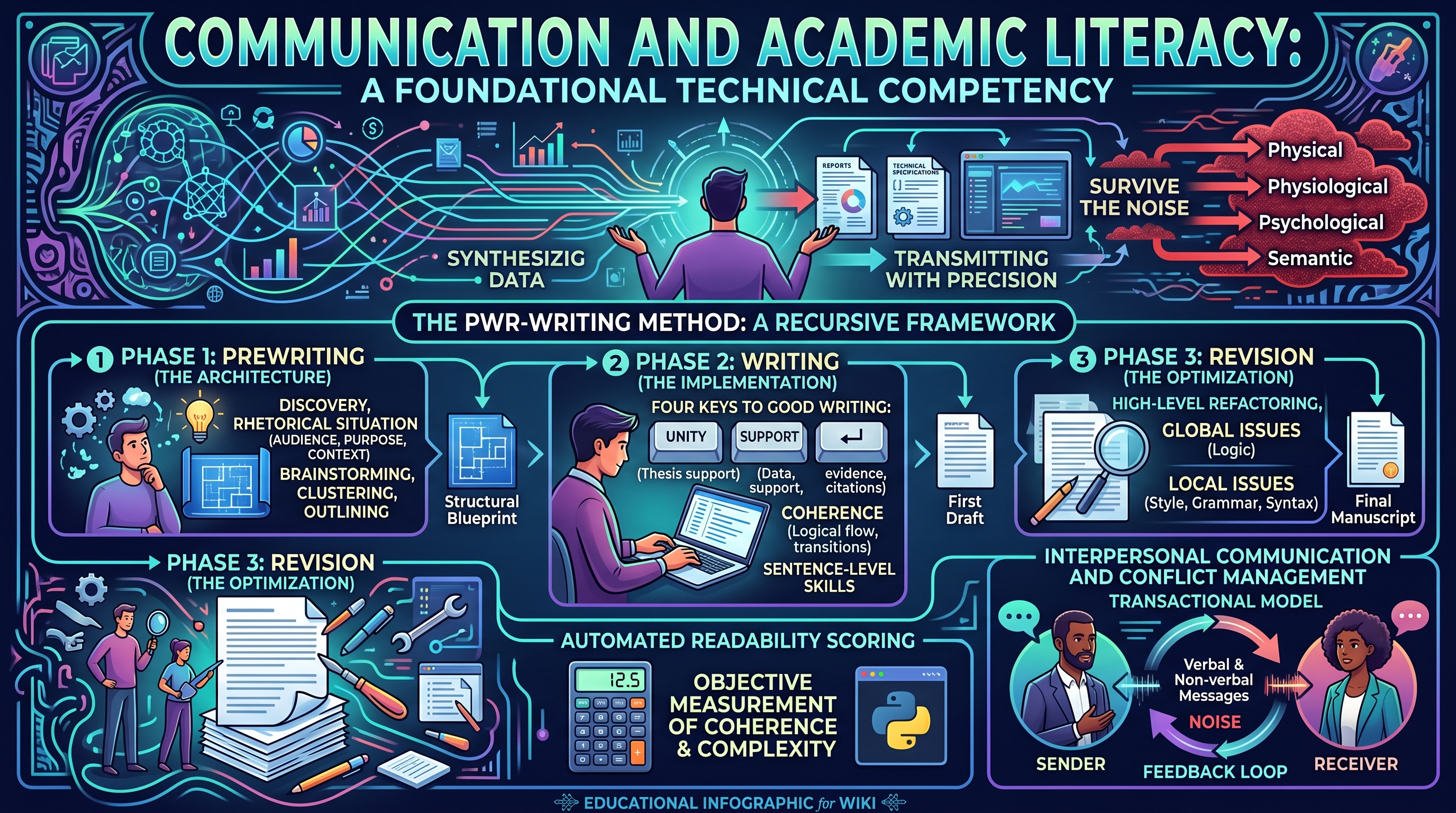
In the modern information economy, the ability to synthesize complex data and transmit it with precision is not merely a "soft skill"—it is a foundational technical competency. Academic literacy and professional communication represent the interface between raw cognition and social impact. Whether drafting a technical specification, a financial report, or a crisis response plan, the practitioner must navigate the recursive process of encoding intent into a medium that survives the "noise" of human interpretation.
The PWR-Writing Method: A Recursive Framework
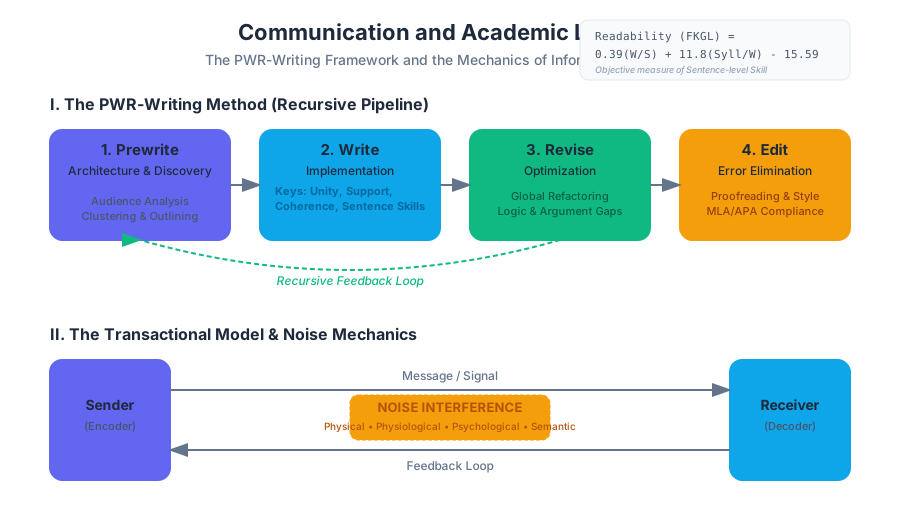
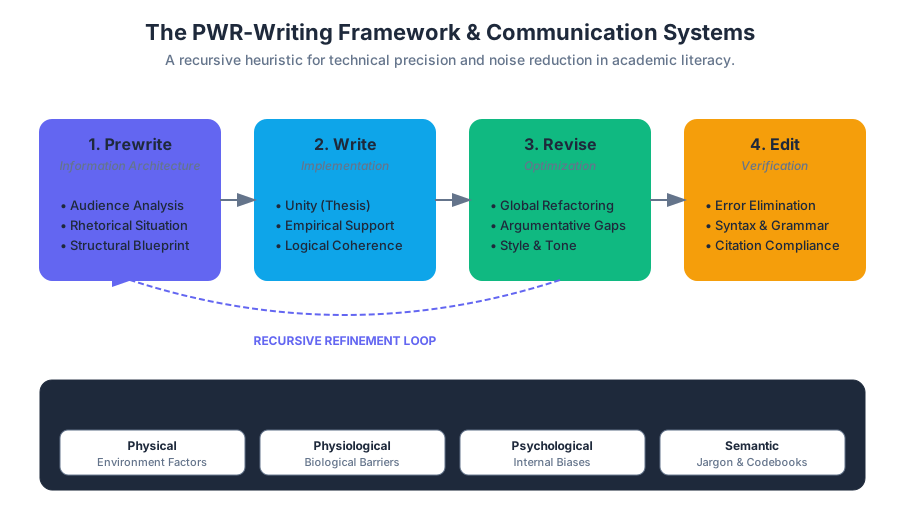
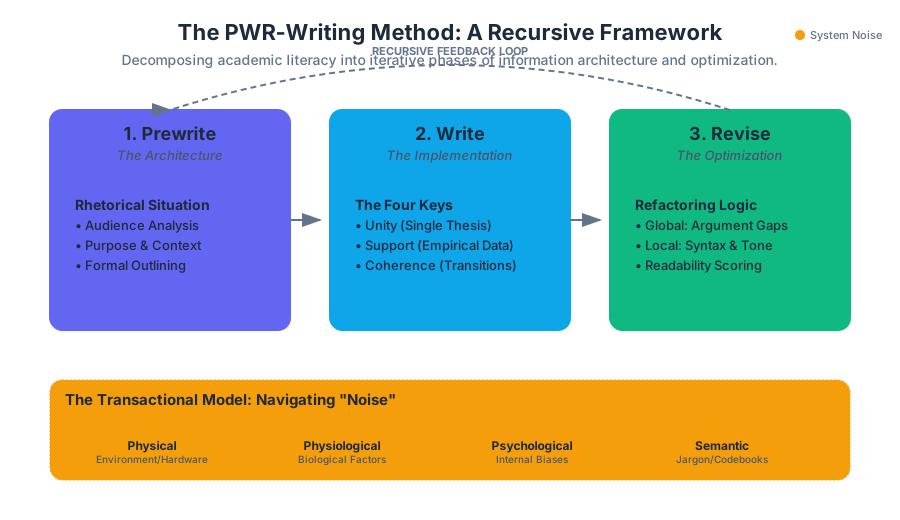
The PWR-Writing Method (Prewrite, Write, Revise) is a structured heuristic designed to decompose the monolithic task of "writing" into manageable, iterative phases. Unlike the linear "stream of consciousness" approach, PWR treats a document as a system that must be engineered for Unity, Support, Coherence, and Sentence-level Skills.
Phase 1: Prewriting (The Architecture)
Prewriting is the discovery phase where the writer establishes the Rhetorical Situation: the intersection of audience, purpose, and context. This involves brainstorming techniques such as clustering, freewriting, and the development of a formal outline.
Phase 2: Writing (The Implementation)
In the writing phase, the focus shifts to the "Four Keys to Good Writing." A successful draft must exhibit:
- Unity: Every paragraph must support a single, clear thesis statement.
- Support: Claims must be backed by empirical evidence, data, or authoritative citations.
- Coherence: Ideas must flow logically using transitional signals and structural consistency.
Phase 3: Revision (The Optimization)
Revision is often misunderstood as mere proofreading. In the PWR framework, revision is a high-level refactoring of the document’s logic. It involves checking for "Global" issues (argumentative gaps) before moving to "Local" issues (grammar and syntax).
| Stage | Primary Goal | Key Activities | Output |
|---|---|---|---|
| Prewrite | Information Architecture | Audience analysis, outlining, research | Structural Blueprint |
| Write | Draft Generation | Paragraph construction, evidence integration | First Draft |
| Revise | Logic & Style Optimization | Refactoring arguments, tone adjustment | Final Manuscript |
| Edit | Error Elimination | Proofreading for grammar, MLA compliance | Publication-Ready |
Interpersonal Communication and Conflict Management
Interpersonal communication is the exchange of information, feelings, and meaning through verbal and non-verbal messages. In professional environments, this is governed by the Transactional Model, which posits that communication is a continuous, circular process where both parties are simultaneously senders and receivers.
The Mechanics of Noise
Communication is rarely 100% efficient due to Noise. In a technical context, noise is categorized as:
- Physical Noise: External environment (e.g., a loud server room).
- Physiological Noise: Biological factors (e.g., fatigue or hearing loss).
- Psychological Noise: Internal biases, preconceptions, or emotional states.
- Semantic Noise: Jargon or language barriers where the sender and receiver use different "codebooks."
Conflict Management Strategies
Conflict in academic or professional settings often arises from resource scarcity or goal misalignment. The Thomas-Kilmann Conflict Mode Instrument (TKI) defines five responses based on Assertiveness and Cooperativeness:
| Mode | Assertiveness | Cooperativeness | Best Use Case |
|---|---|---|---|
| Competing | High | Low | Emergency situations requiring quick, decisive action. |
| Collaborating | High | High | Integrating multiple perspectives for a "win-win" solution. |
| Compromising | Medium | Medium | Temporary settlements for complex issues. |
| Avoiding | Low | Low | Trivial issues where the cost of conflict outweighs benefits. |
| Accommodating | Low | High | When harmony is more important than the specific outcome. |
Mathematical Representation of Communication Efficiency
We can model the probability of successful message transmission ($P_s$) as a function of the Signal-to-Noise Ratio ($SNR$).
P_s = \int_{0}^{\infty} f(S, N) dS \approx \frac{1}{1 + e^{-k(S-N)}}
Where $S$ is the clarity of the signal (the message), $N$ is the cumulative noise, and $k$ is the receiver's decoding proficiency.
Public Relations Fundamentals and Strategic Messaging
Public Relations (PR) is the strategic management of relationships between an organization and its diverse publics. Unlike advertising, PR focuses on earned media and the maintenance of a "Crisis Response" infrastructure.
Crisis Communication Plan (CCP)
A CCP is a technical document that outlines the protocols for communicating during an unforeseen event that threatens an organization's reputation or operations. Key components include:
- Stakeholder Mapping: Identifying who needs to know what, and when.
- Message Standardization: Ensuring a "single source of truth" to prevent misinformation.
- Multicultural Messaging: Tailoring the response to account for cultural nuances and linguistic diversity.
Crisis Response Strategy Selection
Organizations must choose a response based on the level of perceived responsibility:
- Denial: The organization claims no responsibility.
- Diminishment: Minimizing the perceived damage or the organization's role.
- Bolstering: Reminding the public of past good works to offset current negativity.
- Mortification: Accepting full responsibility and asking for forgiveness (Atonement).
Academic Literacy and MLA Citation
Academic literacy is the ability to engage with, evaluate, and produce scholarly discourse. Central to this is the ethical use of information, which is codified through citation styles like the Modern Language Association (MLA) format.
The "Container" System
MLA (9th Edition) uses a universal set of "Core Elements" organized into Containers. This allows for the citation of any source—from a traditional book to a TikTok video—by following a standardized sequence.
Definition: The Container A container is the "larger work" that holds a source. For example, a chapter is a source, and the book it appears in is the container. A television episode is a source, and the streaming service (Netflix) is the second container.
| Element Number | Core Element | Example |
|---|---|---|
| 1 | Author | Smith, John. |
| 2 | Title of Source | "The Ethics of AI." |
| 3 | Title of Container | Journal of Digital Humanities, |
| 4 | Other Contributors | edited by Sarah Doe, |
| 5 | Version | vol. 12, |
| 6 | Number | no. 4, |
| 7 | Publisher | Oxford UP, |
| 8 | Publication Date | 2022, |
| 9 | Location | pp. 45-67. |
Source Evaluation: The CRAAP Test
Before citing a source, it must be vetted using the CRAAP criteria:
- Currency: The timeliness of the information.
- Relevance: The importance of the information for your needs.
- Authority: The source of the information (credentials of the author).
- Accuracy: The reliability, truthfulness, and correctness of the content.
- Purpose: The reason the information exists (bias, persuasion, or fact).
Critical Thinking and Formal Logic
At the heart of academic literacy is Critical Thinking—the disciplined process of actively and skillfully conceptualizing, applying, analyzing, synthesizing, and evaluating information.
Sentential Logic
In Philosophy and Computer Science, arguments are often broken down into Sentential Logic (or Propositional Logic). This allows for the evaluation of an argument's Validity (the logical structure) independent of its Soundness (the truth of its premises).
- Modus Ponens: If $P \rightarrow Q$, and $P$ is true, then $Q$ must be true.
- Modus Tollens: If $P \rightarrow Q$, and $Q$ is false, then $P$ must be false.
Common Fallacies in Communication
- Ad Hominem: Attacking the person rather than the argument.
- Straw Man: Misrepresenting an opponent's position to make it easier to attack.
- False Dilemma: Presenting only two options when more exist.
- Appeal to Authority: Claiming something is true just because an "expert" said it, without providing evidence.
Summary of Professional Synthesis
Communication and Academic Literacy are not disparate skills but a unified set of tools for navigating the modern world. By applying the PWR-Writing Method, practitioners ensure their output is structured and refined. Through Interpersonal Communication and Conflict Management, they maintain the social fabric of the workplace. By mastering Public Relations and MLA Citation, they protect organizational reputation and maintain intellectual integrity. Finally, by grounding all these in Critical Thinking, they ensure that their contributions are not just loud, but meaningful.
Source Materials
Study Interdisciplinary Foundations of Academic and Professional Literacy on Lykke
This course page is free to open: signed out, you can read its first two sections, and signing in, on any plan, opens the rest. The free Lykke Chrome extension syncs your own Canvas courses, so ChatGPT, Claude and Muse can answer from your classes and deadlines. It only reads Canvas.
Add the free extensionSign in to open every sectionAll sections of Interdisciplinary Foundations of Academic and Professional Literacy · Browse more course pages