From the free course Interdisciplinary Foundations of Academic and Professional Literacy on Lykke
BUS202: Principles of Finance
Key concepts: Maximize Shareholder Wealth · Time Value of Money (TVM) · Financial Statement Analysis · Agency Theory · Corporate Governance
The core course content focusing on wealth maximization, financial analysis, and the time value of money.
BUS202: Principles of Finance
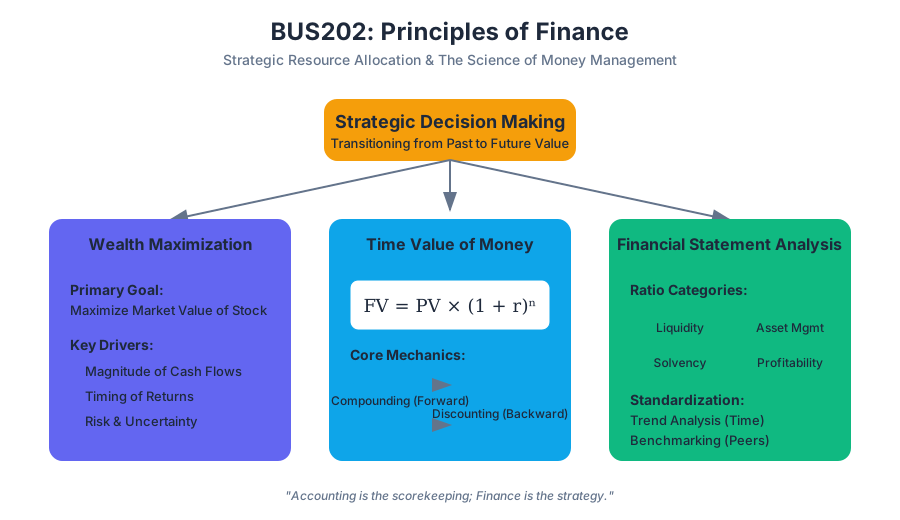
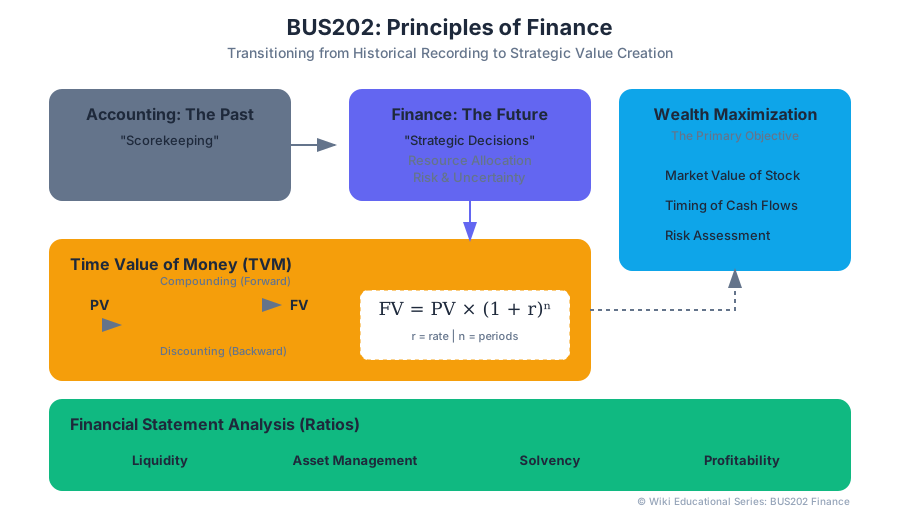
Finance is often described as the "science of money management." While accounting focuses on the historical recording of transactions (the "scorekeeping" of business), finance is inherently forward-looking. It is the study of how individuals and institutions allocate resources over time, accounting for the risks and uncertainties inherent in the future. In the context of BUS202, we transition from understanding what happened in the past to making strategic decisions that determine the future value of a firm.
Maximize Shareholder Wealth
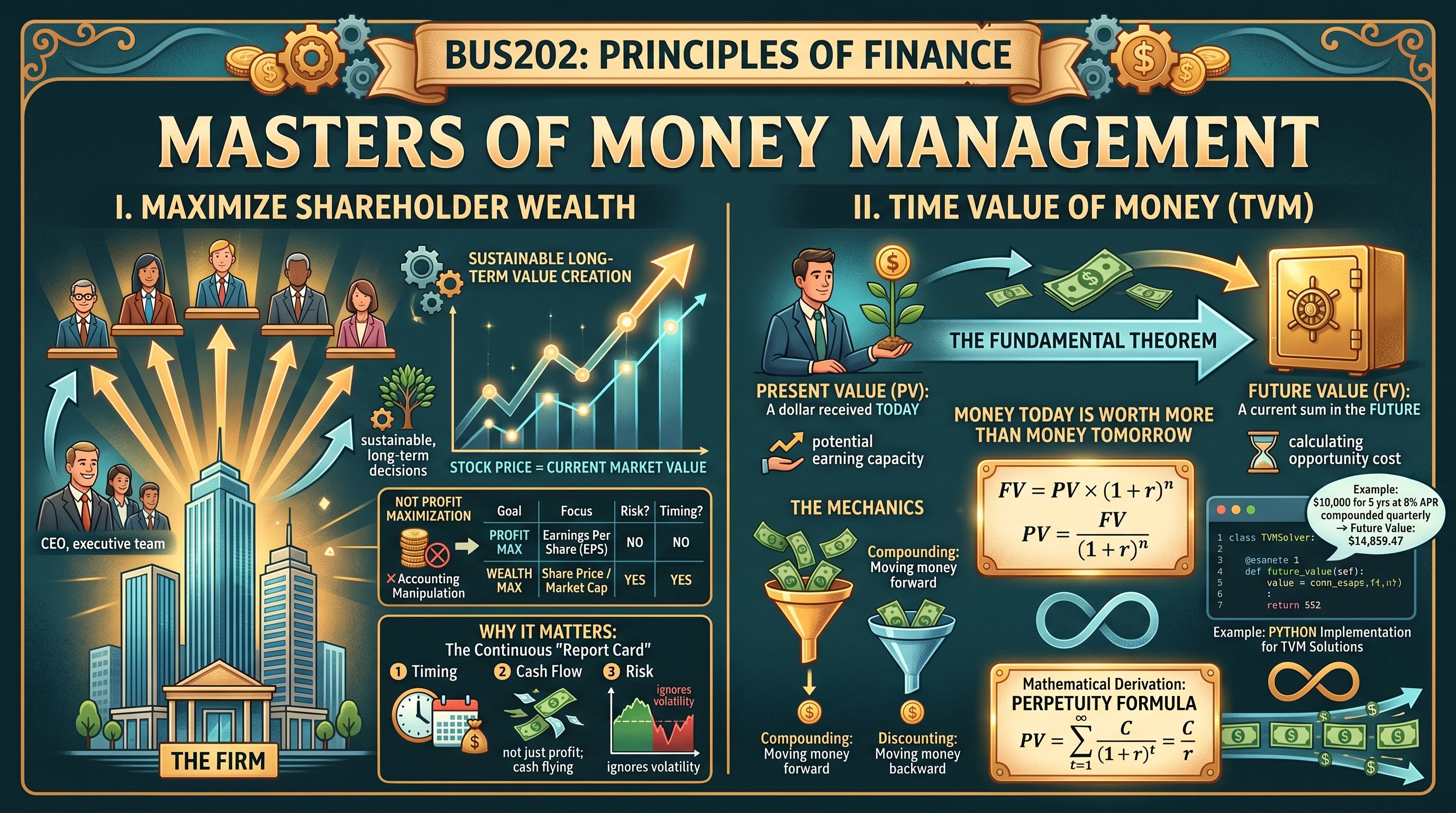
In the classical theory of the firm, the primary objective of financial management is to Maximize Shareholder Wealth. This is specifically defined as maximizing the current market value of the firm's outstanding common stock.
What it is
Unlike "profit maximization," which can be manipulated by accounting choices and ignores the timing of returns, shareholder wealth maximization focuses on the Net Present Value (NPV) of all expected future cash flows. It accounts for the magnitude, timing, and risk of those cash flows.
Why it matters
Profit maximization is a flawed goal for several reasons:
- Timing: It doesn't distinguish between receiving $1 million today versus $1 million in ten years.
- Cash Flow vs. Profit: Accounting profits do not equal cash available to pay dividends or reinvest.
- Risk: It ignores the volatility of earnings. A high-profit project with a 50% chance of bankruptcy is often worse than a lower-profit, stable project.
How it works
The market price of a stock serves as a continuous "report card" on management's performance. When managers make decisions that increase the expected future cash flows or decrease the firm's risk (cost of capital), the stock price rises.
| Goal | Focus | Consideration of Risk | Consideration of Timing |
|---|---|---|---|
| Profit Maximization | Earnings Per Share (EPS) | No | No |
| Wealth Maximization | Share Price / Market Cap | Yes | Yes |
Common Pitfalls: Short-termism
A common mistake is confusing wealth maximization with short-term stock price manipulation. True wealth maximization involves sustainable, long-term value creation. Cutting R&D to boost this quarter's earnings might raise the stock price temporarily, but it destroys long-term shareholder wealth.
Time Value of Money (TVM)
The Time Value of Money (TVM) is the most fundamental concept in finance. It states that a dollar received today is worth more than a dollar received in the future because of its potential earning capacity.
What it is
TVM is the mathematical framework used to compare cash flows occurring at different points in time. The core variables are:
- PV (Present Value): The current value of a future sum.
- FV (Future Value): The value of a current sum at a specific date in the future.
- r (Interest Rate/Discount Rate): The cost of capital or opportunity cost.
- n (Number of Periods): The time horizon.
How it works: The Mechanics of Compounding and Discounting
Compounding moves money forward in time (finding FV), while discounting moves money backward in time (finding PV).
The Fundamental Theorem of TVM: $$FV = PV \times (1 + r)^n$$ $$PV = \frac{FV}{(1 + r)^n}$$
Mathematical Derivation: The Perpetuity Formula
A perpetuity is a constant stream of identical cash flows that continues forever. To derive its present value, we use the sum of a geometric series:
PV = \sum_{t=1}^{\infty} \frac{C}{(1+r)^t}
PV = C \left[ \frac{1}{(1+r)} + \frac{1}{(1+r)^2} + \frac{1}{(1+r)^3} + \dots \right]
This is a geometric series with first term a = C/(1+r) and ratio k = 1/(1+r).
The sum S = a / (1 - k)
PV = \frac{C/(1+r)}{1 - 1/(1+r)}
PV = \frac{C/(1+r)}{(r/(1+r))}
PV = \frac{C}{r}
Financial Statement Analysis
Financial Statement Analysis involves evaluating a firm's past, present, and projected performance through the lens of its financial reports (Balance Sheet, Income Statement, and Cash Flow Statement).
What it is
We use Ratio Analysis to standardize financial data, allowing for comparisons across time (trend analysis) and across different firms (benchmarking).
Major Ratio Categories
Financial analysts typically group ratios into five categories:
| Category | Purpose | Key Metric | Formula |
|---|---|---|---|
| Liquidity | Ability to meet short-term obligations | Current Ratio | Current Assets / Current Liabilities |
| Asset Mgmt | Efficiency of asset utilization | Inventory Turnover | COGS / Average Inventory |
| Solvency | Long-term debt-paying ability | Debt-to-Equity | Total Debt / Total Equity |
| Profitability | Effectiveness of generating returns | Net Profit Margin | Net Income / Sales |
| Market Value | Stock price relative to fundamentals | P/E Ratio | Price per Share / Earnings per Share |
The DuPont System
The DuPont Analysis is a powerful diagnostic tool that breaks down Return on Equity (ROE) into three component parts to identify the source of a firm's performance.
ROE = Profit Margin × Total Asset Turnover × Equity Multiplier
- Profit Margin: Operating efficiency.
- Total Asset Turnover: Asset use efficiency.
- Equity Multiplier: Financial leverage.
Agency Theory and Corporate Governance
In large corporations, there is a separation of ownership and control. Shareholders own the firm, but professional managers run it. This separation leads to the Principal-Agent Problem.
What it is
Agency Theory explores the conflicts of interest between the Principal (shareholders) and the Agent (managers). Managers may be tempted to act in their own best interests (e.g., excessive perks, empire building) rather than maximizing shareholder wealth.
Agency Costs
These are the costs incurred to align the interests of the two parties:
- Monitoring Costs: Auditing, reporting, and board oversight.
- Bonding Costs: Insurance or structures that protect the principal.
- Residual Loss: The inherent inefficiency that remains because interests can never be perfectly aligned.
Corporate Governance Mechanisms
Corporate Governance is the system of rules and processes used to direct and control the firm.
- Internal Mechanisms:
- Board of Directors: Elected by shareholders to oversee management.
- Executive Compensation: Using stock options and performance bonuses to align incentives.
- External Mechanisms:
- The Market for Corporate Control: The threat of a hostile takeover if the stock price is undervalued due to poor management.
- Regulatory Environment: Laws like Sarbanes-Oxley (SOX) that mandate transparency.
Common Pitfalls: Information Asymmetry
A major hurdle in governance is Information Asymmetry, where managers possess more or better information than shareholders. This allows for "moral hazard," where managers take risks because the shareholders bear the cost of failure.
Synthesis: The Capital Budgeting Process
All the concepts above culminate in Capital Budgeting—the process of planning and managing a firm's long-term investments.
- Identify Opportunities: Managers look for projects that align with the firm's strategy.
- Estimate Cash Flows: Using financial analysis to project incremental cash flows (not accounting profits).
- Apply TVM: Discount those cash flows at the firm's Weighted Average Cost of Capital (WACC).
- Decision Rule: If the Net Present Value (NPV) > 0, the project is expected to increase shareholder wealth.
| Method | Decision Rule | Pros | Cons |
|---|---|---|---|
| NPV | Accept if > 0 | Accounts for TVM and Risk | Requires accurate WACC |
| IRR | Accept if > WACC | Intuitive (percentage return) | Can give multiple answers for non-normal cash flows |
| Payback | Accept if < X years | Simple, focuses on liquidity | Ignores TVM and cash flows after the cutoff |
Source Materials
Study Interdisciplinary Foundations of Academic and Professional Literacy on Lykke
This course page is free to open: signed out, you can read its first two sections, and signing in, on any plan, opens the rest. The free Lykke Chrome extension syncs your own Canvas courses, so ChatGPT, Claude and Muse can answer from your classes and deadlines. It only reads Canvas.
Add the free extensionSign in to open every sectionAll sections of Interdisciplinary Foundations of Academic and Professional Literacy · Browse more course pages