From the free course High School Physics on Lykke
Fundamentals of One-Dimensional Motion
Key concepts: Displacement and Distance · Average and Instantaneous Velocity · Acceleration · Free Fall
An introduction to the basic descriptors of motion, focusing on displacement, velocity, and acceleration in a single dimension.
Fundamentals of One-Dimensional Motion
Kinematics is the branch of classical mechanics that describes the motion of points, bodies, and systems of bodies without considering the forces that cause the motion. In its simplest form—One-Dimensional Motion—we constrain the movement of an object to a single straight line. This simplification allows us to build a rigorous mathematical framework using scalars and vectors, providing the essential groundwork for more complex multi-dimensional dynamics.
Displacement and Distance
The study of motion begins with the definition of position. To describe where an object is, we must first establish a Frame of Reference and an Origin. Once a coordinate system is defined, we can distinguish between the total path traveled and the net change in position.
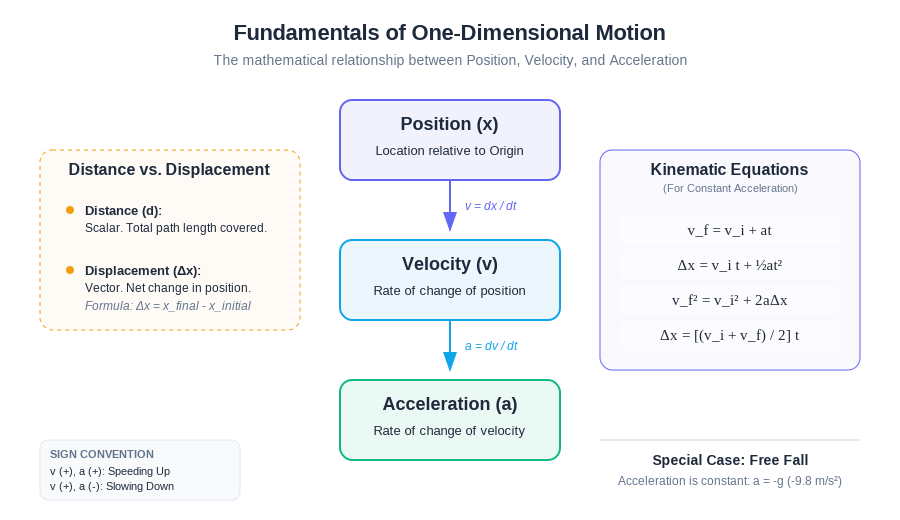
Distance ($d$)
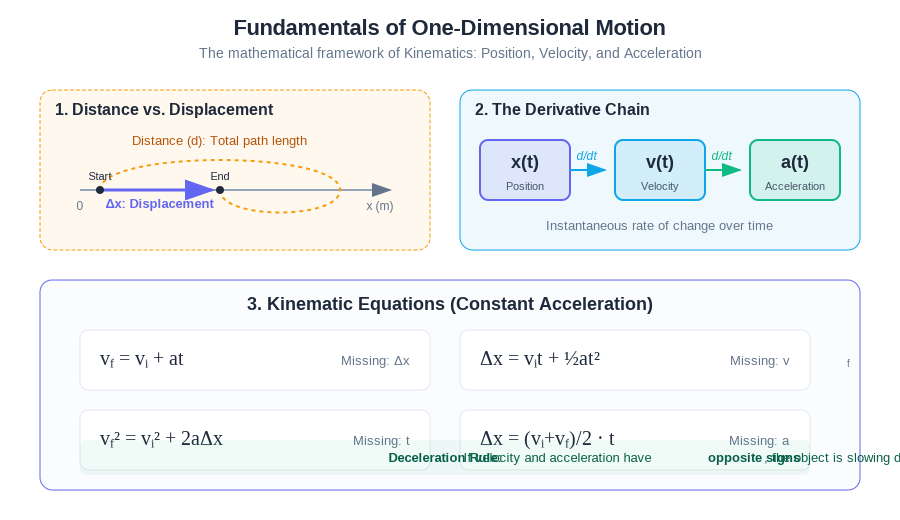
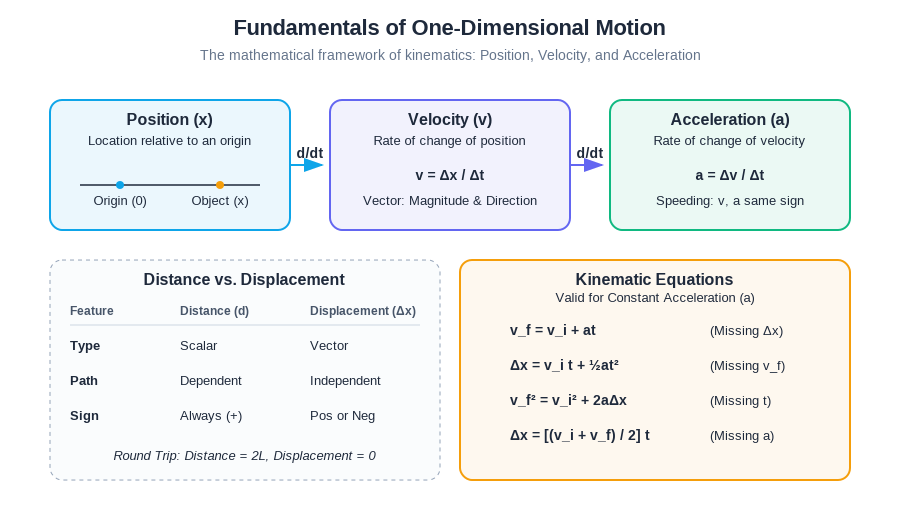
Distance is a scalar quantity that refers to "how much ground an object has covered" during its motion. It is always non-negative and is path-dependent. If you walk 5 meters forward and 3 meters backward, your total distance is 8 meters.
Displacement ($\Delta x$)
Displacement is a vector quantity that refers to "how far out of place an object is"; it is the object's overall change in position. It is path-independent and depends only on the initial and final positions.
The Displacement Formula: $$\Delta x = x_f - x_i$$ Where $x_f$ is the final position and $x_i$ is the initial position.
| Feature | Distance ($d$) | Displacement ($\Delta x$) |
|---|---|---|
| Quantity Type | Scalar (Magnitude only) | Vector (Magnitude and Direction) |
| Path Dependency | Dependent on the actual path taken | Independent (only start and end matter) |
| Sign | Always positive or zero | Can be positive, negative, or zero |
| SI Unit | Meters (m) | Meters (m) |
Common Pitfall: The Round Trip
A common point of confusion occurs in "round trip" scenarios. If an athlete runs one full lap around a 400m track, their distance is 400m, but their displacement is 0m because their initial and final positions are identical. In 1D motion, this is represented by moving from $x=0$ to $x=10$ and back to $x=0$.
Average and Instantaneous Velocity
While displacement tells us the "what" of motion, velocity tells us the "how fast" and "in what direction."
Average Velocity vs. Average Speed
Average Velocity ($v_{avg}$) is the rate at which an object changes its position over a specific time interval. Average Speed is the total distance traveled divided by the time interval.
$$v_{avg} = \frac{\Delta x}{\Delta t} = \frac{x_f - x_i}{t_f - t_i}$$
Instantaneous Velocity
Instantaneous Velocity is the velocity of an object at a specific point in time. Mathematically, it is the limit of the average velocity as the time interval approaches zero. In the language of calculus, velocity is the first derivative of position with respect to time.
$$v(t) = \lim_{\Delta t \to 0} \frac{\Delta x}{\Delta t} = \frac{dx}{dt}$$
Acceleration
Acceleration ($a$) is the rate at which an object changes its velocity. Because velocity is a vector, acceleration occurs if the object changes its speed, its direction, or both. In 1D motion, direction change is limited to a sign flip (positive to negative).
Mathematical Derivation
Acceleration is the derivative of velocity with respect to time, which also makes it the second derivative of position.
v(t) = \frac{dx}{dt}
a(t) = \frac{dv}{dt} = \frac{d^2x}{dt^2}
Constant vs. Variable Acceleration
Most introductory physics problems assume Constant Acceleration (Uniformly Accelerated Motion). This allows us to derive the "Kinematic Equations," a suite of formulas that link displacement, initial velocity, final velocity, acceleration, and time.
| Equation | Missing Variable | Condition |
|---|---|---|
| $v_f = v_i + at$ | $\Delta x$ | Constant $a$ |
| $\Delta x = v_i t + \frac{1}{2}at^2$ | $v_f$ | Constant $a$ |
| $v_f^2 = v_i^2 + 2a\Delta x$ | $t$ | Constant $a$ |
| $\Delta x = \frac{v_i + v_f}{2}t$ | $a$ | Constant $a$ |
Deceleration vs. Negative Acceleration
A critical conceptual hurdle is the distinction between "slowing down" and "negative acceleration."
- If velocity and acceleration have the same sign (both positive or both negative), the object is speeding up.
- If velocity and acceleration have opposite signs, the object is slowing down (decelerating).
Free Fall
Free Fall is a specific type of one-dimensional motion where the only force acting upon an object is gravity. In a vacuum (ignoring air resistance), all objects fall toward the center of the Earth with the same constant acceleration, regardless of their mass.
The Acceleration due to Gravity ($g$)
On the surface of the Earth, this acceleration is approximately: $$g \approx 9.81 , \text{m/s}^2$$ By convention, if we define "up" as the positive y-direction, then the acceleration for an object in free fall is $a = -g$.
Worked Example: The Cliff Diver
A diver drops from a cliff that is 20 meters high. How long does it take to hit the water, and what is their impact velocity?
- Identify Knowns: $y_i = 20m$, $y_f = 0m$, $v_i = 0$ (dropped), $a = -9.8m/s^2$.
- Find Time ($t$): Use $\Delta y = v_i t + \frac{1}{2}at^2$ $-20 = 0 + \frac{1}{2}(-9.8)t^2$ $-20 = -4.9t^2 \implies t^2 \approx 4.08 \implies t \approx 2.02 , \text{s}$
- Find Final Velocity ($v_f$): Use $v_f = v_i + at$ $v_f = 0 + (-9.8)(2.02) = -19.8 , \text{m/s}$
Graphical Analysis of Motion
Visualizing motion through graphs is often more intuitive than algebraic manipulation. There are three primary types of motion graphs:
1. Position vs. Time ($x-t$)
- Slope: Represents the velocity.
- Curvature: A curved line indicates acceleration. A straight line indicates constant velocity.
- Y-Intercept: The initial position ($x_i$).
2. Velocity vs. Time ($v-t$)
- Slope: Represents the acceleration.
- Area Under Curve: Represents the displacement ($\Delta x$).
- Horizontal Line: Indicates constant velocity (zero acceleration).
3. Acceleration vs. Time ($a-t$)
- Slope: Represents "jerk" (rate of change of acceleration).
- Area Under Curve: Represents the change in velocity ($\Delta v$).
| Graph Type | Slope Meaning | Area Meaning |
|---|---|---|
| Position-Time | Velocity | N/A |
| Velocity-Time | Acceleration | Displacement |
| Acceleration-Time | Jerk | Change in Velocity |
Advanced Considerations: Non-Uniform Acceleration
In the real world, acceleration is rarely perfectly constant. Air resistance (drag) is a prime example, where acceleration decreases as velocity increases until Terminal Velocity is reached.
Terminal Velocity Derivation
When an object falls through a fluid (like air), the drag force $F_d$ eventually equals the gravitational force $F_g$. $$F_{net} = ma = mg - \frac{1}{2}\rho v^2 C_d A$$ At terminal velocity, $a = 0$, therefore: $$v_t = \sqrt{\frac{2mg}{\rho C_d A}}$$ Where $\rho$ is fluid density, $C_d$ is the drag coefficient, and $A$ is the cross-sectional area. This demonstrates that while kinematics describes the motion, dynamics (forces) eventually dictates the limits of that motion.
Study High School Physics on Lykke
This course page is free to open: signed out, you can read its first two sections, and signing in, on any plan, opens the rest. The free Lykke Chrome extension syncs your own Canvas courses, so ChatGPT, Claude and Muse can answer from your classes and deadlines. It only reads Canvas.
Add the free extensionSign in to open every sectionAll sections of High School Physics · Browse more course pages