From the free course High School Physics on Lykke
Work, Energy, and Power
Key concepts: Work-Energy Theorem · Kinetic Energy · Potential Energy · Conservation of Energy · Power
Defining work and energy, and exploring the law of conservation of energy in physical systems.
Work, Energy, and Power
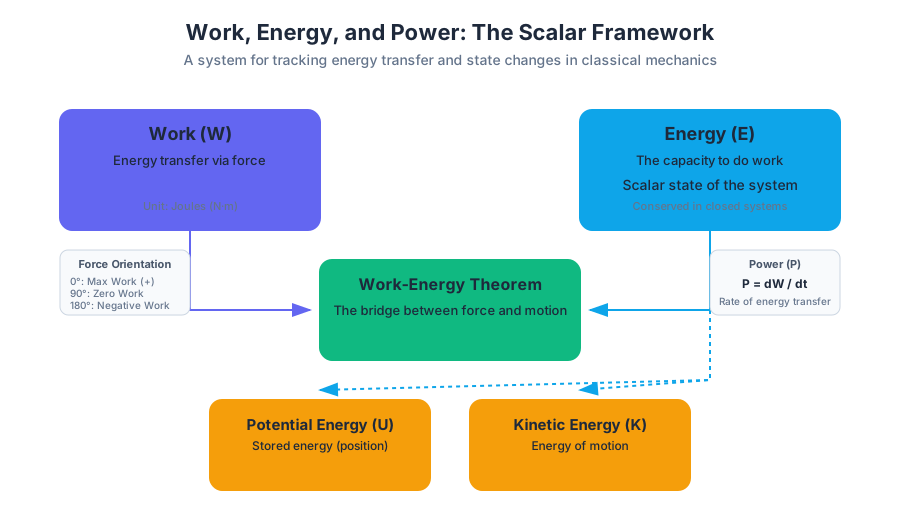
In classical mechanics, we often begin by analyzing motion through the lens of Newton’s Laws. However, as systems grow in complexity—involving varying forces or intricate paths—the vector-based approach of $\vec{F} = m\vec{a}$ becomes computationally taxing. The study of Work, Energy, and Power provides a scalar alternative: a powerful "accounting system" for the universe. By focusing on the state of a system rather than the instantaneous forces acting upon it, we can solve complex trajectories and predict final states with remarkable precision.
The Concept of Work
In physics, Work ($W$) is not merely effort; it is the measure of energy transfer that occurs when a force is applied over a displacement. If a force has no component in the direction of motion, no work is performed on the object, regardless of how much "effort" is expended.
What it is
Mathematically, for a constant force, work is the dot product of the force vector $\vec{F}$ and the displacement vector $\vec{d}$:
$$W = \vec{F} \cdot \vec{d} = Fd \cos \theta$$
Where $\theta$ is the angle between the force and the displacement. In a more general sense, where force varies along a path, work is defined as a line integral:
$$W = \int_{C} \vec{F} \cdot d\vec{r}$$
Why it matters
Work bridges the gap between dynamics (forces) and kinematics (motion). It quantifies how an external influence changes the energy state of an object. Without the concept of work, we would have no formal way to describe how a battery moves a car or how a star's gravity pulls a planet into a tighter orbit.
Mechanics and Scenarios
The value of work depends entirely on the orientation of the force relative to the displacement.
| Scenario | Angle ($\theta$) | Work Done ($W$) | Physical Meaning |
|---|---|---|---|
| Aligned | $0^\circ$ | $Fd$ (Maximum Positive) | Force adds energy to the system (e.g., pushing a sled). |
| Opposed | $180^\circ$ | $-Fd$ (Maximum Negative) | Force removes energy (e.g., kinetic friction slowing a block). |
| Perpendicular | $90^\circ$ | $0$ | Force changes direction but not speed (e.g., centripetal force). |
| Obtuse | $90^\circ < \theta \leq 180^\circ$ | Negative | The force hinders the motion. |
Concrete Example: Numerical Integration of Work
In real-world engineering, forces are rarely constant. Consider a variable force $F(x) = kx^2$ acting on a particle. To find the work done from $x=0$ to $x=5$, we must integrate.
Kinetic Energy and the Work-Energy Theorem
Kinetic Energy ($K$ or $KE$) represents the energy an object possesses due to its motion. It is a scalar quantity, always non-negative, and depends on the square of the velocity.
The Derivation
We can derive the expression for Kinetic Energy using Newton's Second Law and kinematic equations. For a constant force $F$ acting on a mass $m$ over distance $d$:
- $W = Fd$
- From $F = ma$, we get $W = mad$
- From kinematics, $v_f^2 = v_i^2 + 2ad$, which implies $ad = \frac{v_f^2 - v_i^2}{2}$
- Substituting $ad$ into the work equation: $W = m(\frac{v_f^2 - v_i^2}{2})$
- $W = \frac{1}{2}mv_f^2 - \frac{1}{2}mv_i^2$
The Work-Energy Theorem: The net work done by all forces acting on a particle equals the change in the particle's kinetic energy. $$W_{net} = \Delta K = K_f - K_i$$
Why it Matters
This theorem is a shortcut. If you know the initial speed of a car and the work done by the brakes (friction), you can calculate the final speed without ever calculating the time elapsed or the instantaneous acceleration.
Common Pitfalls
- Velocity is Squared: Doubling the speed of a vehicle quadruples its kinetic energy ($2^2 = 4$). This is why high-speed crashes are significantly more lethal than low-speed ones.
- Frame of Reference: While energy is a scalar, velocity is relative. Kinetic energy depends on the observer's frame of reference.
Potential Energy: Stored Capability
Potential Energy ($U$ or $PE$) is the energy stored within a system due to the configuration or position of its parts. It represents the "potential" to do work.
Gravitational Potential Energy ($U_g$)
Near the Earth's surface, the gravitational potential energy is proportional to the height $h$ relative to a chosen reference point (datum): $$U_g = mgh$$
Elastic Potential Energy ($U_s$)
When a spring is compressed or stretched, it stores energy. This follows Hooke's Law ($F = -kx$), where $k$ is the spring constant.
\begin{aligned}
W_s &= \int_{0}^{x} F_{ext} \, dx \\
W_s &= \int_{0}^{x} kx \, dx \\
U_s &= \frac{1}{2}kx^2
\end{aligned}
Conservative vs. Non-Conservative Forces
Potential energy can only be defined for conservative forces.
| Feature | Conservative Forces (e.g., Gravity, Elastic) | Non-Conservative Forces (e.g., Friction, Air Drag) |
|---|---|---|
| Path Dependency | Independent of path taken. | Dependent on path taken. |
| Work on Closed Loop | Zero. | Non-zero (usually negative). |
| Energy Recovery | Energy can be fully recovered. | Energy is dissipated as heat/sound. |
| Potential Energy | Can be defined ($U$). | Cannot be defined. |
Conservation of Energy
The Law of Conservation of Energy states that the total energy of an isolated system remains constant. Energy is neither created nor destroyed; it only transforms from one form to another.
Mechanical Energy
In systems where only conservative forces act, the Total Mechanical Energy ($E_{mech}$) is conserved: $$E_i = E_f \implies K_i + U_i = K_f + U_f$$
The General Energy Equation
In the presence of non-conservative forces like friction ($W_{fric}$), the equation expands: $$K_i + U_i + W_{other} = K_f + U_f$$ Here, $W_{other}$ is usually negative, representing energy leaving the mechanical system (often turning into thermal energy).
Worked Example: The Roller Coaster
A 500 kg roller coaster car starts from rest at the top of a 40m hill. How fast is it going at the bottom of the hill (assume no friction)?
- Initial State: $v_i = 0 \implies K_i = 0$. $h_i = 40m \implies U_i = mgh_i$.
- Final State: $h_f = 0 \implies U_f = 0$. $K_f = \frac{1}{2}mv_f^2$.
- Conservation: $mgh_i = \frac{1}{2}mv_f^2$
- Solve for $v_f$: $v_f = \sqrt{2gh_i} = \sqrt{2 \cdot 9.8 \cdot 40} \approx 28 \text{ m/s}$.
Note that the mass $m$ cancels out—a heavy car and a light car will reach the bottom at the same speed (ignoring air resistance).
Power: The Rate of Energy Transfer
Power ($P$) is the rate at which work is done or energy is transformed. In engineering, power is often more critical than the total energy; a powerful engine isn't just one that can move a heavy load, but one that can move it quickly.
Mathematical Definition
Average power is work divided by time: $$P_{avg} = \frac{W}{\Delta t}$$
Instantaneous power is the derivative of work with respect to time: $$P = \frac{dW}{dt} = \vec{F} \cdot \vec{v}$$
Units and Conversions
The SI unit of power is the Watt (W), defined as 1 Joule per second.
| Unit | Equivalent in Watts | Context |
|---|---|---|
| 1 Watt (W) | $1 \text{ J/s}$ | Electronics, light bulbs. |
| 1 Kilowatt (kW) | $1,000 \text{ W}$ | Household appliances, small motors. |
| 1 Horsepower (hp) | $\approx 746 \text{ W}$ | Automotive and industrial engines. |
| 1 Megawatt (MW) | $10^6 \text{ W}$ | Power plants, locomotives. |
Simple Machines and Mechanical Advantage
Simple machines (levers, pulleys, inclined planes) do not reduce the amount of work required to perform a task. Instead, they allow us to perform that work by applying a smaller force over a larger distance.
Efficiency
In the real world, no machine is 100% efficient due to friction. $$\text{Efficiency} (\eta) = \frac{W_{out}}{W_{in}} \times 100%$$
Mechanical Advantage (MA)
- Ideal Mechanical Advantage (IMA): The ratio of distances ($d_{in} / d_{out}$).
- Actual Mechanical Advantage (AMA): The ratio of forces ($F_{out} / F_{in}$).
| Machine | IMA Formula | How it works |
|---|---|---|
| Lever | $L_{effort} / L_{resistance}$ | Trades distance from fulcrum for force. |
| Inclined Plane | $L / h$ | Spreads the lift over a longer horizontal distance. |
| Pulley System | Number of rope segments | Distributes weight across multiple tension points. |
Summary of Pitfalls and Edge Cases
- The "Holding a Box" Fallacy: If you hold a 50kg box perfectly still, you are doing zero physical work ($d=0$), even though your muscles are consuming chemical energy and you feel tired.
- Centripetal Force: A planet orbiting a star in a perfect circle has a force (gravity) acting on it, but because the force is always perpendicular to the velocity, the work done by gravity is zero, and the kinetic energy remains constant.
- Negative Work: Friction always does negative work because it opposes motion. This energy isn't "lost" from the universe; it is converted into internal (thermal) energy of the surfaces.

Source Materials
Study High School Physics on Lykke
This course page is free to open: signed out, you can read its first two sections, and signing in, on any plan, opens the rest. The free Lykke Chrome extension syncs your own Canvas courses, so ChatGPT, Claude and Muse can answer from your classes and deadlines. It only reads Canvas.
Add the free extensionSign in to open every sectionAll sections of High School Physics · Browse more course pages