From the free course High School Physics on Lykke
Static Electricity and Electric Force
Key concepts: Electric Charge · Conservation of Charge · Coulomb's Law · Conductors and Insulators
Introduction to electric charge, methods of charging, and Coulomb's Law.
Static Electricity and Electric Force
Electrostatics is the branch of physics that deals with the phenomena and properties of stationary or slow-moving electric charges. While the term "static" implies a lack of motion, the field is fundamentally about the potential for interaction—the invisible "action-at-a-distance" that governs everything from the structure of the atom to the catastrophic discharge of a lightning bolt.
The Nature of Electric Charge
At its most fundamental level, Electric Charge is an intrinsic physical property of matter that causes it to experience a force when placed in an electromagnetic field. Unlike mass, which is always positive and only attractive in a Newtonian sense, electric charge comes in two distinct varieties: positive and negative.
The Quantization of Charge
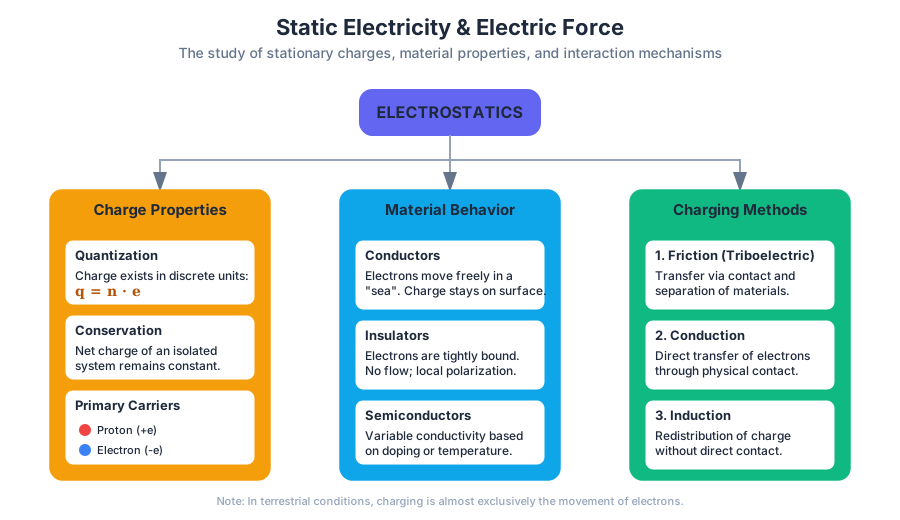
In the macroscopic world, charge appears continuous. However, at the subatomic scale, charge is quantized. This means it exists only in discrete integer multiples of a fundamental unit, known as the elementary charge ($e$).
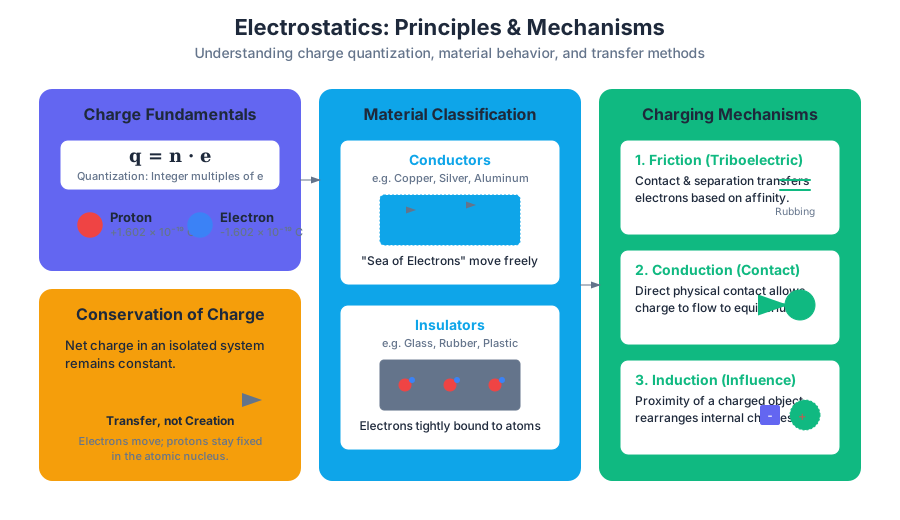
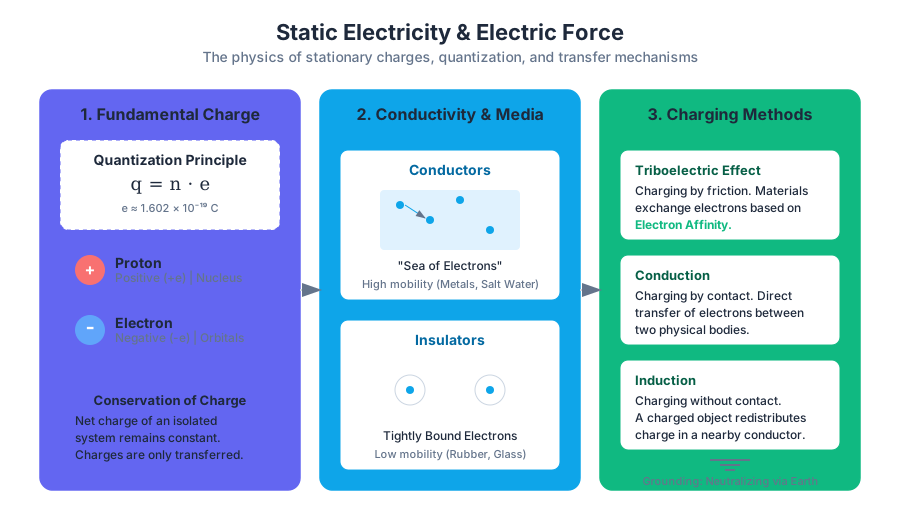
The Quantization Principle: The charge $q$ of any object is given by $q = ne$, where $n$ is an integer (positive or negative) and $e \approx 1.602 \times 10^{-19}$ Coulombs.
Fundamental Particles and Charge
The primary carriers of charge in ordinary matter are protons and electrons. While their masses differ by nearly three orders of magnitude, their charge magnitudes are identical.
| Particle | Charge (C) | Mass (kg) | Location |
|---|---|---|---|
| Proton | $+1.602 \times 10^{-19}$ | $1.673 \times 10^{-27}$ | Nucleus |
| Electron | $-1.602 \times 10^{-19}$ | $9.109 \times 10^{-31}$ | Orbitals/Shells |
| Neutron | $0$ | $1.675 \times 10^{-27}$ | Nucleus |
Conservation of Charge
The Law of Conservation of Charge is a foundational pillar of physics. It states that the net electric charge of an isolated system remains constant regardless of any internal changes. Charge is neither created nor destroyed; it is merely transferred from one body to another.
Mechanics of Transfer
In most terrestrial applications, "charging" an object involves the movement of electrons. Protons are bound tightly within the atomic nucleus by the strong nuclear force; moving them would require nuclear levels of energy. Electrons, particularly those in the outer "valence" shells of conductors, are much more mobile.
- Negative Charge Acquisition: An object gains electrons.
- Positive Charge Acquisition: An object loses electrons (leaving behind uncompensated protons).
Conductors, Insulators, and Semiconductors
The behavior of static charge on an object depends entirely on the material's internal atomic structure and how easily electrons can migrate through the lattice.
| Material Type | Electron Mobility | Mechanism | Common Examples |
|---|---|---|---|
| Conductor | High | "Sea of electrons" move freely across the lattice. | Copper, Silver, Aluminum, Salt Water |
| Insulator | Low | Electrons are tightly bound to specific atoms/molecules. | Rubber, Glass, Plastic, Dry Wood |
| Semiconductor | Variable | Conductivity depends on impurities (doping) or temperature. | Silicon, Germanium, Gallium Arsenide |
| Superconductor | Infinite | Zero resistance below a critical temperature ($T_c$). | Mercury (<4.2K), YBCO |
Charge Distribution in Conductors
In a conductor, like charges repel each other. Consequently, any excess charge placed on a conductor will migrate to the outer surface to maximize the distance between individual charges. Inside the bulk of a static conductor, the net electric field is always zero.
Mechanisms of Charging
Understanding how objects become "static" requires looking at the interface of materials.
1. The Triboelectric Effect (Charging by Friction)
When two different materials are brought into contact and then separated, one may "steal" electrons from the other. This is governed by the Triboelectric Series, a ranking of materials based on their electron affinity.
| Material | Tendency |
|---|---|
| Rabbit Fur | Highly Positive (Loses Electrons) |
| Glass | Positive |
| Human Hair | Positive |
| Silk | Neutral / Slightly Negative |
| Hard Rubber | Negative |
| PVC / Teflon | Highly Negative (Gains Electrons) |
2. Charging by Conduction (Contact)
This involves the direct physical transfer of electrons from a charged object to a neutral (or differently charged) object. If a negatively charged rod touches a neutral metal sphere, electrons flow onto the sphere until a state of equilibrium is reached.
3. Charging by Induction
Induction is a method used to charge an object without touching it.
- Bring a charged object (e.g., a negative rod) near a neutral conductor.
- The electrons in the conductor are repelled to the far side (Polarization).
- "Ground" the far side of the conductor, allowing the repelled electrons to escape to the Earth.
- Remove the ground, then remove the rod. The conductor is now left with a net positive charge.
Coulomb’s Law
Coulomb's Law provides the mathematical framework for calculating the magnitude and direction of the force between two stationary point charges.
Coulomb's Law: The magnitude of the electric force $F$ between two point charges $q_1$ and $q_2$ is directly proportional to the product of the charges and inversely proportional to the square of the distance $r$ between them.
\mathbf{F}_{12} = k \frac{q_1 q_2}{r^2} \mathbf{\hat{r}}_{21}
Where:
- $F$ is the force in Newtons (N).
- $q_1, q_2$ are the charges in Coulombs (C).
- $r$ is the separation distance in meters (m).
- $k$ is Coulomb's constant, $k = \frac{1}{4\pi\epsilon_0} \approx 8.99 \times 10^9 \text{ N}\cdot\text{m}^2/\text{C}^2$.
- $\epsilon_0$ is the permittivity of free space ($\approx 8.854 \times 10^{-12} \text{ C}^2/\text{N}\cdot\text{m}^2$).
Vector Nature and Superposition
Electrostatic force is a vector. If multiple charges are present, the net force on any single charge is the vector sum of the individual forces exerted by all other charges. This is known as the Principle of Superposition.
Comparison: Electrostatic vs. Gravitational Force
Coulomb's Law bears a striking resemblance to Newton's Law of Universal Gravitation. Both are inverse-square laws, but they differ significantly in scale and nature.
| Feature | Electrostatic Force ($F_e$) | Gravitational Force ($F_g$) |
|---|---|---|
| Equation | $k \frac{q_1 q_2}{r^2}$ | $G \frac{m_1 m_2}{r^2}$ |
| Constant | $8.99 \times 10^9$ | $6.67 \times 10^{-11}$ |
| Nature | Attractive or Repulsive | Always Attractive |
| Strength | Extremely Strong | Extremely Weak |
| Range | Infinite | Infinite |
Proof of Strength: Compare the $F_e$ and $F_g$ between two protons. The ratio $F_e / F_g \approx 10^{36}$. Gravity is only dominant on a cosmic scale because large bodies are usually electrically neutral.
Worked Example: The Three-Charge System
Consider three point charges arranged in a line:
- $q_1 = +2.0 \mu\text{C}$ at $x = 0$
- $q_2 = -3.0 \mu\text{C}$ at $x = 0.4\text{ m}$
- $q_3 = -5.0 \mu\text{C}$ at $x = 1.2\text{ m}$
Goal: Find the net force on $q_2$.
-
Force from $q_1$ on $q_2$ ($F_{12}$): Since $q_1$ is positive and $q_2$ is negative, the force is attractive. $q_2$ is pulled toward $x=0$ (the negative x-direction). $F_{12} = k \frac{|q_1 q_2|}{r_{12}^2} = (8.99 \times 10^9) \frac{(2 \times 10^{-6})(3 \times 10^{-6})}{(0.4)^2} = 0.337 \text{ N}$ (Left)
-
Force from $q_3$ on $q_2$ ($F_{32}$): Since both $q_3$ and $q_2$ are negative, the force is repulsive. $q_2$ is pushed away from $q_3$ (toward the negative x-direction). $r_{32} = 1.2 - 0.4 = 0.8\text{ m}$ $F_{32} = k \frac{|q_3 q_2|}{r_{32}^2} = (8.99 \times 10^9) \frac{(5 \times 10^{-6})(3 \times 10^{-6})}{(0.8)^2} = 0.211 \text{ N}$ (Left)
-
Net Force ($F_{net}$): Both forces point in the same direction. $F_{net} = 0.337 + 0.211 = 0.548 \text{ N}$ in the $-x$ direction.
Common Pitfalls and Misconceptions
- The "Static" Misnomer: Static electricity doesn't mean the charges don't move; it means they are not part of a continuous, closed-loop current. A spark is a very rapid movement of "static" charge.
- Mass vs. Charge: Students often confuse the behavior of electrons and protons. Remember: In solids, only electrons move. If an object is positively charged, it has lost electrons, not gained protons.
- The Inverse Square Law: Doubling the distance doesn't halve the force; it reduces it to one-fourth ($1/2^2$). Tripling the distance reduces it to one-ninth.
- Permittivity of the Medium: Coulomb's constant $k$ is for a vacuum. If charges are in water or oil, the force is significantly reduced because the medium polarizes and partially cancels the field. This is why the formula often uses $\epsilon$ instead of $\epsilon_0$.
Advanced Concept: Polarization in Insulators
While insulators do not allow electrons to flow across the material, they can still experience electrostatic effects through Polarization. When a charged object is brought near an insulator, the individual molecules within the insulator distort. The electron clouds shift slightly away from (or toward) the external charge.
This creates a layer of surface charge that allows a neutral insulator (like a balloon) to stick to a neutral wall. The balloon's charge polarizes the wall's molecules, creating an attractive force between the balloon and the shifted charges in the wall.
Source Materials
Study High School Physics on Lykke
This course page is free to open: signed out, you can read its first two sections, and signing in, on any plan, opens the rest. The free Lykke Chrome extension syncs your own Canvas courses, so ChatGPT, Claude and Muse can answer from your classes and deadlines. It only reads Canvas.
Add the free extensionSign in to open every sectionAll sections of High School Physics · Browse more course pages