From the free course High School Physics on Lykke
Simple Harmonic Motion
Key concepts: Amplitude · Period and Frequency · Spring-mass systems · Simple pendulums
Analyzing oscillatory motion in systems like springs and pendulums.
Simple Harmonic Motion (SHM)
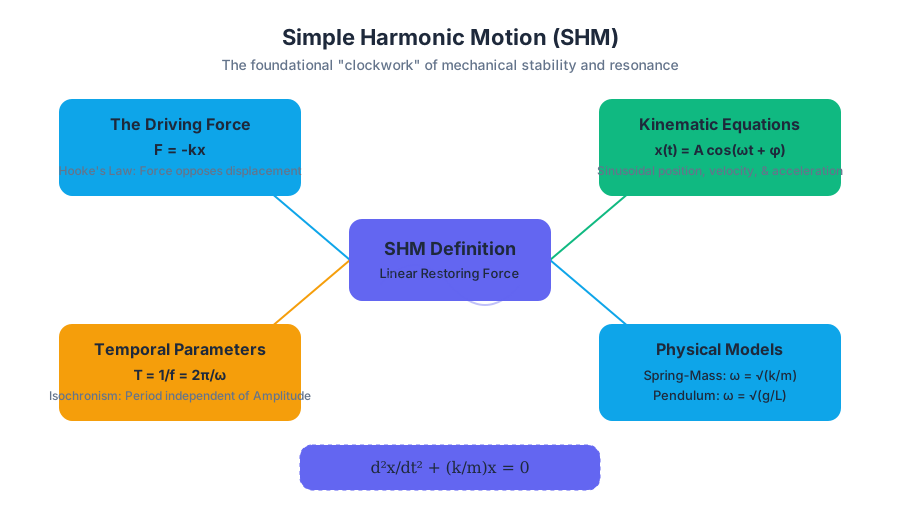
Simple Harmonic Motion (SHM) is the foundational "clockwork" of the physical universe. It describes a specific class of periodic motion where an object oscillates about a central equilibrium point, driven by a restoring force that is linearly proportional to its displacement from that center. From the vibration of atoms in a crystal lattice to the swaying of skyscrapers in the wind, SHM provides the mathematical framework for understanding stability and resonance in mechanical systems.
The Mathematical Foundation of SHM
To understand SHM, we must first define it through the lens of Newtonian mechanics. An oscillator is "simple" and "harmonic" if it obeys a linear restoring force, most famously characterized by Hooke’s Law:
Definition: Hooke's Law The force $F$ exerted by a spring is equal to the displacement $x$ multiplied by a negative constant $k$ (the spring constant): $$F = -kx$$ The negative sign indicates that the force always acts in the direction opposite to the displacement, seeking to return the system to $x = 0$ (equilibrium).
The Second-Order Differential Equation
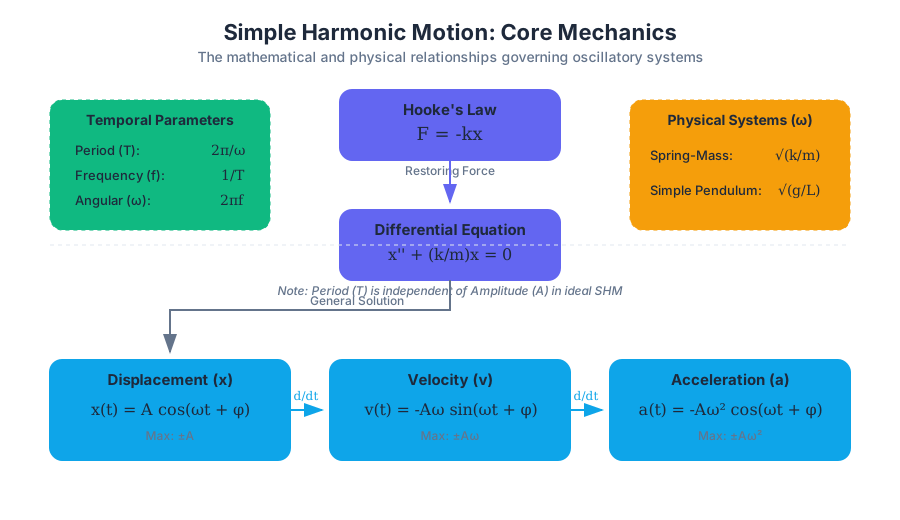
By applying Newton’s Second Law ($F = ma$), we can derive the equation of motion for any SHM system: $$ma = -kx$$ $$m \frac{d^2x}{dt^2} + kx = 0$$ $$\frac{d^2x}{dt^2} + \frac{k}{m}x = 0$$
This is a linear second-order homogeneous differential equation. The solution to this equation must be a function whose second derivative is the negative of itself (scaled by a constant). This naturally leads us to sinusoidal functions (sine and cosine).
Kinematic Equations of SHM
The general solution for the position $x$ as a function of time $t$ is: $$x(t) = A \cos(\omega t + \phi)$$
Where:
- $A$ (Amplitude): The maximum displacement from equilibrium (meters).
- $\omega$ (Angular Frequency): The rate of oscillation in radians per second ($\omega = \sqrt{k/m}$).
- $\phi$ (Phase Constant): Determines the starting position of the oscillator at $t=0$.
| Variable | Definition | Unit | Relationship |
|---|---|---|---|
| Displacement ($x$) | Distance from equilibrium | $m$ | $x(t) = A \cos(\omega t + \phi)$ |
| Velocity ($v$) | Rate of change of position | $m/s$ | $v(t) = -A\omega \sin(\omega t + \phi)$ |
| Acceleration ($a$) | Rate of change of velocity | $m/s^2$ | $a(t) = -A\omega^2 \cos(\omega t + \phi)$ |
| Jerk ($j$) | Rate of change of acceleration | $m/s^3$ | $j(t) = A\omega^3 \sin(\omega t + \phi)$ |
Amplitude, Period, and Frequency
The "heartbeat" of an oscillator is defined by how far it travels and how often it repeats its cycle. Unlike many complex systems, the Period of an ideal simple harmonic oscillator is independent of its Amplitude—a property known as isochronism.
Defining the Temporal Parameters
- Amplitude ($A$): This represents the energy of the system. In a perfect vacuum without friction, the amplitude remains constant.
- Period ($T$): The time required to complete one full cycle (e.g., from peak to peak).
- Frequency ($f$): The number of cycles per unit time, measured in Hertz (Hz).
- Angular Frequency ($\omega$): Often more useful in calculations, representing the frequency in terms of circular motion (rad/s).
Key Insight: The relationship between these variables is strictly defined: $$f = \frac{1}{T}, \quad \omega = 2\pi f = \frac{2\pi}{T}$$
Worked Example: Calculating System Parameters
Suppose a $0.5\text{ kg}$ mass is attached to a spring with $k = 200\text{ N/m}$. It is pulled $0.1\text{ m}$ from equilibrium and released.
- Find $\omega$: $\omega = \sqrt{k/m} = \sqrt{200/0.5} = \sqrt{400} = 20\text{ rad/s}$.
- Find $f$: $f = \omega / 2\pi \approx 3.18\text{ Hz}$.
- Find $T$: $T = 1/f \approx 0.314\text{ s}$.
- Max Velocity: $v_{max} = A\omega = (0.1)(20) = 2.0\text{ m/s}$.
Spring-Mass Systems
The spring-mass system is the quintessential model for SHM. While we often visualize it horizontally on a frictionless surface, the physics applies equally to vertical systems, with one crucial distinction: the equilibrium position.
Vertical Springs and Gravity
In a vertical system, gravity stretches the spring by an amount $\Delta y$ to a new equilibrium point where $mg = k\Delta y$. When the mass oscillates, it moves around this shifted equilibrium. Surprisingly, the Period remains identical to the horizontal case because the constant force of gravity does not change the linear nature of the restoring force.
Simple Pendulums
A simple pendulum consists of a point mass (bob) suspended by a massless, unstretchable string. Unlike the spring-mass system, the pendulum is only "simple" under specific conditions.
The Small Angle Approximation
The restoring force for a pendulum is the component of gravity acting tangent to the arc: $$F_{restoring} = -mg \sin(\theta)$$
Since $F = ma$ and the tangential acceleration $a = L \frac{d^2\theta}{dt^2}$, we have: $$mL \frac{d^2\theta}{dt^2} = -mg \sin(\theta)$$ $$\frac{d^2\theta}{dt^2} + \frac{g}{L} \sin(\theta) = 0$$
This equation is non-linear because of the $\sin(\theta)$ term. To treat it as SHM, we apply the Small Angle Approximation: for small $\theta$ (typically $< 15^\circ$), $\sin(\theta) \approx \theta$ (in radians).
Derivation of the Period
With the approximation, the equation becomes: $$\frac{d^2\theta}{dt^2} + \frac{g}{L} \theta = 0$$ By comparing this to the standard SHM form $\frac{d^2x}{dt^2} + \omega^2 x = 0$, we find: $$\omega = \sqrt{\frac{g}{L}} \implies T = 2\pi \sqrt{\frac{L}{g}}$$
Comparison: Spring vs. Pendulum
It is vital for engineers to distinguish which physical properties influence the timing of these systems.
| Feature | Spring-Mass System | Simple Pendulum |
|---|---|---|
| Restoring Force | Elasticity (Hooke's Law) | Gravity (Component) |
| Angular Frequency ($\omega$) | $\sqrt{k/m}$ | $\sqrt{g/L}$ |
| Period ($T$) | $2\pi \sqrt{m/k}$ | $2\pi \sqrt{L/g}$ |
| Mass Dependence | Period increases with mass | Period is independent of mass |
| Amplitude Dependence | Independent (Ideal) | Independent (Small angles only) |
| Location Dependence | Works in Zero-G | Requires Gravity |
Mathematical Derivation: Taylor Expansion
The reason the small angle approximation works is found in the Taylor Series expansion of the sine function:
\sin(\theta) = \sum_{n=0}^{\infty} \frac{(-1)^n}{(2n+1)!} \theta^{2n+1} = \theta - \frac{\theta^3}{3!} + \frac{\theta^5}{5!} - \dots
When $\theta$ is small, the $\theta^3$ and higher-order terms become negligible, leaving $\sin(\theta) \approx \theta$. If an engineer requires higher precision for large swings, they must use the Elliptic Integral of the First Kind to calculate the period.
Energy in Harmonic Oscillators
In an ideal SHM system, energy is perfectly conserved, constantly sloshing back and forth between Kinetic Energy ($K$) and Potential Energy ($U$).
- Potential Energy: For a spring, $U = \frac{1}{2}kx^2$. It is maximum at the amplitudes ($x = \pm A$).
- Kinetic Energy: $K = \frac{1}{2}mv^2$. It is maximum at the equilibrium position ($x = 0$).
- Total Energy ($E$): The sum is constant at any point in time. $$E = \frac{1}{2}kA^2 = \frac{1}{2}mv_{max}^2$$
Energy Distribution Table
Understanding where energy resides at specific points in the cycle is crucial for solving complex mechanics problems.
| Position ($x$) | Velocity ($v$) | Potential Energy ($U$) | Kinetic Energy ($K$) | Total Energy ($E$) |
|---|---|---|---|---|
| $\pm A$ (Max) | $0$ | $\frac{1}{2}kA^2$ | $0$ | $\frac{1}{2}kA^2$ |
| $0$ (Equil.) | $v_{max}$ | $0$ | $\frac{1}{2}mv_{max}^2$ | $\frac{1}{2}kA^2$ |
| $A/2$ | $v_{max} \sqrt{3}/2$ | $\frac{1}{4} E_{total}$ | $\frac{3}{4} E_{total}$ | $\frac{1}{2}kA^2$ |
Variations: Damping and Resonance
Real-world systems are rarely "simple." They are subject to non-conservative forces.
Damped Harmonic Motion
When friction or air resistance is present, the amplitude decays over time. The force becomes $F = -kx - bv$, where $b$ is the damping coefficient.
- Underdamped: The system oscillates with decreasing amplitude.
- Critically Damped: The system returns to equilibrium as quickly as possible without oscillating.
- Overdamped: The system returns to equilibrium slowly without oscillating.
Driven Oscillations and Resonance
If an external periodic force is applied, we have a driven oscillator. If the driving frequency matches the natural frequency ($\omega_0$) of the system, the amplitude increases dramatically. This is Resonance.
Common Pitfalls and Misconceptions
- Confusion between Frequency and Angular Frequency: Students often use $f$ where $\omega$ is required in the sine/cosine argument. Remember: $x(t) = A \cos(2\pi f t)$.
- Mass in Pendulums: A common trick question asks how the period of a pendulum changes if the mass of the bob is doubled. The answer is: it doesn't. Mass cancels out in the pendulum derivation.
- The "Simple" in Simple Pendulum: Many forget that $T = 2\pi \sqrt{L/g}$ is an approximation. At large angles (e.g., $90^\circ$), the actual period is significantly longer than the formula predicts.
- Spring Constant Units: Ensure $k$ is in N/m. If given in N/cm, a factor of 100 error will propagate through the entire calculation.
- Phase Shifts: If the mass starts at the equilibrium position moving right, the equation is $x(t) = A \sin(\omega t)$, not $A \cos(\omega t)$. This is a phase shift of $\pi/2$.
Source Materials
Study High School Physics on Lykke
This course page is free to open: signed out, you can read its first two sections, and signing in, on any plan, opens the rest. The free Lykke Chrome extension syncs your own Canvas courses, so ChatGPT, Claude and Muse can answer from your classes and deadlines. It only reads Canvas.
Add the free extensionSign in to open every sectionAll sections of High School Physics · Browse more course pages