From the free course High School Physics on Lykke
The Physics of Sound
Key concepts: Doppler Effect · Standing Waves in Tubes · Beat Frequency · Sound Intensity
A specialized look at sound waves, focusing on resonance in tubes, beats, and the Doppler effect.
The Physics of Sound
Sound is a mechanical, longitudinal wave that propagates through a medium via the periodic compression and rarefaction of molecules. Unlike electromagnetic waves, sound requires a physical substrate—be it gas, liquid, or solid—to transmit energy. In the context of fluid dynamics and classical mechanics, sound is best understood as a pressure wave. When a source vibrates, it imparts kinetic energy to adjacent particles, creating a local increase in pressure (compression) followed by a decrease (rarefaction).
The velocity of sound ($v$) is not a universal constant but depends on the elastic and inertial properties of the medium. In a fluid, it is defined by the bulk modulus ($B$) and density ($\rho$): $$v = \sqrt{\frac{B}{\rho}}$$ In the atmosphere, temperature is the primary driver of speed variance, approximated at $v \approx 331.3 \sqrt{1 + \frac{T}{273.15}}$ m/s. Understanding sound requires moving beyond simple wave propagation into the complex interactions of boundary conditions, relative motion, and interference patterns.
Standing Waves in Tubes
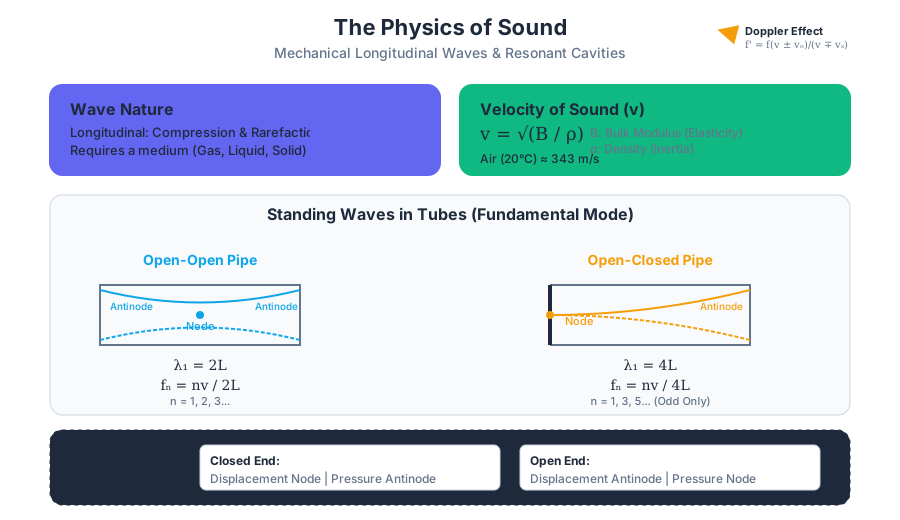
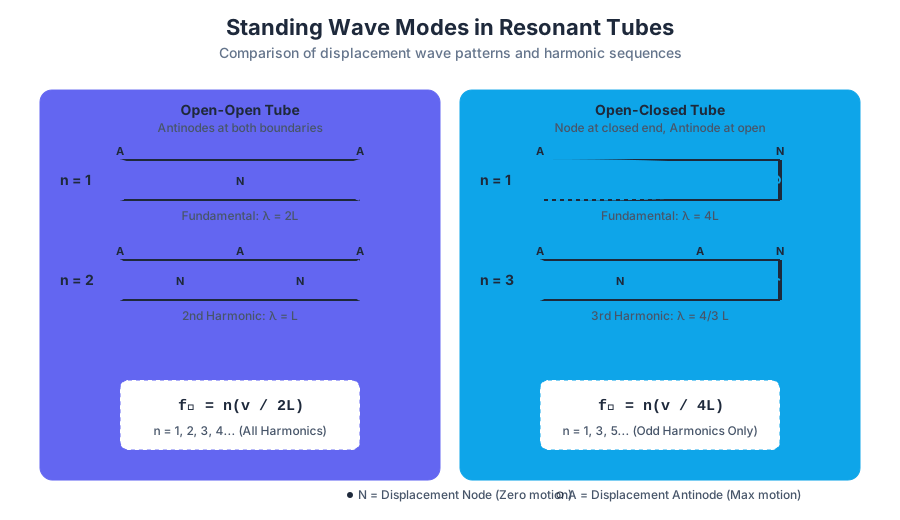
When sound waves are confined within a cylindrical cavity, such as a flute, a pipe organ, or a human vocal tract, they undergo reflection at the boundaries. The interference between the incident wave and the reflected wave creates standing waves. These are stationary patterns where certain points (nodes) remain at rest while others (antinodes) oscillate with maximum amplitude.
Boundary Conditions: Displacement vs. Pressure
It is critical to distinguish between displacement nodes and pressure nodes.
- At a closed end, air molecules are physically stopped by a barrier, creating a displacement node. However, because molecules pile up against this wall, this point experiences the maximum pressure fluctuation, making it a pressure antinode.
- At an open end, the air is free to move, creating a displacement antinode. Because the open end is exposed to the constant atmospheric pressure of the outside environment, it remains a pressure node.
Harmonic Series in Open and Closed Tubes
The geometry of the tube determines which wavelengths ($\lambda$) can survive through constructive interference.
| Tube Type | Boundary Conditions | Fundamental Wavelength ($\lambda_1$) | Harmonic Sequence | Allowed Harmonics ($n$) |
|---|---|---|---|---|
| Open-Open | Antinode at both ends | $2L$ | $f_n = \frac{nv}{2L}$ | $n = 1, 2, 3, \dots$ (All) |
| Open-Closed | Node at one, Antinode at other | $4L$ | $f_n = \frac{nv}{4L}$ | $n = 1, 3, 5, \dots$ (Odd only) |
| Closed-Closed | Node at both ends | $2L$ | $f_n = \frac{nv}{2L}$ | $n = 1, 2, 3, \dots$ (All) |
The End Correction Factor: In real-world acoustics, the displacement antinode at an open end does not occur exactly at the tube's exit but slightly beyond it. For a tube of radius $r$, the effective length $L_{eff}$ is approximately $L + 0.6r$ for each open end. This is why professional instrument tuning involves physical adjustments to the bore length.
Worked Example: The Pipe Organ
Consider an organ pipe that is 2.5 meters long, open at one end and closed at the other, in a room where the speed of sound is 343 m/s.
- Fundamental Frequency ($f_1$): $$f_1 = \frac{v}{4L} = \frac{343}{4(2.5)} = 34.3 \text{ Hz}$$
- Third Harmonic ($f_3$): $$f_3 = 3 \times f_1 = 102.9 \text{ Hz}$$
The Doppler Effect
The Doppler Effect is the observed change in frequency of a wave when there is relative motion between the source and the observer. It is not a change in the frequency emitted by the source, but rather a result of the "bunching up" or "stretching out" of wave fronts in the medium.
The General Doppler Equation
The perceived frequency $f'$ is related to the source frequency $f_s$ by: $$f' = f_s \left( \frac{v \pm v_o}{v \mp v_s} \right)$$ Where:
- $v$: Speed of sound in the medium.
- $v_o$: Velocity of the observer.
- $v_s$: Velocity of the source.
Sign Convention Logic:
- The numerator $(v \pm v_o)$ concerns the observer. Use + if the observer moves toward the source (increasing perceived frequency).
- The denominator $(v \mp v_s)$ concerns the source. Use - if the source moves toward the observer (decreasing the denominator, thus increasing $f'$).
| Scenario | Numerator Sign | Denominator Sign | Resulting $f'$ |
|---|---|---|---|
| Observer moving toward stationary Source | $+$ | $v$ | $f' > f_s$ |
| Source moving toward stationary Observer | $v$ | $-$ | $f' > f_s$ |
| Both moving away from each other | $-$ | $+$ | $f' < f_s$ |
| Source moving at $v_s = v$ | $v$ | $0$ | $f' \to \infty$ (Shockwave) |
Derivation for a Moving Source
Consider a source moving toward a stationary observer at velocity $v_s$. In one period $T$, the source moves a distance $d_s = v_s T$. The wave itself travels $d_w = v T$. The new wavelength $\lambda'$ is the distance between successive wave fronts: $$\lambda' = d_w - d_s = (v - v_s)T$$ Since $T = 1/f_s$ and $f' = v/\lambda'$: $$f' = \frac{v}{(v - v_s)/f_s} = f_s \left( \frac{v}{v - v_s} \right)$$ This confirms that as the source approaches, the wavelength decreases, causing the pitch to rise.
Applications and Extensions
- Astronomy (Redshift/Blueshift): While light follows relativistic Doppler equations, the principle is the same: objects moving away appear "redder" (lower frequency).
- Medical Imaging: Doppler Ultrasound measures the velocity of blood flow by detecting the frequency shift of sound waves reflected off moving red blood cells.
- Sonic Booms: When $v_s > v$, the wave fronts overlap to form a conical pressure ridge known as a Mach cone. The angle of this cone is $\sin \theta = v / v_s = 1/M$, where $M$ is the Mach number.
Beat Frequency
When two sound waves of slightly different frequencies, $f_1$ and $f_2$, overlap at the same point in space, they interfere. Because their frequencies differ, they alternate between being in-phase (constructive interference) and out-of-phase (destructive interference). This results in a periodic variation in volume called beats.
Mathematical Derivation
Assume two waves of equal amplitude $A$: $$y_1 = A \sin(2\pi f_1 t)$$ $$y_2 = A \sin(2\pi f_2 t)$$ Using the trigonometric identity $\sin \alpha + \sin \beta = 2 \sin(\frac{\alpha+\beta}{2}) \cos(\frac{\alpha-\beta}{2})$: $$y_{total} = \left[ 2A \cos\left(2\pi \frac{f_1 - f_2}{2} t\right) \right] \sin\left(2\pi \frac{f_1 + f_2}{2} t\right)$$ The term in the brackets represents a slowly varying amplitude (the envelope). The frequency of this envelope is $\frac{f_1 - f_2}{2}$. However, because a "beat" is heard at every maximum amplitude (both positive and negative peaks of the cosine), the human ear perceives two beats per cycle of the envelope. Therefore, the Beat Frequency ($f_b$) is: $$f_b = |f_1 - f_2|$$
Usage in Instrument Tuning
Musicians use beats to tune instruments to a reference pitch (like a tuning fork). If a piano string and a 440 Hz tuning fork produce 3 beats per second, the string is vibrating at either 437 Hz or 443 Hz. The tuner then tightens or loosens the string; if the beat frequency decreases, they are moving toward the correct pitch.
Sound Intensity and the Decibel Scale
Sound intensity ($I$) is the rate at which energy is transported per unit area perpendicular to the direction of propagation. $$I = \frac{P}{A} = \frac{P}{4\pi r^2}$$ This Inverse Square Law implies that if you double your distance from a point source, the intensity drops to one-fourth of its original value.
The Logarithmic Nature of Hearing
The human ear can detect intensities ranging from $10^{-12} \text{ W/m}^2$ (the Threshold of Hearing) to over $10 \text{ W/m}^2$ (the threshold of pain). Because this range spans 13 orders of magnitude, we use a logarithmic scale called the Sound Intensity Level ($\beta$), measured in Decibels (dB).
$$\beta = 10 \log_{10} \left( \frac{I}{I_0} \right)$$ Where $I_0 = 10^{-12} \text{ W/m}^2$.
| Sound Source | Intensity ($W/m^2$) | Intensity Level (dB) | Perception |
|---|---|---|---|
| Threshold of Hearing | $10^{-12}$ | 0 | Barely audible |
| Rustling Leaves | $10^{-11}$ | 10 | Very quiet |
| Normal Conversation | $10^{-6}$ | 60 | Comfortable |
| Power Lawn Mower | $10^{-2}$ | 100 | Potentially damaging |
| Jet Engine (30m) | $10^{2}$ | 140 | Painful / Immediate damage |
Key Insight: Every increase of 10 dB represents a 10-fold increase in intensity. However, a 10 dB increase is generally perceived by the human ear as only a "doubling" of loudness. This is a physiological artifact described by the Weber-Fechner Law.
Combining Sound Sources
If you have two independent sound sources (e.g., two violins) playing at 60 dB each, the total intensity level is not 120 dB. Instead, you must sum the intensities:
- $I_{total} = I_1 + I_2$
- Since $I_1 = I_2 = 10^{-6} \text{ W/m}^2$, $I_{total} = 2 \times 10^{-6} \text{ W/m}^2$.
- $\beta_{total} = 10 \log_{10} (2 \times 10^{-6} / 10^{-12}) = 10 \log_{10} (2 \times 10^6) \approx 63 \text{ dB}$. Doubling the power of a sound source results in a mere 3 dB increase.
Common Pitfalls and Misconceptions
- Medium Dependency: A common mistake is assuming the speed of sound is constant. In underwater acoustics (SONAR), the speed of sound varies significantly with salinity and depth, creating "shadow zones" where sound waves refract away, making objects invisible to sonar.
- Frequency vs. Speed: Increasing the frequency of a sound wave does not increase its speed. Speed is a property of the medium. $v = f\lambda$; if $f$ increases, $\lambda$ must decrease proportionally.
- The "Vacuum" Myth: Science fiction often depicts loud explosions in space. Since sound is a mechanical wave requiring a medium for particle-to-particle interaction, space is silent.
- Doppler Sign Errors: Students often confuse the signs in the Doppler formula. Remember: Toward = Higher Frequency. If your calculation results in a lower frequency for an approaching source, your signs are reversed.
- Longitudinal Wave: A wave where particle displacement is parallel to the direction of energy transport.
- Node: A point in a standing wave with zero displacement (or zero pressure change).
- Antinode: A point in a standing wave with maximum displacement (or maximum pressure change).
- Fundamental Frequency: The lowest frequency of a standing wave that can be supported by a given geometry.
- Harmonics: Integer multiples of the fundamental frequency.
- Beat Frequency: The absolute difference between two interfering frequencies ($|f_1 - f_2|$).
- Intensity: Power per unit area ($W/m^2$).
- Decibel (dB): A logarithmic unit used to express the ratio of a sound's intensity to a reference level.
- Doppler Shift: The change in frequency caused by relative motion between source and observer.
- Bulk Modulus: A measure of a substance's resistance to uniform compression, key to determining sound speed in fluids.
- Why do open-closed tubes only produce odd harmonics?
- If a source moves away from an observer at the speed of sound, what is the perceived frequency?
- Calculate the decibel level of a sound with an intensity of $10^{-4} \text{ W/m}^2$.
- Two tuning forks of 256 Hz and 260 Hz are struck simultaneously. How many beats are heard in 5 seconds?
- How does the speed of sound change if the air temperature rises from 0°C to 30°C?
- Explain the difference between a pressure node and a displacement node at the open end of a pipe.
Key Formulas to Memorize:
- Speed in gas: $v \approx 331 + 0.6T$
- Open Tube: $f_n = \frac{nv}{2L}$
- Closed Tube: $f_n = \frac{(2n-1)v}{4L}$
- Doppler: $f' = f \frac{v \pm v_o}{v \mp v_s}$
- Intensity Level: $\beta = 10 \log \frac{I}{I_0}$
- Beats: $f_b = |f_1 - f_2|$
Problem Solving Strategy:
- Identify the Medium: Check for temperature or material properties to find $v$.
- Check Boundaries: Is the tube open at both ends or closed at one? This dictates the harmonic formula.
- Determine Motion: For Doppler problems, draw a vector diagram. Define the "positive" direction from observer to source to keep signs consistent.
- Logarithmic Math: Remember that adding 3 dB doubles the intensity, and adding 10 dB increases intensity by 10x.
Source Materials
Study High School Physics on Lykke
This course page is free to open: signed out, you can read its first two sections, and signing in, on any plan, opens the rest. The free Lykke Chrome extension syncs your own Canvas courses, so ChatGPT, Claude and Muse can answer from your classes and deadlines. It only reads Canvas.
Add the free extensionSign in to open every sectionAll sections of High School Physics · Browse more course pages