From the free course High School Physics on Lykke
Newton's Laws of Motion
Key concepts: Inertia · F=ma · Action-Reaction Pairs · Free-body diagrams · Weight
An exploration of the relationship between forces and motion through Isaac Newton's three fundamental laws.
Newton's Laws of Motion
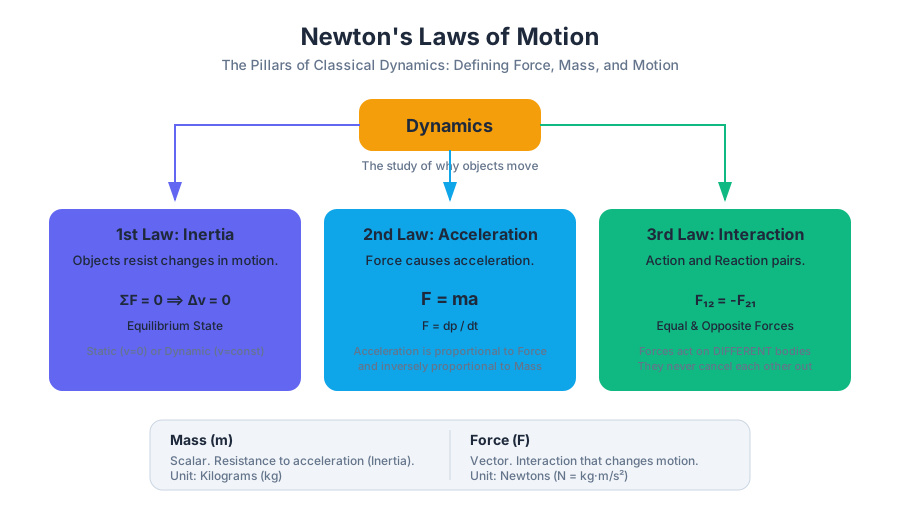
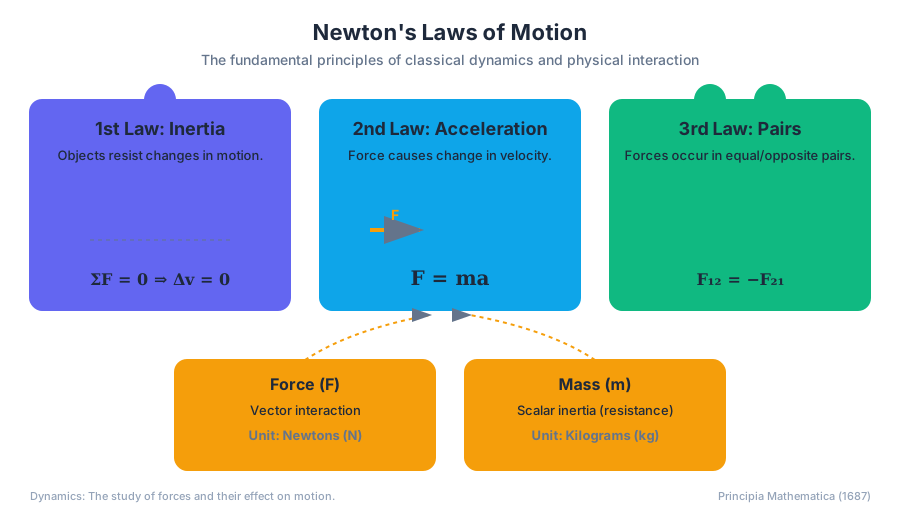
Dynamics is the branch of classical mechanics that addresses the causes of motion. While kinematics describes how objects move (position, velocity, acceleration), dynamics asks why they move. The foundation of this field rests upon three pillars formulated by Sir Isaac Newton in his 1687 masterpiece, Philosophiæ Naturalis Principia Mathematica. These laws are not merely empirical observations; they define the very concepts of mass, force, and momentum within a Galilean reference frame.
The Concept of Force and Mass
Before dissecting the laws, we must establish a rigorous definition of the two primary actors: Force and Mass.
- Force ($\vec{F}$): A vector quantity representing an interaction that, when unopposed, will change the motion of an object. It is measured in Newtons ($N$), where $1 N = 1 kg \cdot m/s^2$.
- Mass ($m$): A scalar quantity representing the intrinsic property of matter that resists acceleration. This is often referred to as Inertial Mass.
| Property | Mass ($m$) | Weight ($W$) | Force ($\vec{F}$) |
|---|---|---|---|
| Definition | Quantity of matter/Inertia | Gravitational pull on mass | Push or pull interaction |
| Type | Scalar | Vector (downward) | Vector |
| Unit | Kilograms ($kg$) | Newtons ($N$) | Newtons ($N$) |
| Variability | Constant regardless of location | Changes with gravity ($g$) | Dependent on interaction |
Newton’s First Law: The Law of Inertia
Theorem: Every object continues in its state of rest, or of uniform motion in a straight line, unless it is compelled to change that state by forces impressed upon it.
The First Law introduces the concept of Inertia—the tendency of an object to resist changes in its state of motion. It essentially defines a special class of reference frames known as Inertial Reference Frames. In these frames, an object with zero net force acting upon it maintains a constant velocity vector ($\vec{v} = \text{constant}$).
The Significance of Equilibrium
When the vector sum of all forces acting on an object is zero ($\sum \vec{F} = 0$), the object is in Translational Equilibrium.
- Static Equilibrium: The object is at rest ($\vec{v} = 0$).
- Dynamic Equilibrium: The object is moving at a constant velocity ($\vec{v} \neq 0, \vec{a} = 0$).
Common Pitfall: The "Force of Motion"
A frequent misconception among students is the "Aristotelian view" that a force is required to keep an object moving. Newton’s First Law explicitly denies this. If a puck slides across an infinite, frictionless ice rink, it requires no force to maintain its velocity. Force is the agent of change, not the agent of existence for motion.
Newton’s Second Law: The Fundamental Equation of Dynamics
Theorem: The acceleration of an object is directly proportional to the net force acting on it and inversely proportional to its mass. The direction of the acceleration is in the direction of the net force.
Mathematically, this is expressed as: $$\sum \vec{F} = m\vec{a}$$
Where $\sum \vec{F}$ (or $\vec{F}_{net}$) is the vector sum of all external forces. This law provides the quantitative link between force and kinematics.
Derivation from Momentum
Newton originally framed the Second Law in terms of Momentum ($\vec{p} = m\vec{v}$). He stated that force is the rate of change of momentum: $$\vec{F} = \frac{d\vec{p}}{dt}$$ If mass is constant: $$\vec{F} = \frac{d(m\vec{v})}{dt} = m\frac{d\vec{v}}{dt} = m\vec{a}$$
Newton’s Third Law: Action and Reaction
Theorem: Whenever one object exerts a force on a second object, the second object exerts an equal and opposite force on the first.
This law is often stated as "For every action, there is an equal and opposite reaction." However, this phrasing leads to the mistake of thinking the forces cancel out. They cannot cancel out because they act on different objects.
Action-Reaction Pairs
An action-reaction pair must satisfy three criteria:
- The forces are equal in magnitude.
- The forces are opposite in direction.
- The forces act on different bodies.
| Situation | Action Force | Reaction Force | Result |
|---|---|---|---|
| Walking | Foot pushes backward on Earth | Earth pushes forward on foot | Person moves forward |
| Rocketry | Rocket pushes gas downward | Gas pushes rocket upward | Rocket accelerates up |
| Gravity | Earth pulls down on Moon | Moon pulls up on Earth | Orbital motion |
| Tug of War | Person A pulls rope | Rope pulls Person A | Tension in rope |
Mathematical Proof of Momentum Conservation
The Third Law is the physical basis for the Law of Conservation of Momentum. If we have two isolated particles interacting:
\begin{aligned}
\vec{F}_{12} &= -\vec{F}_{21} \quad \text{(Newton's 3rd Law)} \\
\frac{d\vec{p}_1}{dt} &= -\frac{d\vec{p}_2}{dt} \quad \text{(Substituting 2nd Law)} \\
\frac{d\vec{p}_1}{dt} + \frac{d\vec{p}_2}{dt} &= 0 \\
\frac{d}{dt}(\vec{p}_1 + \vec{p}_2) &= 0 \\
\vec{p}_{total} &= \text{constant}
\end{aligned}
Free-Body Diagrams (FBDs)
The Free-Body Diagram is the essential analytical tool for applying Newton's Laws. It involves isolating a single body from its environment and representing every external force acting upon it as a vector.
Steps to Construct an FBD
- Isolate the object: Replace the object with a dot (representing the center of mass).
- Identify Field Forces: Draw the weight vector ($W = mg$) pointing straight down.
- Identify Contact Forces: Look for surfaces (Normal force), ropes (Tension), or rough textures (Friction).
- Coordinate System: Choose an axis that aligns with the expected acceleration (e.g., parallel to an inclined plane).
- Decompose Vectors: Resolve any forces not aligned with the axes into $x$ and $y$ components using trigonometry.
Common Forces in FBDs
| Force Name | Symbol | Direction | Magnitude |
|---|---|---|---|
| Weight | $\vec{F}_g$ | Toward center of Earth | $mg$ |
| Normal Force | $\vec{F}_N$ | Perpendicular to surface | Variable (depends on $\sum F_y$) |
| Tension | $\vec{T}$ | Along the string/cable | Variable (equal throughout rope) |
| Friction | $\vec{f}$ | Parallel to surface, opposes motion | $f_s \leq \mu_s F_N$ or $f_k = \mu_k F_N$ |
Weight and Apparent Weight
Weight is the force of gravity acting on an object. Unlike mass, weight is a vector and varies depending on the local gravitational field strength ($g$).
The Normal Force and Apparent Weight
What we "feel" as our weight is actually the Normal Force ($F_N$) exerted by the floor on our feet. In an accelerating frame, such as an elevator, $F_N$ changes, leading to the sensation of being heavier or lighter.
The Elevator Problem Case Study: Consider a person of mass $m$ in an elevator accelerating upward at $a$. Using $\sum F_y = ma$: $$F_N - mg = ma$$ $$F_N = m(g + a)$$
- If $a > 0$ (accelerating up): $F_N > mg$ (You feel heavier).
- If $a < 0$ (accelerating down): $F_N < mg$ (You feel lighter).
- If $a = -g$ (free fall): $F_N = 0$ (Apparent weightlessness).
Worked Example: The Inclined Plane with Friction
Problem: A block of mass $m = 5 kg$ is placed on a ramp inclined at $\theta = 30^\circ$. The coefficient of kinetic friction is $\mu_k = 0.2$. Calculate the acceleration of the block down the ramp.
1. Identify Forces:
- Gravity ($mg$) acting straight down.
- Normal Force ($F_N$) perpendicular to the ramp.
- Friction ($f_k$) acting up the ramp.
2. Set up Axes: Let $x$ be parallel to the ramp (downward) and $y$ be perpendicular to the ramp.
3. Decompose Gravity:
- $F_{gx} = mg \sin \theta$
- $F_{gy} = mg \cos \theta$
4. Solve for $F_N$ (y-axis equilibrium): $$\sum F_y = F_N - mg \cos \theta = 0 \implies F_N = mg \cos \theta$$
5. Solve for $a$ (x-axis dynamics): $$\sum F_x = mg \sin \theta - f_k = ma$$ Since $f_k = \mu_k F_N = \mu_k mg \cos \theta$: $$mg \sin \theta - \mu_k mg \cos \theta = ma$$ $$a = g(\sin \theta - \mu_k \cos \theta)$$
6. Plug in values: $$a = 9.8 (\sin 30^\circ - 0.2 \cos 30^\circ)$$ $$a = 9.8 (0.5 - 0.2 \times 0.866) = 9.8 (0.5 - 0.1732) = 3.20 \text{ m/s}^2$$
Advanced Extensions: Non-Inertial Frames
When we observe motion from an accelerating frame (like a turning car or a rotating space station), Newton's Laws appear to fail unless we introduce Fictitious Forces (or Inertial Forces).
- Centrifugal Force: The outward "force" felt in a rotating frame.
- Coriolis Force: The force that deflects moving objects in a rotating frame, crucial for atmospheric science.
In these frames, the Second Law is modified to: $$\vec{F}{net} + \vec{F}{fictitious} = m\vec{a}_{observed}$$
This highlights that Newton's Laws are not just equations, but a definition of the geometry of the space in which we measure motion.

Source Materials
Study High School Physics on Lykke
This course page is free to open: signed out, you can read its first two sections, and signing in, on any plan, opens the rest. The free Lykke Chrome extension syncs your own Canvas courses, so ChatGPT, Claude and Muse can answer from your classes and deadlines. It only reads Canvas.
Add the free extensionSign in to open every sectionAll sections of High School Physics · Browse more course pages