From the free course High School Physics on Lykke
Linear Momentum and Collisions
Key concepts: Linear Momentum · Impulse · Conservation of Momentum · Elastic vs. Inelastic Collisions · Center of Mass
The study of momentum, impulse, and the behavior of objects during elastic and inelastic collisions.
Linear Momentum and Collisions
Linear momentum is the fundamental metric of an object's motion, encapsulating both its inertia and its velocity. While Newton’s Second Law is often introduced as $F = ma$, Newton’s original formulation was more profound: force is the rate of change of momentum. This section explores the mechanics of how objects interact, the invariants that govern those interactions, and the mathematical frameworks used to predict the outcomes of everything from subatomic scattering to galactic mergers.
Linear Momentum: The Quantity of Motion
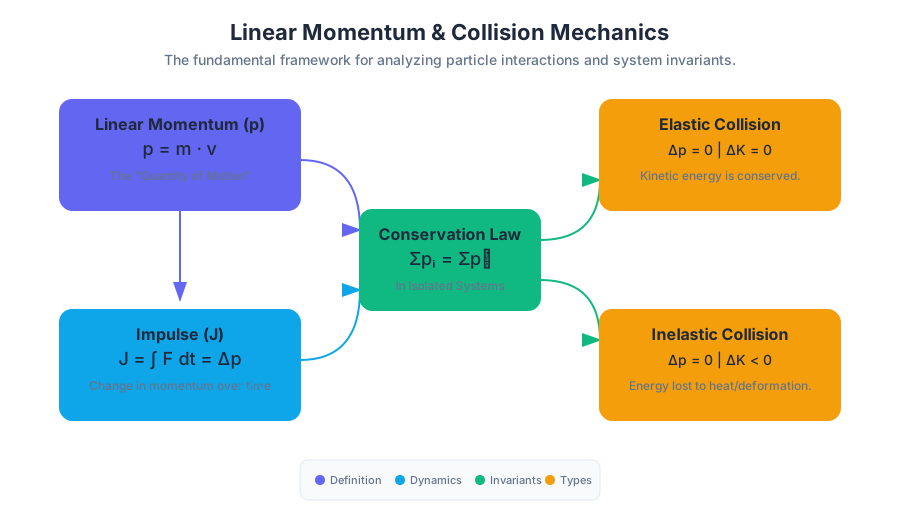
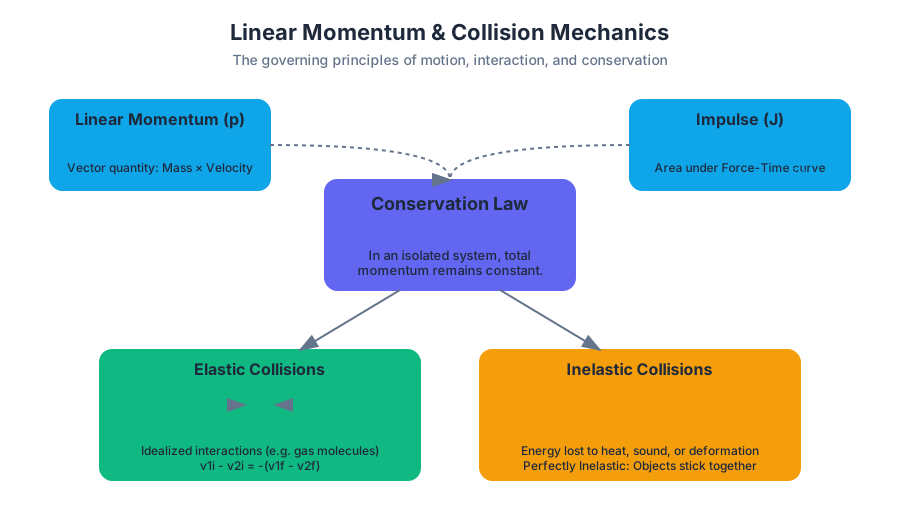
Linear momentum, denoted by the vector p, is defined as the product of an object's mass and its velocity. It is a vector quantity, meaning it possesses both magnitude and direction.
Definition: The linear momentum $\vec{p}$ of a particle of mass $m$ moving with velocity $\vec{v}$ is defined as: $$\vec{p} = m\vec{v}$$ The SI unit of momentum is the kilogram-meter per second ($kg \cdot m/s$).
Why Momentum Matters
While kinetic energy ($K = \frac{1}{2}mv^2$) describes the scalar "scalar energy" of motion, momentum describes the "directed persistence" of motion. Because momentum is proportional to $\vec{v}$ (rather than $v^2$), it is conserved in a way that kinetic energy is not. In any closed system, the total vector momentum remains constant, regardless of the complexity of the internal interactions.
Relativistic Considerations
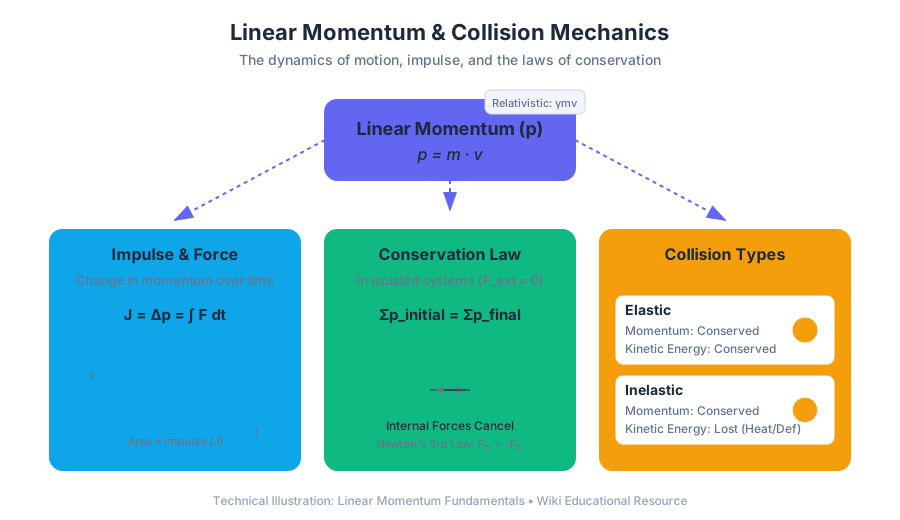
At velocities approaching the speed of light $c$, the classical definition fails. Senior engineers working with particle accelerators or high-energy physics must use the relativistic momentum: $$\vec{p} = \gamma m \vec{v} = \frac{m\vec{v}}{\sqrt{1 - \frac{v^2}{c^2}}}$$
| Parameter | Symbol | Type | Description |
|---|---|---|---|
| Mass | $m$ | Scalar | The inertial resistance to acceleration (kg). |
| Velocity | $\vec{v}$ | Vector | The rate of change of position (m/s). |
| Momentum | $\vec{p}$ | Vector | The product of mass and velocity ($kg \cdot m/s$). |
| Force | $\vec{F}$ | Vector | The time-derivative of momentum ($dp/dt$). |
Impulse and the Impulse-Momentum Theorem
When a force acts on an object over a duration of time, it changes the object's momentum. This change is defined as Impulse ($\vec{J}$).
The Derivation
Starting from Newton's Second Law in its differential form: $$\vec{F} = \frac{d\vec{p}}{dt}$$ Integrating both sides with respect to time from $t_1$ to $t_2$: $$\int_{t_1}^{t_2} \vec{F} dt = \int_{p_1}^{p_2} d\vec{p} = \vec{p}_2 - \vec{p}_1 = \Delta \vec{p}$$
The integral of force over time is the Impulse: $$\vec{J} = \int \vec{F} dt = \Delta \vec{p}$$
Force-Time Graphs
In real-world collisions (like a bat hitting a ball), the force is not constant. It spikes rapidly and then decays. The impulse is the area under the Force-vs-Time curve. For practical engineering, we often use the Average Force ($F_{avg}$): $$\vec{J} = \vec{F}_{avg} \Delta t$$
Conservation of Momentum
The Law of Conservation of Momentum states that if the net external force acting on a system is zero, the total momentum of the system remains constant.
The Principle: $$\sum \vec{p}{initial} = \sum \vec{p}{final}$$ This holds true even if kinetic energy is lost, as long as no external forces (like friction or gravity) interfere with the system during the interaction.
Internal vs. External Forces
- Internal Forces: Forces between objects within the system (e.g., two billiard balls hitting each other). These occur in action-reaction pairs ($F_{12} = -F_{21}$) and cancel out in the total momentum sum.
- External Forces: Forces from outside the system (e.g., gravity, friction). These are the only forces capable of changing the system's total momentum.
| System Type | External Forces | Momentum | Energy |
|---|---|---|---|
| Isolated | Zero | Conserved | Conserved (Total) |
| Closed | Non-zero | Not Conserved | Conserved (Total) |
| Open | Non-zero | Not Conserved | Not Conserved |
Elastic vs. Inelastic Collisions
Collisions are categorized based on whether Kinetic Energy ($K$) is conserved alongside momentum.
1. Elastic Collisions
In a perfectly elastic collision, both momentum and kinetic energy are conserved. These are common in subatomic particles or idealized gas molecules.
- Momentum: $m_1 v_{1i} + m_2 v_{2i} = m_1 v_{1f} + m_2 v_{2f}$
- Kinetic Energy: $\frac{1}{2}m_1 v_{1i}^2 + \frac{1}{2}m_2 v_{2i}^2 = \frac{1}{2}m_1 v_{1f}^2 + \frac{1}{2}m_2 v_{2f}^2$
The Relative Velocity Theorem: In a 1D elastic collision, the relative speed of approach equals the relative speed of recession: $$v_{1i} - v_{2i} = -(v_{1f} - v_{2f})$$
2. Inelastic Collisions
In an inelastic collision, momentum is conserved, but some kinetic energy is converted into other forms (heat, sound, deformation).
- Perfectly Inelastic: The objects stick together after impact ($v_{1f} = v_{2f} = V$). This results in the maximum possible loss of kinetic energy.
- Partially Inelastic: The objects bounce, but with reduced speed.
The Coefficient of Restitution ($e$)
The "bounciness" of a collision is quantified by $e$: $$e = \frac{|v_{2f} - v_{1f}|}{|v_{1i} - v_{2i}|}$$
- $e = 1$: Perfectly Elastic
- $e = 0$: Perfectly Inelastic
- $0 < e < 1$: Real-world Inelastic
/* Mathematical Derivation of 1D Elastic Collision Final Velocities */

Given: m1, m2, v1i, v2i
Solve for v1f, v2f:

Step 1: Conservation of Momentum
m1*v1i + m2*v2i = m1*v1f + m2*v2f

Step 2: Relative Velocity Theorem (derived from KE conservation)
v1i - v2i = v2f - v1f  => v2f = v1f + v1i - v2i

Step 3: Substitute (2) into (1)
m1*v1i + m2*v2i = m1*v1f + m2*(v1f + v1i - v2i)

Resulting Formulas:
v1f = [ (m1 - m2)/(m1 + m2) ] * v1i + [ (2*m2)/(m1 + m2) ] * v2i
v2f = [ (2*m1)/(m1 + m2) ] * v1i + [ (m2 - m1)/(m1 + m2) ] * v2i
Center of Mass (COM)
The Center of Mass is the unique point where the weighted relative position of the distributed mass sums to zero. It is the point that moves as if all the system's mass were concentrated there and all external forces were applied there.
Mathematical Definition
For a system of $n$ particles: $$\vec{R}{cm} = \frac{1}{M} \sum{i=1}^{n} m_i \vec{r}i$$ Where $M = \sum m_i$. For continuous objects, we use integration: $$\vec{R}{cm} = \frac{1}{M} \int \vec{r} dm$$
Motion of the Center of Mass
The velocity of the center of mass ($\vec{V}{cm}$) is directly related to the total momentum of the system ($\vec{P}{tot}$): $$\vec{P}{tot} = M \vec{V}{cm}$$ If the net external force is zero, $\vec{V}_{cm}$ is constant. This leads to a powerful insight: Internal explosions or collisions do not change the trajectory of the center of mass. If a projectile explodes in mid-air, the center of mass of the fragments continues to follow the original parabolic path (ignoring air resistance).
| Geometry | Center of Mass Location |
|---|---|
| Uniform Rod | Geometric center ($L/2$). |
| Solid Sphere | Geometric center. |
| Right Triangle | $1/3$ height from the base, $1/3$ width from the vertical. |
| Semicircle (Wire) | $2r/\pi$ from the diameter. |
| Semicircle (Disk) | $4r/3\pi$ from the diameter. |
Example: Calculating COM for a Point Cloud
In robotics or computer vision, we often need to find the centroid of a set of detected points (masses).
Multi-Dimensional Collisions
In two or three dimensions, momentum conservation must be applied independently to each axis ($x, y, z$).
Strategy for 2D Collisions
- Decompose initial velocities into $v_x$ and $v_y$ components using trigonometry.
- Apply Conservation for each axis:
- $\sum p_{ix} = \sum p_{fx}$
- $\sum p_{iy} = \sum p_{fy}$
- Solve the resulting system of equations.
- Reconstruct the final velocity vectors using the Pythagorean theorem and $\arctan(v_y/v_x)$.
Common Pitfall: Glancing Collisions
In a glancing elastic collision between two identical masses ($m_1 = m_2$) where one is initially at rest, the two masses will always move away at a 90-degree angle to each other. This is a favorite concept in physics exams and billiards.
Summary of Collision Dynamics
| Feature | Elastic | Inelastic | Perfectly Inelastic |
|---|---|---|---|
| Momentum Conserved? | Yes | Yes | Yes |
| Kinetic Energy Conserved? | Yes | No | No (Max loss) |
| Objects Stick Together? | No | No | Yes |
| Coefficient of Restitution | $e = 1$ | $0 < e < 1$ | $e = 0$ |
| Example | Subatomic particles | Car crash (bouncing) | Clay hitting a wall |
Common Pitfalls and Misconceptions
- The "Energy is Conserved" Trap: Students often try to use conservation of kinetic energy for every collision. Remember: Momentum is always conserved in an isolated system, but kinetic energy is only conserved in elastic collisions.
- Vector Neglect: Momentum is a vector. If two objects of equal mass and speed collide head-on and stick, the final momentum is zero, not $2mv$. You must account for signs/directions.
- Impulse vs. Force: A large impulse doesn't necessarily mean a large force. A small force applied over a long time (like an ion thruster) can produce the same change in momentum as a massive force applied for a millisecond (like a hammer blow).
- Center of Mass vs. Geometric Center: The COM only coincides with the geometric center if the object is of uniform density. For a hammer, the COM is much closer to the heavy head than the light handle.
Source Materials
Study High School Physics on Lykke
This course page is free to open: signed out, you can read its first two sections, and signing in, on any plan, opens the rest. The free Lykke Chrome extension syncs your own Canvas courses, so ChatGPT, Claude and Muse can answer from your classes and deadlines. It only reads Canvas.
Add the free extensionSign in to open every sectionAll sections of High School Physics · Browse more course pages