From the free course High School Physics on Lykke
Course Challenge and Mastery
Key concepts: Cumulative Review · Mastery Points · Problem Solving
A final cumulative assessment covering all units of the High School Physics curriculum.
Course Challenge and Mastery
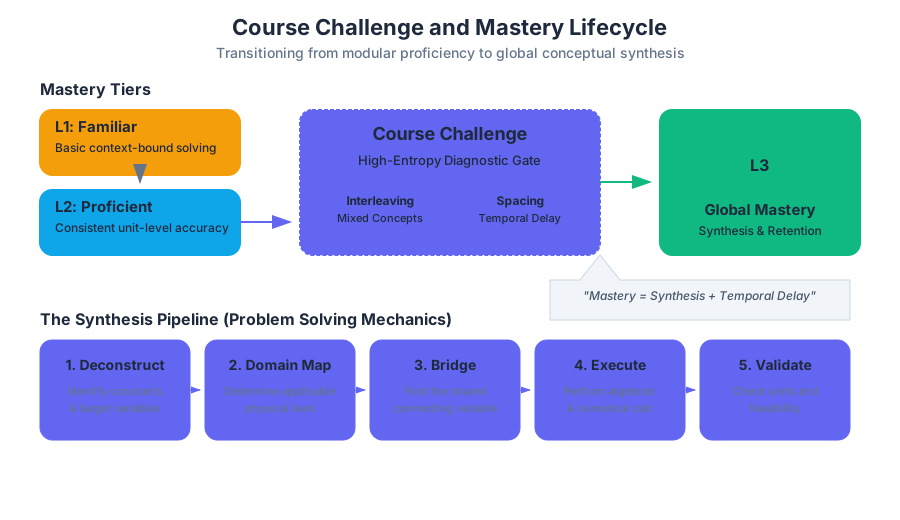
The Course Challenge represents the terminal phase of the pedagogical lifecycle within a technical curriculum. It is not merely a "final exam" in the traditional sense; rather, it is a high-entropy diagnostic tool designed to evaluate a learner's ability to synthesize disparate concepts into a unified mental model. In the context of a Physics curriculum, this involves transitioning from isolated unit-level proficiency to a state of Global Mastery, where the learner can navigate the intersections of kinematics, dynamics, energy, and electromagnetism without the scaffolding provided by modular instruction.
Achieving "Mastery" requires more than just a high score. It demands a demonstration of retention over time and transferability of skill. The Course Challenge serves as the gatekeeper for Mastery Points, the quantitative metric used to track a learner's progression from "Familiar" to "Proficient" and, ultimately, to "Mastered."
The Mechanics of Mastery Points
Mastery is a dynamic state, not a static achievement. The system utilizes a tiered progression model that rewards consistent performance across multiple attempts. Unlike traditional grading, which often penalizes early failures, a mastery-based system views errors as data points in a convergent learning trajectory.
The Mastery Tier Hierarchy
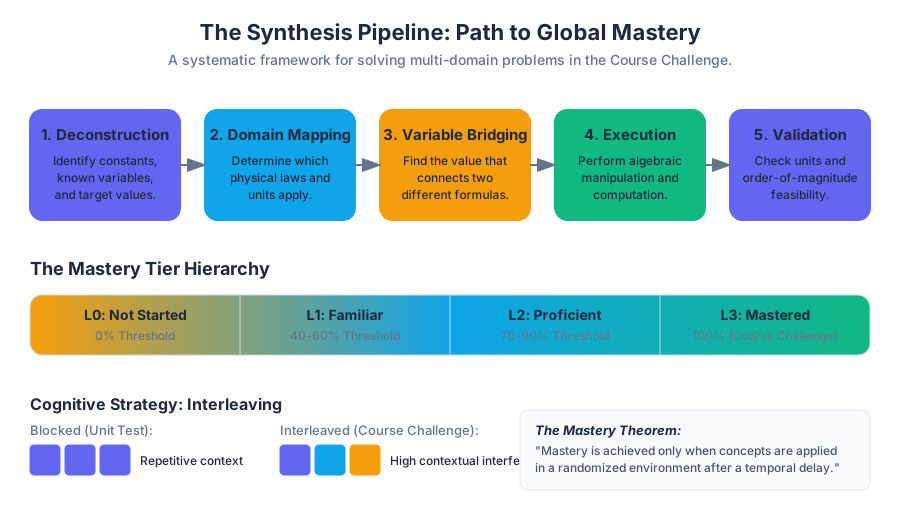
The progression toward mastery is typically divided into four distinct levels. Each level represents a higher degree of cognitive reliability and a lower probability of "false positive" proficiency.
| Level | State | Description | Point Threshold |
|---|---|---|---|
| L0 | Not Started | The learner has not engaged with the material or has failed initial diagnostics. | 0% |
| L1 | Familiar | The learner can solve basic problems with significant prompting or within a narrow context. | 40-60% |
| L2 | Proficient | The learner demonstrates consistent accuracy in unit-level assessments. | 70-90% |
| L3 | Mastered | The learner successfully completes the Course Challenge, demonstrating synthesis and long-term retention. | 100% |
The Mastery Theorem: A concept is considered "Mastered" only when the learner can successfully apply it in a cumulative, randomized environment (the Course Challenge) after a significant temporal delay from the initial instruction phase.
Cumulative Review: The Spacing and Interleaving Effects
The Course Challenge leverages two primary psychological principles: Spaced Repetition and Interleaving. While unit tests focus on "blocked practice" (solving many problems of the same type), the Course Challenge forces the brain to constantly switch between different physical laws and mathematical frameworks.
Blocked vs. Interleaved Practice
| Feature | Blocked Practice (Unit Test) | Interleaved Practice (Course Challenge) |
|---|---|---|
| Context Switching | Low | High |
| Problem Identification | Obvious (based on current unit) | Difficult (must determine which law applies) |
| Long-term Retention | Lower | Significantly Higher |
| Cognitive Load | Moderate | High (Simulates real-world engineering) |
In a Course Challenge, a question on Linear Momentum might be immediately followed by a question on DC Circuits. This "contextual interference" forces the learner to retrieve information from long-term memory more aggressively, strengthening the neural pathways associated with that knowledge.
Synthesis-Level Problem Solving
The hallmark of a senior-level understanding is the ability to solve Synthesis Problems. These are problems where the solution to one part of the problem (e.g., finding velocity using the Work-Energy Theorem) serves as the input for another part of the problem (e.g., using that velocity to calculate the centripetal force in a magnetic field).
The Synthesis Pipeline
- Deconstruction: Identify all physical constants and variables provided.
- Domain Mapping: Determine which domains of physics are involved (e.g., "This is a Kinematics problem disguised as an Energy problem").
- Variable Bridging: Identify the "bridge variable"—the value that connects two different formulas.
- Execution: Perform the algebraic or numerical computation.
- Validation: Check units and order-of-magnitude feasibility.
Worked Example: The Ballistic Pendulum Synthesis
Consider a projectile of mass $m$ moving at velocity $v$ that embeds itself into a stationary pendulum bob of mass $M$. To find the maximum height $h$ reached by the pendulum, the learner must synthesize Conservation of Momentum (the collision) and Conservation of Energy (the swing).
Technical Prerequisites: The "Client Challenge"
A significant, yet often overlooked, aspect of the Course Challenge is the technical environment in which it is delivered. As noted in the system requirements, the Client Challenge—the browser-side execution of the exam—is heavily dependent on JavaScript (JS).
The Course Challenge is not a static document; it is a dynamic application that handles:
- State Management: Tracking which of the 30 questions have been answered.
- Real-time Validation: Checking answers against an encrypted solution key.
- LaTeX Rendering: Using libraries like MathJax or KaTeX to display complex formulas.
- Interactive Diagrams: SVG-based force diagrams that update based on user input.
The JavaScript Dependency
This is a critical "Access Requirement" for any modern mastery-based platform.
Domain Deep Dive: Core Physics Concepts Tested
The Course Challenge tests several key domains. Mastery is achieved when the learner can navigate the specific mathematical nuances of each.
1. Kinematics and One-Dimensional Motion
The foundation of mechanics. It focuses on describing motion without regard to its causes.
- Key Equations: The "Big Four" kinematic equations.
- Common Pitfall: Misinterpreting the sign of acceleration in free-fall (e.g., forgetting that $g$ is downward even when an object is moving upward).
2. Dynamics and Newton’s Laws
The study of forces.
- Newton’s Second Law: $\sum F = ma$.
- Mastery Requirement: Proficiency in drawing Free-Body Diagrams (FBDs) for inclined planes and multi-body systems (Atwood machines).
3. Work, Energy, and Power
The scalar approach to mechanics.
- Work-Energy Theorem: $W_{net} = \Delta K$.
- The Power Formula: $P = \frac{dW}{dt} = \vec{F} \cdot \vec{v}$.
4. Linear Momentum and Collisions
The study of impulse and conservation.
- Elastic vs. Inelastic: In elastic collisions, both momentum and kinetic energy are conserved. In inelastic collisions, only momentum is conserved.
5. Static Electricity and DC Circuits
The transition from mechanics to electromagnetism.
- Coulomb's Law: $F = k \frac{q_1 q_2}{r^2}$.
- Ohm's Law: $V = IR$.
Advanced Problem Archetypes
To reach the "Mastery" level, students must be prepared for specific exam patterns that combine these domains.
| Archetype | Concepts Combined | Difficulty | Logic Flow |
|---|---|---|---|
| The Loop-the-Loop | Energy + Centripetal Force | High | Use $mgh$ to find $v$ at the top, then use $F_c = \frac{mv^2}{r}$ to find Normal Force. |
| The Charged Projectile | Kinematics + Electrostatics | Extreme | Use $E = \frac{F}{q}$ to find acceleration, then apply kinematic equations for trajectory. |
| The Frictional Slide | Dynamics + Energy | Medium | Use $\mu_k F_n$ to find work done by friction, then subtract from initial $E_p$. |
| The Power Lifter | Work + Power + Kinematics | Medium | Calculate Work ($Fd$), then divide by time to find Power. |
Mathematical Derivations for Mastery
A senior engineer or physicist doesn't just memorize formulas; they understand the derivation. The Course Challenge often tests this by asking for variables in terms of other constants.
Derivation of the Work-Energy Theorem
The relationship between work and kinetic energy is derived from Newton's Second Law and the kinematic equation for displacement.
\begin{aligned}
1. & \quad F = ma \\
2. & \quad v_f^2 = v_i^2 + 2a\Delta x \implies a = \frac{v_f^2 - v_i^2}{2\Delta x} \\
3. & \quad W = F \Delta x \\
4. & \quad W = (m \cdot \frac{v_f^2 - v_i^2}{2\Delta x}) \cdot \Delta x \\
5. & \quad W = \frac{1}{2}mv_f^2 - \frac{1}{2}mv_i^2 \\
6. & \quad W = \Delta K
\end{aligned}
Mastery Data Management
From a systems perspective, tracking mastery across thousands of students requires a robust data schema. Each "Mastery Point" is a record in a relational database that tracks the relationship between a student, a specific learning objective, and their performance history.
Common Pitfalls in the Course Challenge
Even high-performing students encounter "edge case" errors that prevent them from achieving full mastery points.
- Vector Directionality: In two-dimensional motion (projectiles), failing to decompose vectors into $x$ and $y$ components.
- Unit Mismatches: Mixing grams with kilograms or centimeters with meters. The system expects SI units unless otherwise specified.
- Static vs. Kinetic Friction: Using $\mu_s$ when the object is already in motion, or failing to check if the applied force exceeds the maximum static friction threshold.
- Energy Dissipation: Forgetting that mechanical energy is not conserved when non-conservative forces (friction, air resistance) are present.
- Rounding Errors: Carrying rounded values through a multi-step calculation. Always keep intermediate values in your calculator's memory.
Summary of Mastery Strategy
Achieving mastery is a marathon, not a sprint. The Course Challenge is the final validation of a journey that begins with basic conceptual understanding. To succeed:
- Enable JavaScript: Ensure your technical environment is ready for the "Client Challenge."
- Practice Synthesis: Don't just solve unit-specific problems; look for "bridge" problems.
- Review FBDs: Dynamics is the "engine" of physics; if you can't draw the forces, you can't solve the motion.
- Embrace the Interleave: If the Course Challenge feels harder than the unit tests, it's working. That struggle is the sound of your brain building a more resilient model of the universe.
Source Materials
Study High School Physics on Lykke
This course page is free to open: signed out, you can read its first two sections, and signing in, on any plan, opens the rest. The free Lykke Chrome extension syncs your own Canvas courses, so ChatGPT, Claude and Muse can answer from your classes and deadlines. It only reads Canvas.
Add the free extensionSign in to open every sectionAll sections of High School Physics · Browse more course pages