From the free course High School Physics on Lykke
Two-Dimensional Motion and Vectors
Key concepts: Vector Analysis · Projectile Motion · Inclined Planes · Static and Kinetic Friction
Expanding motion analysis to two dimensions using vector components, projectile motion, and friction.
Two-Dimensional Motion and Vectors
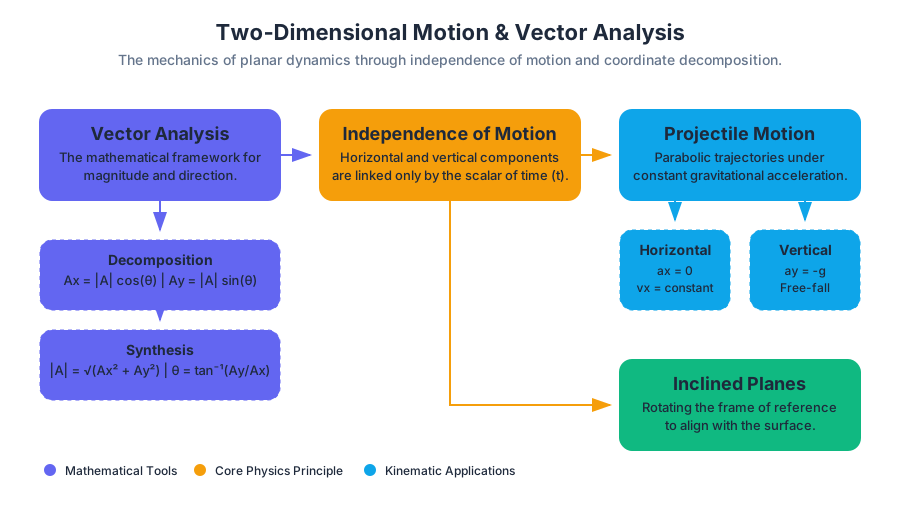
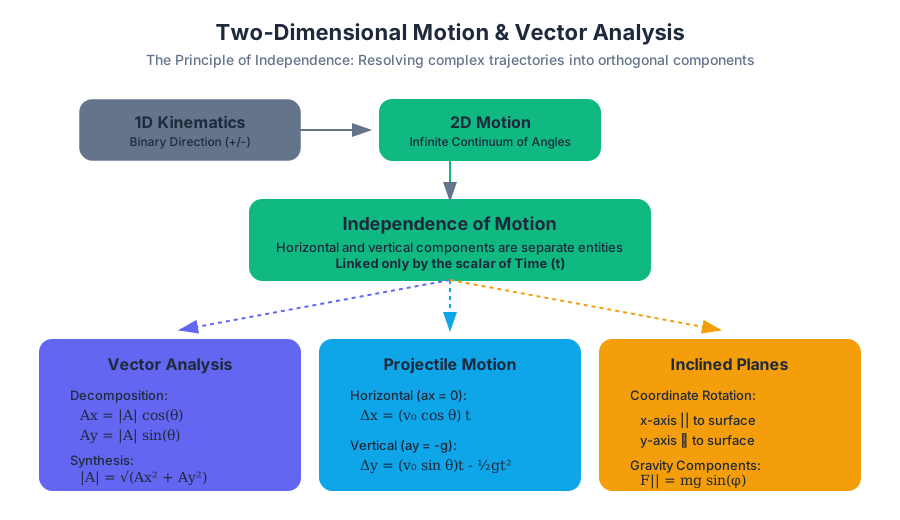
The transition from one-dimensional kinematics to two-dimensional motion represents a fundamental leap in classical mechanics. In a 1D world, direction is binary (positive or negative). In 2D, we must contend with an infinite continuum of directions, requiring a robust mathematical framework to maintain precision. This section explores the mechanics of objects moving through a plane, governed by the principle of independence of motion, where horizontal and vertical components are treated as separate yet simultaneous entities linked only by the scalar of time.
Vector Analysis: The Language of 2D Space
At the heart of multidimensional physics lies Vector Analysis. Unlike scalars (such as mass or temperature), which only possess magnitude, vectors (such as displacement, velocity, and force) require both magnitude and direction. To manipulate these effectively, we employ orthonormal decomposition—breaking a single vector into its constituent $x$ (horizontal) and $y$ (vertical) components.
Vector Decomposition and Synthesis
Any vector $\vec{A}$ at an angle $\theta$ relative to the positive x-axis can be resolved into components using basic trigonometry:
- $A_x = |\vec{A}| \cos(\theta)$
- $A_y = |\vec{A}| \sin(\theta)$
Conversely, the magnitude and direction can be recovered from the components:
- $|\vec{A}| = \sqrt{A_x^2 + A_y^2}$
- $\theta = \tan^{-1}\left(\frac{A_y}{A_x}\right)$
| Operation | Mathematical Definition | Physical Interpretation |
|---|---|---|
| Addition | $\vec{R} = (A_x + B_x)\hat{i} + (A_y + B_y)\hat{j}$ | Finding the net effect of multiple forces or displacements. |
| Scalar Multi. | $k\vec{A} = (kA_x)\hat{i} + (kA_y)\hat{j}$ | Scaling a vector (e.g., $F = ma$ scales acceleration by mass). |
| Dot Product | $\vec{A} \cdot \vec{B} = \vert \vec{A}\vert \vert \vec{B}\vert \cos(\phi)$ | Calculating work done or projecting one vector onto another. |
| Unit Vector | $\hat{u} = \frac{\vec{A}}{\vert \vec{A}\vert }$ | Defining a pure direction with a magnitude of 1. |
The Principle of Superposition: The net response of a system at a given place and time caused by two or more stimuli is the sum of the responses that would have been caused by each stimulus individually. In 2D motion, this means we can solve the $x$-dynamics and $y$-dynamics independently.
Projectile Motion: Dynamics under Gravity
Projectile Motion is the motion of an object thrown or projected into the air, subject only to the acceleration of gravity. In an idealized vacuum, the horizontal component of velocity remains constant because no horizontal forces act upon the object (ignoring air resistance). The vertical component, however, is in a state of constant free-fall acceleration.
The Kinematic Framework
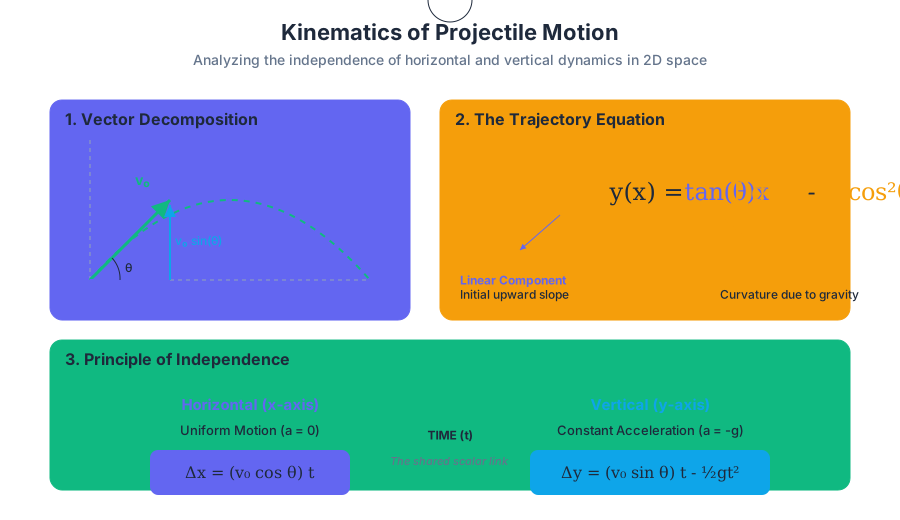
To solve projectile problems, we split the motion into two sets of equations. Let $v_0$ be the initial velocity and $\theta$ be the launch angle.
Horizontal ($x$):
- $a_x = 0$
- $v_x = v_0 \cos(\theta)$
- $\Delta x = (v_0 \cos(\theta))t$
Vertical ($y$):
- $a_y = -g$ (where $g \approx 9.81 , \text{m/s}^2$)
- $v_y = v_0 \sin(\theta) - gt$
- $\Delta y = (v_0 \sin(\theta))t - \frac{1}{2}gt^2$
Derivation: The Trajectory Equation
By isolating $t$ in the horizontal equation ($t = \frac{x}{v_0 \cos(\theta)}$) and substituting it into the vertical displacement equation, we derive the path of the projectile:
y(x) = \tan(\theta)x - \frac{g}{2v_0^2 \cos^2(\theta)}x^2
This is the equation of a parabola. This mathematical reality explains why every thrown ball, launched missile, or leaping athlete follows a parabolic arc.
| Parameter | Impact on Trajectory |
|---|---|
| Launch Angle ($\theta$) | Determines the balance between "hang time" and horizontal reach. $45^\circ$ yields max range. |
| Initial Velocity ($v_0$) | Scales the entire trajectory; range increases with the square of $v_0$. |
| Gravity ($g$) | Inversely proportional to range and height; lower gravity (Moon) leads to longer arcs. |
| Initial Height ($h_0$) | Shifts the parabola upward, increasing time in air and horizontal range. |
Inclined Planes: Rotating the Frame of Reference
When an object moves along a slope, gravity no longer acts purely along the axis of motion. To simplify the mathematics, we perform a coordinate rotation. Instead of using standard horizontal and vertical axes, we align the $x$-axis parallel to the surface of the incline and the $y$-axis perpendicular to it.
Force Decomposition on a Slope
Consider an object of mass $m$ on a plane inclined at angle $\phi$. Gravity ($F_g = mg$) acts straight down. We resolve $F_g$ into:
- Parallel Component ($F_{g\parallel}$): $mg \sin(\phi)$. This is the force pulling the object down the slope.
- Perpendicular Component ($F_{g\perp}$): $mg \cos(\phi)$. This component presses the object into the surface and is countered by the Normal Force ($F_N$).
The Normal Force ($F_N$): On an inclined plane with no other vertical forces, $F_N = mg \cos(\phi)$. As the angle $\phi$ increases, $\cos(\phi)$ decreases, meaning the surface "feels" less weight from the object.
Acceleration on a Frictionless Incline
Using Newton’s Second Law ($F = ma$): $mg \sin(\phi) = ma$ $a = g \sin(\phi)$
This elegant result shows that the acceleration of an object down a frictionless ramp is independent of its mass and depends solely on the tilt of the ramp.
Static and Kinetic Friction
Friction is the resistive force that opposes the relative motion (or intended motion) of two surfaces in contact. It is a complex electromagnetic interaction between surface atoms, but for classical mechanics, we use the Coulomb Friction Model.
Static Friction ($f_s$)
Static friction acts on objects that are not yet moving. It is a "responsive" force—it only pushes back as hard as you push it, up to a certain threshold.
- Formula: $f_s \leq \mu_s F_N$
- $\mu_s$: The coefficient of static friction.
- Threshold: The moment $F_{applied} > \mu_s F_N$, the object breaks free and begins to move.
Kinetic Friction ($f_k$)
Once the object is in motion, the bonds between surfaces cannot fully reform, leading to a lower resistive force.
- Formula: $f_k = \mu_k F_N$
- $\mu_k$: The coefficient of kinetic friction.
- Rule: Generally, $\mu_k < \mu_s$. This is why it is harder to start sliding a heavy box than it is to keep it moving.
| Feature | Static Friction ($f_s$) | Kinetic Friction ($f_k$) |
|---|---|---|
| State of Motion | Stationary | Moving |
| Magnitude | Variable (0 up to $f_{s,max}$) | Constant (mostly) |
| Direction | Opposes potential motion | Opposes actual velocity vector |
| Coefficient | Higher ($\mu_s$) | Lower ($\mu_k$) |
Worked Example: The Angle of Repose
What is the maximum angle $\phi$ an incline can have before a block starts to slide? At the verge of sliding, the parallel gravitational force equals the maximum static friction: $mg \sin(\phi) = \mu_s (mg \cos(\phi))$ $\frac{\sin(\phi)}{\cos(\phi)} = \mu_s$ $\tan(\phi) = \mu_s$
The angle $\phi = \tan^{-1}(\mu_s)$ is known as the Angle of Repose.
Common Pitfalls and Misconceptions
- The "Gravity acts on the x-axis" Error: Students often forget that in projectile motion, $a_x$ is strictly zero (in the absence of air resistance). There is no force pushing the projectile forward after it leaves the launcher.
- Normal Force Misconception: $F_N$ is not always equal to $mg$. On an incline, it is $mg \cos(\phi)$. If you are in an elevator or being pulled at an angle, $F_N$ changes. Always use a Free Body Diagram (FBD) to sum forces in the perpendicular direction.
- Friction Direction: Friction does not always oppose the "direction of the object." It opposes the relative motion between surfaces. In the case of walking, static friction actually points forward, as it prevents your foot from sliding backward, thus propelling you.
- The $\mu$ limit: The coefficients of friction $\mu$ are empirical approximations. In extreme cases (high speeds, high pressures, or very smooth surfaces like silicon wafers), the linear $f = \mu F_N$ model breaks down.
Summary of 2D Dynamics Pipeline
To solve any complex 2D motion problem (e.g., a block sliding down a ramp and then becoming a projectile), follow this engineering pipeline:
- Identify the Phases: Break the motion into distinct segments (e.g., Phase 1: Incline, Phase 2: Free fall).
- Establish Coordinate Systems: Rotate axes for inclines; use standard Cartesian for projectiles.
- Free Body Diagrams: Draw all forces ($F_g, F_N, f, F_{app}$).
- Component Resolution: Use $\sin$ and $\cos$ to align all forces/velocities with your chosen axes.
- Apply Newton's Second Law: $\sum F_x = ma_x$ and $\sum F_y = ma_y$.
- Link via Time: Use kinematic equations to solve for unknowns, using $t$ as the bridge between $x$ and $y$ components.
Core Equations Reference
- Range of Projectile: $R = \frac{v_0^2 \sin(2\theta)}{g}$
- Max Height of Projectile: $H = \frac{v_0^2 \sin^2(\theta)}{2g}$
- Acceleration on Incline with Friction: $a = g(\sin(\phi) - \mu_k \cos(\phi))$
- Vector Magnitude: $v = \sqrt{v_x^2 + v_y^2}$
Source Materials
Study High School Physics on Lykke
This course page is free to open: signed out, you can read its first two sections, and signing in, on any plan, opens the rest. The free Lykke Chrome extension syncs your own Canvas courses, so ChatGPT, Claude and Muse can answer from your classes and deadlines. It only reads Canvas.
Add the free extensionSign in to open every sectionAll sections of High School Physics · Browse more course pages