From the free course High School Biology on Lykke
Cellular Reproduction: Mitosis and Meiosis
Key concepts: The Cell Cycle · Mitosis · Meiosis · Chromatids and Chromatin · Crossover
The mechanics of cell division for growth, repair, and the production of gametes.
Cellular Reproduction: Mitosis and Meiosis
Cellular reproduction is the fundamental process by which life propagates, grows, and maintains its structural integrity. At its core, it is an information-theory problem: how does a biological system replicate a massive, complex instruction set (the genome) and distribute it with high fidelity to progeny? In multicellular organisms, this process bifurcates into two distinct pathways: Mitosis, the mechanism of somatic growth and asexual replication, and Meiosis, the specialized division required for sexual reproduction and genetic diversification.
The Physical Substrate: Chromatin, Chromatids, and Chromosomes
Before analyzing the mechanics of division, we must define the state of the genetic material. DNA does not exist as a loose "soup" within the nucleus; it is highly organized through a hierarchy of protein-DNA complexes.
Definitions and Hierarchy
The terminology of DNA packaging is often a source of confusion. The distinction lies in the level of condensation and the replication state:
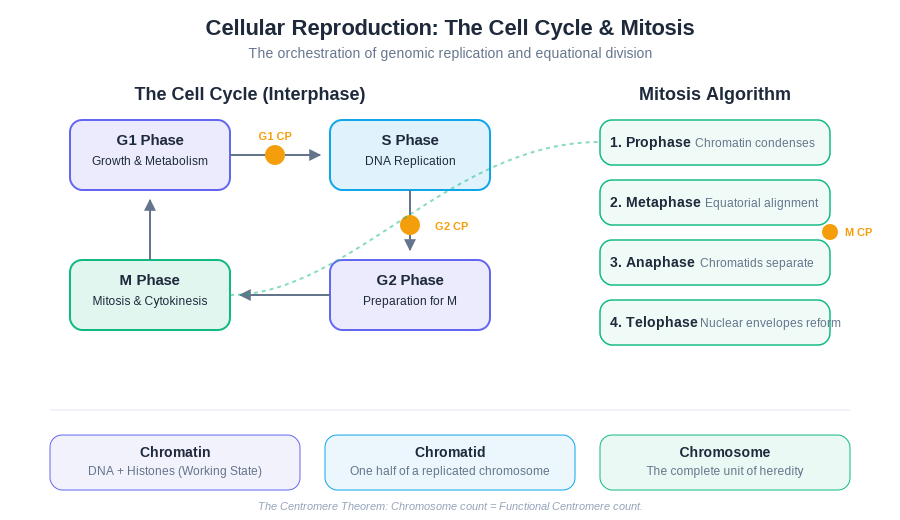
- Chromatin: The "working state" of DNA. It consists of DNA wrapped around histone proteins (nucleosomes). During Interphase, chromatin is relatively decondensed to allow transcription factors and polymerases access to the genetic code.
- Chromatid: Following the S phase of the cell cycle, each chromosome is replicated. The two identical copies are called sister chromatids. They are joined at a specialized DNA sequence called the centromere.
- Chromosome: A single, continuous molecule of DNA. In its unreplicated state, one chromosome equals one chromatid. In its replicated state (post-S phase), one chromosome consists of two sister chromatids.
| Feature | Chromatin | Chromatid | Chromosome |
|---|---|---|---|
| Structure | "Beads on a string" (nucleosomes) | One half of a replicated chromosome | The complete physical unit of heredity |
| Visibility | Visible only with electron microscopy | Visible during Mitosis/Meiosis | Highly condensed during M-phase |
| Function | Gene expression and DNA packaging | Ensuring equal distribution of DNA | Large-scale genomic organization |
| Composition | DNA + Histones | DNA + Histones + Cohesin proteins | DNA + Histones + Scaffolding proteins |
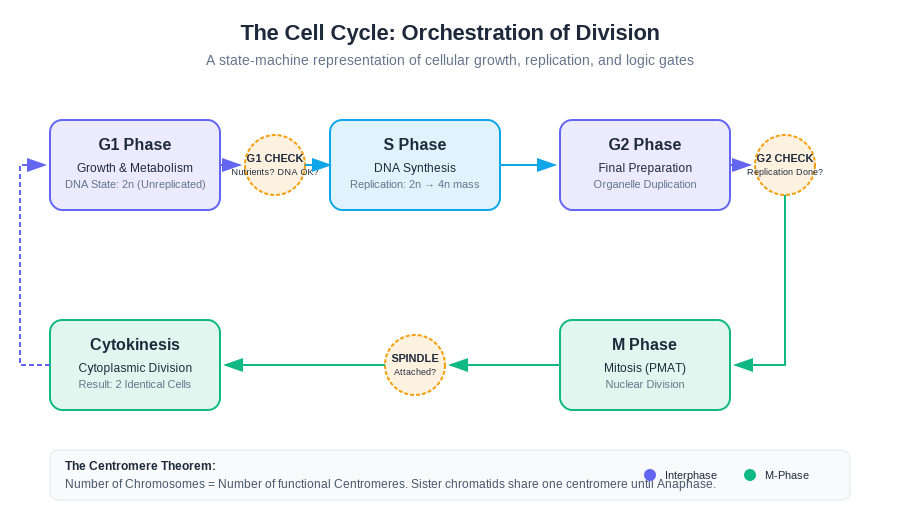
The Centromere Theorem: The number of chromosomes in a cell is always equal to the number of functional centromeres, regardless of how many chromatids are attached to them.
The Cell Cycle: The Orchestration of Division
The Cell Cycle is the ordered sequence of events that a cell undergoes from its "birth" to its own division. It is governed by a complex regulatory network of Cyclins and Cyclin-Dependent Kinases (CDKs) that act as logic gates, ensuring that one stage is completed before the next begins.
Phases of the Cycle
The cycle is divided into two primary epochs: Interphase (preparation) and the M-phase (division).
- G1 Phase (Gap 1): The cell grows and performs normal metabolic functions. It monitors the environment for growth factors and DNA integrity.
- S Phase (Synthesis): DNA replication occurs. The DNA content doubles ($2n \to 4n$ in terms of mass, though the chromosome count remains $2n$).
- G2 Phase (Gap 2): Further growth and protein synthesis. The cell checks for replication errors.
- M Phase (Mitotic Phase): The physical separation of the nucleus (Mitosis) and the cytoplasm (Cytokinesis).
Checkpoint Logic
The cell cycle is not a simple timer; it is a state machine with conditional transitions.
| Checkpoint | Timing | Criteria for Success | Failure Consequence |
|---|---|---|---|
| G1 Checkpoint | Late G1 | Sufficient nutrients, growth factors, no DNA damage | Entry into G0 (quiescence) or Apoptosis |
| G2 Checkpoint | End of G2 | DNA replication complete, no damage | Cell cycle arrest for DNA repair |
| Spindle Checkpoint | Metaphase | All chromosomes attached to spindle fibers | Delay of Anaphase (prevents aneuploidy) |
Mitosis: The Algorithm of Identity
Mitosis is the process of equational division. Its goal is to produce two daughter cells that are genetically identical to the parent cell. This is the mechanism used for embryonic development, tissue renewal, and wound healing.
The Mechanics of Mitosis
Mitosis is traditionally divided into five stages:
- Prophase: Chromatin condenses into visible chromosomes. The nucleolus disappears, and the mitotic spindle (composed of microtubules) begins to form.
- Prometaphase: The nuclear envelope breaks down. Microtubules attach to the kinetochores (protein structures on the centromeres).
- Metaphase: Chromosomes align at the metaphase plate (the cell's equator). This is a high-tension state where opposing spindle fibers pull on sister chromatids.
- Anaphase: The enzyme separase cleaves the cohesin proteins holding sister chromatids together. The chromatids (now individual chromosomes) are pulled to opposite poles.
- Telophase: Nuclear envelopes reform around the two sets of chromosomes. The chromosomes decondense back into chromatin.
Meiosis: The Algorithm of Diversity
Meiosis is a specialized, two-step division process that reduces the chromosome number by half ($2n \to n$), resulting in four non-identical haploid gametes. This reduction is essential to maintain a constant chromosome number across generations after fertilization.
Meiosis I: Reductional Division
The most critical phase is Meiosis I, where homologous chromosomes (the version from the mother and the version from the father) pair up and separate.
- Prophase I: This is the longest and most complex phase. Homologous chromosomes undergo synapsis, forming tetrads. This is where Crossover occurs.
- Metaphase I: Homologous pairs (not individual chromosomes) align at the equator. The orientation of each pair is random (Independent Assortment).
- Anaphase I: Homologous chromosomes separate, but sister chromatids remain attached.
Meiosis II: Equational Division
Meiosis II is mechanically similar to mitosis. The sister chromatids finally separate, resulting in four haploid cells.
The Mathematics of Genetic Recombination
The diversity generated by meiosis is a result of two factors: Independent Assortment and Crossover.
In humans ($n=23$), the number of possible chromosomal combinations due to independent assortment is $2^n$.
\begin{aligned}
\text{Combinations} &= 2^{n} \\
&= 2^{23} \\
&= 8,388,608 \text{ possible gametes per parent}
\end{aligned}
When you factor in crossover, the number of potential genetic variations becomes effectively infinite.
Chromosomal Crossover: The Molecular Shuffle
Crossover (or recombination) occurs during Prophase I of Meiosis. It involves the physical exchange of DNA segments between non-sister chromatids of homologous chromosomes.
The Mechanism: Chiasmata
- Synapsis: The synaptonemal complex (a protein bridge) zips homologous chromosomes together.
- Cleavage: Endonuclease enzymes create breaks in the DNA backbone of non-sister chromatids.
- Ligation: The DNA segments are swapped and fused. The points of contact where the exchange occurred are called chiasmata.
Why it Matters
Without crossover, every chromosome you pass to your offspring would be an exact copy of the one you received from your father or mother. Crossover creates "mosaic" chromosomes, ensuring that every sperm or egg cell is unique.
| Feature | Mitosis | Meiosis |
|---|---|---|
| Purpose | Growth, Tissue Repair, Asexual Reproduction | Production of Gametes for Sexual Reproduction |
| Where it occurs | Somatic Cells | Germline Cells (Gonads) |
| Number of Divisions | One | Two |
| Daughter Cells | Two Diploid ($2n$), Genetically Identical | Four Haploid ($n$), Genetically Unique |
| Synapsis/Crossover | No | Yes (Prophase I) |
| Homologous Pairing | No | Yes (Metaphase I) |
Real-World Application: Bioinformatics and Aneuploidy
In clinical settings, understanding the cell cycle and meiosis is vital for diagnosing genetic disorders. Aneuploidy—an abnormal number of chromosomes—usually results from nondisjunction, a failure of chromosomes to separate correctly during Anaphase I or II.
Analyzing Ploidy with Bioinformatics
Bioinformaticians use sequencing data to detect copy number variations (CNVs).
Common Pitfalls and Misconceptions
- "DNA is only chromosomes": Students often think DNA is always in the X-shape. In reality, DNA is in the decondensed chromatin state for 90% of the cell's life. The X-shape only exists during the brief window of division.
- Sister Chromatids vs. Homologous Chromosomes:
- Sister Chromatids are identical clones (result of S-phase).
- Homologous Chromosomes are similar but not identical (one from mom, one from dad). They carry the same genes but different alleles.
- Centromere Counting: Always count centromeres to find the chromosome number. If two chromatids are stuck together at one centromere, that is one chromosome.
Querying Genetic Data
In a clinical database, we might query for instances where meiosis went wrong (nondisjunction events).
Summary of the Lifecycle
The dance between Mitosis and Meiosis ensures both the stability of the individual and the evolution of the species. Mitosis preserves the "Self," while Meiosis, through the elegant shuffling of Crossover and Independent Assortment, creates the "New."
Study High School Biology on Lykke
This course page is free to open: signed out, you can read its first two sections, and signing in, on any plan, opens the rest. The free Lykke Chrome extension syncs your own Canvas courses, so ChatGPT, Claude and Muse can answer from your classes and deadlines. It only reads Canvas.
Add the free extensionSign in to open every sectionAll sections of High School Biology · Browse more course pages