From the free course High School Biology on Lykke
The Scientific Method and Experimental Design
Key concepts: Experimental design · Bias · Data analysis · Hypothesis testing
An introduction to the systematic approach used by biologists to explore the natural world.
The Scientific Method and Experimental Design
The scientific method is not merely a sequence of steps found in a middle-school textbook; it is a rigorous epistemological framework designed to minimize human error and maximize the reliability of our understanding of the natural world. In biology, where systems are characterized by high stochasticity and complex interdependencies, the application of this method requires a sophisticated grasp of experimental design, statistical inference, and bias mitigation.
The Epistemology of Inquiry: Beyond the Linear Model
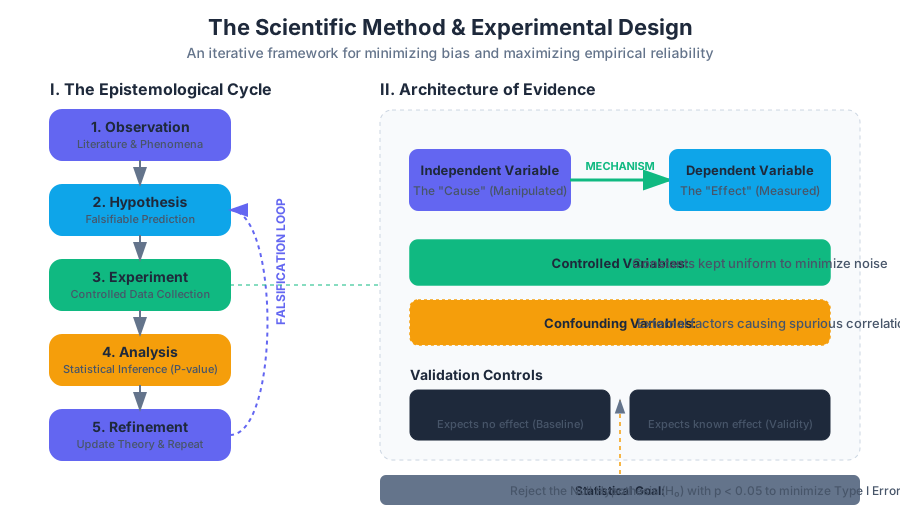
At its core, the scientific method is an iterative cycle of falsification. As proposed by Karl Popper, a theory is only scientific if it is falsifiable—that is, there must be a conceivable observation that could prove it wrong. We do not "prove" hypotheses; we fail to reject them, thereby increasing our confidence in their validity.
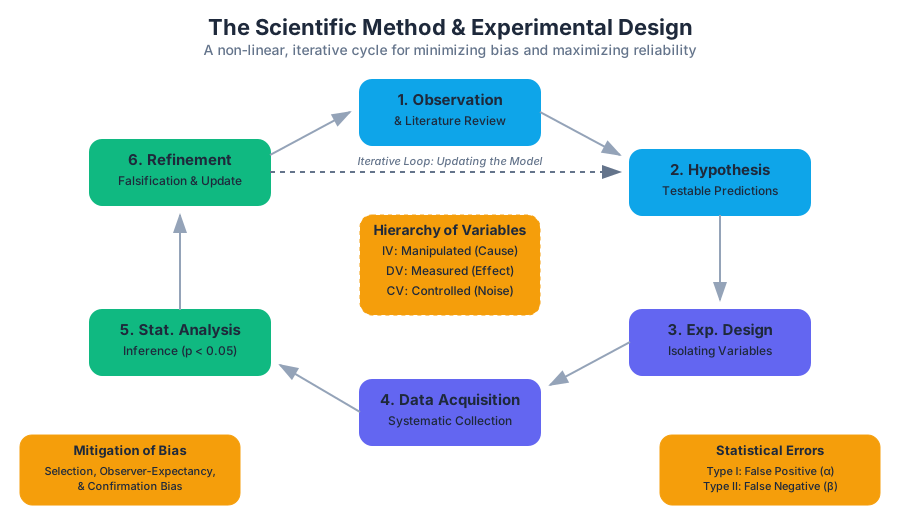
The modern scientific workflow follows a non-linear path:
- Observation and Literature Review: Identifying a phenomenon and situating it within existing theoretical frameworks.
- Hypothesis Formulation: Constructing a testable, predictive statement.
- Experimental Design: Engineering a controlled environment to isolate variables.
- Data Acquisition: Systematic collection of empirical evidence.
- Statistical Analysis: Determining the probability that observed effects are due to chance.
- Refinement: Updating the hypothesis based on results and repeating the cycle.
Experimental Design: The Architecture of Evidence
Experimental design is the process of planning a study to meet specified objectives while ensuring the data collected can be analyzed to yield valid and objective conclusions. In biological research, the primary challenge is confounding variables—uncontrolled factors that influence the outcome, leading to incorrect associations.
The Hierarchy of Variables
To isolate the mechanism of interest, we must strictly categorize the components of our experiment.
| Variable Type | Definition | Role in Experiment |
|---|---|---|
| Independent Variable (IV) | The factor manipulated by the researcher. | The hypothesized "Cause." |
| Dependent Variable (DV) | The factor being measured or observed. | The hypothesized "Effect." |
| Controlled Variables | Factors kept constant across all groups. | Minimizing "Noise" or Confounding. |
| Confounding Variable | An unmeasured third variable that influences both IV and DV. | The source of "Spurious Correlation." |
The Role of Controls
A "controlled experiment" is defined by the presence of comparison groups that allow the researcher to account for variables other than the one being tested.
- Negative Control: A group where no response is expected. This confirms that the experimental system is not producing false positives (e.g., treating a cell culture with a saline solution instead of a drug).
- Positive Control: A group where a known response is expected. This confirms that the experimental setup is capable of detecting an effect (e.g., treating a cell culture with a known toxin to ensure the cell-death assay is working).
The Gold Standard: Randomized Controlled Trials (RCTs) In clinical and high-level biological research, the RCT is the pinnacle of design. By randomly assigning subjects to groups, researchers ensure that both known and unknown confounding variables are distributed equally, isolating the effect of the independent variable.
Statistical Hypothesis Testing
Data analysis is the bridge between raw observations and scientific conclusions. We use Inferential Statistics to make generalizations about a population based on a sample.
The Null and Alternative Hypotheses
Mathematically, we frame our inquiry as a choice between two competing statements:
- Null Hypothesis ($H_0$): There is no effect or relationship (e.g., "Drug X does not affect heart rate").
- Alternative Hypothesis ($H_A$): There is a significant effect or relationship (e.g., "Drug X significantly increases heart rate").
The Logic of the P-Value
The $p$-value is the probability of obtaining results at least as extreme as the observed results, assuming the null hypothesis is true. It is a measure of "surprisal." If the $p$-value is low (typically $p < 0.05$), we reject the null hypothesis.
t = \frac{\bar{x}_1 - \bar{x}_2}{\sqrt{\frac{s_1^2}{n_1} + \frac{s_2^2}{n_2}}}
The formula for the t-statistic, used to compare the means of two groups. Here, $\bar{x}$ is the mean, $s^2$ is the variance, and $n$ is the sample size.
Type I and Type II Errors
No statistical test is perfect. We categorize errors based on whether we incorrectly rejected or failed to reject the null hypothesis.
| Decision | $H_0$ is True (No Effect) | $H_0$ is False (Real Effect) |
|---|---|---|
| Reject $H_0$ | Type I Error ($\alpha$) (False Positive) | Correct Decision (Power) |
| Fail to Reject $H_0$ | Correct Decision | Type II Error ($\beta$) (False Negative) |
Bias: The Silent Corruptor of Data
Bias is a systematic error that results in an incorrect estimate of the association between an exposure and an outcome. Unlike random error (noise), which decreases with larger sample sizes, bias is inherent in the design and cannot be "averaged out."
Common Forms of Bias in Biology
- Selection Bias: Occurs when the individuals included in the study are not representative of the target population.
- Observer-Expectancy Effect (Experimenter Bias): When a researcher’s cognitive bias causes them to subconsciously influence the participants or misinterpret data to fit their hypothesis.
- Confirmation Bias: The tendency to search for, interpret, and favor information that confirms one's pre-existing beliefs.
- Publication Bias: The tendency for journals to publish "positive" results ($p < 0.05$) while ignoring "negative" or null results, skewing the overall body of scientific literature.
Mitigation Strategies
To combat bias, researchers employ several rigorous techniques:
- Blinding: In a single-blind study, the subject does not know if they are in the control or experimental group. In a double-blind study, neither the subject nor the researcher collecting the data knows.
- Randomization: Using algorithmic randomness to assign subjects to groups.
- Placebos: Providing a sham treatment to account for the psychological effect of receiving "care."
Advanced Concepts: Power and Effect Size
A common pitfall in experimental design is focusing solely on the $p$-value while ignoring Effect Size and Statistical Power.
- Effect Size: A quantitative measure of the magnitude of the experimental effect (e.g., Cohen's $d$). A result can be statistically significant but biologically irrelevant if the effect size is tiny.
- Statistical Power ($1 - \beta$): The probability that a test will correctly reject a false null hypothesis. Power is influenced by sample size ($n$), effect size, and the significance level ($\alpha$).
Worked Example: Sample Size Calculation If a researcher wants to detect a medium effect size ($d = 0.5$) with 80% power at a significance level of 0.05, they would need approximately 64 participants per group. If they only use 20 participants, their power drops significantly, increasing the risk of a Type II error (failing to find a real effect).
The Replication Crisis and Open Science
In recent years, the scientific community has faced a "replication crisis," where many landmark studies (particularly in psychology and medicine) have failed to produce the same results when repeated. This has led to a shift toward Open Science practices:
- Pre-registration: Researchers submit their hypothesis and analysis plan to a public registry before conducting the experiment to prevent "p-hacking" (manipulating data until a significant result is found).
- Data Sharing: Making raw data available for independent verification.
- Replication Studies: Explicitly funding and publishing studies that attempt to reproduce previous findings.
Summary of Best Practices
To ensure the integrity of biological research, the following principles must be adhered to:
| Principle | Actionable Step |
|---|---|
| Objectivity | Use double-blinding whenever human subjects or observers are involved. |
| Reproducibility | Document all protocols, reagents (including catalog numbers), and software versions. |
| Transparency | Report all data, including outliers and "failed" experiments. |
| Rigorous Analysis | Use appropriate statistical tests based on data distribution (e.g., non-parametric tests for non-normal data). |
Source Materials
Study High School Biology on Lykke
This course page is free to open: signed out, you can read its first two sections, and signing in, on any plan, opens the rest. The free Lykke Chrome extension syncs your own Canvas courses, so ChatGPT, Claude and Muse can answer from your classes and deadlines. It only reads Canvas.
Add the free extensionSign in to open every sectionAll sections of High School Biology · Browse more course pages