From the free course High School Biology on Lykke
Metabolism and Enzymatic Activity
Key concepts: Anabolism vs. Catabolism · Enzymes · Activation Energy (Ea) · Gluconeogenesis
The chemical reactions that sustain life and the biological catalysts that speed them up.
Metabolism and Enzymatic Activity
Metabolism is the totality of an organism's chemical reactions, a highly coordinated and purposeful activity in which multi-enzyme systems (metabolic pathways) cooperate to satisfy the energetic and structural needs of the cell. At its core, metabolism is a matter of energy management: the conversion of energy from the environment into biologically useful forms, and the synthesis of the molecular building blocks of life.
The Thermodynamic Framework of Metabolism
To understand metabolism, one must first understand the governing laws of thermodynamics. The directionality of metabolic reactions is determined by the change in Gibbs Free Energy ($\Delta G$).
The Gibbs Free Energy Equation: $$\Delta G = \Delta H - T\Delta S$$ Where $\Delta H$ is the change in enthalpy (heat content), $T$ is the absolute temperature in Kelvin, and $\Delta S$ is the change in entropy (disorder).
A reaction is spontaneous (exergonic) only if $\Delta G$ is negative. However, many essential biological processes are endergonic ($\Delta G > 0$). Life persists by coupling these unfavorable reactions to highly favorable ones, typically the hydrolysis of Adenosine Triphosphate (ATP).
Anabolism vs. Catabolism: The Metabolic Seesaw
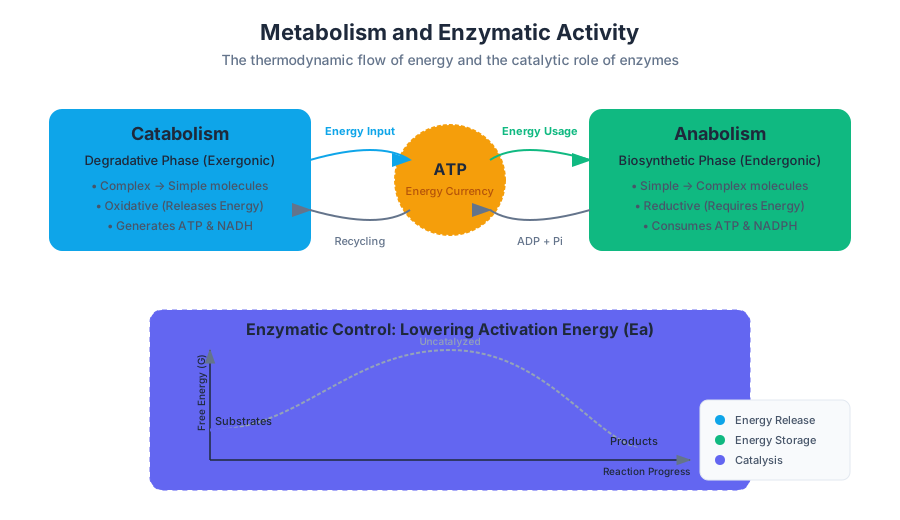
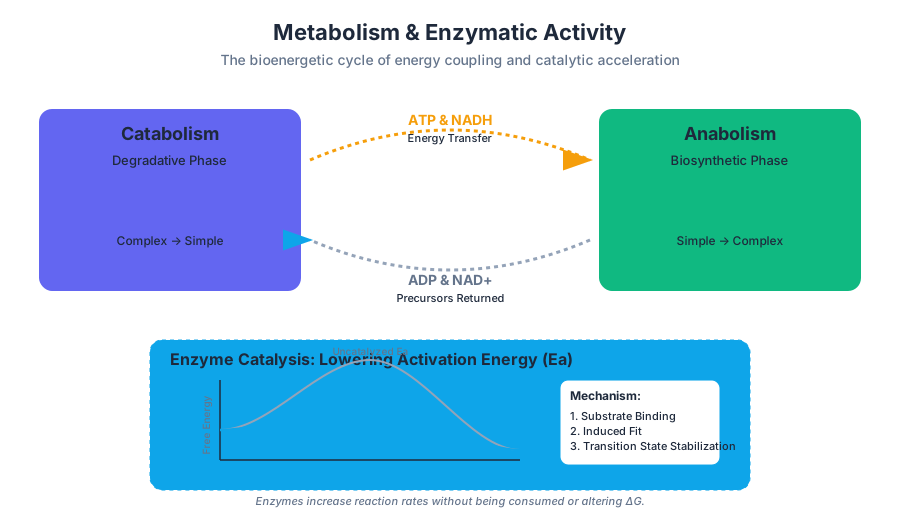
Metabolism is bifurcated into two broad, opposing, yet complementary phases: Catabolism and Anabolism. These pathways are rarely simple linear chains; they are complex networks of interconnected nodes.
Catabolism: The Degradative Phase
Catabolism involves the breakdown of complex organic molecules (carbohydrates, lipids, proteins) into simpler end products (e.g., $CO_2$, $NH_3$, $H_2O$). This process is oxidative and releases free energy, some of which is captured in the form of ATP and reduced electron carriers (NADH, $FADH_2$).
Anabolism: The Biosynthetic Phase
Anabolism, or biosynthesis, is the synthesis of complex molecules from simpler precursors. These processes are reductive and require an input of energy, typically fueled by the ATP generated during catabolism.
| Feature | Catabolism | Anabolism |
|---|---|---|
| Primary Goal | Energy production (ATP generation) | Biosynthesis of macromolecules |
| Thermodynamics | Exergonic ($\Delta G < 0$) | Endergonic ($\Delta G > 0$) |
| Redox State | Oxidative (loss of electrons) | Reductive (gain of electrons) |
| Common Carriers | $NAD^+ \rightarrow NADH$ | $NADPH \rightarrow NADP^+$ |
| Molecular Complexity | Complex $\rightarrow$ Simple | Simple $\rightarrow$ Complex |
| Example | Glycolysis, Citric Acid Cycle | Gluconeogenesis, Protein Synthesis |
Enzymes: The Biological Catalysts
If metabolism is the "what" of cellular life, enzymes are the "how." Most biological reactions, while thermodynamically favorable, occur at rates far too slow to sustain life. Enzymes are typically proteins (though some are RNA-based ribozymes) that accelerate reaction rates by factors of $10^6$ to $10^{12}$.
The Mechanism of Catalysis
Enzymes do not alter the equilibrium of a reaction ($\Delta G$ remains unchanged); instead, they lower the Activation Energy ($E_a$). They achieve this by stabilizing the transition state, a high-energy, transient molecular configuration that must be reached for the reaction to proceed.
- Substrate Binding: The substrate binds to the enzyme's active site via weak interactions (hydrogen bonds, ionic bonds, van der Waals forces).
- Induced Fit: The enzyme undergoes a conformational change to wrap more tightly around the substrate, orienting it for the reaction.
- Catalysis: The enzyme provides a microenvironment (e.g., acidic/basic residues, metal ions) that lowers the energy barrier.
- Product Release: The products have a lower affinity for the active site and are released, leaving the enzyme unchanged and ready for another cycle.
Enzyme Kinetics: The Michaelis-Menten Model
The relationship between substrate concentration $[S]$ and reaction velocity $v$ is described by the Michaelis-Menten equation.
v = \frac{V_{max} [S]}{K_m + [S]}
Where:
- $V_{max}$: The maximum velocity of the reaction when the enzyme is saturated with substrate.
- $K_m$ (Michaelis Constant): The substrate concentration at which the velocity is half of $V_{max}$. It is an inverse measure of the enzyme's affinity for its substrate.
Activation Energy ($E_a$) and the Transition State
The Activation Energy ($E_a$) is the "hump" on a reaction coordinate diagram. It represents the kinetic barrier that prevents all exergonic reactions from happening instantaneously.
The Arrhenius Equation
The rate constant $k$ of a reaction is exponentially dependent on the activation energy:
k = A e^{-\frac{E_a}{RT}}
Where:
- $A$ is the frequency factor.
- $R$ is the gas constant ($8.314 , J/mol \cdot K$).
- $T$ is the temperature.
Small decreases in $E_a$ result in massive increases in the rate constant $k$. Enzymes lower $E_a$ through several strategies:
- Proximity and Orientation: Bringing reactants together in the correct geometry.
- Desolvation: Removing the water shell around the substrate to facilitate interaction.
- Acid-Base Catalysis: Using amino acid side chains to donate or accept protons.
- Covalent Catalysis: Forming a transient covalent bond between the enzyme and substrate.
| Strategy | Description | Example |
|---|---|---|
| Acid-Base | Proton transfer to stabilize charges | Chymotrypsin (Histidine residue) |
| Covalent | Formation of a transient enzyme-substrate bond | Glyceraldehyde 3-phosphate dehydrogenase |
| Metal Ion | Use of $Mg^{2+}$, $Zn^{2+}$, etc., to orient substrates | DNA Polymerase ($Mg^{2+}$) |
| Electrostatic | Charge-charge interactions in the active site | Superoxide dismutase |
Gluconeogenesis: A Case Study in Anabolism
Gluconeogenesis is the metabolic pathway through which organisms synthesize glucose from non-carbohydrate precursors (e.g., pyruvate, lactate, glycerol, and glucogenic amino acids). This process is vital during fasting or intense exercise to maintain blood glucose levels for the brain and red blood cells.
Why it isn't just "Reverse Glycolysis"
While gluconeogenesis shares seven enzymes with glycolysis, it is not a simple reversal. Glycolysis has three "irreversible" steps with highly negative $\Delta G$:
- Glucose $\rightarrow$ Glucose-6-Phosphate (Hexokinase)
- Fructose-6-Phosphate $\rightarrow$ Fructose-1,6-Bisphosphate (PFK-1)
- Phosphoenolpyruvate (PEP) $\rightarrow$ Pyruvate (Pyruvate Kinase)
Gluconeogenesis must bypass these steps using different enzymes to ensure the overall pathway is thermodynamically favorable ($\Delta G \approx -38 , kJ/mol$).
The Bypasses of Gluconeogenesis
- Pyruvate to PEP: This requires two steps. Pyruvate is first converted to oxaloacetate by Pyruvate Carboxylase (requiring ATP and Biotin), and then oxaloacetate is converted to PEP by PEP Carboxykinase (requiring GTP).
- Fructose-1,6-Bisphosphate to Fructose-6-Phosphate: Catalyzed by Fructose-1,6-bisphosphatase. This is the key regulatory step.
- Glucose-6-Phosphate to Glucose: Catalyzed by Glucose-6-phosphatase, found primarily in the liver and kidneys.
The Cost of Gluconeogenesis: Synthesis of 1 mole of glucose from 2 moles of pyruvate requires:
2 Pyruvate + 4 ATP + 2 GTP + 2 NADH + 2 H+ + 6 H2O → Glucose + 4 ADP + 2 GDP + 6 Pi + 2 NAD+It is an energetically expensive process, consuming 6 high-energy phosphate bonds.
Derivation: The Energetic Barrier of Pyruvate Kinase
To see why a bypass is needed, consider the $\Delta G$ of the Pyruvate Kinase reaction in glycolysis: $PEP + ADP \rightarrow Pyruvate + ATP \quad (\Delta G'^\circ = -31.4 , kJ/mol)$ The reverse reaction ($Pyruvate + ATP \rightarrow PEP + ADP$) would have a $\Delta G'^\circ$ of $+31.4 , kJ/mol$, making it virtually impossible under cellular conditions without the two-step bypass involving oxaloacetate.
DERIVATION OF THE BYPASS THERMODYNAMICS:
Step 1: Pyruvate + HCO3- + ATP -> Oxaloacetate + ADP + Pi  (dG1)
Step 2: Oxaloacetate + GTP -> PEP + CO2 + GDP             (dG2)
---------------------------------------------------------------
Net: Pyruvate + ATP + GTP -> PEP + ADP + GDP + Pi         (dG_net)

By splitting the reaction, the cell uses two high-energy
phosphoryl group transfers (ATP and GTP) to push the
equilibrium toward PEP synthesis.
Regulation of Metabolic Flux
Metabolic pathways are regulated to prevent futile cycles (e.g., glycolysis and gluconeogenesis running simultaneously at high rates).
Allosteric Regulation
Enzymes like Phosphofructokinase-1 (PFK-1) in glycolysis and Fructose-1,6-bisphosphatase (FBPase-1) in gluconeogenesis are reciprocally regulated by the same molecules.
- AMP: Signals low energy. It activates PFK-1 and inhibits FBPase-1.
- Citrate: Signals high energy/biosynthetic precursors. It inhibits PFK-1 and activates FBPase-1.
- Fructose-2,6-bisphosphate: The most potent allosteric effector, which stimulates glycolysis and inhibits gluconeogenesis.
Data Representation: Metabolic Intermediates
In a laboratory or clinical database, metabolic states are often tracked via concentrations of these intermediates.
Common Pitfalls and Misconceptions
- Misconception: Enzymes change the $\Delta G$ of a reaction.
- Correction: Enzymes only change the rate ($k$), not the thermodynamic favorability or the equilibrium constant ($K_{eq}$).
- Misconception: Anabolism and Catabolism are just the reverse of each other.
- Correction: They often use different enzymes for key steps and occur in different cellular compartments (e.g., fatty acid synthesis in the cytosol vs. breakdown in the mitochondria) to allow for independent regulation.
- Misconception: Gluconeogenesis happens in all cells.
- Correction: It is primarily a hepatic (liver) and renal (kidney) process. Muscle cells lack Glucose-6-phosphatase and therefore cannot release glucose into the blood.
Summary of Metabolic Integration
Metabolism is a dynamic equilibrium. The cell constantly monitors its energy charge ($[ATP]/[AMP]$ ratio) and adjusts the flux through catabolic and anabolic pathways. Enzymes serve as the logic gates in this biological circuit, integrating chemical signals to maintain homeostasis.
Source Materials
Study High School Biology on Lykke
This course page is free to open: signed out, you can read its first two sections, and signing in, on any plan, opens the rest. The free Lykke Chrome extension syncs your own Canvas courses, so ChatGPT, Claude and Muse can answer from your classes and deadlines. It only reads Canvas.
Add the free extensionSign in to open every sectionAll sections of High School Biology · Browse more course pages