From the free course High School Biology on Lykke
Foundations of Genetics: Mendelian Inheritance
Key concepts: Law of Segregation · Law of Independent Assortment · Punnett squares · Genotype vs. Phenotype
The laws of inheritance and the use of Punnett squares to predict genetic outcomes.
Foundations of Genetics: Mendelian Inheritance
The study of genetics began not with the discovery of DNA, but with the meticulous observation of patterns. Before the mid-19th century, the prevailing "Blending Theory" of inheritance suggested that parental traits mixed like paint—red and white flowers would produce pink offspring, and the original red and white traits would be lost forever. Gregor Mendel, an Augustinian friar, systematically dismantled this notion through his work with Pisum sativum (garden peas). His "Particulate Theory" proposed that traits are passed as discrete, heritable units that retain their identity across generations.
The Genotype-Phenotype Distinction
To understand Mendelian inheritance, one must first master the distinction between the physical expression of a trait and the underlying genetic composition. This duality is the cornerstone of modern biological analysis.
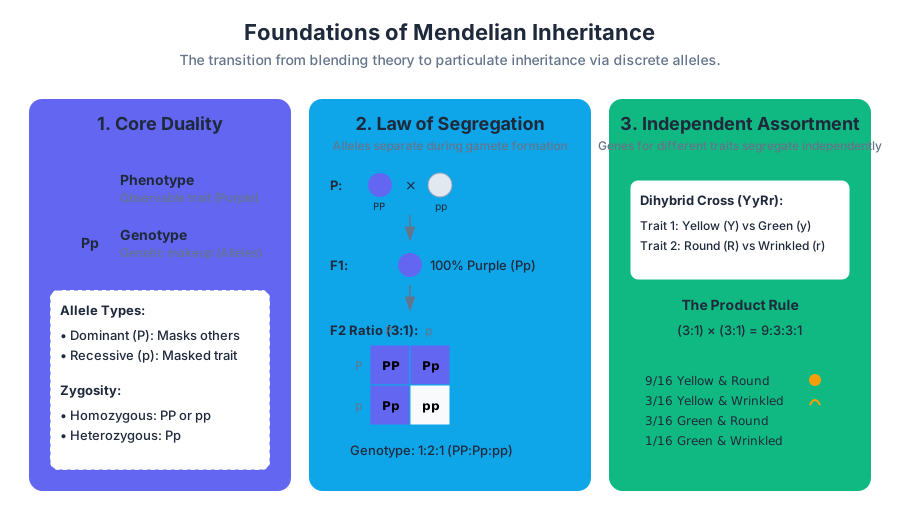
Definition: The Phenotype is the observable physical or physiological trait of an organism (e.g., purple flowers). The Genotype is the specific genetic makeup or set of alleles that determines that phenotype (e.g., Pp).
In Mendel's system, traits are governed by alleles—alternative versions of a gene found at the same locus (position) on homologous chromosomes.
| Term | Definition | Example (Pea Plants) |
|---|---|---|
| Allele | A variant form of a specific gene. | P (Purple) vs. p (White) |
| Homozygous | Having two identical alleles for a particular gene. | PP (Dominant) or pp (Recessive) |
| Heterozygous | Having two different alleles for a particular gene. | Pp |
| Dominant | An allele that masks the expression of a recessive allele. | Purple (P) |
| Recessive | An allele whose expression is masked by a dominant one. | White (p) |
The Mechanics of Dominance
Dominance is not a "strength" of an allele, but rather a functional relationship. In many cases, the dominant allele codes for a functional protein (like an enzyme that produces pigment), while the recessive allele is a "loss-of-function" mutation that produces a non-functional protein or none at all. In a heterozygote, the single functional allele often produces enough protein to achieve the full phenotype, making the trait appear dominant.
The First Law: The Law of Segregation
Mendel’s First Law, the Law of Segregation, describes how a single trait is passed from parents to offspring. It provides the mechanical explanation for why recessive traits can "disappear" in one generation and "reappear" in the next.
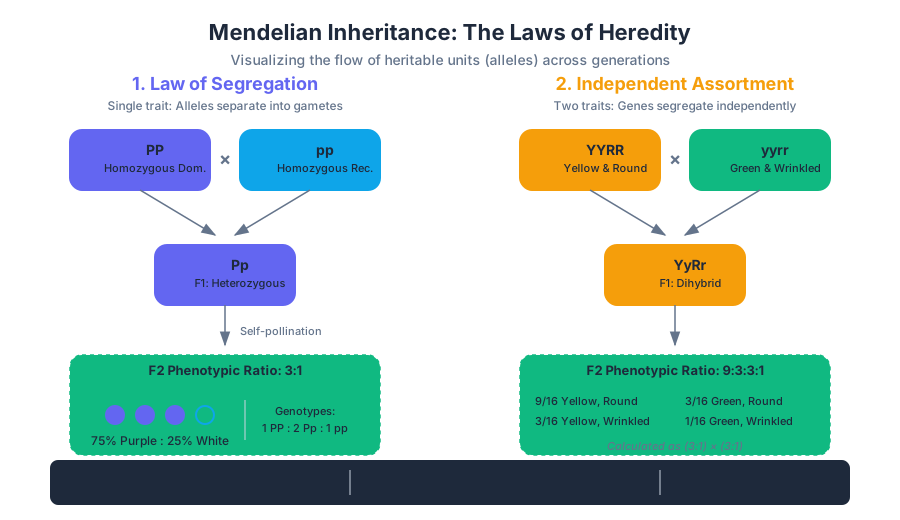
The Law of Segregation: During the formation of gametes (eggs and sperm), the two alleles for a heritable character segregate (separate) from each other and end up in different gametes.
The Derivation of the 3:1 Ratio
When Mendel crossed true-breeding purple-flowered plants (PP) with true-breeding white-flowered plants (pp), the $F_1$ (first filial) generation was 100% purple. However, when the $F_1$ plants were self-pollinated to produce the $F_2$ generation, the white trait reappeared in a consistent 3:1 ratio (Purple:White).
This ratio is a mathematical consequence of the random fusion of gametes. We can implement a simulation of this stochastic process to observe how these ratios emerge in large populations.
The Second Law: The Law of Independent Assortment
While the Law of Segregation deals with single genes, the Law of Independent Assortment addresses the behavior of multiple genes relative to one another.
The Law of Independent Assortment: Each pair of alleles segregates independently of each other pair of alleles during gamete formation.
This law applies only to genes located on different chromosomes (or very far apart on the same chromosome). If two genes are "linked" (close together on the same chromosome), they tend to be inherited together, violating this law.
The Dihybrid Cross and the 9:3:3:1 Ratio
To prove this, Mendel performed a dihybrid cross, tracking two traits at once: seed color (Yellow Y vs. Green y) and seed shape (Round R vs. Wrinkled r). By crossing a double-homozygous dominant (YYRR) with a double-homozygous recessive (yyrr), he produced an $F_1$ generation of YyRr.
The $F_2$ generation produced four distinct phenotypes in a 9:3:3:1 ratio. This ratio is essentially the product of two independent 3:1 ratios: $(3:1) \times (3:1) = 9:3:3:1$.
Mathematical Derivation of Dihybrid Probabilities
We can express the probability of a specific phenotype using the Product Rule of probability, which states that the probability of two independent events occurring together is the product of their individual probabilities.
\begin{aligned}
&\text{Let } P(\text{Yellow}) = \frac{3}{4}, \quad P(\text{Green}) = \frac{1}{4} \\
&\text{Let } P(\text{Round}) = \frac{3}{4}, \quad P(\text{Wrinkled}) = \frac{1}{4} \\
\\
&P(\text{Yellow and Round}) = \frac{3}{4} \times \frac{3}{4} = \frac{9}{16} \\
&P(\text{Yellow and Wrinkled}) = \frac{3}{4} \times \frac{1}{4} = \frac{3}{16} \\
&P(\text{Green and Round}) = \frac{1}{4} \times \frac{3}{4} = \frac{3}{16} \\
&P(\text{Green and Wrinkled}) = \frac{1}{4} \times \frac{1}{4} = \frac{1}{16}
\end{aligned}
Punnett Squares: Probability Visualization
The Punnett Square is a visual grid used to predict the possible genetic outcomes of a cross. While simple for monohybrid crosses, it becomes a powerful tool for understanding the combinatorial nature of genetics.
Constructing a Punnett Square
- Identify the genotypes of the parents.
- Determine all possible gametes each parent can produce.
- Place the gametes of one parent across the top and the other down the side.
- Fill in the boxes by combining the row and column gametes.
| Gametes | YR | Yr | yR | yr |
|---|---|---|---|---|
| YR | YYRR | YYRr | YyRR | YyRr |
| Yr | YYRr | YYrr | YyRr | Yyrr |
| yR | YyRR | YyRr | yyRR | yyRr |
| yr | YyRr | Yyrr | yyRr | yyrr |
Beyond the Square: The Branch Diagram
For trihybrid crosses or higher, Punnett squares become unwieldy (a trihybrid square has 64 boxes). Instead, we use the Branch Diagram or Probability Method. To find the probability of a YyRrPp genotype from a YyRrPp x YyRrPp cross:
- Probability of Yy = 1/2
- Probability of Rr = 1/2
- Probability of Pp = 1/2
- Total Probability = $1/2 \times 1/2 \times 1/2 = 1/8$.
Practical Application: Pedigree Analysis and Data Management
In modern genetics, Mendelian principles are used to track disease inheritance in humans. Because we cannot perform controlled crosses on humans, we use pedigrees (family trees) to deduce genotypes.
When managing large-scale genetic data, researchers use relational databases to track phenotypes and genotypes across generations.
Common Pitfalls and Misconceptions
Even at the foundational level, Mendelian genetics is often misunderstood.
- The "Dominant is Common" Fallacy: A dominant allele is not necessarily more common in a population than a recessive one. For example, polydactyly (extra fingers/toes) is caused by a dominant allele, but it is rare in the human population.
- The Gambler's Fallacy: If two heterozygous parents have three children with the dominant phenotype, the fourth child is not "due" to be recessive. Each fertilization event is an independent probability event ($P=1/4$ for recessive).
- Phenotype $\neq$ Genotype: You cannot always determine the genotype by looking at the phenotype. A purple flower could be PP or Pp. To distinguish them, Mendel used a Testcross—crossing the unknown individual with a homozygous recessive (pp).
| Scenario | Result of Testcross (with pp) | Conclusion |
|---|---|---|
| All offspring are Purple | 100% Pp | Unknown was PP |
| 50% Purple, 50% White | 50% Pp, 50% pp | Unknown was Pp |
Extensions of Mendelian Genetics
While Mendel's laws are the "laws of physics" for genetics, real-world biology often adds layers of complexity.
- Incomplete Dominance: The $F_1$ phenotype is a blend (e.g., Pink snapdragons from Red and White parents). Note that the alleles still segregate; the red and white traits reappear in the $F_2$.
- Codominance: Both alleles are expressed equally (e.g., AB blood type).
- Pleiotropy: One gene affects multiple phenotypic traits (e.g., the gene for sickle-cell anemia affects hemoglobin shape, malaria resistance, and organ health).
- Polygenic Inheritance: Multiple genes contribute to a single phenotype, creating a continuous spectrum (e.g., human skin color or height).
Source Materials
Study High School Biology on Lykke
This course page is free to open: signed out, you can read its first two sections, and signing in, on any plan, opens the rest. The free Lykke Chrome extension syncs your own Canvas courses, so ChatGPT, Claude and Muse can answer from your classes and deadlines. It only reads Canvas.
Add the free extensionSign in to open every sectionAll sections of High School Biology · Browse more course pages