From the free course High School Biology on Lykke
Chemical Foundations: Water and pH
Key concepts: Hydrogen bonding · Density of ice · Thermal insulation · pH scale · Acids and bases
Exploring the unique properties of water and the importance of pH balance in biological systems.
Chemical Foundations: Water and pH
Life, as we understand it, is not merely supported by water; it is fundamentally written in the language of aqueous chemistry. From the folding of complex proteins to the maintenance of electrochemical gradients across cell membranes, the physical and chemical properties of water dictate the boundary conditions of biology. This section explores the molecular architecture of water, the anomalous behavior of its solid phase, and the logarithmic scale of pH that governs enzymatic activity and homeostasis.
The Molecular Architecture of Water: Hydrogen Bonding
At the heart of water’s unique behavior is its polarity. A single water molecule ($H_2O$) consists of one oxygen atom covalently bonded to two hydrogen atoms. However, these bonds are polar covalent. Oxygen, being highly electronegative, exerts a stronger pull on the shared electrons than the hydrogen atoms.
What it is
Hydrogen Bonding is a specific type of dipole-dipole attraction that occurs when a hydrogen atom, covalently bonded to a highly electronegative atom (like Oxygen), experiences the electrostatic pull of a lone pair of electrons on a neighboring electronegative atom.
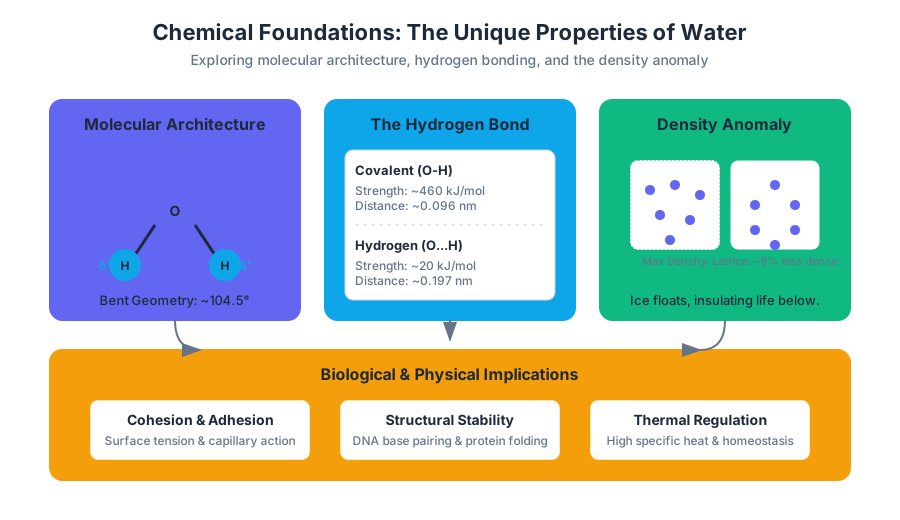
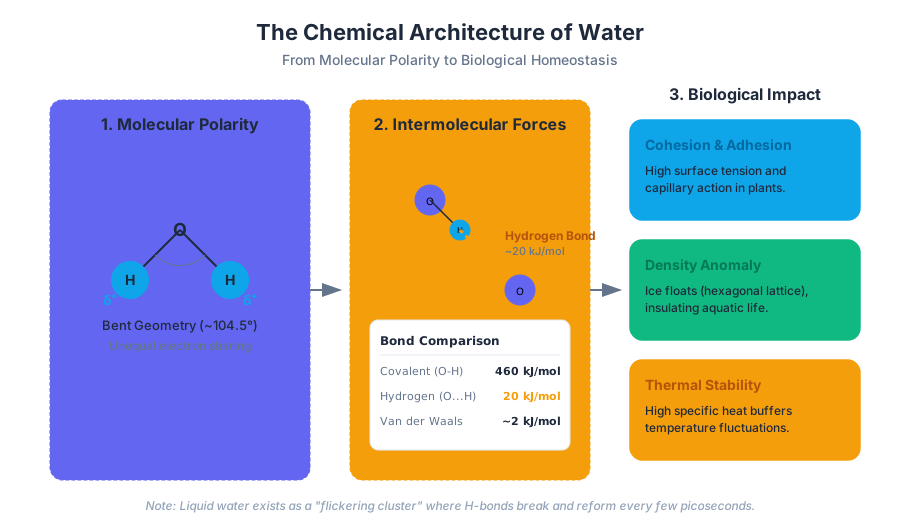
Definition: The Hydrogen Bond A non-covalent interaction where a hydrogen atom serves as a bridge between two electronegative atoms. In water, the bond energy is approximately 20 kJ/mol—significantly weaker than a covalent O-H bond (~460 kJ/mol) but strong enough to confer structural stability to liquid water.
Why it matters
Without hydrogen bonding, water would be a gas at room temperature (similar to hydrogen sulfide, $H_2S$). These bonds are responsible for cohesion (water sticking to itself), adhesion (water sticking to other surfaces), and the high surface tension that allows certain insects to walk on ponds. In a biological context, hydrogen bonds hold the two strands of the DNA double helix together and are the primary force behind protein secondary structures (alpha-helices and beta-sheets).
How it works: The Dipole Moment
The geometry of water is "bent" (approximately 104.5°) due to the two lone pairs of electrons on the oxygen atom. This asymmetry, combined with the electronegativity difference, creates a molecular dipole where the oxygen side is partially negative ($\delta^-$) and the hydrogen side is partially positive ($\delta^+$).
| Property | Covalent Bond (O-H) | Hydrogen Bond (O...H) | Van der Waals Forces |
|---|---|---|---|
| Type | Intramolecular | Intermolecular | Intermolecular |
| Strength | Very Strong (~460 kJ/mol) | Moderate (~20 kJ/mol) | Weak (~1-4 kJ/mol) |
| Distance | Short (~0.096 nm) | Longer (~0.197 nm) | Variable |
| Role | Holds the molecule together | Creates fluid networks | General atomic attraction |
Common Pitfalls
A frequent misconception is that hydrogen bonds are "real" bonds like covalent ones. They are actually electrostatic attractions. Another error is assuming water only forms four hydrogen bonds in a static way. In reality, liquid water is a "flickering cluster" where bonds break and reform every few picoseconds.
The Density Anomaly and Thermal Insulation
Most substances follow a simple rule: the solid phase is denser than the liquid phase because molecules pack more tightly as kinetic energy decreases. Water is a defiant exception.
What it is
The Density Anomaly refers to the fact that water reaches its maximum density at 4°C (39.2°F). As it cools further toward 0°C, it begins to expand. Upon freezing, it undergoes a phase transition into a crystalline lattice that is roughly 9% less dense than liquid water.
Why it matters: The Survival of Aquatic Ecosystems
If ice were denser than liquid water, lakes and oceans would freeze from the bottom up. During winter, the entire body of water would eventually turn into a solid block of ice, killing all complex life. Because ice floats, it creates a surface layer of thermal insulation. This layer traps the heat of the liquid water below, keeping it at a relatively stable temperature (usually around 4°C at the bottom) and allowing fish and plants to survive the winter.
How it works: The Hexagonal Lattice
In liquid water, molecules are crowded together, constantly shifting. As water freezes, the hydrogen bonds become stable and force the molecules into a hexagonal crystal lattice. In this arrangement, each oxygen atom is at the center of a tetrahedron of four hydrogen atoms. This geometry requires more space than the disordered liquid state, resulting in an increase in volume and a decrease in density.
| State of Water | Temperature (°C) | Density (g/cm³) | Molecular Arrangement |
|---|---|---|---|
| Liquid | 100 | 0.9584 | Highly disordered, rapid motion |
| Liquid | 4 | 1.0000 | Maximum packing efficiency |
| Liquid | 0 | 0.9998 | Beginning of lattice formation |
| Solid (Ice) | 0 | 0.9167 | Rigid, open hexagonal lattice |
Concrete Example: The Clausius-Clapeyron Relation
The relationship between pressure and the freezing point of water is described by the Clausius-Clapeyron equation. Because ice is less dense than water, increasing pressure actually lowers the melting point—a phenomenon called regelation.
\frac{dP}{dT} = \frac{L}{T \Delta V}
Where:
- $L$ is the latent heat of fusion.
- $T$ is the temperature.
- $\Delta V$ is the change in molar volume ($V_{liquid} - V_{solid}$).
- Since $\Delta V$ is negative for water, the slope $dP/dT$ is negative.
Variations: Heavy Water ($D_2O$)
In "heavy water," the hydrogen atoms are replaced by deuterium. $D_2O$ is about 11% denser than normal water and has a slightly higher freezing point (3.82°C). Interestingly, while chemically similar, high concentrations of heavy water are toxic to eukaryotic organisms because they disrupt the delicate timing of mitosis.
The pH Scale and Auto-ionization
The chemical reactivity of water is defined by its ability to dissociate into ions. This self-ionization is the foundation of the pH scale.
What it is
The pH scale is a logarithmic measure of the molar concentration of hydrogen ions ($H^+$) in a solution. Since $H^+$ ions do not exist freely in water but rather associate with water molecules to form hydronium ($H_3O^+$), pH is technically a measure of hydronium activity.
The pH Equation $$pH = -\log_{10}[H^+]$$ In pure water at 25°C, $[H^+] = 1.0 \times 10^{-7} M$, resulting in a pH of 7.0.
Why it matters
Biological systems are extremely sensitive to pH. Human blood must be maintained within a narrow window (7.35 to 7.45). A shift of even 0.5 units can lead to coma or death. This is because the charge of amino acid side chains in proteins changes with pH, which in turn alters the protein's shape and function (denaturation).
How it works: The Ion Product of Water ($K_w$)
Water undergoes auto-ionization according to the following equilibrium:
H_2O + H_2O \rightleftharpoons H_3O^+ + OH^-
The equilibrium constant for this reaction, known as $K_w$, is constant at a given temperature. At 25°C: $$K_w = [H^+][OH^-] = 1.0 \times 10^{-14}$$
Derivation of the Scale
If we take the negative logarithm of both sides of the $K_w$ expression: $$-\log(K_w) = -\log([H^+][OH^-])$$ $$pK_w = pH + pOH = 14$$
This relationship ensures that as the concentration of hydrogen ions increases (acidic), the concentration of hydroxide ions must decrease proportionally.
| Solution Type | $[H^+]$ (M) | pH | $[OH^-]$ (M) | pOH |
|---|---|---|---|---|
| Strongly Acidic | $10^0$ | 0 | $10^{-14}$ | 14 |
| Gastric Acid | $10^{-2}$ | 2 | $10^{-12}$ | 12 |
| Neutral Water | $10^{-7}$ | 7 | $10^{-7}$ | 7 |
| Bleach | $10^{-12}$ | 12 | $10^{-2}$ | 2 |
| Strongly Basic | $10^{-14}$ | 14 | $10^0$ | 0 |
Concrete Example: Calculating pH of a Strong Acid
If you add 0.01 moles of Hydrochloric Acid ($HCl$) to 1 liter of water, what is the pH? Since $HCl$ is a strong acid, it dissociates completely.
Acids, Bases, and Biological Buffers
While strong acids dissociate completely, most biological molecules are weak acids or weak bases, meaning they only partially dissociate in water.
What it is
- Brønsted-Lowry Acid: A substance that donates a proton ($H^+$).
- Brønsted-Lowry Base: A substance that accepts a proton.
- Buffer: A solution consisting of a weak acid and its conjugate base that resists changes in pH when small amounts of acid or base are added.
How it works: The Henderson-Hasselbalch Equation
The behavior of buffers is governed by the Henderson-Hasselbalch equation, which relates pH to the acid dissociation constant ($pK_a$) and the ratio of conjugate base to acid.
$$pH = pK_a + \log_{10}\left(\frac{[A^-]}{[HA]}\right)$$
When the concentration of the acid $[HA]$ equals the concentration of the conjugate base $[A^-]$, the $pH = pK_a$. This is the point where the buffer is most effective at resisting change.
Concrete Example: The Bicarbonate Buffer System
The human body manages blood pH primarily through the bicarbonate system:
CO_2 + H_2O \rightleftharpoons H_2CO_3 \rightleftharpoons HCO_3^- + H^+
If blood becomes too acidic, the equilibrium shifts to the left, and the excess $H^+$ is converted into $CO_2$, which is then exhaled by the lungs. If blood becomes too basic, the kidneys excrete more $HCO_3^-$ (bicarbonate) in the urine.
Common Pitfalls: The "Neutral" Misconception
A common mistake is thinking that "neutral" always means pH 7.0. The neutral point is defined as $[H^+] = [OH^-]$. Because $K_w$ changes with temperature, the neutral pH of water at 37°C (human body temperature) is actually approximately 6.8, not 7.0.
Summary of Chemical Foundations
Water is the "Universal Solvent" not because it dissolves everything, but because its polar nature and hydrogen-bonding capacity allow it to interact with a vast array of biological molecules. Its thermal properties provide a stable environment for life, and its ionization provides the chemical landscape (pH) in which metabolism occurs.
| Concept | Key Takeaway | Biological Impact |
|---|---|---|
| Hydrogen Bonding | Polar attraction between $H$ and $O$. | Stabilizes DNA and protein structures. |
| Density Anomaly | Ice is less dense than liquid water. | Prevents lakes from freezing solid. |
| Specific Heat | Water absorbs high energy with low temp change. | Regulates body and environmental temperature. |
| pH Scale | Logarithmic measure of $[H^+]$. | Controls enzyme activity and reaction rates. |
| Buffers | Mixtures that resist pH shifts. | Maintains blood homeostasis. |
Source Materials
Study High School Biology on Lykke
This course page is free to open: signed out, you can read its first two sections, and signing in, on any plan, opens the rest. The free Lykke Chrome extension syncs your own Canvas courses, so ChatGPT, Claude and Muse can answer from your classes and deadlines. It only reads Canvas.
Add the free extensionSign in to open every sectionAll sections of High School Biology · Browse more course pages