From the free course High School Biology on Lykke
Cellular Energy: Photosynthesis and Respiration
Key concepts: Photosynthesis · Cellular Respiration · ATP · Energy transformation
How organisms transform energy from the sun or food into a usable form (ATP).
Cellular Energy: Photosynthesis and Respiration
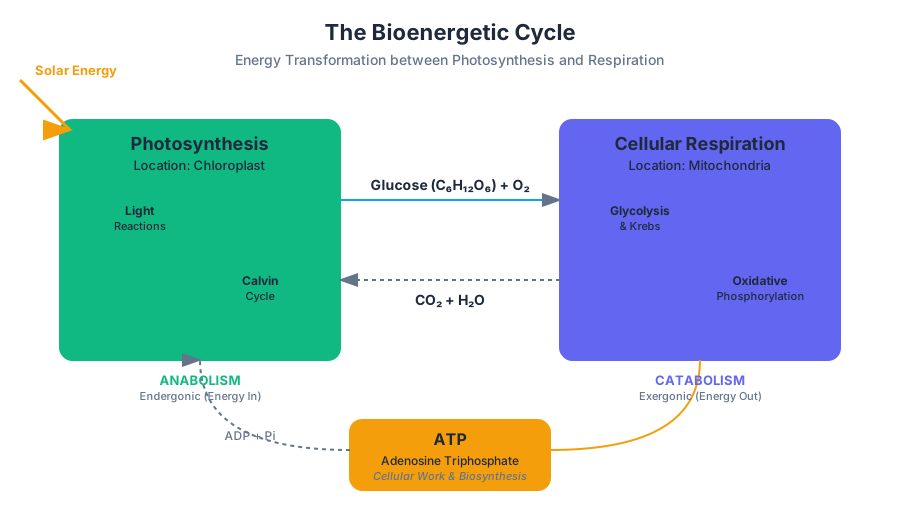
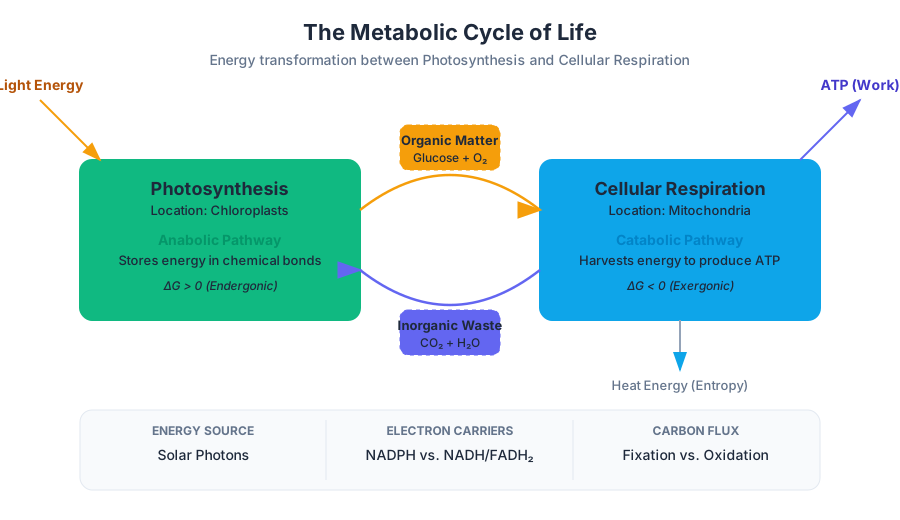
In the biological theater, energy is the fundamental currency that dictates the feasibility of every cellular transaction. From the synthesis of complex macromolecules to the mechanical contraction of muscle fibers, life operates under the strict constraints of thermodynamics. This article explores the dual engines of life: Photosynthesis, which captures and stores solar energy in chemical bonds, and Cellular Respiration, which harvests that energy to produce Adenosine Triphosphate (ATP).
The Thermodynamic Foundation of Metabolism
Metabolism is the sum of all chemical reactions within an organism. These reactions are categorized into two broad pathways that maintain the cell's internal order against the tide of entropy.
- Anabolism: The "building up" phase. These are endergonic reactions, meaning they require an input of energy ($\Delta G > 0$) to synthesize complex molecules from simpler precursors (e.g., building a protein from amino acids).
- Catabolism: The "breaking down" phase. These are exergonic reactions, releasing stored energy ($\Delta G < 0$) by degrading complex molecules into simpler ones (e.g., the breakdown of glucose).
The First Law of Thermodynamics in Biology: Energy cannot be created or destroyed, only transformed. In cells, light energy is transformed into chemical bond energy, which is then transformed into work and heat.
Energy Coupling and ATP
Cells perform work by energy coupling, using an exergonic process to drive an endergonic one. The mediator of this coupling is ATP. Structurally, ATP consists of an adenine nitrogenous base, a ribose sugar, and three phosphate groups. The bonds between the phosphate groups are often called "high-energy bonds," but more accurately, they are unstable bonds due to the mutual repulsion of the negatively charged phosphate groups.
| Parameter | ATP (Adenosine Triphosphate) | ADP (Adenosine Diphosphate) |
|---|---|---|
| Phosphate Groups | 3 | 2 |
| Energy State | High (Potential Energy) | Low |
| Role | Energy Donor | Energy Acceptor |
| Stability | Relatively Unstable | More Stable |
| Hydrolysis $\Delta G$ | $\approx -30.5$ kJ/mol | N/A |
Photosynthesis: Harvesting the Light
Photosynthesis is the primary anabolic pathway of the biosphere. It occurs in the chloroplasts of plants and algae, and in the plasma membranes of certain prokaryotes. The process is summarized by the equation:
6CO_2 + 6H_2O + \text{Light Energy} \rightarrow C_6H_{12}O_6 + 6O_2
The Light-Dependent Reactions
These reactions occur in the thylakoid membranes. They convert solar energy into the chemical energy of ATP and NADPH.
- Photoexcitation: Chlorophyll molecules absorb photons, boosting electrons to a higher energy state.
- Photosystem II (PSII): Water is split (photolysis), releasing $O_2$, protons ($H^+$), and electrons. These electrons replace those lost by chlorophyll.
- Electron Transport Chain (ETC): Electrons move through a series of proteins, pumping $H^+$ into the thylakoid space, creating a proton gradient.
- Photosystem I (PSI): Electrons are re-energized by light and used to reduce $NADP^+$ to $NADPH$.
- Chemiosmosis: The $H^+$ gradient drives ATP Synthase to produce ATP from ADP and inorganic phosphate ($P_i$).
The Light-Independent Reactions (Calvin Cycle)
Occurring in the stroma, this cycle uses the ATP and NADPH from the light reactions to "fix" carbon from $CO_2$ into sugar.
- Phase 1: Carbon Fixation: The enzyme RuBisCO attaches $CO_2$ to a five-carbon sugar, Ribulose Bisphosphate (RuBP).
- Phase 2: Reduction: The resulting molecules are phosphorylated by ATP and reduced by NADPH to form Glyceraldehyde-3-phosphate (G3P).
- Phase 3: Regeneration: Some G3P molecules exit to form glucose, while others are recycled to regenerate RuBP.
Cellular Respiration: The Engine of Catabolism
Cellular respiration is the process by which cells extract energy from food molecules. While it can occur anaerobically (fermentation), aerobic respiration is the most efficient, utilizing oxygen as the final electron acceptor.
Stage 1: Glycolysis
Glycolysis occurs in the cytosol and does not require oxygen. It breaks down one molecule of glucose ($C_6$) into two molecules of pyruvate ($C_3$).
- Energy Investment: 2 ATP are consumed to phosphorylate glucose.
- Energy Payoff: 4 ATP and 2 NADH are produced.
- Net Yield: 2 ATP, 2 NADH, and 2 Pyruvate.
Stage 2: The Citric Acid Cycle (Krebs Cycle)
Before entering the cycle, pyruvate is converted into Acetyl-CoA in the mitochondrial matrix, releasing $CO_2$ and producing NADH. The Krebs Cycle then fully oxidizes the acetyl group.
| Input (per Glucose) | Output (per Glucose) |
|---|---|
| 2 Acetyl-CoA | 4 $CO_2$ |
| 6 $NAD^+$ | 6 $NADH$ |
| 2 $FAD$ | 2 $FADH_2$ |
| 2 $ADP + P_i$ | 2 $ATP$ (via GTP) |
Stage 3: Oxidative Phosphorylation
This is the "grand finale" occurring on the inner mitochondrial membrane (cristae). It consists of the Electron Transport Chain and Chemiosmosis.
- Electron Transport: NADH and $FADH_2$ donate electrons to the ETC. As electrons move down the chain toward Oxygen (the final acceptor), energy is used to pump $H^+$ into the intermembrane space.
- Proton-Motive Force: The resulting electrochemical gradient represents stored potential energy.
- ATP Synthesis: $H^+$ ions flow back into the matrix through ATP Synthase, which acts like a molecular turbine, spinning to catalyze the synthesis of ATP.
The Efficiency of Energy Transformation
How efficient is the cell at converting the energy in glucose into ATP? We can derive this using the standard Gibbs free energy change.
\text{Efficiency} = \frac{\text{Energy captured in ATP}}{\text{Total energy available in Glucose}} \times 100
Mathematical Derivation of Efficiency
- Energy in Glucose: The complete oxidation of one mole of glucose releases $\Delta G = -686$ kcal/mol.
- Energy in ATP: The phosphorylation of ADP to ATP requires $\Delta G = +7.3$ kcal/mol.
- Total ATP Yield: Under ideal conditions, one molecule of glucose yields approximately 30 to 32 ATP.
Let's calculate the efficiency for 32 ATP:
Energy Captured = 32 moles ATP * 7.3 kcal/mol = 233.6 kcal
Efficiency = (233.6 / 686) * 100
Efficiency ≈ 34%
The remaining 66% of the energy is released as heat, which is not "wasted" in endothermic organisms but used to maintain body temperature.
Gluconeogenesis: The Anabolic Mirror
When glucose levels are low, the body performs Gluconeogenesis—the synthesis of glucose from non-carbohydrate precursors (like lactate, glycerol, or certain amino acids). While it shares many enzymes with glycolysis, it is not a simple reversal.
Le Chatelier’s Principle and Irreversibility: Three steps in glycolysis are highly exergonic and essentially irreversible ($\Delta G \ll 0$). Gluconeogenesis bypasses these steps using different enzymes to ensure the pathway is thermodynamically favorable in the direction of glucose synthesis.
Key Bypass Reactions
| Glycolysis Enzyme | Gluconeogenesis Bypass Enzyme | Significance |
|---|---|---|
| Hexokinase | Glucose-6-phosphatase | Allows glucose to exit the cell |
| Phosphofructokinase (PFK) | Fructose-1,6-bisphosphatase | Major regulatory point |
| Pyruvate Kinase | Pyruvate Carboxylase & PEP Carboxykinase | Requires ATP and GTP input |
Real-World Application: Bioinformatics and Mitochondrial Analysis
In clinical settings, analyzing the efficiency of cellular respiration often involves looking at mitochondrial DNA (mtDNA) or the expression of ETC proteins. Researchers use tools like blast to compare mitochondrial genomes across species or identify mutations that lead to metabolic disorders.
Common Pitfalls and Misconceptions
- "Plants only do photosynthesis": This is a major error. Plants have mitochondria and perform cellular respiration 24/7 to power cellular work. Photosynthesis only provides the fuel.
- "The purpose of the ETC is to make ATP": Strictly speaking, the ETC's purpose is to create a proton gradient. ATP Synthase is the enzyme that actually synthesizes ATP. If the membrane is "leaky" (uncoupled), the ETC will run, but no ATP will be made (energy is lost as heat).
- "High energy bonds": As mentioned, the energy isn't "in" the bond itself like a battery. The energy release comes from the fact that the products (ADP + $P_i$) are significantly more stable and have lower free energy than the reactant (ATP).
Summary of Interconnectivity
The relationship between photosynthesis and respiration is a perfect cycle of matter. The oxygen produced in the thylakoid becomes the terminal electron acceptor in the mitochondria. The $CO_2$ produced in the Krebs cycle becomes the substrate for RuBisCO in the Calvin cycle.
Source Materials
Study High School Biology on Lykke
This course page is free to open: signed out, you can read its first two sections, and signing in, on any plan, opens the rest. The free Lykke Chrome extension syncs your own Canvas courses, so ChatGPT, Claude and Muse can answer from your classes and deadlines. It only reads Canvas.
Add the free extensionSign in to open every sectionAll sections of High School Biology · Browse more course pages