From the free course High School Biology on Lykke
Biological Macromolecules
Key concepts: Carbohydrates · Proteins · Lipids · Nucleic acids
A deep dive into the four major classes of organic molecules that make up living organisms.
Biological Macromolecules
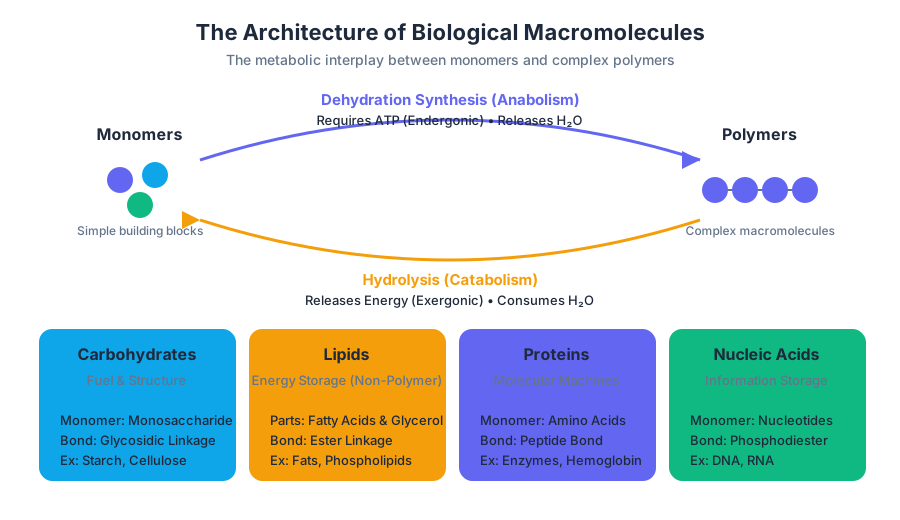
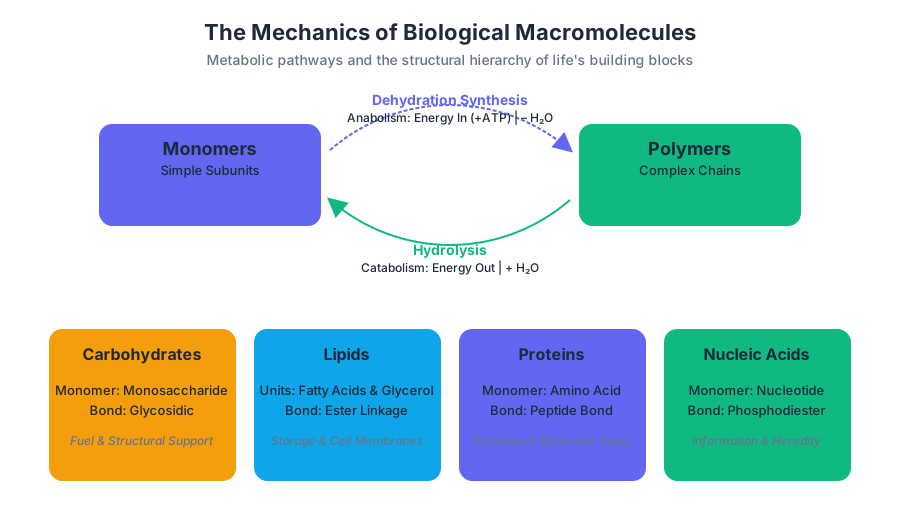
The architecture of life is built upon a foundation of four primary classes of organic compounds: Carbohydrates, Lipids, Proteins, and Nucleic Acids. These "macromolecules" are large, complex polymers synthesized from smaller, repeating units called monomers. The assembly and disassembly of these structures are governed by the laws of thermodynamics and the specific chemistry of the carbon atom.
Understanding biological macromolecules requires moving beyond simple definitions and into the realm of molecular mechanics. We must examine how covalent bonds are formed through dehydration synthesis, how they are cleaved via hydrolysis, and how the resulting three-dimensional conformations dictate the functional limits of a cell.
The Chemical Engine: Polymerization and Metabolism
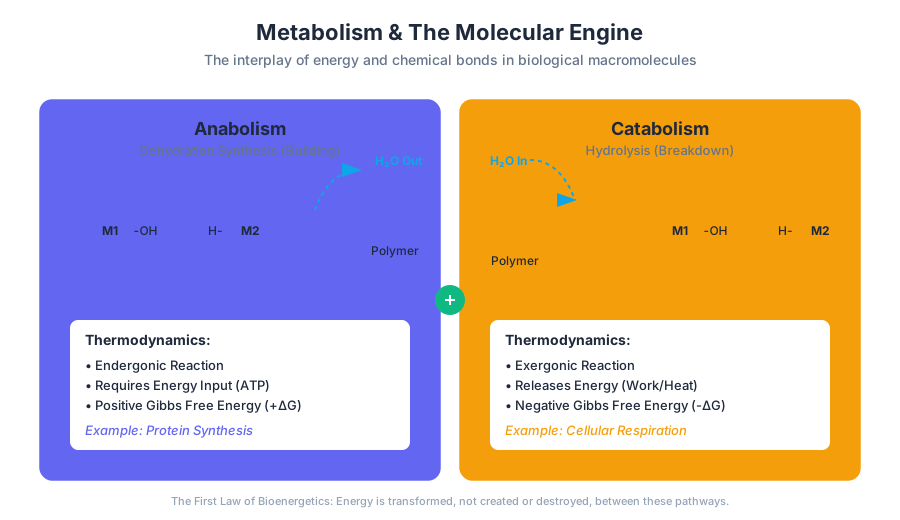
Before diving into specific classes, we must define the universal mechanism of macromolecular construction. Most biological polymers are formed through dehydration synthesis (also known as condensation reactions), where the hydrogen of one monomer combines with the hydroxyl group of another, releasing a water molecule ($H_2O$) and forming a covalent bond.
Conversely, the breakdown of these polymers occurs via hydrolysis, where a water molecule is consumed to bridge the gap between monomers, effectively "lysing" the bond. This interplay is the basis of metabolism, which is divided into two distinct pathways:
- Anabolism: The synthesis of complex molecules from simpler ones. These are endergonic reactions, meaning they require an input of energy (usually in the form of ATP).
- Catabolism: The breakdown of complex molecules into simpler ones. These are exergonic reactions, releasing energy that the cell can capture to perform work.
The First Law of Bioenergetics: Energy cannot be created or destroyed within a biological system, only transformed. The synthesis of a protein (anabolism) is fueled by the breakdown of glucose (catabolism), ensuring a continuous flow of Gibbs Free Energy ($\Delta G$) to maintain homeostasis.
| Process | Energy Change | Reaction Type | Example |
|---|---|---|---|
| Anabolism | Positive $\Delta G$ (Requires Energy) | Endergonic | Gluconeogenesis, Protein Synthesis |
| Catabolism | Negative $\Delta G$ (Releases Energy) | Exergonic | Glycolysis, Cellular Respiration |
| Dehydration | Bond Formation | Synthesis | Building Starch from Glucose |
| Hydrolysis | Bond Cleavage | Decomposition | Digestion of Dietary Proteins |
Carbohydrates: The Molecular Fuel and Scaffold
Carbohydrates are organic molecules composed of carbon, hydrogen, and oxygen, typically in a molar ratio of $1:2:1$, represented by the empirical formula $(CH_2O)_n$. They serve as the primary short-term energy source for cells and provide structural integrity to plants, fungi, and arthropods.
Monosaccharides and Disaccharides
The simplest carbohydrates are monosaccharides (e.g., glucose, fructose, galactose). In aqueous solutions, these often exist as cyclic structures. When two monosaccharides link via a glycosidic bond, they form a disaccharide (e.g., sucrose, lactose).
The orientation of the hydroxyl group on the anomeric carbon (the carbon derived from the carbonyl group) determines whether the bond is $\alpha$ (alpha) or $\beta$ (beta). This distinction is biologically critical: humans possess enzymes to digest $\alpha$-glycosidic bonds (starch) but lack the enzymes to break $\beta$-glycosidic bonds (cellulose).
Polysaccharides: Storage vs. Structure
Polysaccharides are long chains of monosaccharides. Their function is determined by their branching and the type of glycosidic linkage:
- Storage Polysaccharides: Starch (in plants) and Glycogen (in animals) are composed of $\alpha$-glucose. Glycogen is highly branched, allowing for rapid mobilization of glucose during exercise or fasting.
- Structural Polysaccharides: Cellulose (plant cell walls) and Chitin (fungal cell walls and arthropod exoskeletons) are composed of $\beta$-linkages, creating rigid, unbranched fibrils that are incredibly resistant to mechanical stress.
Lipids: Hydrophobicity and Energy Density
Unlike the other three macromolecules, lipids are not true polymers. They are a heterogeneous group of non-polar, hydrophobic compounds. Their primary roles include long-term energy storage, insulation, and forming the core of biological membranes.
Fatty Acids and Triacylglycerols
A fatty acid consists of a long hydrocarbon chain attached to a carboxyl group.
- Saturated Fatty Acids: Contain no double bonds between carbon atoms. They are "saturated" with hydrogen, allowing them to pack tightly and remain solid at room temperature (e.g., butter).
- Unsaturated Fatty Acids: Contain one or more double bonds, creating "kinks" in the chain. These kinks prevent tight packing, making them liquid at room temperature (e.g., vegetable oil).
Phospholipids and the Membrane
Phospholipids are the most important lipids for cellular structure. They are amphipathic, possessing a hydrophilic (polar) head and two hydrophobic (non-polar) tails. In water, they spontaneously organize into a lipid bilayer, the fundamental structure of the cell membrane.
The Fluid Mosaic Model: The cell membrane is not a static wall but a dynamic, fluid environment where proteins and lipids move laterally. The "fluidity" is regulated by the ratio of saturated to unsaturated fats and the presence of cholesterol, which acts as a temperature buffer.
| Lipid Type | Structure | Primary Function |
|---|---|---|
| Triglycerides | Glycerol + 3 Fatty Acids | Long-term energy storage (Adipose) |
| Phospholipids | Glycerol + 2 Fatty Acids + Phosphate | Membrane structure |
| Steroids | Four fused carbon rings | Signaling (Hormones) and Membrane fluidity |
| Waxes | Long-chain alcohol + Fatty acid | Protection and water-proofing |
Proteins: The Molecular Machines
Proteins are the most versatile macromolecules, accounting for more than 50% of the dry mass of most cells. They function as enzymes, structural supports, transporters, and signaling molecules.
Amino Acids: The Building Blocks
Proteins are polymers of amino acids. Each amino acid has a central carbon ($\alpha$-carbon) bonded to an amino group ($NH_2$), a carboxyl group ($COOH$), a hydrogen atom, and a variable R-group (side chain). There are 20 standard amino acids, categorized by the chemical properties of their R-groups: polar, non-polar, acidic, or basic.
The Four Levels of Protein Structure
The function of a protein is entirely dependent on its three-dimensional shape. This shape is achieved through four levels of organization:
- Primary (1°): The unique sequence of amino acids in the polypeptide chain, determined by genetic information.
- Secondary (2°): Localized folding patterns, such as $\alpha$-helices and $\beta$-pleated sheets, stabilized by hydrogen bonds between the polypeptide backbone.
- Tertiary (3°): The overall 3D shape of a single polypeptide, stabilized by interactions between R-groups (hydrophobic interactions, van der Waals forces, hydrogen bonds, ionic bonds, and disulfide bridges).
- Quaternary (4°): The structure resulting from the aggregation of two or more polypeptide subunits (e.g., Hemoglobin).
\text{Gibbs Free Energy of Folding: } \Delta G_{folding} = \Delta H_{folding} - T\Delta S_{folding}
For a protein to fold spontaneously, $\Delta G$ must be negative. While the decrease in entropy ($\Delta S$) of the protein itself is unfavorable, the "hydrophobic effect"—the increase in entropy of the surrounding water molecules—drives the process forward.
Enzymes and Activation Energy
Enzymes are protein catalysts that speed up biochemical reactions by lowering the activation energy ($E_a$). They do not change the $\Delta G$ of a reaction; they simply provide a pathway for the reaction to occur more rapidly.
Nucleic Acids: Information Storage and Transfer
Nucleic Acids (DNA and RNA) are the polymers responsible for storing, transmitting, and expressing genetic information. They are composed of monomers called nucleotides.
Nucleotide Structure
Each nucleotide consists of three components:
- A Pentose Sugar (Deoxyribose in DNA, Ribose in RNA).
- A Phosphate Group.
- A Nitrogenous Base (Adenine, Guanine, Cytosine, Thymine in DNA, or Uracil in RNA).
Nucleotides are linked by phosphodiester bonds between the 5' phosphate of one nucleotide and the 3' hydroxyl group of the next, creating a sugar-phosphate backbone with a distinct directionality ($5' \to 3'$).
DNA vs. RNA
DNA serves as the long-term "hard drive" of the cell, existing as a double-stranded helix held together by hydrogen bonds between complementary bases (A-T, G-C). RNA is typically single-stranded and acts as a "temporary copy" (mRNA), a structural component (rRNA), or an adapter (tRNA) to translate genetic code into proteins.
| Feature | DNA (Deoxyribonucleic Acid) | RNA (Ribonucleic Acid) |
|---|---|---|
| Sugar | Deoxyribose | Ribose |
| Bases | A, G, C, T | A, G, C, U |
| Structure | Double-stranded Helix | Usually single-stranded |
| Stability | Highly stable (Long-term) | Relatively unstable (Short-term) |
| Location | Nucleus (Eukaryotes) | Nucleus and Cytoplasm |
Integration: Gluconeogenesis and Metabolic Flux
To see these macromolecules in action, consider Gluconeogenesis. This is a metabolic pathway where the body synthesizes glucose (a carbohydrate) from non-carbohydrate precursors like pyruvate, lactate, or certain amino acids (derived from proteins).
This process is the reverse of glycolysis but is not a simple mirror image. It requires bypassing three irreversible steps of glycolysis using different enzymes. This is a classic example of anabolism:
- Energy Input: It consumes 4 ATP, 2 GTP, and 2 NADH to produce one molecule of glucose.
- Regulation: It is stimulated by the hormone glucagon when blood glucose levels are low, ensuring the brain has a constant fuel supply even during starvation.
Insight: The ability of a cell to switch between breaking down macromolecules (catabolism) and building them (anabolism) is what allows for homeostasis. If you consume excess protein, your body doesn't just store it as protein; it deaminates the amino acids and converts the carbon skeletons into lipids for long-term storage.
Common Pitfalls and Misconceptions
- "Lipids are polymers": This is technically false. While they are large molecules, they are not made of repeating monomeric units linked in a chain like proteins or carbohydrates.
- "All enzymes are proteins": Most are, but ribozymes (catalytic RNA molecules) prove that nucleic acids can also perform enzymatic work.
- "Saturated fats are 'bad'": Biologically, saturation is about membrane fluidity and energy density. The "health" aspect is a matter of dietary balance and physiological context, not a fundamental property of the molecule itself.
- "DNA is the only genetic material": While true for cellular life, many viruses use RNA as their primary genetic storage medium.
Source Materials
Study High School Biology on Lykke
This course page is free to open: signed out, you can read its first two sections, and signing in, on any plan, opens the rest. The free Lykke Chrome extension syncs your own Canvas courses, so ChatGPT, Claude and Muse can answer from your classes and deadlines. It only reads Canvas.
Add the free extensionSign in to open every sectionAll sections of High School Biology · Browse more course pages