From the free course Geology on Lykke
Earthquakes and Geological Structures
Key concepts: Seismology · Faults and Folds · Crustal Deformation · Seismic Waves · Subsurface Deduction
Focuses on crustal deformation, the resulting structures like folds and faults, and the science of seismology.
Earthquakes and Geological Structures
The Earth’s crust is not a static shell but a dynamic medium under constant internal pressure. When tectonic forces—driven by mantle convection and plate movements—exert pressure on rock masses, the crust undergoes deformation. This deformation manifests as the bending, breaking, and tilting of rock layers, creating the complex geological structures we observe today. Seismology is the study of the energy released when these rocks finally fail, sending shockwaves through the planetary interior.
Mechanics of Crustal Deformation: Stress and Strain
To understand why a mountain range folds or a fault ruptures, we must first distinguish between the force applied and the resulting change in the rock.
- Stress ($\sigma$ or $\tau$): The force applied per unit area. It is a vector quantity that can be resolved into normal stress (perpendicular to a surface) and shear stress (parallel to a surface).
- Strain ($\epsilon$): The physical change in shape or volume of the rock in response to stress.
Rocks respond to stress in three distinct stages:
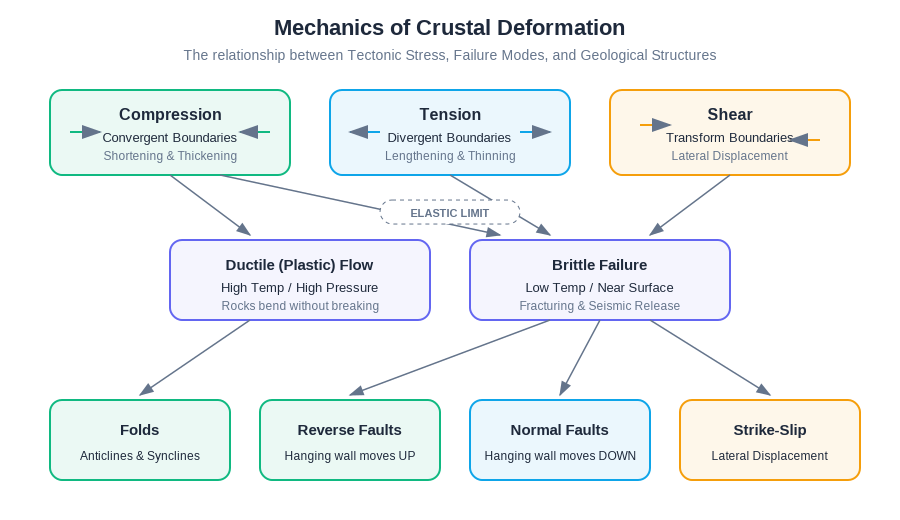
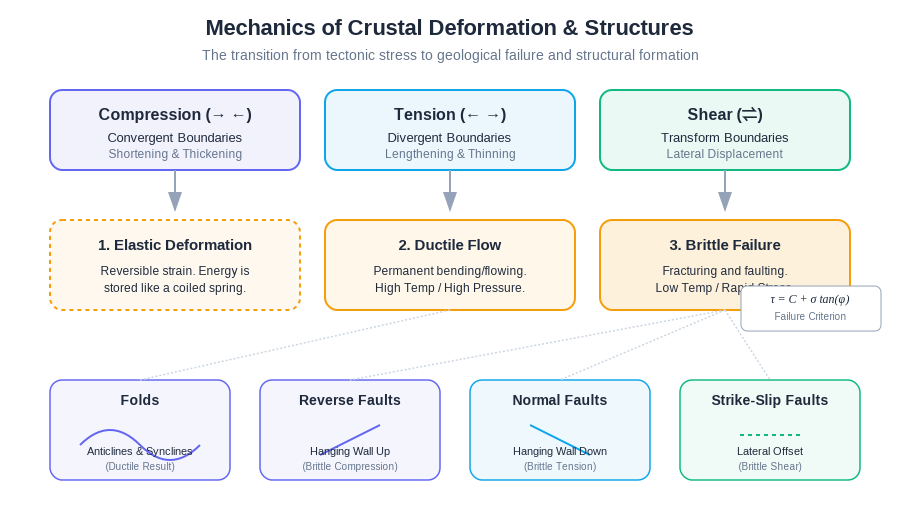
- Elastic Deformation: The rock deforms but returns to its original shape once stress is removed. This is the "spring" mechanism that stores energy for earthquakes.
- Ductile (Plastic) Deformation: Beyond the elastic limit, the rock flows or bends permanently without breaking. This typically occurs at high temperatures and pressures deep within the crust.
- Brittle Failure: If stress is applied rapidly or the rock is cold (near the surface), it fractures. This is the primary cause of faults and earthquakes.
| Stress Type | Tectonic Environment | Primary Resulting Structure | Dimensional Change |
|---|---|---|---|
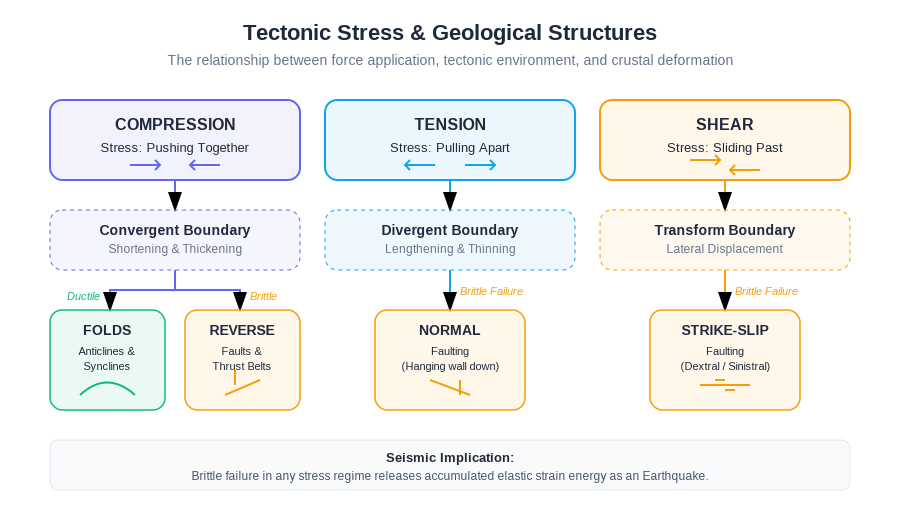
| Compression | Convergent Boundaries | Folds, Reverse Faults | Shortening and Thickening |
| Tension | Divergent Boundaries | Normal Faults | Lengthening and Thinning |
| Shear | Transform Boundaries | Strike-Slip Faults | Lateral Displacement |
The Mohr-Coulomb Failure Criterion
In structural engineering and geology, we use the Mohr-Coulomb criterion to predict when a rock will transition from elastic behavior to brittle failure. The shear strength of a rock ($\tau$) is defined by its internal cohesion ($C$) and the angle of internal friction ($\phi$).
Geological Structures: Folds
Folds are the result of ductile deformation under compressional stress. They are most commonly found in the roots of mountain belts where heat and pressure allow rock to behave like a viscous fluid over millions of years.
Anatomy of a Fold
- Hinge Line: The line of maximum curvature on a folded surface.
- Axial Plane: An imaginary plane that divides the fold as symmetrically as possible, connecting the hinge lines of successive layers.
- Limbs: The "sides" of the fold on either side of the axial plane.
Primary Fold Types
- Anticlines: Arch-like folds where the limbs dip away from the hinge. Crucially, the oldest rocks are found in the core of the fold.
- Synclines: Trough-like folds where the limbs dip toward the hinge. The youngest rocks are found in the core.
- Monoclines: A step-like fold in otherwise horizontal sedimentary strata, often caused by a deep-seated fault that does not reach the surface.
The Rule of Superposition in Folding: In an upright (non-overturned) fold, the relative age of the strata is the most reliable way to distinguish an anticline from a syncline, especially when the surface topography has been eroded flat.
Geological Structures: Faults
Faults are fractures in the crust along which significant displacement has occurred. They are the primary sources of seismic activity.
Dip-Slip Faults
Movement is primarily vertical, parallel to the dip of the fault plane.
- Normal Faults: The hanging wall (the block above the fault) moves down relative to the footwall. This indicates tensional stress (crustal stretching).
- Reverse Faults: The hanging wall moves up relative to the footwall. This indicates compressional stress.
- Thrust Faults: A low-angle reverse fault (dip < 45°). These are responsible for massive crustal shortening in mountain ranges like the Himalayas.
Strike-Slip Faults
Movement is primarily horizontal.
- Right-Lateral (Dextral): If you stand on one side, the opposite side appears to have moved to the right.
- Left-Lateral (Sinistral): The opposite side appears to have moved to the left.
| Fault Type | Stress Regime | Tectonic Setting | Example |
|---|---|---|---|
| Normal | Tension | Mid-Ocean Ridges, Basin & Range | East African Rift |
| Reverse | Compression | Subduction Zones | Andes Mountains |
| Strike-Slip | Shear | Transform Boundaries | San Andreas Fault |
Seismology: The Science of Earthquakes
An earthquake is the sudden release of stored elastic strain energy. According to the Elastic Rebound Theory, rocks on opposite sides of a fault are subjected to force and shift elastically until they reach their internal strength limit. At the moment of rupture (the focus or hypocenter), the rocks snap back to an unstrained state, releasing energy as seismic waves.
Seismic Wave Mechanics
Seismic waves are categorized into Body Waves (traveling through the Earth's interior) and Surface Waves (traveling along the crust).
- P-waves (Primary): Longitudinal/Compressional waves. They are the fastest and can travel through solids, liquids, and gases.
- S-waves (Secondary): Transverse/Shear waves. They move slower than P-waves and cannot travel through liquids because liquids have no shear strength. This property allowed geologists to deduce that the Earth's outer core is liquid.
\text{P-wave Velocity: } V_p = \sqrt{\frac{K + \frac{4}{3}\mu}{\rho}}
\quad \quad
\text{S-wave Velocity: } V_s = \sqrt{\frac{\mu}{\rho}}
Where:
- $K$ = Bulk Modulus (resistance to compression)
- $\mu$ = Shear Modulus (rigidity)
- $\rho$ = Density
Insight: Since $\mu = 0$ in a liquid, the formula for $V_s$ becomes zero, explaining why S-waves are blocked by the outer core (the S-wave Shadow Zone).
| Wave Type | Particle Motion | Velocity | Damage Potential |
|---|---|---|---|
| P-Wave | Parallel to propagation (Push-Pull) | Fast (~6-8 km/s) | Low |
| S-Wave | Perpendicular to propagation (Shake) | Medium (~3-4 km/s) | Moderate |
| Rayleigh | Elliptical (Rolling) | Slow | Very High |
| Love | Side-to-side (Horizontal shear) | Slow | Very High |
Locating an Epicenter
The distance to an earthquake is determined by the time lag between the arrival of the P-wave and the S-wave ($S-P$ interval). By using data from at least three seismic stations, the epicenter can be located via triangulation.
Subsurface Deduction and Mapping
Geologists cannot see beneath the Earth's surface directly. Instead, they use surface measurements of Strike and Dip to project structures into the third dimension.
- Strike: The compass direction of a line formed by the intersection of a tilted rock layer with a horizontal plane.
- Dip: The angle of inclination of the rock layer, measured downward from the horizontal plane, perpendicular to the strike.
The Rule of Vs
When a V-shaped outcrop pattern appears on a map where a bed crosses a stream valley:
- For horizontal beds, the "V" points upstream.
- For beds dipping upstream, the "V" points upstream (narrower).
- For vertical beds, there is no "V"; the outcrop is a straight line.
Practical Data Acquisition
Modern seismologists use automated tools to query global earthquake databases for structural analysis.
Seismic Hazards and Risk Mitigation
The danger of an earthquake is not just the magnitude, but the local geological conditions.
- Liquefaction: Unconsolidated, water-saturated sediments lose their strength during shaking and behave like a liquid, causing buildings to sink.
- Amplification: Soft soils (like bay mud) amplify seismic waves compared to hard bedrock.
- Tsunamis: Vertical displacement of the seafloor (usually via thrust faults in subduction zones) displaces the entire water column, creating long-period waves that grow in height as they approach the shore.
Magnitude vs. Intensity
It is a common pitfall to confuse the Moment Magnitude Scale ($M_w$) with the Modified Mercalli Intensity (MMI) Scale.
| Scale | Measure | Type | Range |
|---|---|---|---|
| Moment Magnitude | Energy released | Quantitative/Logarithmic | 1.0 - 10.0+ |
| Modified Mercalli | Observed damage/shaking | Qualitative/Subjective | I - XII |
Summary of Subsurface Interpretation
To reconstruct the history of a region, geologists combine these concepts into a Cross-Section. By applying the Principle of Cross-Cutting Relationships, we know that a fault or an igneous intrusion must be younger than the rock layers it cuts through. Similarly, if a fold is cut by a fault, the folding event occurred first.
Source Materials
- Geological Structures - A Practical Introduction (Waldron and Snyder)
- Geology (Lumen)
- Physical Geology (Earle)
- Physical Geology (Panchuk)
- GEOS: A Physical Geology Lab Manual for California Community Colleges (Branciforte and Haddad)
- Fundamentals of Geology (Schulte)
- An Introduction to Geology (Johnson, Affolter, Inkenbrandt, and Mosher)
- Engaging Adults in Science and Energy
Study Geology on Lykke
This course page is free to open: signed out, you can read its first two sections, and signing in, on any plan, opens the rest. The free Lykke Chrome extension syncs your own Canvas courses, so ChatGPT, Claude and Muse can answer from your classes and deadlines. It only reads Canvas.
Add the free extensionSign in to open every section