From the free course Geology on Lykke
Weathering, Sediments, and Sedimentary Rocks
Key concepts: Mechanical vs. Chemical Weathering · Lithification · Stratigraphy · Depositional Environments · Soil Formation
An examination of how rocks break down at the surface and reform into sedimentary layers, preserving Earth's history.
Weathering, Sediments, and Sedimentary Rocks: The Earth's Surface Archive
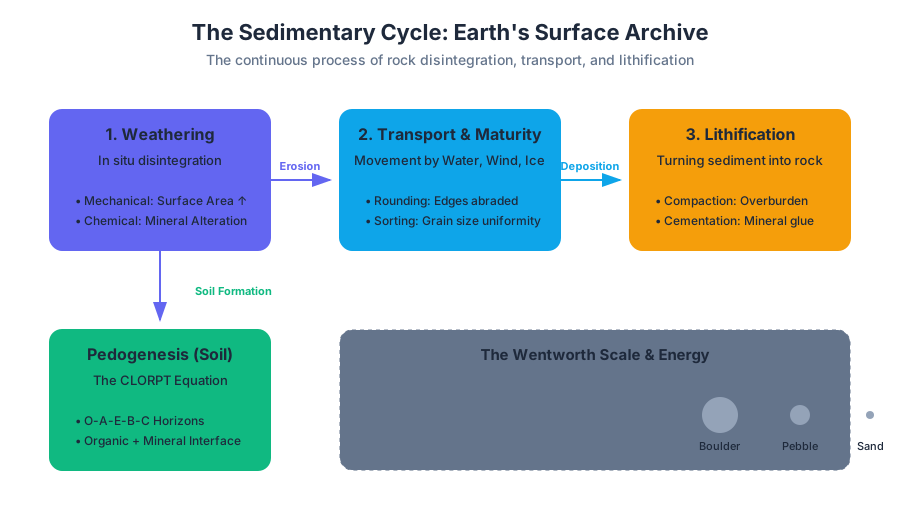
The Earth’s surface is a dynamic interface where the lithosphere, hydrosphere, atmosphere, and biosphere converge. This intersection facilitates the sedimentary cycle, a continuous process of rock degradation, transport, and reconstruction. Unlike igneous and metamorphic rocks, which often originate in high-pressure, high-temperature environments deep within the crust, sedimentary rocks are the primary records of Earth's surface history. They archive the evolution of life (fossils), fluctuations in ancient climates, and the migration of tectonic plates.
1. Weathering: The Engine of Disintegration
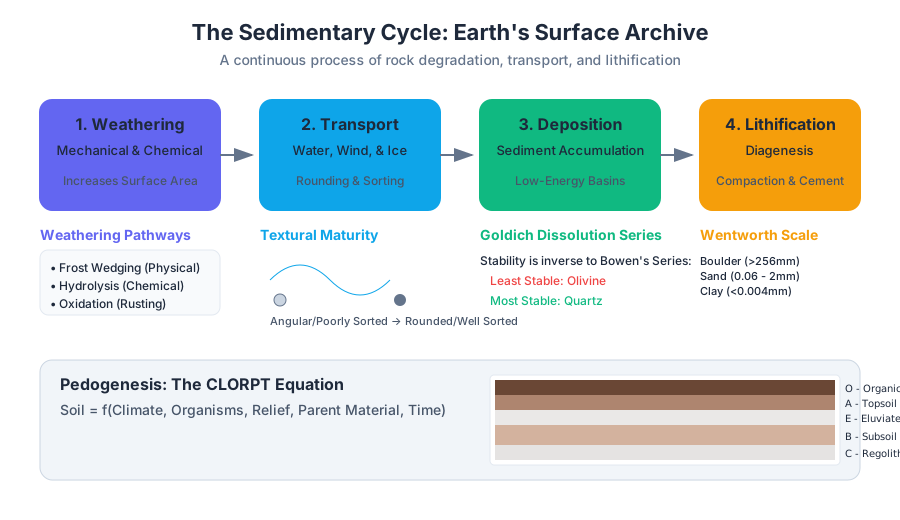
Weathering is the in situ physical disintegration and chemical decomposition of rocks. It is distinct from erosion, which involves the transport of the resulting debris. Weathering acts as the precursor to the sedimentary cycle by reducing solid bedrock into transportable particles and dissolved ions.
1.1 Mechanical Weathering
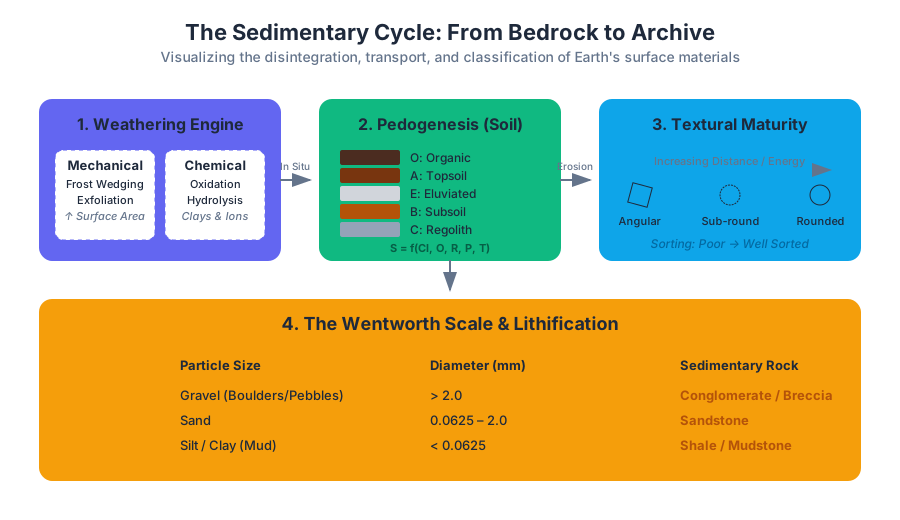
Mechanical (or physical) weathering involves the physical breakage of rock into smaller fragments without changing the mineral chemistry. This process is critical because it exponentially increases the surface area available for chemical attack.
| Mechanism | Description | Primary Environment |
|---|---|---|
| Frost Wedging | Water enters cracks, freezes, expands by ~9%, and exerts outward pressure. | Alpine/Sub-polar |
| Exfoliation | Pressure release (unloading) causes plutonic rocks to expand and peel in sheets. | High-relief granitic terrains |
| Thermal Expansion | Differential expansion of minerals due to extreme diurnal temperature swings. | Arid Deserts |
| Biogenic Activity | Root wedging and animal burrowing physically displace rock material. | Vegetated regions |
1.2 Chemical Weathering
Chemical weathering involves the transformation of original minerals into new, stable phases (usually clays) and dissolved ions. This process is governed by the principles of chemical equilibrium; minerals formed at high temperatures (e.g., Olivine) are most unstable at the Earth's surface.
Goldich Dissolution Series: A conceptual model stating that the order of mineral weathering is the inverse of Bowen's Reaction Series. Olivine weathers most rapidly, while Quartz is the most resistant.
The primary chemical pathways include:
- Oxidation: Reaction with oxygen (e.g., $4Fe^{2+} + 3O_2 \rightarrow 2Fe_2O_3$, forming hematite/rust).
- Hydrolysis: Reaction with $H^+$ and $OH^-$ ions in water, typically converting silicates to clay minerals.
- Carbonation: Dissolution by carbonic acid ($H_2CO_3$), formed when $CO_2$ dissolves in rainwater.
2. Pedogenesis: The Formation of Soil
Soil is the bridge between the inorganic and organic worlds. It is defined as a combination of mineral matter, organic matter (humus), water, and air. Pedogenesis (soil formation) is controlled by the CLORPT equation:
$$S = f(Cl, O, R, P, T)$$
Where:
- Cl: Climate (Temperature and precipitation)
- O: Organisms (Biological activity)
- R: Relief (Topography and slope)
- P: Parent Material (The source rock)
- T: Time (Duration of weathering)
2.1 Soil Horizons
As soil matures, it develops distinct layers called horizons.
| Horizon | Name | Characteristics |
|---|---|---|
| O | Organic | Fresh and decaying organic matter (humus). |
| A | Topsoil | Mineral matter mixed with humus; high biological activity. |
| E | Eluviated | Zone of leaching; light-colored, depleted of clay and iron. |
| B | Subsoil | Zone of accumulation (illuviation) of minerals from above. |
| C | Regolith | Partially altered parent material. |
| R | Bedrock | Unweathered source rock. |
3. Sediment Transport and Deposition
Once rock is weathered, it becomes sediment. The transport of this sediment is a function of the medium's energy (water, wind, or ice).
3.1 Textural Maturity
As sediment is transported further from its source, it undergoes predictable changes:
- Rounding: Angular edges are abraded; grains become spherical.
- Sorting: The range of grain sizes narrows. High-energy environments (e.g., mountain streams) have poor sorting; low-energy environments (e.g., deep lakes) have high sorting.
- Mineral Maturity: Unstable minerals (feldspars, micas) disappear, leaving only resistant minerals like quartz.
3.2 The Wentworth Scale
Geologists use the Wentworth Scale to classify sediment by diameter ($d$):
| Particle | Size Range ($mm$) | Typical Rock Equivalent |
|---|---|---|
| Boulder | $> 256$ | Conglomerate / Breccia |
| Cobble | $64 - 256$ | Conglomerate / Breccia |
| Pebble | $2 - 64$ | Conglomerate / Breccia |
| Sand | $0.0625 - 2$ | Sandstone |
| Silt | $0.0039 - 0.0625$ | Siltstone |
| Clay | $< 0.0039$ | Shale / Mudstone |
\text{Stokes' Law for Settling Velocity } (v_s):
v_s = \frac{2}{9} \frac{(\rho_p - \rho_f)}{\mu} g R^2

\text{Where:}
\rho_p = \text{density of particle}
\rho_f = \text{density of fluid}
\mu = \text{dynamic viscosity}
g = \text{gravity}
R = \text{radius of particle}
4. Lithification: Turning Sediment into Rock
Lithification is the process of converting loose sediment into solid sedimentary rock. This occurs through two primary mechanisms:
- Compaction: As layers of sediment accumulate, the weight of the overburden squeezes the grains together, reducing porosity and expelling pore water. This is most effective in fine-grained sediments like clay.
- Cementation: Dissolved minerals in groundwater (e.g., Calcite, Silica, Iron Oxide) precipitate in the pore spaces between grains, acting as a chemical "glue."
Insight: Silica ($SiO_2$) cement produces the strongest sedimentary rocks (e.g., orthoquartzite), while Calcite ($CaCO_3$) cement is susceptible to dissolution by acidic groundwater.
5. Classification of Sedimentary Rocks
Sedimentary rocks are categorized based on their origin and composition.
5.1 Clastic (Detrital) Rocks
Formed from the physical fragments of pre-existing rocks. Classification is based primarily on grain size.
- Conglomerate: Rounded gravel-sized clasts (indicates high-energy transport).
- Breccia: Angular gravel-sized clasts (indicates minimal transport).
- Sandstone: Sand-sized grains; further divided into Quartz Arenite, Arkose (feldspar-rich), and Wacke (matrix-rich).
5.2 Chemical and Organic Rocks
Formed from ions precipitated from solution or from the remains of organisms.
- Evaporites: Formed by the evaporation of seawater (e.g., Halite, Gypsum).
- Carbonates: Primarily Limestone ($CaCO_3$) and Dolostone ($CaMg(CO_3)_2$). Most limestones are biochemical, formed from the shells of marine organisms.
- Chert: Microcrystalline silica, often originating from the skeletal remains of radiolaria or diatoms.
- Coal: Formed from the lithification of organic plant matter in anaerobic swamp environments.
6. Stratigraphy and Depositional Environments
Stratigraphy is the study of rock layers (strata) and the relationship between them. It is governed by several fundamental principles:
- Superposition: In an undeformed sequence, the oldest rocks are at the bottom.
- Original Horizontality: Sediments are deposited in flat, horizontal layers.
- Lateral Continuity: Layers extend in all directions until they thin out or reach a basin edge.
6.1 Sedimentary Facies
A facies is a distinct body of rock with characteristics reflecting a specific depositional environment. As sea levels change, these facies migrate.
- Transgression: Sea level rises; offshore facies (limestone) move over nearshore facies (sandstone).
- Regression: Sea level falls; nearshore facies move over offshore facies.
6.2 Depositional Environments Summary
| Environment | Energy Level | Dominant Processes | Common Rock Types |
|---|---|---|---|
| Alluvial Fan | High (Episodic) | Gravity, Flash floods | Breccia, Conglomerate |
| Fluvial (River) | Variable | Unidirectional flow | Cross-bedded Sandstone |
| Delta | Medium to Low | Deposition at river mouth | Siltstone, Shale, Coal |
| Deep Marine | Very Low | Turbidity currents, Pelagic rain | Shale, Chert, Turbidites |
| Aeolian (Desert) | Medium (Wind) | Saltation, Suspension | Large-scale Cross-bedded Sandstone |
7. Common Pitfalls in Interpretation
- Confusing Weathering with Erosion: Remember that weathering is the breakdown, while erosion is the removal. A rock can be highly weathered but not yet eroded.
- Assuming All Limestone is Marine: While most limestone is marine, freshwater limestones (tufa/travertine) can form in caves and springs.
- Misinterpreting Grain Size: Large grains don't always mean "near source." They mean "high energy." A storm in the middle of the ocean can move large particles.
- Ignoring Diagenesis: The properties of a sedimentary rock (like porosity) are often altered long after deposition by chemical fluids, which is a critical consideration for petroleum engineers.
Source Materials
Study Geology on Lykke
This course page is free to open: signed out, you can read its first two sections, and signing in, on any plan, opens the rest. The free Lykke Chrome extension syncs your own Canvas courses, so ChatGPT, Claude and Muse can answer from your classes and deadlines. It only reads Canvas.
Add the free extensionSign in to open every section