From the free course Geology on Lykke
Earth's Interior and Plate Tectonics
Key concepts: Plate Tectonics · Mantle Convection · Lithosphere and Asthenosphere · Boundary Types · Mantle Plumes
The unifying theory of geology, explaining the movement of Earth's lithospheric plates and the structure of the planet's interior.
Earth's Interior and Plate Tectonics
The theory of Plate Tectonics serves as the "Grand Unified Theory" of geology. It provides a robust physical framework that links seemingly disparate phenomena—such as the distribution of fossilized tropical plants in Antarctica, the deep-focus earthquakes of the Pacific Rim, and the chemistry of mid-ocean ridge basalts—into a single, coherent system. At its core, plate tectonics describes the Earth's surface as a mosaic of rigid segments, or lithospheric plates, that move relative to one another over a ductile substratum. This movement is the primary mechanism by which Earth loses its internal heat to space.
The Stratified Earth: Compositional vs. Rheological Layers
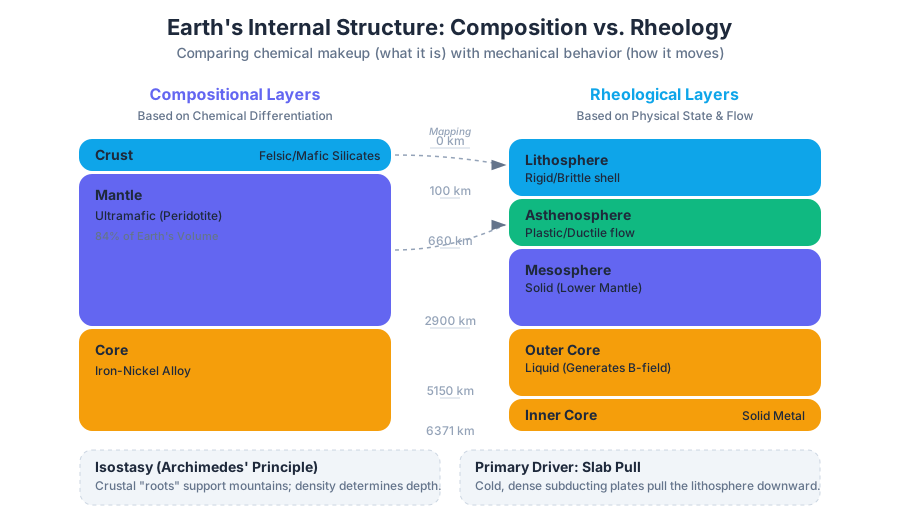
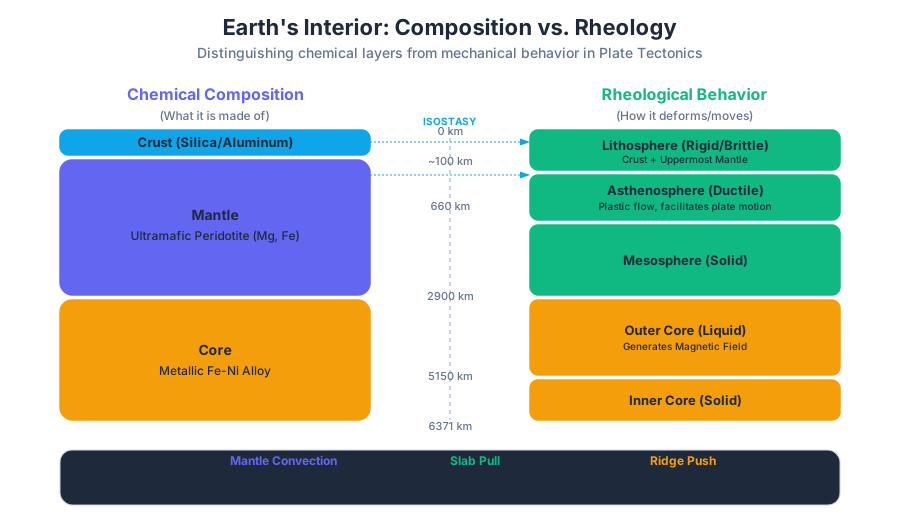
To understand plate tectonics, one must first distinguish between the Earth's layers based on chemical composition (what they are made of) versus their rheology or mechanical behavior (how they deform).
Compositional Layers
The Earth is chemically differentiated into three primary units:
- Crust: The outermost "skin," rich in silica and aluminum. It is divided into thin, dense oceanic crust (basaltic) and thick, buoyant continental crust (granitic).
- Mantle: A 2,900 km thick layer of silicate rock rich in magnesium and iron (peridotite). It comprises about 84% of Earth's volume.
- Core: A dense metallic center composed primarily of iron and nickel.
Rheological Layers
Plate tectonics is concerned primarily with the mechanical properties of the upper 700 km.
- Lithosphere: The cool, rigid outer shell. It includes the crust and the uppermost portion of the mantle. It behaves elastically or brittly; when stressed, it breaks (earthquakes).
- Asthenosphere: Located beneath the lithosphere, this layer is "plastic" or ductile. While it is solid rock, it is near its melting point, allowing it to flow over geologic timescales.
- Mesosphere: The lower mantle, where high pressure increases the strength of the rock despite higher temperatures.
- Outer Core: Liquid metal; its flow generates Earth's magnetic field.
- Inner Core: Solid metal due to extreme pressure.
| Layer | Depth (km) | State | Composition | Density (g/cm³) |
|---|---|---|---|---|
| Continental Crust | 30–70 | Rigid | Granitic (Felsic) | 2.7 |
| Oceanic Crust | 5–10 | Rigid | Basaltic (Mafic) | 3.0 |
| Lithospheric Mantle | Crust to ~100 | Rigid | Peridotite (Ultramafic) | 3.3 |
| Asthenosphere | 100–660 | Plastic/Ductile | Peridotite | 3.4–4.4 |
| Outer Core | 2890–5150 | Liquid | Fe-Ni Alloy | 9.9–12.2 |
| Inner Core | 5150–6371 | Solid | Fe-Ni Alloy | 12.8–13.1 |
The Physics of Isostasy
The lithosphere "floats" on the asthenosphere according to the principle of Isostasy, which is essentially Archimedes' Principle applied to the Earth's crust. The depth to which a plate sinks depends on its thickness and its density relative to the underlying mantle.
The Airy Isostasy Model: States that the pressure at a certain "compensation depth" must be equal everywhere. For a mountain of height $h$ and density $\rho_c$ floating in a mantle of density $\rho_m$, the "root" $r$ extending into the mantle is calculated as: $$r = h \frac{\rho_c}{\rho_m - \rho_c}$$
Mantle Convection: The Engine of Tectonics
Plate movement is driven by the transfer of heat from the Earth's interior to its surface. This occurs primarily through convection—the physical movement of hot, less-dense material upward and cool, denser material downward.
The Rayleigh Number ($Ra$)
Whether a fluid (or a plastic solid like the mantle) will undergo convection is determined by the Rayleigh Number. If $Ra$ exceeds a critical value (typically around 1000 for the mantle), convection begins.
Ra = \frac{\alpha g \Delta T d^3}{\kappa \nu}
Where:
- $\alpha$: Thermal expansion coefficient
- $g$: Acceleration due to gravity
- $\Delta T$: Temperature difference across the layer
- $d$: Depth of the layer
- $\kappa$: Thermal diffusivity
- $\nu$: Kinematic viscosity
In the mantle, $\nu$ is extremely high ($10^{19}$ to $10^{21}$ Pa·s), but the depth $d$ is so large that $Ra$ is estimated to be $10^6$ to $10^8$, far exceeding the threshold for convection.
Driving Forces
While convection cells provide the general motion, two specific gravitational forces dominate plate movement:
- Slab Pull: As a subducting plate sinks into the mantle, its high density (due to cooling and phase changes like the basalt-to-eclogite transition) pulls the rest of the plate behind it. This is considered the strongest force.
- Ridge Push: The elevated position of a mid-ocean ridge creates a gravitational gradient, causing the lithosphere to "slide" away from the ridge axis.
Plate Boundary Dynamics
The interactions between plates occur at their boundaries. These interactions are classified into three fundamental types, each characterized by specific geologic structures and seismic signatures.
1. Divergent Boundaries (Constructive)
Plates move apart, and new lithosphere is created by the upwelling of mantle material.
- Oceanic: Mid-Ocean Ridges (e.g., Mid-Atlantic Ridge). Characterized by shallow earthquakes and basaltic volcanism.
- Continental: Rift Valleys (e.g., East African Rift). Can eventually lead to the formation of a new ocean basin.
2. Convergent Boundaries (Destructive)
Plates collide, leading to the recycling of lithosphere or mountain building.
- Ocean-Ocean: One plate subducts beneath the other, forming a Volcanic Island Arc (e.g., Japan, Marianas).
- Ocean-Continent: The denser oceanic plate subducts under the continental plate, forming a Continental Volcanic Arc (e.g., The Andes).
- Continent-Continent: Neither plate is dense enough to subduct deeply; instead, the crust thickens and is thrust upward to form massive mountain ranges (e.g., The Himalayas).
3. Transform Boundaries (Conservative)
Plates slide past each other horizontally. No lithosphere is created or destroyed.
- Example: The San Andreas Fault.
- These boundaries facilitate the "stepping" of mid-ocean ridges and accommodate the movement of plates on a spherical Earth.
| Boundary Type | Stress Type | Volcanism? | Earthquakes | Key Feature |
|---|---|---|---|---|
| Divergent | Tension | Yes (Mafic) | Shallow, Weak | Central Rift Valley |
| Convergent (Subduction) | Compression | Yes (Intermediate) | Shallow to Deep (Benioff Zone) | Trench / Arc |
| Convergent (Collision) | Compression | No | Shallow to Medium | High Mountains |
| Transform | Shear | No | Shallow, Strong | Strike-slip fault |
Kinematics: Describing Plate Motion
Because plates move on the surface of a sphere, their motion cannot be described by simple linear vectors. Instead, we use Euler’s Rotation Theorem, which states that any displacement of a rigid body on the surface of a sphere can be described as a rotation around a fixed axis passing through the center of the sphere. This axis intersects the surface at the Euler Pole.
Calculating Relative Velocity
The velocity $v$ of a point on a plate at a distance $R$ from the Earth's center is: $$v = \omega \times r$$ Where $\omega$ is the angular velocity vector and $r$ is the position vector of the point. Consequently, the linear velocity of a plate is zero at the Euler pole and reaches its maximum at the "equator" relative to that pole.
To analyze plate motions, geologists often query large datasets of GPS station coordinates.
Mantle Plumes and Hotspots
While plate tectonics explains most volcanic activity, it does not account for intraplate volcanism—volcanoes that appear in the middle of a plate, far from any boundary. The most widely accepted explanation is the Mantle Plume hypothesis.
Mechanics of Plumes
A mantle plume is a buoyant mass of hot rock rising from the core-mantle boundary (the D'' layer). As the plume head reaches the base of the lithosphere, it undergoes decompression melting, creating a hotspot.
- Stationary Source: Plumes are relatively stationary compared to the rapidly moving lithospheric plates.
- Hotspot Tracks: As a plate moves over a stationary plume, it creates a chain of volcanoes that get progressively older as you move away from the current hotspot location (e.g., the Hawaiian-Emperor Seamount Chain).
The Wilson Cycle
The opening and closing of ocean basins is a cyclical process driven by these forces:
- Embryonic: Continental rifting (East Africa).
- Juvenile: Opening of a narrow sea (Red Sea).
- Mature: Wide ocean basin with passive margins (Atlantic).
- Declining: Subduction begins; ocean starts to close (Pacific).
- Terminal: Narrowing sea due to collision (Mediterranean).
- Suturing: Continent-continent collision (Himalayas).
Common Pitfalls and Misconceptions
- "Plates float on a sea of liquid magma": This is perhaps the most common error. The mantle is solid. It flows via solid-state creep (dislocation climb and diffusion) at the rate of centimeters per year. Only in very specific areas (mid-ocean ridges, subduction zones, hotspots) does the mantle melt to form magma.
- Confusing Crust and Lithosphere: The crust is a chemical definition; the lithosphere is a mechanical one. The lithosphere contains the crust plus the uppermost rigid mantle.
- The "Conveyor Belt" Misconception: While mantle convection is the ultimate driver, the plates are not merely passive passengers on a conveyor belt. Because of slab pull, the plates are active participants in the convective system—they are the cold, upper boundary layer of the convection cells themselves.
Source Materials
Study Geology on Lykke
This course page is free to open: signed out, you can read its first two sections, and signing in, on any plan, opens the rest. The free Lykke Chrome extension syncs your own Canvas courses, so ChatGPT, Claude and Muse can answer from your classes and deadlines. It only reads Canvas.
Add the free extensionSign in to open every section