From the free course Geology on Lykke
Minerals: The Building Blocks of Earth
Key concepts: Mineral Chemistry · Crystallography · Optical Mineralogy · Silicate Minerals · Gemstone Identification
Explores the chemical and physical properties of minerals, including crystallography and the identification of gemstones.
Minerals: The Building Blocks of Earth
Minerals are the fundamental units of the geosphere, representing the naturally occurring, inorganic solids that constitute the Earth's crust and mantle. To a geologist, a mineral is not merely a "rock component" but a highly ordered chemical system. Every mineral possesses a specific chemical composition and a characteristic crystalline structure, which dictates its physical properties—from the hardness of a diamond to the perfect cleavage of mica.
Understanding minerals requires an interdisciplinary approach, blending solid-state chemistry, geometry (crystallography), and classical physics (optics). This article provides a deep dive into the mechanics of mineral formation, the structural hierarchy of silicates, and the analytical methods used to identify these materials at the atomic and macroscopic scales.
Mineral Chemistry: The Laws of Atomic Architecture
At its core, mineralogy is the study of how atoms pack together in the solid state. Unlike liquids or gases, minerals are defined by long-range periodic order. The chemical identity of a mineral is determined by the ions present and the nature of the bonds between them.
The Nature of Bonding
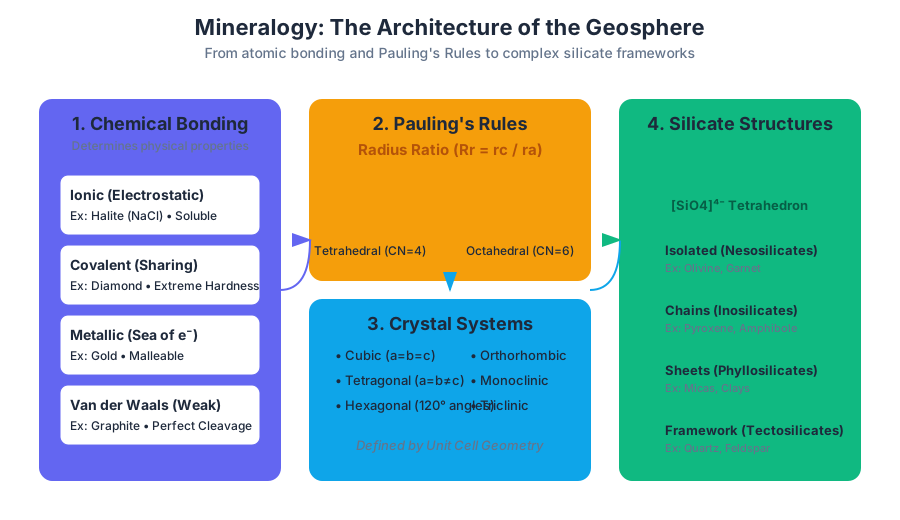
Most minerals are held together by a combination of ionic and covalent bonds. However, the physical behavior of a mineral is often dictated by its weakest bond. For instance, graphite and diamond are both pure carbon (polymorphs), but diamond’s three-dimensional covalent network makes it the hardest known natural substance, while graphite’s weak Van der Waals forces between sheets allow it to be used as a lubricant.
| Bond Type | Mechanism | Mineral Example | Physical Property Impact |
|---|---|---|---|
| Ionic | Electrostatic attraction between oppositely charged ions | Halite (NaCl) | High solubility, moderate hardness |
| Covalent | Sharing of electron pairs between atoms | Diamond (C) | Extreme hardness, high melting point |
| Metallic | Delocalized "sea" of electrons | Native Gold (Au) | Malleability, high conductivity |
| Van der Waals | Weak dipole-dipole interactions | Graphite (C), Talc | Perfect cleavage, "greasy" feel |
Pauling’s Rules and Coordination
To predict how minerals form, we use Pauling’s Rules, which govern the stability of ionic crystals. The most critical is the Radius Ratio Rule, which determines the coordination number (CN)—the number of anions surrounding a central cation.
The Radius Ratio ($R_r$): Defined as the ratio of the radius of the cation ($r_c$) to the radius of the anion ($r_a$). $$R_r = \frac{r_{cation}}{r_{anion}}$$
Worked Example: Predicting Coordination
If we have a Magnesium ion ($Mg^{2+}$, radius $\approx 0.72 \text{ \AA}$) and an Oxygen ion ($O^{2-}$, radius $\approx 1.40 \text{ \AA}$): $$R_r = \frac{0.72}{1.40} \approx 0.514$$ Looking at the coordination table, a ratio of 0.514 falls into the range of Octahedral Coordination (CN=6). This explains why $Mg$ typically sits in octahedral sites within silicate structures like Olivine.
Crystallography: Symmetry and the Lattice
Crystallography is the mathematical description of the internal order of minerals. A crystal is formed by the repetition of a unit cell—the smallest repeating unit that retains the full symmetry of the crystal.
The 7 Crystal Systems
All minerals fall into one of seven systems based on the geometry of their unit cell (lengths of axes $a, b, c$ and angles $\alpha, \beta, \gamma$).
| System | Axial Relationships | Angles | Examples |
|---|---|---|---|
| Cubic (Isometric) | $a = b = c$ | $\alpha = \beta = \gamma = 90^\circ$ | Garnet, Pyrite, Halite |
| Tetragonal | $a = b \neq c$ | $\alpha = \beta = \gamma = 90^\circ$ | Zircon, Rutile |
| Orthorhombic | $a \neq b \neq c$ | $\alpha = \beta = \gamma = 90^\circ$ | Olivine, Topaz |
| Hexagonal | $a_1 = a_2 = a_3 \neq c$ | $\alpha = \beta = 90^\circ, \gamma = 120^\circ$ | Quartz, Apatite |
| Monoclinic | $a \neq b \neq c$ | $\alpha = \gamma = 90^\circ, \beta \neq 90^\circ$ | Orthoclase, Gypsum |
| Triclinic | $a \neq b \neq c$ | $\alpha \neq \beta \neq \gamma \neq 90^\circ$ | Plagioclase, Albite |
Miller Indices
To describe specific planes of atoms within a crystal, we use Miller Indices $(hkl)$. These are the reciprocals of the intercepts that a plane makes with the crystallographic axes.
\text{Step 1: Identify intercepts on axes } a, b, c. \text{ (e.g., 1, 2, } \infty)
\text{Step 2: Take reciprocals: } \frac{1}{1}, \frac{1}{2}, \frac{1}{\infty} \rightarrow 1, 0.5, 0
\text{Step 3: Clear fractions to find smallest integers: } (2 1 0)
Silicate Minerals: The Framework of the Crust
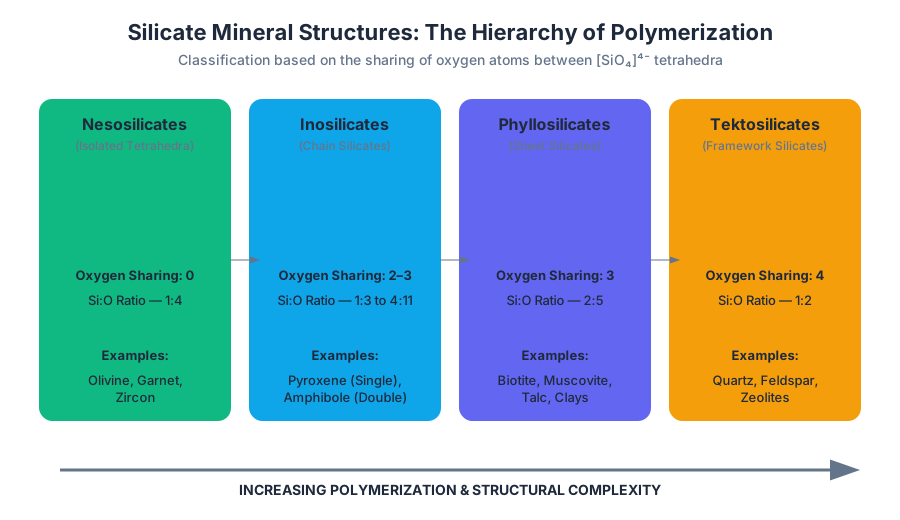
Over 90% of the Earth's crust is composed of silicates. The fundamental building block of all silicates is the Silicon-Oxygen Tetrahedron $[SiO_4]^{4-}$. The diversity of silicate minerals arises from polymerization—the sharing of oxygen atoms between tetrahedra.
The Silicate Classification Hierarchy
Silicates are classified by how their tetrahedra are linked. This structure directly influences the mineral's cleavage and stability.
- Nesosilicates (Island): Isolated tetrahedra linked by cations (e.g., Olivine).
- Sorosilicates (Double): Two tetrahedra sharing one oxygen.
- Cyclosilicates (Ring): Tetrahedra linked in rings (e.g., Beryl/Emerald).
- Inosilicates (Chain): Single chains (Pyroxenes) or double chains (Amphiboles).
- Phyllosilicates (Sheet): Tetrahedra sharing three oxygens to form 2D sheets (e.g., Micas, Clays).
- Tectosilicates (Framework): Every oxygen is shared, forming a 3D network (e.g., Quartz, Feldspar).
| Silicate Group | O:Si Ratio | Structure | Cleavage Pattern |
|---|---|---|---|
| Nesosilicates | 4:1 | Isolated | None/Conchoidal |
| Inosilicates (Single) | 3:1 | Single Chain | 2 planes at ~90° |
| Inosilicates (Double) | 2.75:1 | Double Chain | 2 planes at 56°/124° |
| Phyllosilicates | 2.5:1 | Sheet | 1 perfect basal plane |
| Tectosilicates | 2:1 | 3D Framework | Complex or None |
Optical Mineralogy: Light as a Diagnostic Tool
When light enters a non-opaque mineral, it interacts with the crystal lattice in ways that allow for precise identification using a petrographic microscope.
Isotropic vs. Anisotropic
- Isotropic minerals (Cubic system): Light travels at the same speed in all directions. They appear dark under Cross-Polarized Light (XPL).
- Anisotropic minerals (All other systems): Light is split into two rays traveling at different velocities. This phenomenon is known as Birefringence.
The Michel-Lévy Chart and Retardation
The difference in speed between the "fast" and "slow" rays results in a phase shift called retardation ($\Delta$). When the rays recombine, they produce interference colors.
Formula for Birefringence ($\delta$): $$\delta = \frac{\Delta}{d}$$ Where $d$ is the thickness of the thin section (standardized at 30 microns).
Common Pitfalls in Optical Identification
A common mistake for students is confusing extinction with isotropy. An anisotropic mineral will go dark (extinguish) every 90 degrees of rotation in XPL, whereas an isotropic mineral remains dark throughout the full 360-degree rotation.
Gemstone Identification: Beyond the Loupe
Gemology is the applied science of mineralogy focused on "precious" specimens. Identification relies on non-destructive testing to differentiate natural stones from synthetics and "simulants" (imitations).
Specific Gravity (SG)
SG is a measure of density relative to water. It is a critical diagnostic because chemical composition is fixed. $$SG = \frac{W_{air}}{W_{air} - W_{water}}$$
Refractive Index (RI)
Using a refractometer, gemologists measure how much light bends as it enters the stone. Since many gems are anisotropic, they will show two RIs (birefringence). For example:
- Diamond: RI = 2.417 (Singly refractive)
- Ruby/Sapphire: RI = 1.762 – 1.770 (Doubly refractive, $\delta = 0.008$)
Spectroscopic Analysis
Advanced identification uses Raman Spectroscopy or FTIR. These tools detect the vibrational modes of the crystal lattice, allowing gemologists to identify heat treatments or polymer injections in emeralds.
Practical Identification Pipeline
When a geologist encounters an unknown mineral in the field, they follow a systematic "elimination" pipeline:
- Luster: Is it metallic or non-metallic?
- Hardness: Can it be scratched by a copper penny (3.5), a glass plate (5.5), or a steel file (6.5)?
- Cleavage/Fracture: Does it break along flat planes (cleavage) or irregular surfaces (fracture)?
- Streak: What is the color of the mineral in powdered form? (Crucial for metallic minerals).
- Specific Gravity: Does it feel "heavy" for its size (e.g., Galena or Barite)?
Summary of Mineral Groups
While silicates dominate, other groups are economically and geologically vital:
| Group | Anion / Complex | Examples | Importance |
|---|---|---|---|
| Native Elements | Single element | Gold, Diamond, Sulfur | Rare, economically valuable |
| Oxides | $O^{2-}$ | Hematite, Magnetite | Primary iron ores |
| Sulfides | $S^{2-}$ | Pyrite, Galena | Metal ores (Pb, Zn, Cu) |
| Carbonates | $[CO_3]^{2-}$ | Calcite, Dolomite | Carbon cycle, limestone |
| Halides | $Cl^-, F^-$ | Halite, Fluorite | Industrial salts, flux |
| Sulfates | $[SO_4]^{2-}$ | Gypsum, Barite | Evaporites, construction |
Source Materials
Study Geology on Lykke
This course page is free to open: signed out, you can read its first two sections, and signing in, on any plan, opens the rest. The free Lykke Chrome extension syncs your own Canvas courses, so ChatGPT, Claude and Muse can answer from your classes and deadlines. It only reads Canvas.
Add the free extensionSign in to open every section