From the free course Geology on Lykke
Metamorphism and the Rock Cycle
Key concepts: Metamorphic Grade · Foliation · Contact vs. Regional Metamorphism · The Rock Cycle
Discusses the transformation of rocks under high pressure and temperature, and the overarching cycle that links all rock types.
Metamorphism and the Rock Cycle
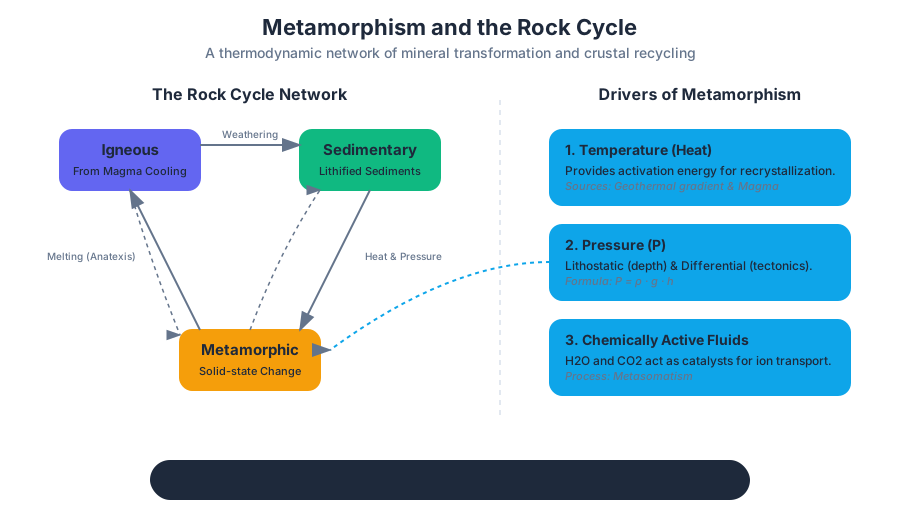
Metamorphism is the process by which the mineralogy, texture, and chemical composition of a rock change in the solid state due to extreme variations in temperature, pressure, and the introduction of chemically active fluids. Unlike igneous processes, metamorphism does not involve melting; if a rock melts, it enters the igneous realm. Instead, metamorphism is a "recrystallization" event where atoms migrate through crystal lattices to form new, stable mineral assemblages.
The Rock Cycle: A Thermodynamic Network
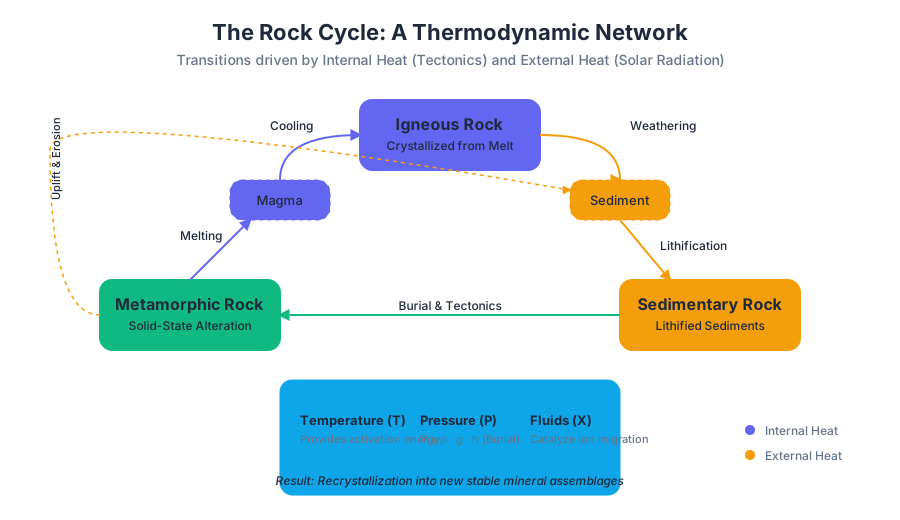
The Rock Cycle is a conceptual framework that describes the transitions through geologic time among the three main rock types: Sedimentary, Igneous, and Metamorphic. While often depicted as a simple circle, it is more accurately viewed as a complex network where any rock type can be transformed into any other, depending on the tectonic and environmental "forcing functions" applied to it.
The Fundamental Law of the Rock Cycle: No rock is permanent. The Earth is a heat engine, and the rock cycle is the physical manifestation of the planet's attempt to reach thermodynamic equilibrium in a constantly shifting environment.
Transitions and Drivers
The transitions within the cycle are driven by two primary energy sources: Internal Heat (radioactive decay and primordial heat driving plate tectonics) and External Heat (solar radiation driving the hydrologic cycle and weathering).
| Transition | Process | Primary Driver |
|---|---|---|
| Any Rock → Sedimentary | Weathering, Erosion, Deposition, Lithification | Hydrologic Cycle / Gravity |
| Any Rock → Igneous | Melting (Anatexis) and Crystallization | Mantle Convection / Internal Heat |
| Any Rock → Metamorphic | Recrystallization under Heat and Pressure | Tectonic Burial / Magmatic Intrusion |
To understand the rock cycle as a system, we can model the "residence time" of minerals in different states using a state-transition approach.
The Drivers of Metamorphism
Metamorphism is governed by three primary variables: Temperature ($T$), Pressure ($P$), and Fluid Composition ($X_{fluid}$).
1. Temperature (Heat)
Heat is the most essential agent. It provides the activation energy required for chemical reactions and the breaking of atomic bonds.
- Sources: The geothermal gradient (averaging 25°C/km) and localized magmatic intrusions.
- Effect: Increases atomic vibration, allowing ions to migrate more freely. This leads to Recrystallization (small grains joining to form larger ones) and Neocrystallization (formation of entirely new minerals).
2. Pressure
Pressure increases with depth due to the weight of overlying rock (Lithostatic Pressure).
- Lithostatic Pressure: Equal in all directions, similar to hydrostatic pressure in water. It results in a reduction of volume and the formation of high-density minerals.
- Differential Stress: Unequal pressure in different directions, typically caused by tectonic forces. This is the primary driver of Foliation.
The lithostatic pressure $P$ at depth $h$ is derived as:
P = \rho \cdot g \cdot h
Where:
- $\rho$ is the average density of the crust (~2,700 to 3,000 kg/m³)
- $g$ is the acceleration due to gravity (9.81 m/s²)
- $h$ is the depth in meters.
3. Chemically Active Fluids
Mainly water ($H_2O$) and carbon dioxide ($CO_2$) trapped in the pore spaces of sedimentary rocks or hydrated minerals. At high $P$ and $T$, these fluids become "supercritical," acting as catalysts that transport ions across great distances. This process is known as Metasomatism.
Metamorphic Grade and Facies
Metamorphic Grade is a relative term used to describe the intensity of metamorphism. It reflects the maximum $P$ and $T$ conditions a rock has experienced.
The P-T Path and Phase Boundaries
Minerals are stable only within specific $P-T$ ranges. When a rock is subjected to conditions outside its stability field, a phase transition occurs. We can describe the boundary between two mineral phases (e.g., Andalusite to Kyanite) using the Clausius-Clapeyron Equation:
\frac{dP}{dT} = \frac{\Delta S}{\Delta V}
Where:
- $dP/dT$ is the slope of the boundary on a P-T diagram.
- $\Delta S$ is the change in entropy.
- $\Delta V$ is the change in molar volume.
Metamorphic Facies
A Metamorphic Facies is a set of mineral assemblages that repeatedly associate in space and time, indicating a specific range of $P$ and $T$.
| Facies | Temperature | Pressure | Tectonic Setting |
|---|---|---|---|
| Zeolite | Low (<200°C) | Low | Shallow burial |
| Greenschist | Moderate (300-450°C) | Moderate | Regional metamorphism (Orogeny) |
| Amphibolite | High (450-700°C) | Moderate/High | Deep crustal orogeny |
| Granulite | Very High (>700°C) | High | Base of the continental crust |
| Blueschist | Low/Moderate | Very High | Subduction zones (high P, low T) |
| Eclogite | High | Extremely High | Deep subduction (mantle depths) |
Foliation: The Geometry of Stress
Foliation refers to any planar (flat) arrangement of mineral grains or structural features within a rock. It is a fundamental diagnostic tool for identifying metamorphic rocks and reconstructing tectonic history.
Mechanisms of Foliation
- Rotation: Platy minerals (like mica) rotate until they are perpendicular to the direction of maximum stress.
- Recrystallization: Minerals grow in a preferred orientation.
- Pressure Solution: Ions dissolve at high-stress contact points and reprecipitate in low-stress areas (perpendicular to the stress).
The Foliation Sequence (Protolith: Shale)
As metamorphic grade increases, the texture of a pelitic (clay-rich) rock evolves:
- Slate: Excellent Slaty Cleavage. Microscopic micas. Dull surface.
- Phyllite: Micas grow larger; the rock develops a "sheen" or "silky luster." Surfaces are often wavy.
- Schist: Visible mica flakes. Exhibits Schistosity. Often contains "porphyroblasts" (large crystals like garnet).
- Gneiss: High-grade metamorphism. Ion migration results in Gneissic Banding (segregation of light silicates and dark ferromagnesian minerals).
Insight: Gneissic banding represents a high-degree of chemical segregation. The rock has almost reached its melting point, allowing minerals to migrate into distinct layers based on their chemical affinities.
Contact vs. Regional Metamorphism
The environment in which metamorphism occurs dictates the resulting rock's characteristics.
Contact (Thermal) Metamorphism
- Mechanism: "Baking" of country rock by an adjacent magma body.
- Dominant Factor: Temperature.
- Result: Non-foliated rocks (e.g., Hornfels, Quartzite, Marble).
- Aureole: The zone of alteration surrounding the intrusion. The width of the aureole depends on the size of the intrusion and the fluid content of the host rock.
Regional Metamorphism
- Mechanism: Large-scale tectonic processes, such as continental collisions or subduction.
- Dominant Factor: Both Temperature and Differential Pressure.
- Result: Foliated rocks covering thousands of square kilometers. This is where the majority of the Earth's metamorphic crust is formed.
| Feature | Contact Metamorphism | Regional Metamorphism |
|---|---|---|
| Scale | Local (meters to kilometers) | Vast (hundreds of kilometers) |
| Pressure | Low (shallow depths) | High (deep burial) |
| Texture | Non-foliated (Granoblastic) | Foliated |
| Example Rock | Marble, Quartzite | Schist, Gneiss |
Protolith Evolution: From Source to Product
The identity of a metamorphic rock is determined by two things: the metamorphic grade and the Protolith (the original, parent rock).
| Protolith | Low Grade | Intermediate Grade | High Grade |
|---|---|---|---|
| Shale / Mudstone | Slate | Schist | Gneiss |
| Basalt | Greenschist | Amphibolite | Granulite / Eclogite |
| Limestone | Marble | Marble (coarser) | Marble (very coarse) |
| Sandstone | Quartzite | Quartzite | Quartzite |
| Granite | (Little change) | Orthogneiss | Orthogneiss |
Worked Example: The Barrovian Sequence
In the late 19th century, George Barrow mapped the Scottish Highlands and noticed a predictable sequence of mineral appearances as he moved toward the core of the mountain range. This "Barrovian Sequence" serves as the gold standard for understanding regional metamorphism in pelitic rocks:
- Chlorite Zone (Low grade)
- Biotite Zone
- Garnet Zone
- Staurolite Zone
- Kyanite Zone
- Sillimanite Zone (High grade)
To visualize this data or analyze mineral stability in a lab setting, geologists often use thermodynamic modeling software.
Common Pitfalls and Misconceptions
- Metamorphism vs. Weathering: While both involve mineral changes, weathering occurs at the surface (low $P$, low $T$) and involves disintegration. Metamorphism occurs at depth and involves "growth" in the solid state.
- The "Melting" Myth: Students often think metamorphic rocks are "partially melted." If a rock melts significantly, it is a Migmatite (the bridge between metamorphic and igneous). If it melts completely, it is magma.
- Foliation and Bedding: Foliation is a metamorphic texture; bedding is a sedimentary structure. They are rarely parallel. Foliation usually cuts across original bedding planes because tectonic stress is rarely aligned with the original depositional horizontal.
- Isochemical Nature: Metamorphism is generally isochemical, meaning the bulk chemical composition of the rock stays the same (except for the loss of volatiles like $H_2O$). If the chemistry changes significantly due to fluid transport, it is specifically called metasomatism.
Source Materials
- Physical Geology (Earle)
- GEOS: A Physical Geology Lab Manual for California Community Colleges (Branciforte and Haddad)
- Introduction to Petrology (Johnson and Liu)
- 7: Metamorphism and Metamorphic Rocks
- Fundamentals of Geology (Schulte)
- Geological Structures - A Practical Introduction (Waldron and Snyder)
- Geology (Lumen)
- Engaging Adults in Science and Energy
Study Geology on Lykke
This course page is free to open: signed out, you can read its first two sections, and signing in, on any plan, opens the rest. The free Lykke Chrome extension syncs your own Canvas courses, so ChatGPT, Claude and Muse can answer from your classes and deadlines. It only reads Canvas.
Add the free extensionSign in to open every section