From the free course Geology on Lykke
Introduction to Geology and the Scientific Method
Key concepts: Scientific Method · Earth System Science · Geological Vocabulary · Physical vs Historical Geology
An introduction to the field of geology, defining its scope and the scientific methods used to study the Earth as a dynamic system.
Introduction to Geology and the Scientific Method
Geology is the comprehensive study of the Earth, encompassing its composition, the physical and chemical processes that shape it, and the history of the planet and its life forms. Far from being a static catalog of rocks, modern geology is a dynamic, interdisciplinary field that integrates chemistry, physics, biology, and mathematics to understand the "Earth System." This section explores the foundational frameworks—the scientific method, specialized vocabulary, and the dual nature of physical and historical geology—that allow us to decode the 4.54 billion-year narrative of our planet.
The Dual Pillars: Physical vs. Historical Geology
Geology is traditionally divided into two broad, overlapping sub-disciplines. While they share the same fundamental principles, their objectives and methodologies differ in scope and temporal focus.
Physical Geology
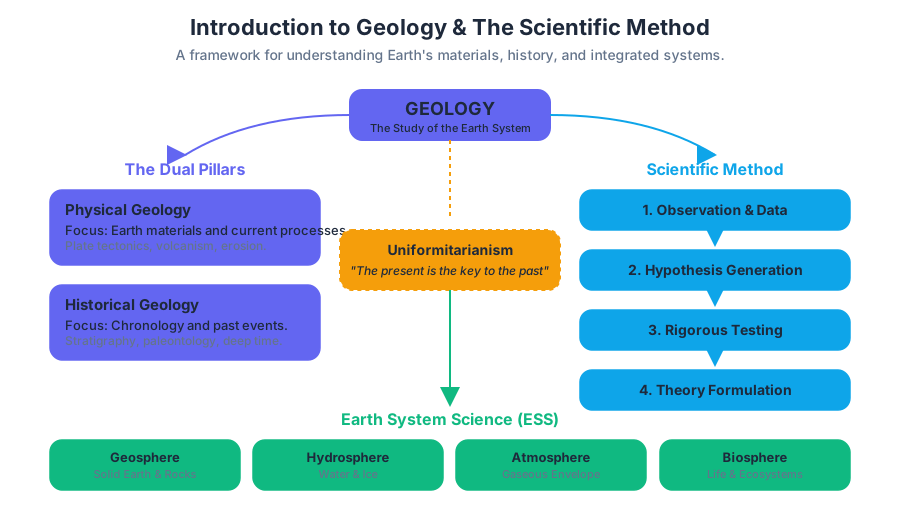
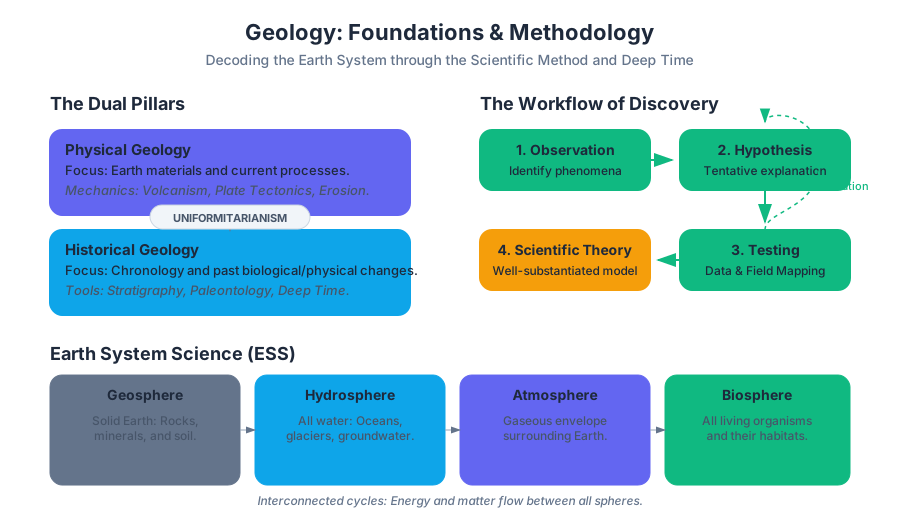
Physical Geology examines the materials composing Earth and seeks to understand the many processes that operate beneath and upon its surface. It focuses on the "mechanics" of the planetary engine, including volcanism, plate tectonics, rock formation, and erosion.
Historical Geology
Historical Geology aims to understand the origin of Earth and its development through time. It strives to establish a chronological arrangement of the vast physical and biological changes that have occurred in the geologic past. It relies heavily on stratigraphy (the study of rock layers) and paleontology (the study of fossils).
| Feature | Physical Geology | Historical Geology |
|---|---|---|
| Primary Focus | Earth materials and current processes. | Chronology and past events. |
| Key Questions | How do mountains form? What is this mineral? | When did the Rockies rise? How did life evolve? |
| Core Concepts | Plate tectonics, Petrology, Mineralogy. | Stratigraphy, Paleontology, Deep Time. |
| Temporal Scale | Often focuses on the "instantaneous" or cyclical. | Focuses on linear time over billions of years. |
The Scientific Method in Geoscience
Geology is an empirical science. Unlike "hard" sciences like physics where variables can be strictly controlled in a laboratory, geologists often deal with uncontrolled natural experiments that have run for millions of years. The Scientific Method in geology is an iterative process of observation, hypothesis generation, and rigorous testing.
The Workflow of Discovery
- Observation: Identifying a phenomenon (e.g., "These two continents have matching fossil records").
- Hypothesis: A tentative explanation (e.g., "The continents were once joined").
- Testing and Data Collection: Gathering evidence through field mapping, isotopic dating, or seismic imaging.
- Theory Building: If a hypothesis survives extensive scrutiny and competing explanations are eliminated, it may be elevated to a Theory (e.g., Plate Tectonics).
Definition: Scientific Theory A well-substantiated explanation of some aspect of the natural world that is acquired through the scientific method and repeatedly tested and confirmed through observation and experimentation. It is NOT a "hunch."
Abductive Reasoning: The Geologist's Tool
Because geologists cannot travel back in time, they often use abductive reasoning (inference to the best explanation). If a specific process (like a modern volcanic eruption) produces a specific result (a certain type of basalt), and we find that same result in ancient rocks, we infer the same process occurred in the past. This is the essence of Uniformitarianism: "The present is the key to the past."
Earth System Science (ESS)
Modern geology views the Earth not as a collection of isolated parts, but as a complex, integrated system. Earth System Science (ESS) studies the interactions between the "spheres" of our planet.
| Sphere | Description | Geological Interaction |
|---|---|---|
| Geosphere (Lithosphere) | The solid Earth (rocks, minerals, soil). | Plate movements create habitats and influence climate. |
| Hydrosphere | All Earth's water (oceans, glaciers, groundwater). | Water is the primary agent of erosion and sediment transport. |
| Atmosphere | The gaseous envelope surrounding the planet. | Volcanic outgassing created the early atmosphere. |
| Biosphere | All living organisms. | Life (e.g., stromatolites) altered the atmosphere's oxygen levels. |
Radioactive Decay Modeling
To understand the age of the Earth, geologists use the physics of radioactive decay.
Geological Vocabulary and Communication
Precision in language is vital in geology because terms often carry specific genetic implications (how something formed). For example, calling a rock "granite" implies a specific mineralogy and an intrusive igneous origin.
The Taxonomy of Earth Materials
- Minerals: Naturally occurring, inorganic solids with a definite chemical composition and ordered internal structure.
- Rocks: Aggregates of one or more minerals.
- Igneous: Formed from cooling magma/lava.
- Sedimentary: Formed from lithified sediment or chemical precipitation.
- Metamorphic: Formed by altering existing rocks via heat and pressure.
Measurement and Observation
Geologists use specific tools to quantify the subsurface. Structural Geology involves measuring the orientation of rock layers using "Strike and Dip."
\text{Airy Isostasy Equation:} \\
h_r = \frac{\rho_c}{\rho_m - \rho_c} \cdot h_s \\
\text{Where: } \\
h_r = \text{thickness of the mountain root} \\
h_s = \text{height of the mountain above sea level} \\
\rho_c = \text{density of the crust} \\
\rho_m = \text{density of the mantle}
Plate Tectonics: The Unifying Theory
If the scientific method is the "how," Plate Tectonics is the "why" of geology. It provides a framework that explains earthquakes, volcanoes, mountain building, and the distribution of fossils.
- The Lithosphere: The rigid outer shell of the Earth, broken into plates.
- The Asthenosphere: The ductile layer of the mantle upon which plates "float."
- Plate Boundaries:
- Divergent: Plates move apart (e.g., Mid-Atlantic Ridge).
- Convergent: Plates collide (e.g., The Himalayas).
- Transform: Plates slide past each other (e.g., San Andreas Fault).
| Boundary Type | Motion | Resulting Feature | Example |
|---|---|---|---|
| Divergent | Spreading | Oceanic Ridges / Rifts | East African Rift |
| Convergent (O-C) | Subduction | Volcanic Arcs / Trenches | Andes Mountains |
| Convergent (C-C) | Collision | Fold-Thrust Mountains | Alps |
| Transform | Lateral Slip | Fault Zones | North Anatolian Fault |
Deep Time and the Geologic Time Scale
One of the most difficult concepts for the human mind to grasp is Deep Time. While human history spans thousands of years, geologic history spans billions.
The Eon-Era-Period Hierarchy
The Geologic Time Scale is a system of chronological dating that relates geological strata to time. It is divided into:
- Eons: The largest division (e.g., Phanerozoic).
- Eras: Subdivisions of eons (e.g., Mesozoic - "Age of Dinosaurs").
- Periods: Subdivisions of eras (e.g., Jurassic).
- Epochs: Subdivisions of periods (e.g., Holocene).
Practical Data Interaction
Geologists often query large datasets to find patterns in seismic activity or resource distribution.
Resource Accessibility and Social Impact
Geology is not purely academic; it is the foundation of the global economy. The study of Energy and Mineral Resources dictates where we get the materials for modern life.
- Critical Minerals: Elements like Lithium and Cobalt, essential for green energy, are found in specific geological settings (pegmatites or brine deposits).
- Water Resources: Hydrogeology studies the movement of water through aquifers, a critical skill as climate change impacts water security.
- Geohazards: Understanding the recurrence intervals of floods, landslides, and eruptions is essential for urban planning and disaster mitigation.
Common Pitfalls and Misconceptions
- "Rocks are permanent": In reality, the Rock Cycle ensures that every rock is eventually recycled through subduction or erosion.
- "The Earth is solid": While the mantle is solid rock, it behaves as a high-viscosity fluid over geologic timescales (mantle convection).
- "Geology is just naming things": Modern geology is highly quantitative. It involves complex fluid dynamics, thermodynamics, and chemical modeling.
Summary of the Geological Workflow
To conclude, the study of geology follows a rigorous pipeline:
- Field Observation: Mapping and measuring structures in the crust.
- Sample Analysis: Using tools like the Petrographic Microscope to identify minerals and textures.
- Deduction: Using the laws of stratigraphy and physics to reconstruct the sequence of events.
- Synthesis: Integrating local findings into the global Plate Tectonics model.
Further Reading and References
- Johnson, C., et al. (2019). An Introduction to Geology.
- Waldron, J.W.F., & Snyder, M.C. (2020). Geological Structures: A Practical Introduction.
- Earle, S. (2015). Physical Geology.
- Ruppert, S., et al. Introduction to Historical Geology.
Source Materials
- An Introduction to Geology (Johnson, Affolter, Inkenbrandt, and Mosher)
- Geological Structures - A Practical Introduction (Waldron and Snyder)
- The Dynamic Earth (Kious and Tilling)
- Physical Geology (Earle)
- Physical Geology (Panchuk)
- Controversies in the Earth Sciences (Richardson)
- Environmental Geology (Earle)
- Fundamentals of Geology (Schulte)
Study Geology on Lykke
This course page is free to open: signed out, you can read its first two sections, and signing in, on any plan, opens the rest. The free Lykke Chrome extension syncs your own Canvas courses, so ChatGPT, Claude and Muse can answer from your classes and deadlines. It only reads Canvas.
Add the free extensionSign in to open every section