From the free course Geology on Lykke
Igneous Processes and Volcanism
Key concepts: Magma and Lava · Intrusive vs. Extrusive · Petrology · Volcanic Hazards · Bowen's Reaction Series
Covers the formation of igneous rocks from magma and the dynamic surface expressions of volcanic activity.
Igneous Processes and Volcanism
Igneous processes represent the primary engine of Earth’s crustal evolution. Derived from the Latin ignis (fire), igneous rocks are the products of the cooling and solidification of molten rock. This cycle begins deep within the mantle or lower crust where phase transitions turn solid rock into magma, and ends either deep underground as plutons or at the surface as lava and tephra. Understanding these processes is not merely an exercise in classification; it is the study of the thermal and chemical differentiation of our planet.
The Physics and Chemistry of Melt
To understand igneous rocks, one must first understand the state of the parent material. Magma is a complex, high-temperature solution consisting of three components:
- Melt: The liquid portion, composed primarily of mobile ions (Si, O, Al, Ca, Fe, Mg, Na, K).
- Solids: Any silicate minerals that have already crystallized from the melt.
- Volatiles: Dissolved gases, primarily $H_2O$, $CO_2$, and $SO_2$, which remain in solution due to high confining pressure.
The Thermodynamics of Melting
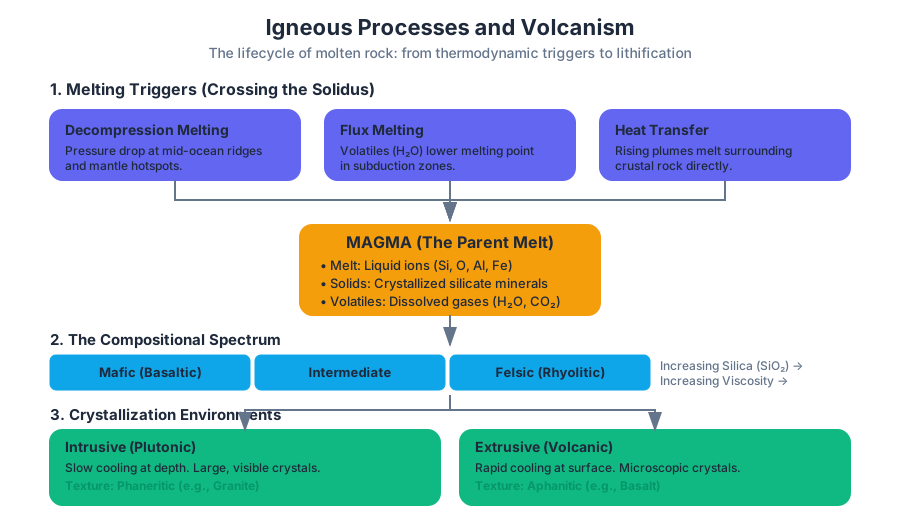
Contrary to popular belief, the Earth’s mantle is not a sea of liquid magma; it is a plastic solid. Magma only forms under specific thermodynamic "triggers" that cross the solidus (the temperature at which a rock begins to melt).
The Solidus-Liquidus Gap: The Solidus is the locus of points in P-T space below which a substance is completely solid. The Liquidus is the boundary above which it is completely liquid. Between them lies a "mush zone" of partial melting.
There are three primary mechanisms for generating melt:
- Decompression Melting: Reducing pressure without losing heat. This occurs at mid-ocean ridges and hotspots.
- Flux Melting: The introduction of volatiles (like water) into the hot mantle, which lowers the melting temperature. This is the primary driver of subduction zone volcanism.
- Heat Transfer: Direct heating of crustal rocks by rising mantle plumes.
Magma Compositional Spectrum
The chemistry of magma is defined by its Silica ($SiO_2$) content, which dictates its viscosity, density, and eruptive style.
| Magma Type | Silica Content ($SiO_2$) | Temperature (°C) | Viscosity | Gas Content | Resulting Rock (Extrusive) |
|---|---|---|---|---|---|
| Felsic (Rhyolitic) | >65% | 600–800 | Very High | High | Rhyolite |
| Intermediate (Andesitic) | 55–65% | 800–1000 | Intermediate | Intermediate | Andesite |
| Mafic (Basaltic) | 45–55% | 1000–1200 | Low | Low | Basalt |
| Ultramafic | <45% | >1200 | Very Low | Very Low | Komatiite (rare) |
Petrology: The Science of Rock Origins
Petrology is the branch of geology that studies the origin, composition, and structure of rocks. In the igneous context, we differentiate rocks based on their texture (cooling history) and mineralogy (chemical composition).
Intrusive vs. Extrusive
The most fundamental division in petrology is based on the environment of crystallization.
- Intrusive (Plutonic): Magma that crystallizes at depth. Because the surrounding "country rock" acts as an insulator, heat loss is extremely slow. This allows ions to migrate to existing crystal seeds, resulting in large, visible crystals (Phaneritic texture).
- Extrusive (Volcanic): Magma that reaches the surface (lava). Rapid cooling against the air or water prevents large crystal growth, resulting in a fine-grained (Aphanitic) or even glassy (Vitreous) texture.
Texture as a Diagnostic Tool
Texture provides a "fossilized" record of the cooling rate.
| Texture | Cooling Rate | Description | Typical Environment |
|---|---|---|---|
| Phaneritic | Slow | Coarse-grained; crystals visible to the naked eye. | Deep Plutons |
| Aphanitic | Fast | Fine-grained; crystals require magnification. | Lava Flows |
| Porphyritic | Bimodal | Large crystals (phenocrysts) in a fine matrix. | Two-stage cooling |
| Vitreous | Instantaneous | Glassy; no crystalline structure. | Obsidian flows |
| Vesicular | Rapid | Pitted with gas bubbles (vesicles). | Top of lava flows |
| Pyroclastic | Explosive | Fragmented rock, ash, and glass shards. | Volcanic eruptions |
Bowen’s Reaction Series: The Chemical Blueprint
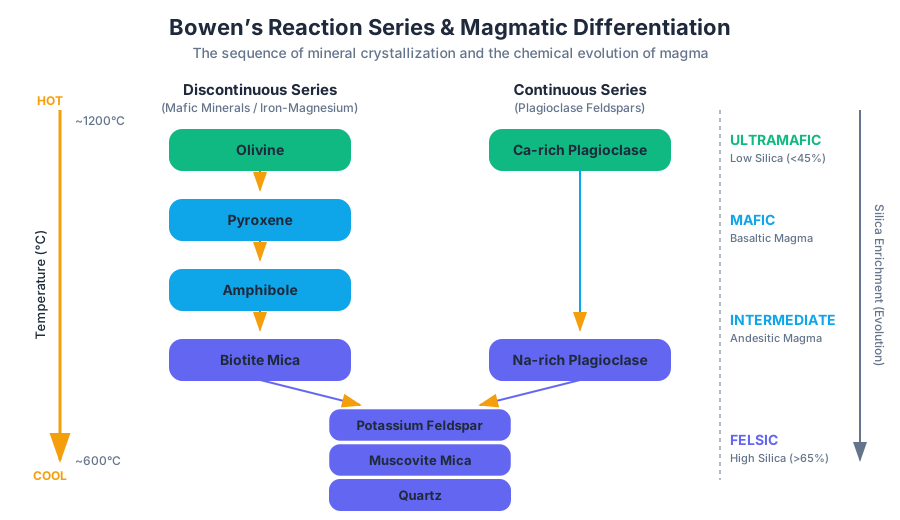
In the early 20th century, N.L. Bowen discovered that minerals do not crystallize simultaneously. Instead, they follow a predictable sequence as temperature drops. This is the Bowen’s Reaction Series, which explains why certain minerals (like quartz and olivine) are rarely found in the same rock.
The Discontinuous Series
As the melt cools, the first mineral to form is Olivine. As the temperature drops further, the olivine reacts with the remaining melt to form Pyroxene, then Amphibole, and finally Biotite Mica. Each step represents a fundamental change in the silicate structure, moving from isolated tetrahedra to single chains, double chains, and finally sheets.
The Continuous Series
Simultaneously, Plagioclase Feldspar crystallizes. It begins as calcium-rich (Anorthite) and continuously exchanges Ca for Na as the temperature decreases, ending as sodium-rich (Albite).
Magmatic Differentiation
If crystals are removed from the melt (e.g., by gravity settling), the remaining liquid becomes "evolved"—it is depleted in Mg and Fe and enriched in Si, Na, and K. This process allows a single parent mafic magma to produce a variety of intermediate and felsic daughter rocks.
Volcanism: The Surface Expression
When magma breaches the surface, it becomes lava. The style of the resulting eruption is governed by the Gas-Viscosity Paradox: high-viscosity melts trap gas more effectively, leading to explosive pressure build-ups.
Volcano Morphologies
The physical shape of a volcano is a direct function of the rheology of its lava.
| Volcano Type | Magma Type | Shape | Eruptive Style |
|---|---|---|---|
| Shield | Mafic | Broad, low-profile (e.g., Mauna Loa) | Effusive (Lava flows) |
| Composite (Stratovolcano) | Intermediate/Felsic | Tall, steep, conical (e.g., Mt. St. Helens) | Explosive |
| Cinder Cone | Mafic/Intermediate | Small, steep, made of scoria | Sputtering (Strombolian) |
| Caldera | Felsic | Large depression from collapsed chamber | Catastrophic collapse |
Volcanic Hazards
Volcanism poses diverse threats to human infrastructure and life.
- Pyroclastic Density Currents (PDCs): Gravity-driven clouds of hot gas and ash. They can travel at speeds >100 km/h and temperatures >500°C.
- Lahars: Volcanic mudflows triggered by the melting of snow/ice or heavy rain on loose ash. They have the consistency of wet concrete.
- Tephra Fall: Ash and lapilli can collapse roofs, destroy aircraft engines, and cause respiratory failure.
- Lava Flows: While rarely life-threatening due to slow speeds, they are unstoppable and destroy all property in their path.
The VEI Scale: The Volcanic Explosivity Index (VEI) is a relative measure of the explosiveness of volcanic eruptions. It is logarithmic, ranging from 0 (non-explosive) to 8 (mega-colossal).
\text{The Clausius-Clapeyron Relation for Decompression Melting:} \\
\frac{dP}{dT} = \frac{L}{T \Delta V} \\
\text{Where:} \\
P = \text{Pressure} \\
T = \text{Temperature} \\
L = \text{Latent heat of fusion} \\
\Delta V = \text{Change in specific volume during melting} \\
\text{Insight: Since rocks expand when they melt (positive } \Delta V \text{),} \\
\text{decreasing pressure (negative } dP \text{) lowers the melting temperature.}
Worked Example: Calculating Crystal Settling (Stokes' Law)
In a cooling magma chamber, how fast does an olivine crystal sink? This determines the degree of magmatic differentiation.
Given:
- Crystal radius ($r$): 0.002 m (2mm)
- Density of Olivine ($\rho_s$): 3300 $kg/m^3$
- Density of Basaltic melt ($\rho_f$): 2700 $kg/m^3$
- Viscosity of melt ($\eta$): 100 $Pa \cdot s$
- Gravity ($g$): 9.8 $m/s^2$
Formula (Stokes' Law): $$v = \frac{2}{9} \frac{(\rho_s - \rho_f) g r^2}{\eta}$$
Calculation:
- $\Delta \rho = 3300 - 2700 = 600$
- $r^2 = 0.000004$
- $v = (2/9) * (600 * 9.8 * 0.000004) / 100$
- $v \approx 0.22 * (0.02352) / 100$
- $v \approx 0.000052$ m/s $\approx$ 4.5 meters per day.
Conclusion: In a large magma chamber (kilometers deep), olivine crystals can settle to the floor over decades, creating a "cumulate" layer and changing the chemistry of the remaining melt.
Common Pitfalls in Igneous Geology
- "Magma is just melted rock": While true, the process of melting is usually partial. A rock rarely melts 100%; instead, the silica-rich components melt first, leaving behind a "restite" of mafic minerals.
- Confusing Viscosity with Density: Felsic magma is less dense than mafic magma (it rises), but it is more viscous (it flows poorly). Students often assume "thicker" means "heavier."
- Obsidian is Felsic: Despite its dark color (caused by trace iron), obsidian is almost always rhyolitic (felsic). Color is a poor proxy for composition in glasses.
Source Materials
- Introduction to Petrology (Johnson and Liu)
- Physical Geology (Earle)
- GEOS: A Physical Geology Lab Manual for California Community Colleges (Branciforte and Haddad)
- Physical Geology (Panchuk)
- Geological Structures - A Practical Introduction (Waldron and Snyder)
- Engaging Adults in Science and Energy
- 3: Intrusive Igneous Rocks
- Fundamentals of Geology (Schulte)
Study Geology on Lykke
This course page is free to open: signed out, you can read its first two sections, and signing in, on any plan, opens the rest. The free Lykke Chrome extension syncs your own Canvas courses, so ChatGPT, Claude and Muse can answer from your classes and deadlines. It only reads Canvas.
Add the free extensionSign in to open every section