From the free course Geology on Lykke
Measuring Geologic Time and Earth History
Key concepts: Relative Dating · Radiometric Dating · Geologic Time Scale · Evolution · Mass Extinctions
Explores the methods geologists use to date rocks and the major events in Earth's 4.6 billion-year history.
Measuring Geologic Time and Earth History
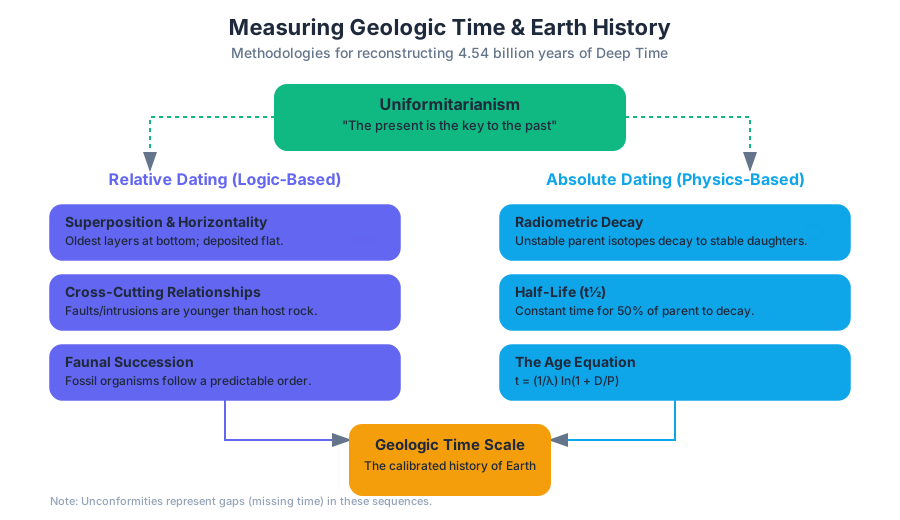
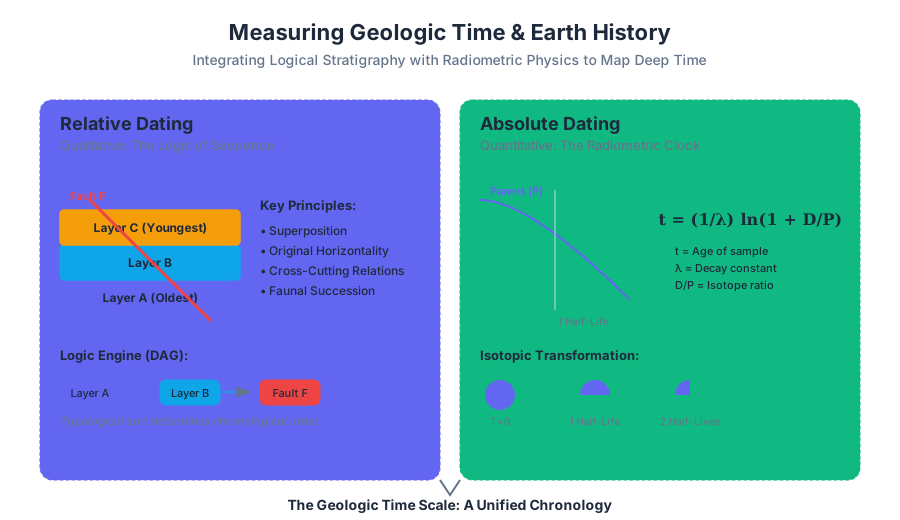
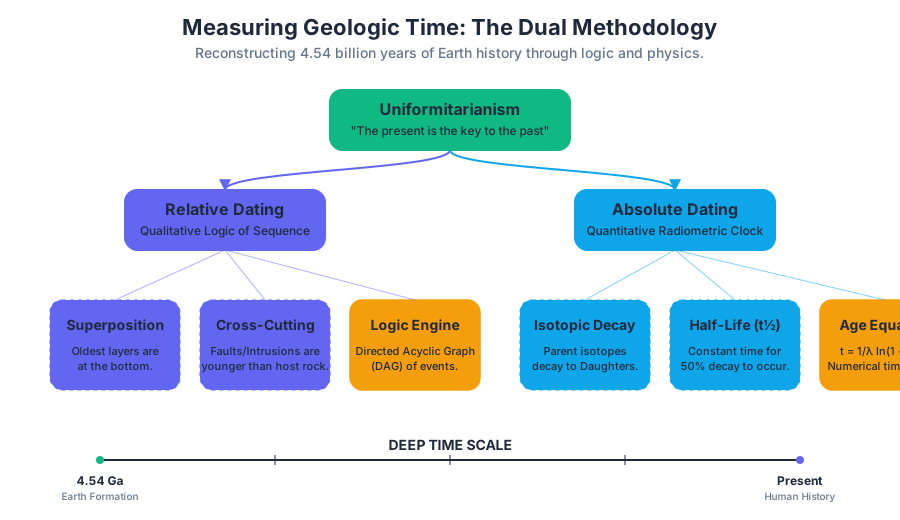
The study of Earth history is an exercise in temporal scaling. While human history is measured in decades and centuries, geologic history—often referred to as Deep Time—spans 4.54 billion years. To reconstruct this history, geologists employ two distinct but complementary methodologies: Relative Dating, which establishes the chronological order of events without necessarily determining their absolute age, and Absolute (Radiometric) Dating, which provides numerical ages in years before present.
The Philosophy of Deep Time
The foundation of modern geology rests on the principle of Uniformitarianism, famously summarized by James Hutton as "the present is the key to the past." This principle posits that the physical and chemical laws governing the universe today have remained constant throughout geologic time. Consequently, by observing modern processes like silt deposition in a river delta or the cooling of lava, geologists can infer the origins of ancient rock formations.
Uniformitarianism: The theory that changes in the earth's crust during geological history have resulted from the action of continuous and uniform processes. It stands in contrast to Catastrophism, the idea that Earth's features were formed primarily by sudden, short-lived, violent events.
Relative Dating: The Logic of Sequence
Relative dating is the "logic-based" approach to Earth history. It does not require laboratory equipment; rather, it requires the application of several fundamental principles to "read" the stratigraphic record.
Fundamental Principles of Stratigraphy
Geologists use a set of rules, many first articulated by Nicolas Steno in the 17th century, to determine the relative timing of geologic events.
| Principle | Description | Geologic Implication |
|---|---|---|
| Superposition | In an undeformed sequence of sedimentary rocks, each layer is older than the one above it. | Establishes a vertical timeline from bottom (old) to top (young). |
| Original Horizontality | Layers of sediment are generally deposited in a horizontal position. | Folded or tilted layers indicate post-depositional tectonic activity. |
| Lateral Continuity | Sedimentary layers extend in all directions until they thin out or reach the edge of the basin. | Allows for the correlation of rock units across valleys or canyons. |
| Cross-Cutting Relationships | If a fault or igneous intrusion cuts through another rock body, the fault/intrusion must be younger. | Identifies the timing of tectonic or magmatic events relative to host rock. |
| Inclusions | Fragments of one rock unit (xenoliths or clasts) contained within another must be older than the host rock. | Helps distinguish between a lava flow and a later sill intrusion. |
| Faunal Succession | Fossil organisms succeed one another in a definite and determinable order. | Enables global correlation of strata based on biological evolution. |
Unconformities: Gaps in the Record
The geologic record is rarely continuous. Unconformities represent periods of non-deposition or erosion, effectively acting as "missing pages" in Earth's history book.
- Angular Unconformity: Tilted or folded sedimentary rocks are overlain by younger, more flat-lying strata.
- Disconformity: A gap in the rock record between parallel layers of sedimentary rock, usually caused by erosion.
- Nonconformity: Younger sedimentary rocks are deposited directly on top of older metamorphic or igneous rocks.
Absolute Dating: The Radiometric Clock
While relative dating provides the order, Radiometric Dating provides the timestamp. This method relies on the spontaneous decay of unstable atomic nuclei (isotopes).
The Physics of Decay
A radioactive parent isotope decays into a stable daughter isotope at a constant, measurable rate called a half-life ($t_{1/2}$). The half-life is the time required for half of the parent nuclei in a sample to decay.
The Age Equation: The age ($t$) of a mineral can be calculated using the decay constant ($\lambda$) and the current ratio of daughter ($D$) to parent ($P$) atoms.
t = \frac{1}{\lambda} \ln \left( 1 + \frac{D}{P} \right)
Where the decay constant $\lambda$ is related to the half-life by:
\lambda = \frac{\ln(2)}{t_{1/2}} \approx \frac{0.693}{t_{1/2}}
Common Isotopic Systems
Different isotopes are used depending on the expected age and the composition of the material.
| Isotope System | Parent $\rightarrow$ Daughter | Half-Life (Years) | Effective Dating Range | Typical Materials |
|---|---|---|---|---|
| Uranium-238 | $^{238}U \rightarrow ^{206}Pb$ | 4.47 Billion | 10M – 4.6B years | Zircon, Apatite |
| Potassium-40 | $^{40}K \rightarrow ^{40}Ar$ | 1.25 Billion | 100k – 4.6B years | Micas, Feldspar, Hornblende |
| Rubidium-87 | $^{87}Rb \rightarrow ^{87}Sr$ | 48.8 Billion | 10M – 4.6B years | Micas, Metamorphic rocks |
| Carbon-14 | $^{14}C \rightarrow ^{14}N$ | 5,730 | 100 – 50,000 years | Organic matter (bone, wood) |
The "Resetting" of the Clock
A critical concept in radiometric dating is the Closure Temperature. Radiometric clocks in igneous rocks start when the mineral cools below a specific temperature, "locking in" the parent and daughter isotopes. If a rock is later reheated (metamorphism), the daughter isotopes may escape, effectively "resetting" the clock and providing the age of the metamorphic event rather than the original crystallization.
Data Acquisition Workflow
To obtain a date, geologists follow a rigorous analytical pipeline.
The Geologic Time Scale
The Geologic Time Scale (GTS) is the "calendar" of Earth's history. It is a hierarchical system that divides time based on major geological and biological events.
Hierarchy of Time
- Eons: The largest division (e.g., Phanerozoic, Proterozoic, Archean, Hadean).
- Eras: Subdivisions of Eons (e.g., Paleozoic, Mesozoic, Cenozoic).
- Periods: Subdivisions of Eras (e.g., Jurassic, Cretaceous).
- Epochs: Subdivisions of Periods (e.g., Holocene, Pleistocene).
Key Transitions in Earth History
The GTS is not divided into equal time blocks; instead, boundaries are defined by significant changes in the fossil record or global geochemistry.
- The Precambrian (88% of Earth history): Includes the Hadean, Archean, and Proterozoic eons. This era saw the formation of Earth, the rise of oxygen (Great Oxygenation Event), and the first multicellular life.
- The Cambrian Explosion: The beginning of the Phanerozoic Eon, marked by a rapid diversification of life forms with hard shells.
- The Great Dying (Permian-Triassic Boundary): The largest mass extinction in history, marking the end of the Paleozoic Era.
- The Age of Dinosaurs (Mesozoic): Ended by the K-Pg extinction event 66 million years ago.
Evolution and Mass Extinctions
The fossil record provides the biological context for geologic time. Biostratigraphy uses the presence of Index Fossils to correlate rock layers across vast distances.
Index Fossil: A fossil that is useful for dating and correlating the strata in which it is found. A good index fossil must be:
- Geographically widespread.
- Easily identifiable.
- Short-lived (existed for a narrow slice of geologic time).
- Abundant.
The "Big Five" Mass Extinctions
Mass extinctions serve as the primary markers for the boundaries between geologic Eras and Periods.
| Extinction Event | Time (Ma) | Major Groups Lost | Probable Cause |
|---|---|---|---|
| End Ordovician | 444 | 85% of marine species | Glaciation and falling sea levels |
| Late Devonian | 365 | 75% of species | Global cooling, ocean anoxia |
| End Permian | 252 | 96% of marine, 70% of terrestrial | Siberian Traps volcanism, CO2 spike |
| End Triassic | 201 | 80% of species | CAMP volcanism, climate change |
| End Cretaceous | 66 | Dinosaurs, ammonites | Asteroid impact (Chicxulub) |
Common Pitfalls and Misconceptions
1. Dating Sedimentary Rocks Directly
A common mistake is attempting to radiometrically date a sandstone to find out when it was deposited. Radiometric dating of a sand grain (e.g., a zircon) tells you when that specific grain crystallized in its original igneous source rock, not when it was deposited as sediment. To date sedimentary layers, geologists must date interbedded volcanic ash layers (tuffs) or use relative dating principles.
2. The Meaning of "Absolute"
"Absolute" dating does not mean "perfect." Every radiometric date comes with an error margin (e.g., $66.0 \pm 0.5$ Ma). These margins are calculated based on analytical precision and potential contamination.
3. Carbon-14 Limitations
Carbon-14 is often mentioned in popular media for dating everything from dinosaurs to the Earth. However, due to its short half-life (5,730 years), it is useless for anything older than approximately 50,000 years. Dinosaurs (which died out 66 million years ago) cannot be dated with Carbon-14.
4. The "Incomplete" Record
Charles Darwin famously noted that the geologic record is like a book with most of its pages torn out and only a few lines remaining on the pages that are left. This is due to the constant recycling of the Earth's crust via plate tectonics and erosion.
Summary of Methodological Integration
The reconstruction of Earth history is an iterative process. A geologist might find a fossil (Relative Dating), identify the rock layer's position relative to a fault (Relative Dating), and then find a volcanic ash layer nearby that can be dated in a lab (Absolute Dating). By combining these data points, we create the high-resolution timeline used to understand climate change, evolution, and the movement of continents.
Source Materials
- Historical Geology (Bentley et al.)
- Physical Geology (Earle)
- Physical Geology (Panchuk)
- Geological Structures - A Practical Introduction (Waldron and Snyder)
- The Dynamic Earth (Kious and Tilling)
- Geology (Lumen)
- An Introduction to Geology (Johnson, Affolter, Inkenbrandt, and Mosher)
- Controversies in the Earth Sciences (Richardson)
Study Geology on Lykke
This course page is free to open: signed out, you can read its first two sections, and signing in, on any plan, opens the rest. The free Lykke Chrome extension syncs your own Canvas courses, so ChatGPT, Claude and Muse can answer from your classes and deadlines. It only reads Canvas.
Add the free extensionSign in to open every section